

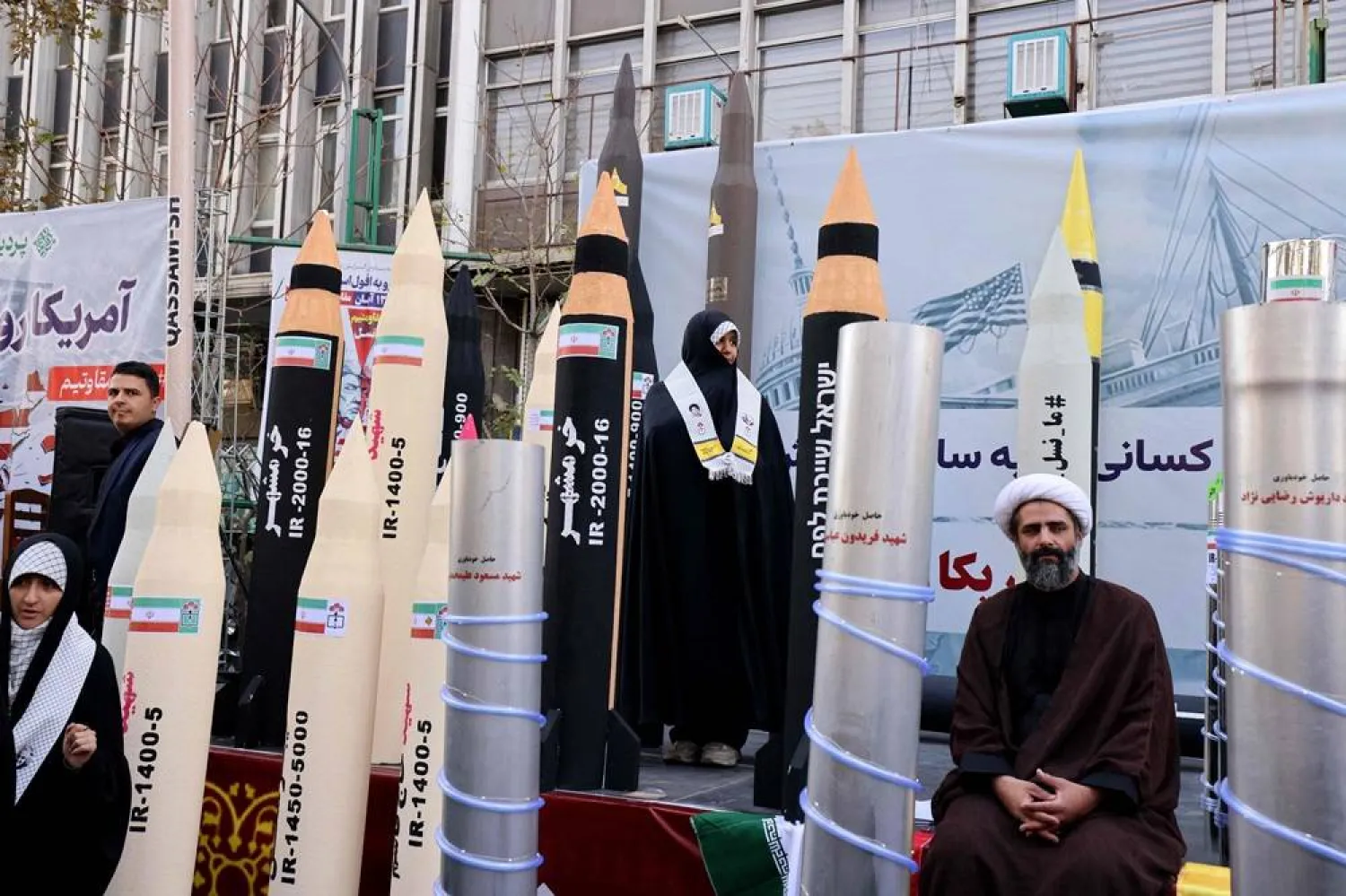

Iran Commemorates Storming of US Embassy with Missile Replicas

People sit and others stand next to models missiles and nuclear enrichment centrifuge during a rally outside the former US embassy in Tehran as Iranians mark the 46th anniversary of the start of the Iran hostage crisis, on November 4, 2025. (AFP)
TT

Iran Commemorates Storming of US Embassy with Missile Replicas

People sit and others stand next to models missiles and nuclear enrichment centrifuge during a rally outside the former US embassy in Tehran as Iranians mark the 46th anniversary of the start of the Iran hostage crisis, on November 4, 2025. (AFP)

With replicas of missiles on display and effigies of Donald Trump and Benjamin Netanyahu hanging from a crane, thousands of Iranians commemorated on Tuesday the 1979 storming of the US embassy in Tehran.

Five months after a brief war with Israel that saw the US join in with strikes on key nuclear facilities, demonstrators chanted "Death to America, death to Israel!" and sang revolutionary songs in a particularly charged outing for the annual event.

Though the commemorations are held annually, "this year, the country is under a bit of pressure" from its two arch foes, said student Mohammad Hossein, 15, standing next to a friend whose shoes bore the trademark swoosh of American apparel giant Nike.

"We must be more visible this year so that the authorities, the army and others can feel at ease and know that we are behind them," he added.

Throughout the day, US and Israeli flags were burned and trampled, and participants dressed as Israeli soldiers pretended to mourn over fake coffins draped with the Star of David, mocking the country's losses in Gaza.

The swinging effigies of Trump and Netanyahu, meanwhile, called to mind the public executions sometimes carried out by Iran.

"America's hostility towards us will never end," said Malek, 57, a laborer who declined to give his full name, adding "America's job is to deceive".

In mid-June, Israel launched an unprecedented wave of air strikes on targets across Iran, including military sites, nuclear facilities and residential areas, killing dozens of senior officials and scientists.

Over the course of the 12-day war that followed, Washington joined its ally in striking three nuclear sites, despite having been involved in ongoing talks with Tehran over its atomic program.

"Our feeling is much different (this year) because our country has been seriously attacked," said Sareh Habibi, a 17-year-old student.

"Our peers, teenagers and the youth, were martyred, and somehow it seems like a mission on our shoulders to come" to the demonstration, she added.

Along the parade route, replicas of missiles -- similar to the ones fired at Israeli cities during the war -- were displayed bearing the slogan "We love to fight the Israeli regime".

Mock uranium centrifuges were also set out, a nod to Iran's insistence on its right to develop a civilian nuclear program despite Western suspicions it is seeking a bomb -- an accusation Tehran denies.

According to state media, similar commemorations took place in several other cities, including Mashhad in the northeast, Kerman in the south and Rasht in the north.

Some participants carried portraits of Iranian supreme leader Ali Khamenei, while others hoisted the image of Hassan Nasrallah, the longtime leader of the Iran-backed Lebanese Hezbollah group who was killed in an Israeli strike last year.

On November 4, 1979, less than nine months after the overthrow of Iran's monarchy and the establishment of the current republic, a group of students stormed the US embassy in Tehran, deeming it a "nest of spies".

Several dozen American diplomats were held hostage, some for 444 days, marking a break between Tehran and Washington, which were previously allies.

The animosity has persisted for decades, and Khamenei ruled out on Monday any cooperation with the United States until Washington changed its policy towards the region, including its support for Israel.



US Military Expands Iran Blockade to Include Contraband Shipments

FILE PHOTO: Two F/A-18 Super Hornets launch from the flight deck of the US Navy Nimitz-class aircraft carrier USS Abraham Lincoln in support of the Operation Epic Fury attack on Iran from an undisclosed location March 3, 2026. US Navy/Handout via REUTERS
TT

US Military Expands Iran Blockade to Include Contraband Shipments

FILE PHOTO: Two F/A-18 Super Hornets launch from the flight deck of the US Navy Nimitz-class aircraft carrier USS Abraham Lincoln in support of the Operation Epic Fury attack on Iran from an undisclosed location March 3, 2026. US Navy/Handout via REUTERS

The US Navy said on Thursday the military had expanded a maritime blockade on Iran to include “contraband” shipments, adding that any vessel suspected of heading to Iranian territory would be subject to verification and inspection.

“These vessels, regardless of their location, are subject to boarding, inspection and seizure of cargo,” the Navy said in a statement updated after the blockade was imposed on Monday, according to Reuters.

Contraband includes weapons, weapons systems, ammunition, nuclear materials, crude oil and refined petroleum products, as well as iron, steel and aluminum.

As diplomatic activity intensifies, signals remain mixed over the course of US-Iran talks. A date for a second round of negotiations has yet to be set, with disagreements persisting over the nuclear file and sensitive issues related to highly enriched uranium and the duration of restrictions on Iran’s nuclear program.


IEA Chief Says Europe Has 'Maybe 6 Weeks or So' of Jet Fuel Left

 Aircraft pass behind kerosene storage facilities at Liege Airport in Liege, Belgium, 16 April 2026.  EPA/Olivier Hoslet
Aircraft pass behind kerosene storage facilities at Liege Airport in Liege, Belgium, 16 April 2026. EPA/Olivier Hoslet
TT

IEA Chief Says Europe Has 'Maybe 6 Weeks or So' of Jet Fuel Left

 Aircraft pass behind kerosene storage facilities at Liege Airport in Liege, Belgium, 16 April 2026.  EPA/Olivier Hoslet
Aircraft pass behind kerosene storage facilities at Liege Airport in Liege, Belgium, 16 April 2026. EPA/Olivier Hoslet

Europe has “maybe six weeks or so (of) jet fuel left,” the head of the International Energy Agency said Thursday in a wide-ranging Associated Press interview, warning of possible flight cancellations “soon” if oil supplies remain blocked by the Iran war.
IEA Executive Director Fatih Birol painted a sobering picture of the global repercussions of what he called “the largest energy crisis we have ever faced,” stemming from the pinch-off of oil, gas and other vital supplies through the Strait of Hormuz.
“In the past there was a group called ‘Dire Straits.’ It’s a dire strait now, and it is going to have major implications for the global economy. And the longer it goes, the worse it will be for the economic growth and inflation around the world,” he said.
The impact will be “higher petrol (gasoline) prices, higher gas prices, high electricity prices,” Birol told the AP, speaking in his Paris office looking out over the Eiffel Tower.
No country is immune Economic pain will be felt unevenly and "the countries who will suffer the most will not be those whose voice are heard a lot. It will be mainly the developing countries. Poorer countries in Asia, in Africa and in Latin America,” said the Turkish economist and energy expert who has led the IEA since 2015.
But without a settlement of the Iran war that permanently reopens the Strait of Hormuz, “Everybody is going to suffer,” he added.
“Some countries may be richer than the others. Some countries may have more energy than the others, but no country, no country is immune to this crisis," he said.
Without a reopening of the waterway, some oil products may dry up, he warned.
In Europe, “I can tell you soon we will hear the news that some of the flights from city A to city B might be canceled as a result of lack of jet fuel," he said.
Hormuz tolls a risk for the future Birol spoke out against the so-called “toll booth” system that Iran has applied to some ships, letting them travel through the strait for a fee. He said allowing that to become more permanent would run the risk of setting a precedent that could then be applied to other waterways, including the vital Malacca Strait in Asia.
“If we change it once, it may be difficult to get it back,” he said. “It will be difficult to have a toll system here, applied here, but not there.”
“I would like to see that the oil flows unconditionally from the point A to point B,” he said.
Even with a peace deal, strikes on energy facilities means it could be many months before pre-war production levels are restored, he said.
“Over 80 key assets in the region have been damaged. And out of these 80, more than one third are severely or very severely damaged,” he said.
“It will be extremely optimistic to believe that it will very quick," Birol said. “It will take gradually, gradually, up to two years to come back where we were before the war.”


EU, NATO to Work to Strengthen Relationship, Von der Leyen Says 

FILE PHOTO: A NATO flag flutters at the Tapa military base, Estonia April 30, 2023. REUTERS/Ints Kalnins/File Photo
TT

EU, NATO to Work to Strengthen Relationship, Von der Leyen Says 

FILE PHOTO: A NATO flag flutters at the Tapa military base, Estonia April 30, 2023. REUTERS/Ints Kalnins/File Photo

European Commission President Ursula von der Leyen said on Thursday that she agreed with NATO Secretary General Mark Rutte to work in the coming weeks to strengthen the European Union's relationship with the military alliance.

"We discussed the upcoming NATO Summit and how we can upscale defense industrial output in Europe," von der Leyen said in a post on social media platform X after meeting Rutte in Brussels, Reuters reported.

"We need to invest more, to produce more and to do both faster. With the rise in global security threats, we agreed to work closely together in the next weeks to strengthen the EU-NATO relationship and prepare a successful Summit in Ankara," she added.

Rutte said in a post about his discussion with von der Leyen that "a stronger Europe means a stronger NATO".