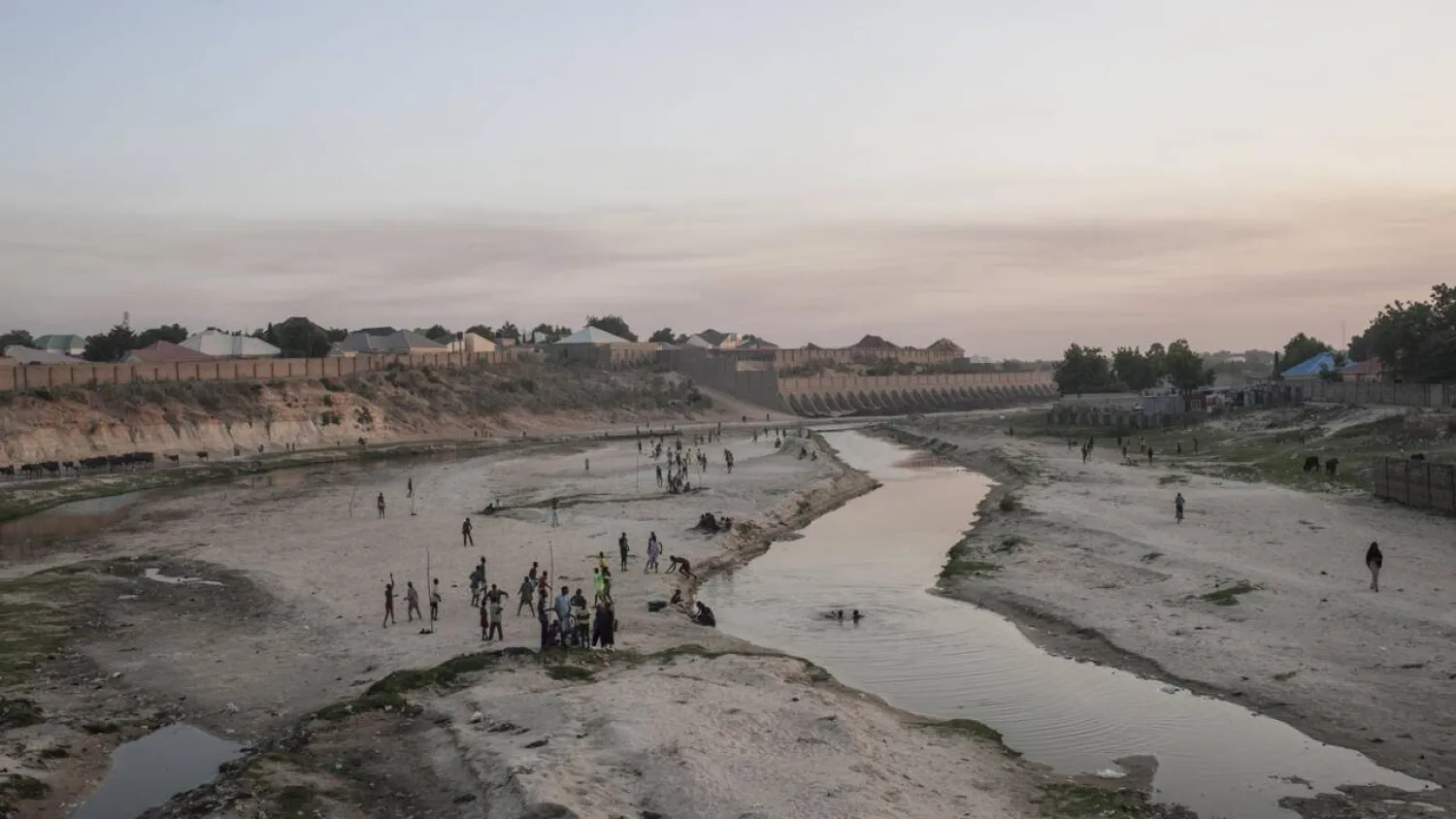

Home in Nigeria, Ex-refugees Find Themselves in a War Zone

A deal struck in February between Nigeria, Chad and the UN refugee agency, UNHCR, saw nearly 8,000 refugees return voluntarily to Nigeria. STEFAN HEUNIS / AFP/File
TT

Home in Nigeria, Ex-refugees Find Themselves in a War Zone

A deal struck in February between Nigeria, Chad and the UN refugee agency, UNHCR, saw nearly 8,000 refugees return voluntarily to Nigeria. STEFAN HEUNIS / AFP/File

Abdulhamid Mohammed fled his home in northeast Nigeria in 2015, chased into neighboring Chad by extremists who torched homes and shot civilians in his lakeside village.

A decade later, little has changed in the fishing community of Doron Baga -- though that didn't stop the government from trying to send him back there earlier this year.

As extremist violence has ticked down from its peak a decade ago, Nigeria has closed down most displacement camps on its own soil and repatriated refugees living abroad, in an effort to repopulate the countryside and restore "dignity" for people driven from their homes, said AFP.

A deal struck in February between Nigeria, Chad and the UN refugee agency, UNHCR, saw nearly 8,000 refugees return voluntarily to Nigeria.

But many like Mohammed are considering returning to life as a refugee.

The 40-year-old fisherman came home only to find parts of Lake Chad were still under extremists control.

"You can't go there," he told AFP in Maiduguri, the Borno state capital, where he is now living. "I have the intention to go back to Chad, because in Chad... I can continue catching fish."

In May, an attack a village just 10 kilometers (6 miles) away from Doron Baga, left 17 farmers and fishermen dead.

"There's nothing left in my hometown," said Mohammed Abubakar, 46, another ex-refugee from Doron Baga.

Border town cut off

Nigeria has been fighting an extremist insurgency since Boko Haram's uprising in 2009, in a conflict that has spread across borders and birthed deadly splinter groups like the rival ISIS West Africa Province.

Suicide bombings and gun fights no longer rock the Borno state capital Maiduguri, where markets now throng and restaurants stay open late.

But while the city has found safety, it lacks jobs: Abubakar strings together piecemeal work as a day laborer, but he said he's also considering trying his luck in Chad.

Both men described similar situations: being promised a better life in Nigeria, waiting in a camp for displaced people once they crossed over from Chad, then arriving in their largely deserted village, still on the front lines of war.

People have been returning to Malam Fatori, a once-thriving border town a stone's throw away from Niger, since 2022, when the government organized a return of refugees.

But years of insecurity have wiped out the town's economy. The Nigerian army sometimes closes the border crossing to Niger.

Many of the returned farmers lack start-up capital, leading to food shortages, residents say.

Fishermen and traders who venture into the bush meanwhile must pay off extremists at makeshift checkpoints. Civilians describe living in fear, worried that fighting could flare up between militants and the nearby military base.

"We were happy to come back to our ancestral home," said Falmata Mohammed, 35, a mother of four and former IDP.

But she and her fellow returnees "have no money to buy food. Sometimes we sleep hungry."

Others have paid with their lives: in September, an attack by extremists on the recently repopulated town of Darul Jamal left scores dead.

Returning to Chad

Babagana Zulum, governor of Borno -- the epicenter of the Boko Haram conflict -- earlier this year warned that security forces were "losing ground" to extremists.

But he has kept steady the government's policy of shutting down IDP camps.

The government has described them as crowded, costly and unsustainable, especially as international funding has withered in recent years.

"We are not denying that insecurity still persists in some areas. The fact remains that Borno state remains largely peaceful," Dauda Iliya, a spokesman for Zulum, said in a statement, noting that more than one million people have been resettled under his administration.

But some returnees have already returned to life as a refugee.

"The money finished quickly. There was no work. No lake. No way to survive," Mala Abdallah, 55, said of his return to Nigeria.

Living in Chad the first time, he had been able to sell firewood work as a small-time trade. It wasn't easy work, but it paid the bills.

Just months after returning to Nigeria, Abdallah made the painful decision to leave again, this time not to escape violence, but poverty.

"In Chad, at least I can eat," he told AFP, speaking on the phone from Chad.


US Envoy Kellogg Says Ukraine Peace Deal Is Really Close

A Ukrainian serviceman walks near apartment buildings damaged by a Russian military strike, amid Russia's attack on Ukraine, in the frontline town of Kostiantynivka in Donetsk region, Ukraine November 15, 2025. (Oleg Petrasiuk/Press Service of the 24th King Danylo Separate Mechanized Brigade of the Ukrainian Armed Forces/Handout via Reuters)
TT

US Envoy Kellogg Says Ukraine Peace Deal Is Really Close

A Ukrainian serviceman walks near apartment buildings damaged by a Russian military strike, amid Russia's attack on Ukraine, in the frontline town of Kostiantynivka in Donetsk region, Ukraine November 15, 2025. (Oleg Petrasiuk/Press Service of the 24th King Danylo Separate Mechanized Brigade of the Ukrainian Armed Forces/Handout via Reuters)

US President Donald Trump's outgoing Ukraine envoy said a deal to end the Ukraine war was "really close" and now depended on resolving two main outstanding issues: the future of Ukraine's Donbas region and the Zaporizhzhia nuclear power plant.

Russia invaded Ukraine in February 2022 after eight years of fighting between Russian-backed separatists and Ukrainian troops in the Donbas, which is made up of the Donetsk and Luhansk regions.

The Ukraine war is the deadliest European conflict since World War Two and has triggered the biggest confrontation between Russia and the West since the depths of the Cold War.

US Special Envoy for Ukraine Keith Kellogg, who is due to step down in January, told the Reagan National Defense Forum that efforts to resolve the conflict were in "the last 10 meters" which he said was always the hardest.

The two main outstanding issues, Kellogg said, were on territory - primarily the future of the Donbas - and the future of Ukraine's Zaporizhzhia nuclear power plant, Europe's largest, which is under Russian control.

"If we get those two issues settled, I think the rest of the things will work out fairly well," Kellogg said on Saturday at the Ronald Reagan Presidential Library and Museum in Simi Valley, California. "We're almost there."

"We're really, really close," said Kellogg.

Kellogg, a retired lieutenant general who served in Vietnam, Panama and Iraq, said the scale of the death and injuries caused by the Ukraine war was "horrific" and unprecedented in terms of a regional war.

He said that, together, Russia and Ukraine have suffered more than 2 million casualties, including dead and wounded since the war began. Neither Russia nor Ukraine disclose credible estimates of their losses.

Moscow says Western and Ukrainian estimates inflate its losses. Kyiv says Moscow inflates estimates of Ukrainian losses.

Russia currently controls 19.2% of Ukraine, including Crimea, which it annexed in 2014, all of Luhansk, more than 80% of Donetsk, about 75% of Kherson and Zaporizhzhia, and slivers of the Kharkiv, Sumy, Mykolaiv and Dnipropetrovsk regions.

A leaked set of 28 US draft peace proposals emerged last month, alarming Ukrainian and European officials who said it bowed to Moscow's main demands on NATO, Russian control of a fifth of Ukraine and restrictions on Ukraine's army.

Those proposals, which Russia now says contain 27 points, have been split up into four different components, according to the Kremlin. The exact contents are not in the public domain.

Under the initial US proposals, the Zaporizhzhia nuclear plant, whose reactors are currently in cold shutdown, would be relaunched under the supervision of the International Atomic Energy Agency, and the electricity produced would be distributed equally between Russia and Ukraine.

Ukrainian President Volodymyr Zelenskiy said on Saturday that he had had a long and "substantive" phone call with Trump's special envoy Steve Witkoff and Trump's son-in-law Jared Kushner.

The Kremlin said on Friday it expected Kushner to be doing the main work on drafting a possible deal.


7.0 Earthquake Hits in Remote Wilderness Along Alaska-Canada Border

 Hubbard Glacier, located near Yakutat, Alaska, is seen on Aug. 1, 2024. (AP)
Hubbard Glacier, located near Yakutat, Alaska, is seen on Aug. 1, 2024. (AP)
TT

7.0 Earthquake Hits in Remote Wilderness Along Alaska-Canada Border

 Hubbard Glacier, located near Yakutat, Alaska, is seen on Aug. 1, 2024. (AP)
Hubbard Glacier, located near Yakutat, Alaska, is seen on Aug. 1, 2024. (AP)

A powerful, magnitude-7.0 earthquake struck in a remote area near the border between Alaska and the Canadian territory of Yukon on Saturday. There was no tsunami warning, and officials said there were no immediate reports of damage or injury.

The US Geological Survey said it struck about 230 miles (370 kilometers) northwest of Juneau, Alaska, and 155 miles (250 kilometers) west of Whitehorse, Yukon.

In Whitehorse, Royal Canadian Mounted Police Sgt. Calista MacLeod said the detachment received two 911 calls about the earthquake.

“It definitely was felt,” MacLeod said. “There are a lot of people on social media, people felt it.”

Alison Bird, a seismologist with Natural Resources Canada, said the part of Yukon most affected by the temblor is mountainous and has few people.

“Mostly people have reported things falling off shelves and walls,” Bird said. “It doesn’t seem like we’ve seen anything in terms of structural damage.”

The Canadian community nearest to the epicenter is Haines Junction, Bird said, about 80 miles (130 kilometers) away. The Yukon Bureau of Statistics lists its population count for 2022 as 1,018.

The quake was also about 56 miles (91 kilometers) from Yakutat, Alaska, which the USGS said has 662 residents.

It struck at a depth of about 6 miles (10 kilometers) and was followed by multiple smaller aftershocks.


Japan and Australia Urge Calm after Chinese Radar Locks on Japanese Jets

Printed Chinese and Japanese flags are seen in this illustration, July 21, 2022. REUTERS/Dado Ruvic/Illustration Purchase Licensing Rights
TT

Japan and Australia Urge Calm after Chinese Radar Locks on Japanese Jets

Printed Chinese and Japanese flags are seen in this illustration, July 21, 2022. REUTERS/Dado Ruvic/Illustration Purchase Licensing Rights

Japan and Australia urged calm on Sunday after Chinese military aircraft locked radar on Japanese fighter jets, a month after the Japanese leader’s recent remarks on Taiwan that stirred tensions between Tokyo and Beijing.

Defense Minister Shinjiro Koizumi said Japan formally protested the incident, calling it “an extremely regrettable” act and “a dangerous" one that "exceeded the scope necessary for safe aircraft operations.”

“We have lodged a strong protest with the Chinese side and demanded strict preventive measures,” Koizumi said.

Japan’s Defense Ministry said China’s military aircraft J-15 took off from the Chinese carrier Liaoning near the southern island of Okinawa on Saturday and “intermittently” latched its radar on Japanese F-15 fighter jets on two occasions Saturday, for about three minutes in the late afternoon and for about 30 minutes in the evening. It was not made clear whether the radar lock incident involved the same Chinese J-15 both times.

Japanese fighter jets that had been scrambled to pursue Chinese jets that were conducting aircraft takeoff and landing exercises in the Pacific. They were pursuing the Chinese aircraft at a safe distance and did not take actions that could be interpreted as provocation, Kyodo News agency said, quoting defense officials, when the radar lock happened. There was no breach of Japanese airspace, and no injury or damage was reported from the incident.

Senior Colonel Wang Xuemeng, spokesperson for the Chinese navy, defended China’s flight training near the Miyako island Saturday, saying Beijing announced the exercises beforehand and accused Japanese aircraft of “harassment.”

“We solemnly asked the Japanese side to immediately stop slandering and smearing, and strictly restrain its frontline actions. The Chinese Navy will take necessary measures in accordance with the law to resolutely safeguard its own security and legitimate rights and interests,” Wang said in a statement posted Sunday on the Chinese Ministry of Defense website.

Relations between Japan and China have worsened after Japan’s Prime Minister Sanae Takaichi said in early November its military could get involved if China were to take action against Taiwan, the self-governing island that Beijing claims as its own.

Japan and Australia, whose defense ministers held their scheduled talks in Tokyo on Sunday, expressed worry over the development.

“We are deeply concerned by the actions of China in the last 24 hours,” Australian Defense Minister Richard Marles told a joint news conference Sunday after holding talks with Koizumi. “We expect those interactions to be safe and professional."

Australia does “not want to see any change to the status quo across the Taiwan Straits,” Marles said, adding that China is his country's largest trade partner and he wants to have productive relations with Beijing.

“We continue to advocate to China about these issues again, in a very calm, sensible and moderate way,” he said.

Japan and Australia, during Sunday talks, agreed to bolster military ties to lead the region’s multilateral defense cooperation. The two ministers agreed to form a comprehensive “framework for strategic defense coordination” and discuss further details.

Tokyo has been accelerating its military buildup while expanding its defense ties beyond its only treaty ally, the United States. It now considers Australia to be a semi-ally.

Marles also visited a Mitsubishi Heavy Industries shipyard in Nagasaki on Saturday to observe production of the upgraded Mogami-class frigate that his country chose in September as a replacement for its aging fleet.

Saturday's radar lock is believed to be the first involving Japanese and Chinese military aircraft. In 2013, a Chinese warship targeted a radar on a Japanese destroyer, Kyodo said.

Fighter jets use radars for search operations or fire control ahead of a missile launch.

Elsewhere in the Pacific, the Philippine coast guard said China fired three flares toward a fisheries bureau plane on patrol in the South China Sea on Saturday. Chinese forces fire flares to warn planes to move away from what they consider their airspace over the disputed waters.