


UK Sends Defense Equipment to Help Belgium Deal with Disruptive Drones

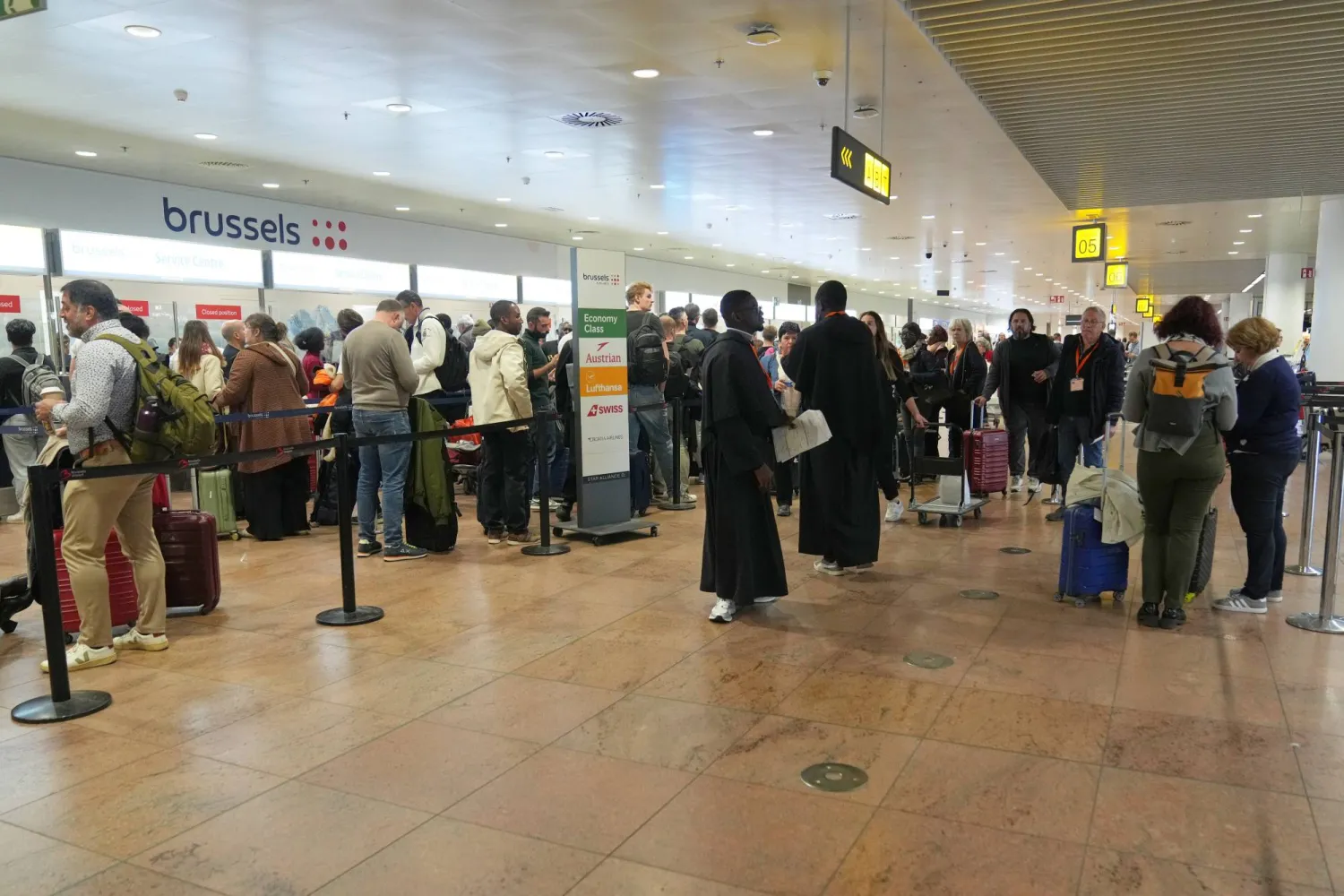
Passengers in the departures terminal after several cancellations and delays due to reported overnight drone activity over Brussels International Airport in Zaventem, Wednesday, Nov. 5, 2025. (AP Photo/Virginia Mayo)
TT

UK Sends Defense Equipment to Help Belgium Deal with Disruptive Drones

Passengers in the departures terminal after several cancellations and delays due to reported overnight drone activity over Brussels International Airport in Zaventem, Wednesday, Nov. 5, 2025. (AP Photo/Virginia Mayo)

Britain is sending experts and equipment to Belgium to help it combat disruptive drone sightings, which have temporarily closed airports, the head of the British military said on Sunday.

Drones have been spotted over airports and military bases in Belgium in the last week, having caused major disruption across Europe in recent months, Reuters said.

Richard Knighton, head of Britain's armed forces, told the BBC that his Belgian counterpart had asked for assistance and that equipment and personnel were on the way.

"The defense secretary and I agreed at the end of last week that we would deploy our people and our equipment to Belgium to help them," he said, without giving details of what sort of equipment would be sent or how many personnel.

Knighton said it was not known yet who was behind the drone sightings, but noted Russia has been involved in a pattern of "hybrid warfare" in recent years.

Russia has denied any connection with the incidents.

Drones spotted flying over airports serving the capital, Brussels, and Liege, in the country's east, forced the diversion of many incoming planes and the grounding of some due to depart on Tuesday.

Drone sightings also forced the temporary closures of airports in several countries including Sweden on Thursday.

The German defense minister suggested a link on Friday between recent drone incidents in Belgium and discussions over the use of frozen Russian assets, held by Belgian financial institution Euroclear, to fund a large loan to Ukraine.



Israel Launches New Strikes on Tehran and Lebanon as Iran Hits Back and Fires on Gulf Neighbors

This video grab taken from UGC images posted on social media and verified by AFPTV staff on March 16, 2026, show smoke rising from the side of a mountain in Hamedan, in Hamedan Province, western Iran. (Photo by UGC / AFP)
TT

Israel Launches New Strikes on Tehran and Lebanon as Iran Hits Back and Fires on Gulf Neighbors

This video grab taken from UGC images posted on social media and verified by AFPTV staff on March 16, 2026, show smoke rising from the side of a mountain in Hamedan, in Hamedan Province, western Iran. (Photo by UGC / AFP)

Residents of Dubai and Doha, Qatar, awoke to the sound of explosions Tuesday as air defenses worked to intercept new waves of incoming Iranian fire, and Israel launched new strikes on Iran and Lebanon, as the war in the Middle East showed no signs of abating.

Dubai, a major transit hub for international travel, briefly shut its airspace as the military said it was “responding to incoming missile and drone threats” around the city, The Associated Press said.

The Israeli military said early Tuesday it had begun a “wide-scale wave of strikes” across Iran’s capital and was also stepping up strikes on Iran-backed Hezbollah militants in Lebanon. Israel also reported two incoming salvos before dawn from Iran at Tel Aviv and elsewhere, and said Hezbollah targeted Israel's north.

Iranian strikes pressure neighbors and oil markets

Iran kept up the pressure on the energy infrastructure of its Gulf Arab neighbors, hitting an oil facility in Fujairah, a UAE emirate on the country’s east coast with the Gulf of Oman that has been repeatedly targeted. State-run WAM news reported that no one had been injured in the blast from the drone strike.

Iran's attacks on Gulf nations and its stranglehold on the Strait of Hormuz, through which a fifth of the world's oil is transported, has given rise to increasing concerns of a global energy crisis. Early Tuesday it hit a tanker anchored off the coast of Fujairah, one of about 20 vessels hit since Israel and the United States started the war with an attack on Iran on Feb. 28.

With Washington under increasing pressure over rising oil prices, Brent crude, the international standard, remained over $100 a barrel, up more than 40% since the war started.

US President Donald Trump said he had demanded that roughly a half-dozen countries send warships to keep the Strait of Hormuz open. But his appeals brought no immediate commitments, with many saying they are hesitant to get involved in a war with no defined exit plan and skeptical that they could do more than the US Navy.

UAE briefly closes airspace as Iran launches new attacks on Gulf neighbors

The UAE shut down its airspace early Tuesday as its military reported it was “responding to missile and drone threats from Iran." The closure was soon lifted, and not long after the sounds of explosions could be heard as the military worked to intercept incoming fire.

The snap announcement on its airspace showed the balancing act Emirati authorities face in trying to keep their long-haul carriers, Emirates and Etihad, flying as Iranian attacks continue to target the country.

Saudi Arabia’s Defense Ministry reported intercepting a dozen drones Tuesday morning over the country’s vast Eastern Province, home to oil infrastructure.

In Qatar, the sounds of explosions boomed over the capital early in the day as defenses worked to intercept incoming fire. Qatar's Defense Ministry said later that it had successfully thwarted a missile attack on the city, though a fire broke out in an industrial area from a downed projectile.

Attacks from Iran-linked proxy forces continued in Iraq, as the US Embassy in Baghdad was hit with shrapnel from drones that had been intercepted.

The embassy's air defenses were able to shoot down all four drones targeting the facility, according to two Iraqi security officials, speaking on condition of anonymity to discuss intelligence matters.

A separate strike targeted a house in the heavily fortified Presidential Compound in Baghdad’s al-Jadriya area, the officials said. It wasn’t clear who carried out either attack but Iran-allied militias have regularly been attacking American targets inside Iraq since the conflict began.

Israel launches new attacks on Tehran and steps up strikes on Beirut

The Israeli military early Tuesday said it had launched new attacks across Tehran in addition to the Lebanese capital targeting Hezbollah militants.

More than 1,300 people have been killed in Iran since the start of the conflict, according to the Iranian Red Crescent.

Israel’s strikes have also displaced more than 1 million Lebanese — or roughly 20% of the population — according to the Lebanese government, which says some 850 people have been killed.

Some Israeli troops have pushed into southern Lebanon, and there are fears Israel is preparing a large-scale invasion.

The military's chief of staff, Lt. Gen. Eyal Zamir, said Monday on a visit to the northern border that Israel's army is “determined to deepen the operation until all of our objectives are achieved” and that the military's Northern Command is being reinforced with additional soldiers.

Israel reported two Iranian salvos early Tuesday fired toward Tel Aviv and an area south of the Sea of Galilee. More launches from Lebanon were also reported.

In Israel, 12 people have been killed by Iranian missile fire. At least 13 US military members have been killed.

Trump seeks allies' help to police the Strait of Hormuz

The virtual shutdown of the Strait of Hormuz is unnerving the world economy, driving up energy prices, threatening food shortages in poor countries, destabilizing fragile states and complicating efforts by central banks to drive down prices for consumers.

There have been a handful of ships getting through, primarily Iranian but also from other countries including India and Türkiye, and Iranian Foreign Minister Abbas Araghchi said: “from our perspective it is open” — just not for the United States, Israel and its allies.

Underscoring the danger of even getting close to the strait, a tanker anchored off the eastern coast of the United Arab Emirates was hit by a projectile early Tuesday morning.

The United Kingdom Maritime Trade Operations center, run by the British military, reported the attack, saying the vessel was in the Gulf of Oman off Fujairah. It said the tanker sustained “minor structural damage” and no one was hurt.

On Monday, Trump said “numerous countries” have told him “they’re on the way” to help police the Strait of Hormuz but there was no sign of that actually happening.

Europeans have been critical of the US and Israel for failing to provide clarity on their objectives in the war and have suggested that they are more interested in a diplomatic solution than getting dragged into the conflict.

Japan and Australia said Monday they had not been asked to help protect the strait and had no current plans to do so, and Italy's Foreign Minister Antonio Tajani said his country favors strengthening anti-piracy and defensive missions in the Red Sea, but not expanding their role in the Strait of Hormuz.

British Prime Minister Keir Starmer said his country might deploy mine-hunting drones already in the region, but “will not be drawn into the wider war.”


Europeans Seek Clarity About Trump’s Iran War Aims Before Agreeing to His Warship Demands

European Union High Representative for Foreign Affairs and Security Policy Kaja Kallas arrives ahead of a Foreign Affairs Council meeting at the Council of the European Union in Brussels, Belgium, 16 March 2026. (EPA)
TT

Europeans Seek Clarity About Trump’s Iran War Aims Before Agreeing to His Warship Demands

European Union High Representative for Foreign Affairs and Security Policy Kaja Kallas arrives ahead of a Foreign Affairs Council meeting at the Council of the European Union in Brussels, Belgium, 16 March 2026. (EPA)

European countries on Monday sought more details about US President Donald Trump's plans for the war on Iran and warned that NATO must not become involved it, as they weighed whether to agree to his call to send warships to help shore up security in the Gulf.

The cool response to Trump’s demand reflects wide caution about the US-Israeli war among allies kept in the dark before, and largely since, it was launched on Feb. 28.

Trump has asked partners, including France, China, Japan, South Korea and Britain, to help secure the Strait of Hormuz for global shipping. He said the United States was talking to “about seven” countries, but he wouldn’t say which ones and gave no indication of when such a coalition might be formed.

UK Prime Minister Keir Starmer insisted Britain “will not be drawn into the wider war,” and said British troops should only be sent into action that is legal and has “a proper thought-through plan.” But his country is considering other forms of help in conjunction with allies.

In an interview with the Financial Times, Trump also warned that “if there’s no response or if it’s a negative response, I think it will be very bad for the future of NATO.”

German Chancellor Friedrich Merz said that “NATO is a defensive alliance, not an interventionist one. And that is precisely why NATO has no business being involved here.” He said he hopes that NATO allies “will treat one another with the necessary respect within the alliance.”

Merz agreed that “this Iranian regime must come to an end,” but he said that "based on all the experience we have gained in previous years and decades, bombing it into submission is, in all likelihood, not the right approach.”

EU debates Trump's demand

Many are keen to know when the war will end.

At a meeting in Brussels, where European Union foreign ministers gathered to discuss Trump's demand, German Foreign Minister Johann Wadephul said it's important for the US and Israel to define “when they consider the military aims of their deployment to have been reached.”

“We need more clarity here,” Wadephul told reporters.

Estonian Foreign Minister Margus Tsahkna also said that US allies in Europe want to understand Trump’s “strategic goals. What will be the plan?”

Polish Foreign Minister Radek Sikorski invited the Trump administration to go through the proper channels.

“If there is a request via NATO, we will of course out of respect and sympathy for our American allies consider it very carefully,” he said. Sikorski made a reference to Article 4 of NATO's founding treaty, which allies can invoke if they believe their territory or security is under threat.

Acting in Europe's interests

Still, EU foreign policy chief Kaja Kallas said that “it is in our interest to keep the Strait of Hormuz open."

Kallas had urged the 27 member countries to expand the EU's Operation Aspides naval mission to protect shipping in the Red Sea up into the Persian Gulf. But after chairing the meeting, she said there had been “no appetite” to boost its mandate.

But Kallas said the EU would closely monitor threats to maritime security also in the Red Sea, where Aspides operates with three warships. “The risk that the Houthis get involved is real. So we must remain vigilant,” she said.

Yemen’s Iran-backed Houthi militants have so far remained on the sidelines of the war even as it has spread across the Middle East, raising questions about why, and perhaps when, the battle-hardened militants might join the fight.

It was not immediately clear whether some European countries might go it alone and form a “coalition of the willing” to provide military support on an ad hoc basis.

The war in Iran has driven up energy prices worldwide, with Brent crude up more than 40%. The conflict has also disrupted the wider global supply chain beyond oil, affecting things like pharmaceuticals from India, semiconductors from Asia and oil-derived products like fertilizers that come from the Middle East.

Cargo ships are stuck in the Gulf or making a much longer detour around the southern tip of Africa. Planes carrying air cargo out of the Middle East are grounded. And the longer the war drags on, the more likely that there will be shortages and price increases on a wide range of goods.

France has said it is working with countries — French President Emmanuel Macron mentioned partners in Europe, India and Asia — on a possible mission to escort ships through the strait but has stressed it must be when “the circumstances permit,” when fighting has subsided.

French senior officials, speaking anonymously on ongoing talks, said the Netherlands, Italy and Greece had shown interest and that Spain might be involved in some way.

Starmer said Britain is discussing with the US and allies in Europe and the Gulf the possibility of using its mine-hunting drones already in the region.


Trump on Iran: We Don’t Know Their Leaders

US President Donald Trump speaks during a meeting with trustees of the John F. Kennedy Center for Performing Arts in the East Room of the White House in Washington, DC, USA, 16 March 2026. (EPA)
TT

Trump on Iran: We Don’t Know Their Leaders

US President Donald Trump speaks during a meeting with trustees of the John F. Kennedy Center for Performing Arts in the East Room of the White House in Washington, DC, USA, 16 March 2026. (EPA)

President Donald Trump said on Monday that he believes Iran wants to make a deal to end the US-Israeli conflict with Tehran but that it is unclear who is actually leading Iran.

"We don't know who their leader is. We ‌have people ‌wanting to negotiate. We have ‌no ⁠idea who they ⁠are," Trump told reporters during a White House event.

After Iran's supreme leader, Ali Khamenei, was killed in the initial strikes of the war, Tehran announced his ⁠son, Mojtaba Khamenei, had been ‌named as ‌his successor.

Pentagon chief Pete Hegseth said ‌last week the new leader ‌was believed to have been wounded in a strike. He has not been seen publicly.

"A lot of people ‌are saying that he's badly disfigured. They're saying that he lost ⁠his ⁠leg ... and he's been hurt very badly. Other people are saying he's dead," Trump said.

Oman has attempted multiple times to open a line of communication between the United States and Iran, but the White House made it clear it is not interested at this juncture, Reuters reported on Saturday.