


Afghanistan Shifts Trade to Iran Route to Avoid Pakistan Closures

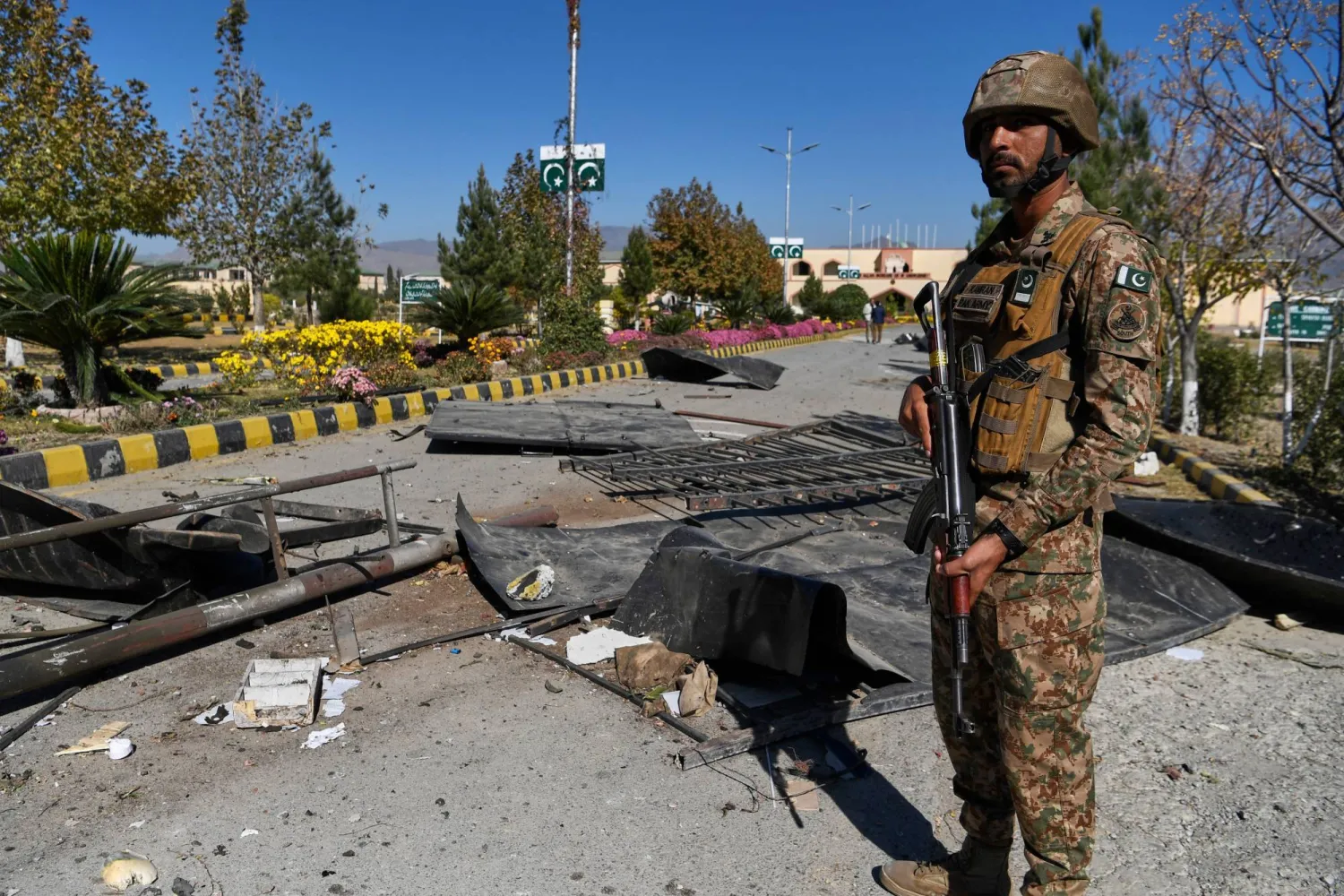
An Army soldier stands guard next to damages at the main gate of an army-run cadet college that was assaulted by militants on Monday, in Wana, a city in the northwestern Pakistani district South Waziristan bordering with Afghanistan, Thursday, Nov. 13, 2025. (AP Photo/Ahsan Shahzad)
TT

Afghanistan Shifts Trade to Iran Route to Avoid Pakistan Closures

An Army soldier stands guard next to damages at the main gate of an army-run cadet college that was assaulted by militants on Monday, in Wana, a city in the northwestern Pakistani district South Waziristan bordering with Afghanistan, Thursday, Nov. 13, 2025. (AP Photo/Ahsan Shahzad)

Landlocked Afghanistan is leaning more heavily on trade routes through Iran and Central Asia to reduce dependence on Pakistan, officials said, as tension between the neighbors escalates, with their border closed in recent weeks.

Afghanistan's reliance on Pakistan's ports has long given Islamabad leverage to press Kabul over Pakistani militants sheltering across the border.

But Afghanistan is increasingly making use of Iran's concessions to shift freight to its Indian-backed port of Chabahar, bypassing Pakistan and avoiding recurring border and transit disruptions.

"In the past six months, our trade with Iran has reached $1.6 billion, higher than the $1.1 billion exchanged with Pakistan," Abdul Salam Jawad Akhundzada, a spokesman for the commerce ministry, told Reuters.

"The facilities at Chabahar have reduced delays and given traders confidence that shipments will not stop when borders close."

THREE-MONTH DEADLINE

Traders have three months to settle contracts in Pakistan and shift to other routes, said Mullah Abdul Ghani Baradar, Afghanistan's deputy prime minister for economic affairs.

Accusing Islamabad of using "commercial and humanitarian matters as political leverage", he said Afghanistan would not mediate disputes after the deadline and ordered ministries to stop clearing Pakistani medicines, citing "low-quality" imports.

The biggest shift is to Chabahar, used since 2017 under a transit pact with Iran and India. Afghan officials say incentives from tariff cuts and discounted storage to faster handling are drawing more cargo south.

Iran has installed updated equipment and X-ray scanners, while offering Afghan cargo a 30% cut in port tariffs, 75% off storage fees and 55% off docking charges, said Akhundzada, the commerce ministry spokesman.

PAKISTAN SEES NO HARM FROM AFGHAN DECISION

Afghanistan’s decision would cause no economic harm to Pakistan, Defense Minister Khawaja Asif told Geo News.

"Afghanistan can trade through any port or country," he said.

However, Commerce Minister Jam Kamal Khan told Reuters, "We cannot compromise on security."

India has stepped up engagement with Afghanistan's ruling Taliban, hosting acting foreign minister Amir Khan Muttaqi and broadening humanitarian assistance.

It runs key terminals at Chabahar, which it sees as a strategic link to Afghanistan and Central Asia. In October, the United States gave New Delhi a six-month sanctions waiver to keep running the port.

CENTRAL ASIA CORRIDORS EXPAND

Afghanistan has boosted shipments through Turkmenistan, Uzbekistan and Tajikistan, routes it says are growing faster than Pakistan's.

As advantages Akhundzada cited new transit deals, lower border costs and offices at Milak and Zahedan, Iran's main border crossing points for Afghan trade.

But Pakistan is still the fastest route to the sea, with trucks reaching its southern port of Karachi in three days. Its exports to Afghanistan neared $1.5 billion in 2024.

Islamabad says closures curb militant movement; Kabul denies providing safe haven to the militants.



Iran Guards Vow to 'Pursue and Kill' Israeli Premier Netanyahu

Israeli Prime Minister Benjamin Netanyahu at a press conference in Jerusalem (archive – Reuters)
TT

Iran Guards Vow to 'Pursue and Kill' Israeli Premier Netanyahu

Israeli Prime Minister Benjamin Netanyahu at a press conference in Jerusalem (archive – Reuters)

Iran's Revolutionary Guards vowed on Sunday to target Israeli Prime Minister Benjamin Netanyahu as the war with Israel and the United States continues.

"If this child-killing criminal is alive, we will continue to pursue and kill him with full force," said the Guards on their website Sepah News.


Pakistan Says Hit Military Facilities in Afghanistan

A man surveys the damage following alleged Pakistani airstrikes in Kabul, Afghanistan, 14 March 2026. (EPA)
TT

Pakistan Says Hit Military Facilities in Afghanistan

A man surveys the damage following alleged Pakistani airstrikes in Kabul, Afghanistan, 14 March 2026. (EPA)

Pakistan said on Sunday its forces had attacked military facilities in southern Afghanistan, as well as "terrorist hideouts", in the latest strikes between the two sides.

Security sources said troops "effectively destroyed technical support infrastructure and equipment storage facility in Kandahar", which is home to the Taliban administration's supreme leader Hibatullah Akhundzada.

Another strike targeted a tunnel in Kandahar purportedly used by the Afghan Taliban and the Pakistani Taliban militant group or TTP, which Islamabad blames for a wave of strikes, they added.

Local residents in Kandahar told AFP they saw jet planes flying over the city and heard explosions during the night.

"Military planes flew over the mountain where there is a military facility, and an explosion followed," one said, adding flames could be seen.

An air strike was also heard in Spin Boldak, southeast of Kandahar, residents said, while authorities in the eastern border province of Khost said there were clashes on Saturday night.

Taliban government spokesman Zabihullah Mujahid told AFP that the strikes caused some damage to a drug rehabilitation center and an empty container in Kandahar.

"The places they are talking about are far away from these two places," he added.

Pakistan said on Saturday it had thwarted "drone attacks" launched by Afghanistan which were intercepted on Friday night.

At least three locations were targeted, including the Pakistani military headquarters in Rawalpindi, near the capital Islamabad, authorities said.

Pakistan President Asif Ali Zardari's office said the Afghan Taliban had "crossed a red line" by targeting civilians and promised a response.

Islamabad launched a military operation against Afghanistan last month, targeting what it said were Islamist extremists following attacks in Pakistan.

The Taliban government has denied any involvement or the use of Afghan territory for militancy, while Pakistan insists it does not target civilians.

There have been repeated clashes at the border in recent weeks, hampering trade and forcing nearby residents to leave their homes.

The UN mission in Afghanistan said on Friday that at least 75 civilians have been killed and 193 injured in Afghanistan as a result of the clashes since February 26.


American Flag Raised at US Embassy in Venezuela for the 1st Time since 2019

The US flag flies at the former US embassy now housing the Venezuela Affairs Unit (VAU), as the United States and interim authorities in Venezuela agreed to re-establish diplomatic and consular relations, following Nicolas Maduro’s capture, in Caracas, Venezuela March 14, 2026. REUTERS/Leonardo Fernandez Viloria
TT

American Flag Raised at US Embassy in Venezuela for the 1st Time since 2019

The US flag flies at the former US embassy now housing the Venezuela Affairs Unit (VAU), as the United States and interim authorities in Venezuela agreed to re-establish diplomatic and consular relations, following Nicolas Maduro’s capture, in Caracas, Venezuela March 14, 2026. REUTERS/Leonardo Fernandez Viloria

The American flag was raised Saturday over the US Embassy in Venezuela for the first time since 2019, a move that highlighted the recent shift in relations between the two countries since then President Nicolás Maduro was captured by American troops in January.

Though the flag is now waving, the building is undergoing renovations and it remains unclear when it will fully reopen.

The move comes after several statements from US President Donald Trump in support of Maduro’s successor, acting President Delcy Rodríguez, who has tried to keep negotiations open with the American government.

The flag was raised "exactly seven years after it was taken down,” the US Embassy team said in a statement published on its social media channels.

The American flag being raised drew immediate attention from local residents.

“It’s a good thing, really, what a joy,” said Caracas resident Luz Verónica López. “Other countries must come back too because that’s what we need; progress, to move forward with good relations with the rest of the world, as it should be.”

Alessandro Di Benedetto, another Caracas resident, noted the positive atmosphere among those witnessing the moment.

“I found several people here surprised and happy because today they raised the US flag at the embassy,” he said. “This is positive; this is another step.”

Despite the initiative, large chunks of Venezuelan society and the political establishment remain critics of Trump, his decision to forcefully remove Maduro from office and jail him in New York with his wife, and growing US influence in the South American country's oil industry.