
Bangladesh Tribunal Sentences Ousted Leader Sheikh Hasina to Death for Crimes Against Humanity 

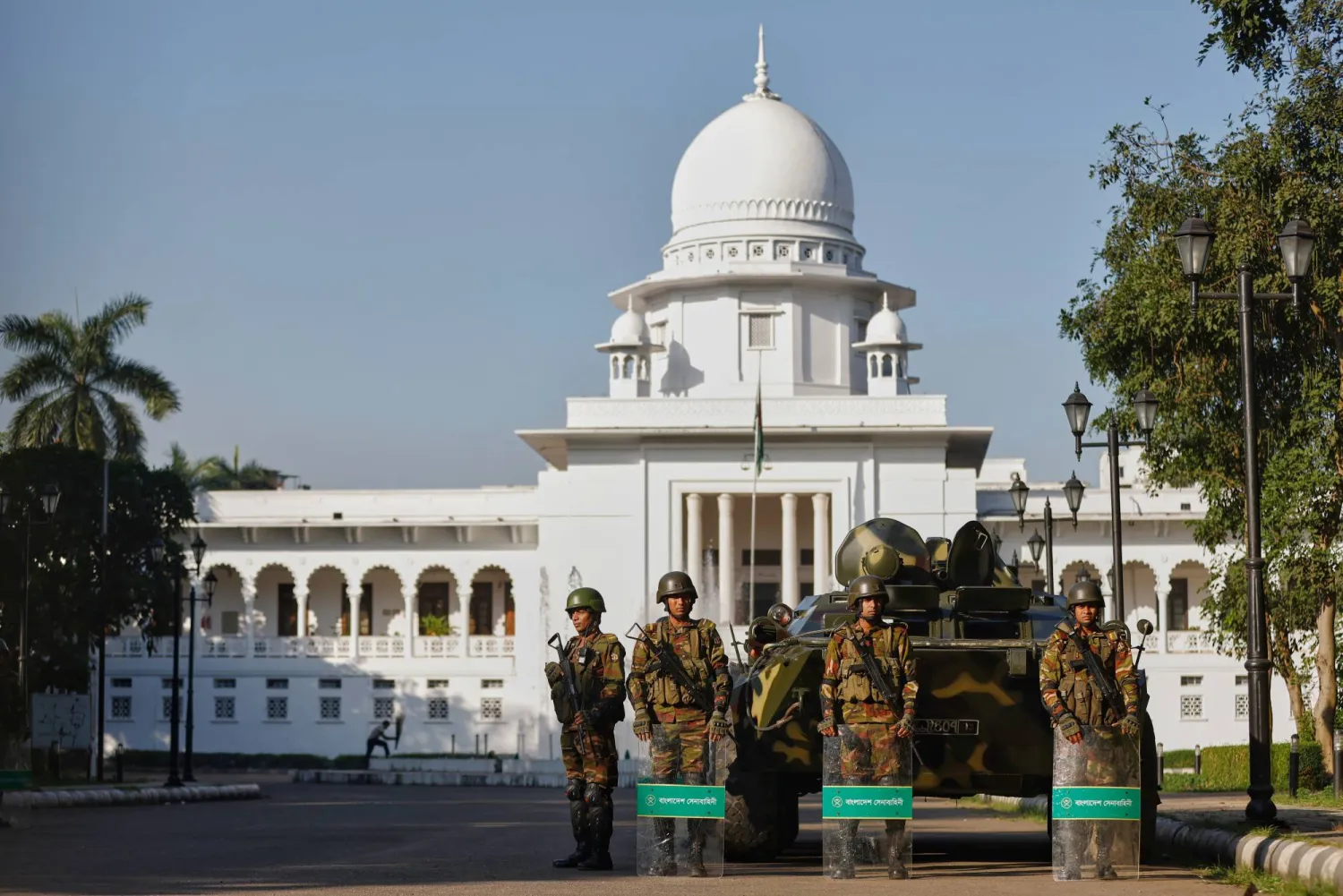
Bangladeshi Army soldiers stand guard outside the Supreme Court after security have been beefed up across the country ahead of an expected verdict against ousted Prime Minister Sheikh Hasina, in Dhaka, Bangladesh, Monday, Nov. 17, 2025. (AP)
TT

Bangladesh Tribunal Sentences Ousted Leader Sheikh Hasina to Death for Crimes Against Humanity 

Bangladeshi Army soldiers stand guard outside the Supreme Court after security have been beefed up across the country ahead of an expected verdict against ousted Prime Minister Sheikh Hasina, in Dhaka, Bangladesh, Monday, Nov. 17, 2025. (AP)

A special tribunal sentenced Bangladesh’s ousted Prime Minister Sheikh Hasina to death on charges of crimes against humanity for her crackdown on a student uprising last year that killed hundreds of people and led to the toppling of her 15-year rule.

The Dhaka-based International Crimes Tribunal also sentenced former Home Minister Asaduzzaman Khan to death for his involvement in the use of deadly force against protesters.

Both Hasina and Khan fled to India last year and were sentenced in absentia.

A third suspect, a former police chief, was sentenced to five years in prison after becoming a state witness against Hasina and pleading guilty.

Hasina and Khan were accused of crimes against humanity over the killing of hundreds of people during a student-led uprising in July and August of 2024. The country’s health adviser under the country’s current interim government said more than 800 people were killed and about 14,000 were injured. However, the United Nations in a February report said up to 1,400 may have been killed.

Hasina says the charges are unjustified, arguing that she and Khan “acted in good faith and were trying to minimize the loss of life.”

“We lost control of the situation, but to characterize what happened as a premeditated assault on citizens is simply to misread the facts,” she said Monday.

The verdict comes as the country still grapples with instability after Hasina was ousted on Aug. 5, 2024. Bangladeshi Nobel Peace Prize laureate Muhammad Yunus took over as the head of an interim government three days after her fall. Yunus has vowed to punish Hasina and banned the activities of her Awami League party.

A three-member tribunal, headed by Justice Golam Mortuza Mozumder, announced the tribunal's ruling in the capital, Dhaka. Tensions in the country were high and the tribunal was broadcast live.

Some of those in the packed courtroom cheered when Mazumder announced the death penalty for Hasina. He admonished them, telling them to express their feelings outside the courtroom.

Many families of the killed and the injured during last year's uprising gathered outside the tribunal premises, where they had waited hours to hear the verdict.

It appeared unlikely that Hasina would return to Bangladesh to face her sentence. India had not responded to requests by Bangladesh to extradite her to face the trial.

Hasina can’t also appeal.

The interim government beefed up security ahead of the verdict, with paramilitary border guards and police deployed in Dhaka and many other parts of the country.

Hasina’s Awami League party called for a nationwide shutdown to protest the verdict on Monday.

Hasina denounced Monday’s ruling, calling it “biased and politically motivated” in a statement. She also denounced the tribunal as “rigged” and alleged that it was “established and presided over by an unelected government with no democratic mandate.”

“In their distasteful call for the death penalty, they reveal the brazen and murderous intent of extremist figures within the interim government to remove Bangladesh’s last elected prime minister, and to nullify the Awami League as a political force,” she said.

Hasina cannot appeal the verdict unless she surrenders or is arrested within 30 days of the judgment.

Tensions and disruptions grew in the country in the days leading up to the expected verdict.

Nearly 50 arson attacks, mostly targeting vehicles, and dozens of crude bombs explosions were reported nationwide over the past week. Two people were killed in the arson attacks, local media reported.

Authorities at the Supreme Court, in a letter to army headquarters on Sunday, requested the deployment of soldiers around the tribunal premises ahead of the verdict.

Yunus said his interim government would hold the country's next elections in February, and that Hasina’s party would not get a chance to contest the race.

Bangladesh's politics under Yunus has remained at a crossroads with limited signs of stability.


‘I Know the Pain’: Ex-Refugee Takes over as UNHCR Chief

United Nations (UN) High Commissioner for Refugees, Barham Salih (C) holds a meeting with local administrative and security leaders following his arrival at the Kakuma refugee complex in Kakamu on January 11, 2026. (AFP)
TT

‘I Know the Pain’: Ex-Refugee Takes over as UNHCR Chief

United Nations (UN) High Commissioner for Refugees, Barham Salih (C) holds a meeting with local administrative and security leaders following his arrival at the Kakuma refugee complex in Kakamu on January 11, 2026. (AFP)

Barham Salih has known torture and the wrenching loss of exile. Four decades after his own ordeal, he has taken the helm of the UN refugee agency as it grapples with a funding shortfall and ever-rising needs.

A former Iraqi president, Salih, 65, became the first former head of state to run the United Nations High Commission for Refugees (UNHCR) at the start of the year.

"It is a profound moral and legal responsibility," Salih told AFP during his first trip in the new role -- to Kakuma refugee camp in Kenya.

"I know the pain of losing a home, losing your friends," he said.

The Kakuma refugee camp, which Salih visited on Sunday, is east Africa's second largest, hosting roughly 300,000 people from South Sudan, Somalia, Uganda and Burundi. It has been in place since 1992.

The world "should not allow this to continue", Salih said, praising a new initiative by Kenya to turn its camps into economic hubs.

"We should not only protect refugees... but also enable them to have more durable solutions," he said, while adding: "The better way is to have peace established in their own countries... nowhere is nicer than home."

- 'Electric shocks, beating' -

The son of a judge and a women's rights activist, Salih was born in 1960 in Sulaymaniyah, a stronghold of the Patriotic Union of Kurdistan (PUK), which sought self-determination for Iraq's Kurds.

He went into exile in Iran in 1974, spending a year at a school for refugees. As a teenager in 1979, back in Iraq and already a member of the PUK, he was arrested twice by former ruler Saddam Hussein's regime.

"I was released after 43 days after having suffered torture, electric shocks, beating," he said.

Upon release, he still managed to rank among Iraq's top three high school students, according to a former colleague, before fleeing with his family to Britain where he earned a degree in computer engineering and a doctorate.

Salih has "real experience of exile... He brings a personal perspective of displacement, which is very important," Filippo Grandi, his predecessor at UNHCR, told AFP last month.

Salih went on to a successful career in Iraqi Kurdistan and Iraq's federal government after Hussein's overthrow in 2003, holding the largely ceremonial role of president from 2018 to 2022.

- 'Serious budget cuts' -

Refugee numbers have doubled to 117 million in the past decade, the UNHCR said in June, but funding has dropped sharply, especially since Donald Trump returned to the White House.

UN Secretary-General Antonio Guterres recently praised Salih's experience as a "crisis negotiator and architect of national reforms" at a time when the agency faces "very serious challenges".

"We have had very serious budget cuts last year. A lot of staff have been reduced," Salih told AFP.

"But we have to understand, we have to adapt," he said, calling for "more efficiency and accountability" while also insisting the international community meets its "legal and moral obligations to help".


Landmark Myanmar Rohingya Genocide Case Opens at UN’s Top Court

A view of the courtroom as the International Court of Justice (ICJ) starts two weeks of hearings in a landmark case brought by Gambia, which accuses Myanmar of committing genocide ​the Rohingya, a minority Muslim group, in The Hague, Netherlands, January 12, 2026. (Reuters)
TT

Landmark Myanmar Rohingya Genocide Case Opens at UN’s Top Court

A view of the courtroom as the International Court of Justice (ICJ) starts two weeks of hearings in a landmark case brought by Gambia, which accuses Myanmar of committing genocide ​the Rohingya, a minority Muslim group, in The Hague, Netherlands, January 12, 2026. (Reuters)

A landmark case ​accusing Myanmar of committing genocide against minority Muslim Rohingya opened at the United Nations' top court on Monday.

It is the first genocide case the International Court of Justice will hear in full in more than a decade. The outcome will have repercussions beyond Myanmar, likely affecting South Africa’s genocide case at the ICJ against Israel over the war in Gaza.

Myanmar has denied accusations of genocide.

"The case is likely to set critical precedents for how genocide is defined ‌and how it ‌can be proven, and how violations can be ‌remedied," ⁠Nicholas ​Koumjian, head ‌of the UN's Independent Investigative Mechanism for Myanmar, told Reuters.

The predominantly Muslim West African country of Gambia filed the case at the ICJ - also known as the World Court - in 2019, accusing Myanmar of committing genocide against the Rohingya, a mainly Muslim minority in the remote western Rakhine state.

Myanmar's armed forces launched an offensive in 2017 that forced at least 730,000 Rohingya from their homes and into neighboring Bangladesh, where they ⁠recounted killings, mass rape and arson.

A UN fact-finding mission concluded the 2017 military offensive had included "genocidal acts".

ROHINGYA VICTIMS ‌SAY THEY WANT JUSTICE

Speaking in The Hague before ‍the hearings, Rohingya victims said they ‍want the long-awaited court case to deliver justice.

"We are hoping for a ‍positive result that will tell the world that Myanmar committed genocide, and we are the victims of that and we deserve justice," Yousuf Ali, a 52-year-old Rohingya refugee who says he was tortured by the Myanmar military, told Reuters.

Myanmar authorities rejected that report, saying ​its military offensive was a legitimate counter-terrorism campaign in response to attacks by Muslim militants. In the 2019 preliminary hearings in the ICJ ⁠case, Myanmar's then leader, Aung San Suu Kyi, rejected Gambia's accusations of genocide as "incomplete and misleading".

The hearings at the ICJ will mark the first time that Rohingya victims of the alleged atrocities will be heard by an international court, although those sessions will be closed to the public and the media for sensitivity and privacy reasons.

In total, the hearings at the ICJ will span three weeks. The ICJ is the U.N.'s highest court and deals with disputes between states.

Myanmar has been in further turmoil since 2021, when the military toppled the elected civilian government and violently suppressed pro-democracy protests, sparking a nationwide armed rebellion.

The country is currently holding phased elections ‌that have been criticized by the United Nations, some Western countries and human rights groups as not free or fair.


Trump Says Working Well with Venezuela’s New Leaders, Open to Meeting

A motorcyclist rides past graffiti depicting former Venezuelan President Nicolas Maduro, who is facing trial in the United States after US forces captured him, in Caracas, Venezuela, Sunday, Jan. 11, 2026. (AP)
TT

Trump Says Working Well with Venezuela’s New Leaders, Open to Meeting

A motorcyclist rides past graffiti depicting former Venezuelan President Nicolas Maduro, who is facing trial in the United States after US forces captured him, in Caracas, Venezuela, Sunday, Jan. 11, 2026. (AP)

US President Donald Trump said Sunday his administration was working well with Venezuela's interim leader Delcy Rodriguez -- and that he would be open to meeting with her.

Trump's upbeat remarks came just over a week after Venezuelan leader Nicolas Maduro was seized in a US special forces raid and brought to New York to face drug trafficking charges.

Trump has said that the United States now has de facto control of Venezuela, as it enforces a naval blockade of the South American nation's vital oil exports.

Rodriguez, despite being a close Maduro ally, has indicated a willingness to work with the United States, saying she is open to cooperate on Trump's demands for access to Venezuelan oil.

Her government has also vowed to release political prisoners and begin talks on reestablishing diplomatic ties with Washington.

US envoys visited Caracas on Friday to discuss reopening Washington's embassy there.

"Venezuela is really working out well. We're working along really well with the leadership," Trump told reporters Sunday aboard Air Force One.

Asked if he planned to meet with Rodriguez, Trump said: "At some point I'll be."

He also said he expected to meet with Venezuelan opposition leader Maria Corina Machado on Tuesday or Wednesday.

Many were stunned when Trump dismissed the possibility of Machado serving as Venezuela's interim leader following the toppling of Maduro, and instead accepted Rodriguez's ascent.

Machado was given the Nobel Peace Prize last year and dedicated it to Trump, though he has made no secret of his frustration at being passed over for the award.

- Political prisoners -

The Venezuelan government began to release prisoners jailed under Maduro on Thursday, saying a "large" number would be released -- but rights groups and the opposition say only about 20 have walked free so far, including several prominent opposition figures.

Relatives have gathered outside prisons believed to be holding political detainees, to await their loved ones' release, sometimes even camping outside.

Rights groups estimate there are 800 to 1,200 political prisoners currently being held in Venezuela.

"Venezuela has started the process, in a BIG WAY, of releasing their political prisoners. Thank you!" Trump said in a post late Saturday on his Truth Social platform.

"I hope those prisoners will remember how lucky they got that the USA came along and did what had to be done."

Meanwhile, a detained police officer accused of "treason" against Venezuela died in state custody after a stroke and heart attack, the state prosecution service confirmed Sunday.

Opposition groups said the 52-year-old man, Edison Jose Torres Fernandez, had shared messages critical of Maduro's government.

"We directly hold the regime of Delcy Rodriguez responsible for this death," Justice First, part of the Venezuelan opposition alliance, said on X.

Late Saturday, families held candlelight vigils outside El Rodeo prison east of Caracas and El Helicoide, a notorious jail run by the intelligence services, holding signs with the names of their imprisoned relatives.

Prisoners include Freddy Superlano, a close ally of Machado who was jailed after challenging Maduro's widely contested reelection in 2024.

"He is alive -- that was what I was most afraid about," Superlano's wife Aurora Silva told reporters.

"He is standing strong and I am sure he is going to come out soon."

Maduro's supporters rallied in Caracas on Saturday but the demonstrations were far smaller than his camp had mustered in the past, and top figures from his government were notably absent.

- Oil -

Trump pressed top oil executives at a White House meeting on Friday to invest in Venezuela, but was met with a cautious reception.

ExxonMobil's chief executive Darren Woods notably dismissed the country as "uninvestable" without sweeping reforms -- earning a rebuke from Trump.

"I didn't like Exxon's response. You know, we have so many that want it, I'd probably be inclined to keep Exxon out. I didn't like their response. They're playing too cute," Trump said Sunday.

Experts say Venezuela's oil infrastructure is creaky after years of mismanagement and sanctions.