


China Bans Japanese Seafood as Diplomatic Dispute Deepens 

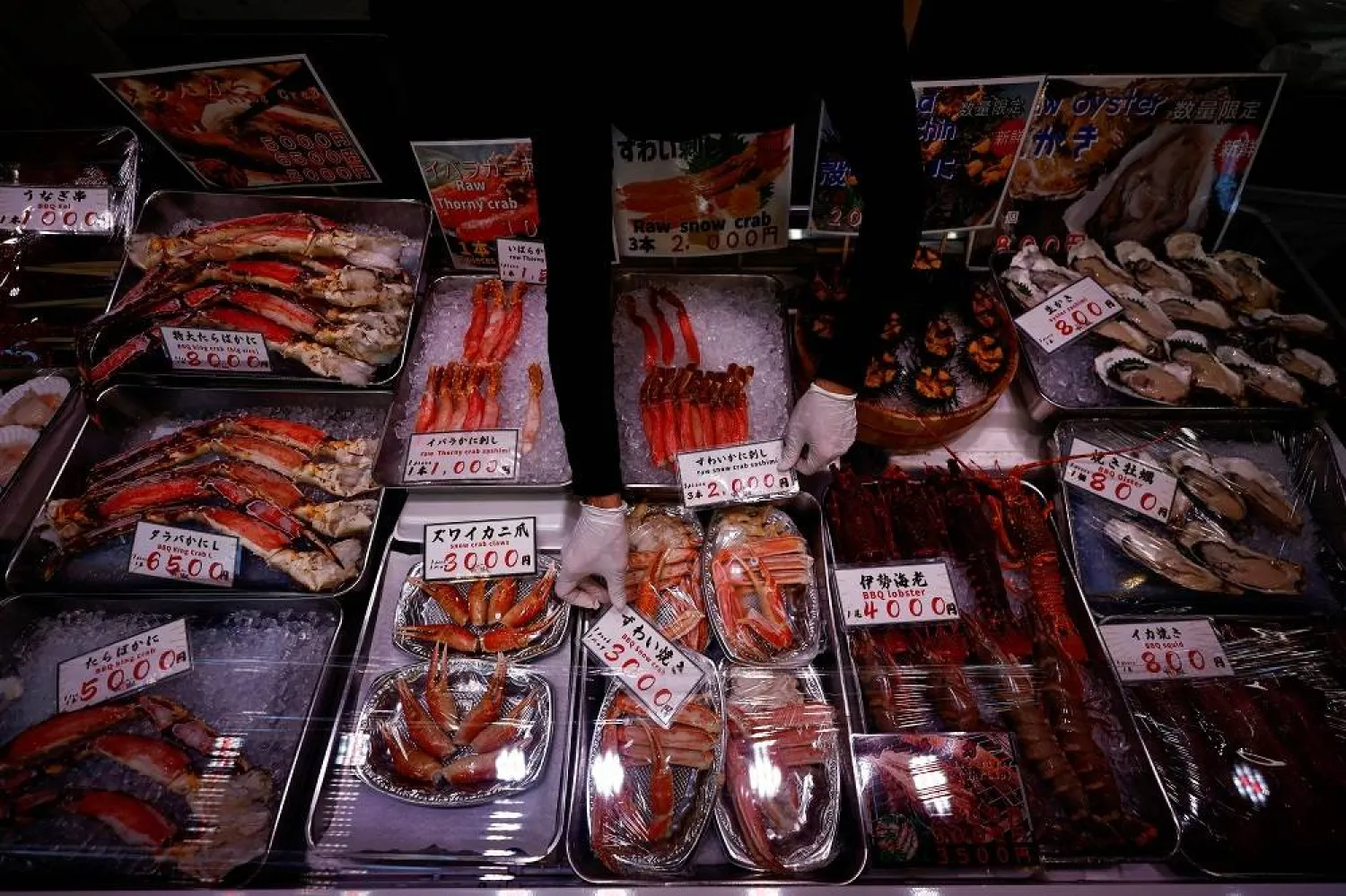
A vendor arranges seafood for sale at Tsukiji Outer Market in Tokyo, Japan, August 12, 2024. (Reuters)
TT

China Bans Japanese Seafood as Diplomatic Dispute Deepens 

A vendor arranges seafood for sale at Tsukiji Outer Market in Tokyo, Japan, August 12, 2024. (Reuters)

China informed Japan on Wednesday that it will ban all imports of Japanese seafood, media outlets reported - a decision which comes amid an escalating diplomatic dispute between Asia's top two economies.

Tensions between the two countries ignited after new Japanese Prime Minister Sanae Takaichi said this month that a Chinese attack on Taiwan threatening Japan's survival could trigger a military response.

China has demanded she retract the remarks and urged its citizens not to travel to Japan, resulting in mass cancellations that could deal a sizable blow to the world's fourth-largest economy.

The latest pain point for Japan comes after Beijing just months ago partially eased restrictions on Japanese seafood that had been imposed due to Tokyo's decision to release treated wastewater from its Fukushima nuclear power plant in 2023.

China has told Japan that the re-imposition of the ban was due to the need for further monitoring of the water release, Kyodo news agency reported citing sources.

China's commerce ministry and customs administration did not immediately respond to Reuters requests for comment. Representatives for Japan's Ministry of Agriculture, Forestry and Fisheries were not immediately available for comment.

Facing a wave of vitriolic responses by a Chinese diplomat in Japan and Chinese state media aimed at Takaichi, Japan warned its citizens in China on Monday to step up safety precautions and avoid crowded places.

Tokyo has said Takaichi's remarks in parliament are in line with the government's position, suggesting no breakthrough is imminent.

JAPAN COUNTS THE COSTS

China had said in June that it would resume importing Japanese seafood products from all but 10 of Japan's 47 prefectures.

The re-imposition will be a painful blow for many companies eager to re-enter a market that previously accounted for more than a fifth of all Japan's seafood exports.

Nearly 700 Japanese exporters had applied to re-register for shipments to China, Japanese Agriculture Minister Norikazu Suzuki told reporters on Tuesday. However, only three had been approved to date.

Before the 2023 ban, China was Japan's top scallop buyer and a major importer of sea cucumbers.

More immediately, China's travel boycott could have far-reaching consequences for Japan's shaky economy.

Tourism accounts for around 7% of Japan's overall gross domestic product, according to the World Travel & Tourism Council, and has been a major driver of growth in recent years. Visitors from mainland China and Hong Kong account for around a fifth of all arrivals, official figures show.

More than 10 Chinese airlines have offered refunds on Japan-bound routes until December 31, with one airline analyst estimating that around 500,000 tickets have already been cancelled.

A person at a state-owned Chinese bank said staff were informally told by managers on Tuesday that requests to travel to Japan would not be approved for the time being. The person declined to be named due to the sensitivity of the matter.

ACADEMIC, CULTURAL EXCHANGES CANCELLED

An annual meeting of scholars from both countries due to start in Beijing on Saturday has also been postponed, China's foreign ministry said.

An event promoting Japan–China friendship scheduled for November 21 in the western Japanese city of Hiroshima has also been cancelled.

China has suspended the screenings of upcoming Japanese films, and Japanese celebrities popular there have tried to pre-empt any potential backlash with messages showing their support for China.

"China is like my second homeland to me and all my friends in China are my cherished family — I will always support One China," Japanese singer MARiA wrote on Weibo on Tuesday.



Trump Moves to Block Courts from Seizing Venezuelan Oil Revenue in US Accounts

 The sun rises in Caracas, Venezuela, Saturday, Jan. 10, 2026, a week after US forces captured Venezuelan President Nicolas Maduro. (AP)
The sun rises in Caracas, Venezuela, Saturday, Jan. 10, 2026, a week after US forces captured Venezuelan President Nicolas Maduro. (AP)
TT

Trump Moves to Block Courts from Seizing Venezuelan Oil Revenue in US Accounts

 The sun rises in Caracas, Venezuela, Saturday, Jan. 10, 2026, a week after US forces captured Venezuelan President Nicolas Maduro. (AP)
The sun rises in Caracas, Venezuela, Saturday, Jan. 10, 2026, a week after US forces captured Venezuelan President Nicolas Maduro. (AP)

US President Donald Trump signed an executive order aimed at blocking courts or creditors from impounding revenue tied to the sale of Venezuelan oil held in US Treasury accounts, the White House said on Saturday.

The emergency order said the revenue, held in foreign government deposit funds, should be used in Venezuela to help create "peace, prosperity and stability."

The order was signed on ‌Friday, less ‌than a week after US ‌forces ⁠captured Venezuelan leader ‌Nicolas Maduro in Caracas. Several companies have longstanding claims against the country. Exxon Mobil and ConocoPhillips, for example, left Venezuela nearly 20 years ago after their assets were nationalized. Both are still owed billions of dollars.

The order does not mention any ⁠specific company. It declares that the money is the sovereign ‌property of Venezuela held in US ‍custody for governmental and ‍diplomatic purposes and is not subject to private ‍claims.

"President Trump is preventing the seizure of Venezuelan oil revenue that could undermine critical US efforts to ensure economic and political stability in Venezuela," the White House said in a fact sheet.

A US agreement with Venezuela's interim leaders would provide ⁠up to the US, where numerous refineries are specially equipped to refine it.

Trump cited the 1977 International Emergency Economic Powers Act and the 1976 National Emergencies Act as a legal justification.

Trump signed the order the same day he met in Washington with executives from Exxon, Conoco, Chevron and other oil companies as part of a bid to encourage them to invest $100 billion in Venezuela's oil ‌industry.


As Protests Rage, Iran Pulls the Plug on Contact with the World

 This frame grab from a video released Friday, Jan. 9, 2026, by Iranian state television shows a man holding a device to document burning vehicles during a night of mass protests in Zanjan, Iran. (Iranian state TV via AP)
This frame grab from a video released Friday, Jan. 9, 2026, by Iranian state television shows a man holding a device to document burning vehicles during a night of mass protests in Zanjan, Iran. (Iranian state TV via AP)
TT

As Protests Rage, Iran Pulls the Plug on Contact with the World

 This frame grab from a video released Friday, Jan. 9, 2026, by Iranian state television shows a man holding a device to document burning vehicles during a night of mass protests in Zanjan, Iran. (Iranian state TV via AP)
This frame grab from a video released Friday, Jan. 9, 2026, by Iranian state television shows a man holding a device to document burning vehicles during a night of mass protests in Zanjan, Iran. (Iranian state TV via AP)

Just after 8 p.m. Thursday, Iran's theocracy pulled the plug and disconnected the country's 85 million people from the rest of the world.

Following a playbook used both in demonstrations and in war, Iran severed the internet connections and telephone lines that connect its people to the vast diaspora in the United States, Europe and elsewhere. Until now, even while facing strict sanctions over the country's nuclear program, Iranians still could access mobile phone apps and even websites blocked by the theocracy, using virtual private networks to circumvent restrictions.

Thursday's decision sharply limits people from sharing images and witness accounts of the nationwide protests over Iran's ailing economy that have grown to pose the biggest challenge to the government in years. It also could provide cover for a violent crackdown after the Trump administration warned Iran's government about consequences for further deaths among demonstrators.

As the country effectively goes dark, loved ones abroad are frantic for any scrap of news, especially as Iran’s attorney general warned on Saturday that anyone taking part in protests will be considered an “enemy of God,” a death-penalty charge

“You can’t understand our feelings. My brothers, my cousins, they will go on the street. You can’t imagine the anxiety of the Iranian diaspora,” said Azam Jangravi, a cybersecurity expert in Toronto who opposes Iran's government. “I couldn’t work yesterday. I had meetings but I postponed them because I couldn’t focus. I was thinking of my family and friends.”

Her voice cracked as she added: “A lot of people are being killing and injured by Iran, and we don’t know who.”

Even Starlink is likely being jammed

This is the third time Iran has shut down the internet from the outside world. The first was in 2019, when demonstrators angry about a spike in government-subsidized gasoline prices took to the streets. Over 300 people reportedly were killed.

Then came the protests over the 2022 death of Mahsa Amini following her arrest by the country’s morality police over allegedly not wearing her hijab, or headscarf, to the liking of authorities. A monthslong crackdown killed more than 500 people.

While the connectivity offered by Starlink played a role in the Amini demonstrations, the deployment of its receivers is now far greater in Iran. That's despite the government never authorizing Starlink to function, making the service illegal to possess and use.

A year ago, an Iranian official estimated tens of thousands of Starlink receivers in the country, a figure that Los Angeles-based internet freedom activist Mehdi Yahyanejad said sounded right.

While many receivers likely are in the hands of business people and others wanting to stay in touch with the outside world for their livelihoods, Yahyanejad said some are now being used to share videos, photos and other reporting on the protests.

“In this case, because all those things have been disrupted, Starlink is playing the key for getting all these videos out,” Yahyanejad said.

However, Starlink receivers are facing challenges. Since its 12-day war with Israel last June, Iran has been disrupting GPS signals, likely in a bid to make drones less effective. Starlink receivers use GPS signals to position themselves to connect to a constellation of low-orbit satellites.

Amir Rashidi, director of digital rights and security at the Miaan Group and an expert on Iran, said that since Thursday he had seen about a 30% loss in packets being sent by Starlink devices — basically units of data that transmit across the internet. In some areas of Iran, Rashidi said there had been an 80% loss in packets.

“I believe the Iranian government is doing something beyond GPS jamming, like in Ukraine where Russia tried to jam Starlink,” Rashidi said. He suggested Iran may be using a mobile jammer, like it did in previous decades to disrupt satellite television receivers.

The International Telecommunication Union, a United Nations agency, has called on Iran to stop jamming in the past.

Meanwhile, Iran has been advocating at the ITU for Starlink service to the country to be stopped.

Help ‘needs to come soon’

It appears that the majority of information coming out of Iran since Thursday night is being transmitted via Starlink, which is now illegal. That carries dangers for those possessing the devices.

“It’s really hard to use it because if they arrest a person, they can execute the person and say this person is working for Israel or the United States,” Jangravi said.

Not using it, however, means the world knows even less about what's happening inside Iran at a pivotal moment.

“This sort of nonviolent protest is not sustainable when the violence (by security forces) is so extreme,” Yahyanejad said. “Unless something changes in the next two or three days, these protests can die down, too. If there’s any help, it needs to come soon.”


One Dead, Seven Missing After Migrant Boat Sinks off Türkiye

This photograph shows the oil tanker the "Maridive 703" sailing in the search-and-rescue zone of the international waters between Malta and Tunisia, on December 31, 2025. (AFP)
TT

One Dead, Seven Missing After Migrant Boat Sinks off Türkiye

This photograph shows the oil tanker the "Maridive 703" sailing in the search-and-rescue zone of the international waters between Malta and Tunisia, on December 31, 2025. (AFP)

One person died and seven others were missing Saturday after a migrant boat sank in the Aegean Sea off the coast of Türkiye, the Turkish coast guard said.

Thirty-seven passengers on a rubber dinghy which took on water before dawn off the western city of Dikili, north of Izmir, were rescued alive, the coast guard stated.

Dikili, a small seaside resort, faces the Greek island of Lesbos, some 20 kilometers (12 miles) away.

"Search operations ... are continuing to find the seven missing irregular migrants," the coast guard said.

Shipwrecks are common for perilous crossings to the Greek islands, which are a gateway to the European Union.

Nearly 1,900 migrants either disappeared or were found drowned in the Mediterranean in 2025, according to the International Organization for Migration.