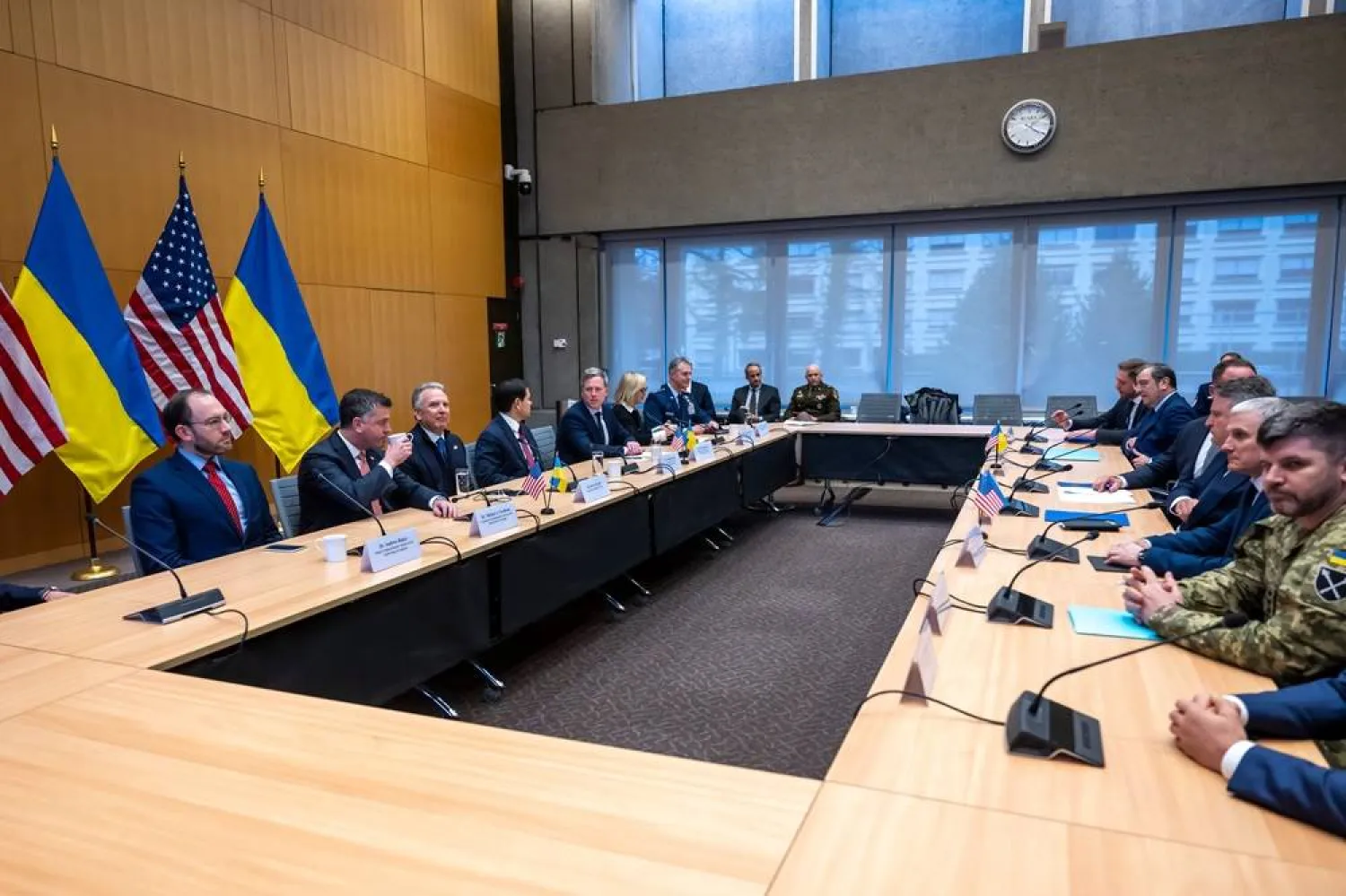
Ukraine and Western Allies Meet in Geneva to Discuss US Peace Plan

US, left, and Ukrainian, right, delegations at the beginning of their talks at the US Permanent Mission in Geneva, Switzerland, Sunday, Nov. 23, 2025. (Martial Trezzini/Keystone via AP)
TT

Ukraine and Western Allies Meet in Geneva to Discuss US Peace Plan

US, left, and Ukrainian, right, delegations at the beginning of their talks at the US Permanent Mission in Geneva, Switzerland, Sunday, Nov. 23, 2025. (Martial Trezzini/Keystone via AP)

Top Ukrainian envoys met with US Secretary of State Marco Rubio in Geneva Sunday to discuss President Donald Trump’s proposal to end Russia’s war on Ukraine. 

Speaking to journalists, Rubio described that first session of talks as “probably the most productive and meaningful meeting" since the Trump administration came to power. He also said that both delegations would meet again in a second meeting later on Sunday night. 

“This will ultimately have to be signed off by our presidents, although I feel very comfortable about that happening given the progress we’ve made,” said Rubio, who was joined at the talks by Army Secretary Dan Driscoll and Trump’s special envoy Steve Witkoff. 

Russia will also need to approve the final peace plan, Rubio said. 

The head of the Ukrainian delegation, presidential chief of staff Andrii Yermak, also confirmed an initial session of talks had concluded and that a second meeting would soon take place.  

“I want to confirm that we had a very productive first session with the distinguished American delegation. We have made very good progress and are moving forward to a just and lasting peace,” he said.  

“Very soon today the second meeting will take place, where we will continue to work on joint proposals with the engagement of our European partners. Final decisions will be taken by our Presidents.” 

Before the meeting, Trump on Sunday used a lengthy online post to blast Ukraine for a lack of gratitude for US military assistance, while notably shying away from criticizing Russia. 

“With strong and proper US and Ukrainian LEADERSHIP,” Trump wrote, Russia’s invasion of Ukraine “would have NEVER HAPPENED.” 

Trump also took a swipe at US allies in Europe, writing, “UKRAINE ‘LEADERSHIP’ HAS EXPRESSED ZERO GRATITUDE FOR OUR EFFORTS, AND EUROPE CONTINUES TO BUY OIL FROM RUSSIA.” 

After Trump's post, Ukrainian President Volodymyr Zelenskyy said he was “grateful” for US-led efforts on security, but stressed that “the crux of the entire diplomatic situation is that it was Russia, and only Russia, that started this war.” 

“Ukraine is grateful to the United States, to every American heart, and personally to President Trump for the assistance that – starting with the Javelins – has been saving Ukrainian lives. We thank everyone in Europe, in the G7, and in the G20 who is helping us defend life. It is important to preserve the support. 

“It is important not to forget the main goal – to stop Russia’s war and prevent it from ever igniting again.” 

“The leadership of the United States is important, we are grateful for everything that America and President Trump are doing for security, and we remain as constructive as possible,” Zelenskyy said in a post on Telegram. 

Ukraine and allies have ruled out territorial concessions  

The 28-point blueprint drawn up by the US to end the nearly four-year war has sparked alarm in Kyiv and European capitals. Zelenskyy has said his country could face a stark choice between standing up for its sovereign rights and preserving the American support it needs. 

The proposal, originating from negotiations between Washington and Moscow, acquiesces to many Russian demands that Zelenskyy has categorically rejected on dozens of occasions, including giving up large pieces of territory. 

The Ukrainian leader has vowed that his people “will always defend” their home. 

Before convening with US officials, Yermak and his team also met with national security advisers from the UK, France and Germany. The allies have rallied around Kyiv in a push to revise the plan, which is seen as favoring Moscow. 

Speaking before Sunday’s talks, Alice Rufo, France’s minister delegate at the Defense Ministry, told broadcaster France Info that key points of discussion would include the plan’s restrictions on the Ukrainian army, which she described as “a limitation on its sovereignty.” 

“Ukraine must be able to defend itself,” she said. “Russia wants war and waged war many times in fact over the past years.” 

On Sunday, Zelenskyy said that there was an understanding the US would take into account “a number of elements” in a peace deal that are important for Ukraine, but did not elaborate further. 

“There have already been brief reports from the team about the results of the first meetings and conversations,” he said. “There is now an understanding that the American proposals may take into account a number of elements based on the Ukrainian vision and are critically important for Ukraine’s national interests.” 

Previously, Trump said the US proposal was not his “final offer.” 

“I would like to get to peace. It should have happened a long time ago. The Ukraine war with Russia should have never happened,” Trump told reporters outside the White House on Saturday. “One way or the other, we have to get it ended.” 

Trump didn’t explain what he meant by the plan not being his final offer and the White House didn’t respond to a request for clarification. 

Rubio's reported comments cause confusion  

Polish Prime Minister Donald Tusk said Sunday that Warsaw was ready to work on the plan with the leaders of Europe, Canada and Japan, but also said that it “would be good to know for sure who is the author of the plan and where was it created.” 

Some US lawmakers said Saturday that Rubio had described the plan as a Russian “wish list” rather than a Washington-led proposal. 

The bipartisan group of senators told a news conference that they had spoken to Rubio about the peace plan after he reached out to some of them while on his way to Geneva. Independent Maine Sen. Angus King said Rubio told them the plan “was not the administration’s plan” but a “wish list of the Russians.” 

A State Department spokesperson denied their account, calling it “blatantly false.” 

Rubio himself then took the extraordinary step of suggesting online that the senators were mistaken, even though they said he was their source for the information. The secretary of state doubled down on the assertion that Washington was responsible for a proposal that had surprised many from the beginning for being so favorable to Moscow. 

On Sunday, the top Democrat on the US Senate Intelligence Committee said the peace plan appeared to be “almost a series of Russian talking points,” had made Europeans “feel like they’ve been totally left high and dry” and had led to “ferocious pushback.” 

US Sen. Mark Warner told ABC’s “This Week” that he thought Trump was “seeing this one-sided plan kind of blow up in his face.” 

“My hope is he’ll come back and be a bit more reasonable," Warner said. 

Possibility for additional talks  

Meanwhile, Turkish President Recep Tayyip Erdogan announced that he would hold a phone call with Russian President Vladimir Putin on Monday. He said he would talk to the Russian leader about reviving a previous deal from July 2022 that allowed Ukraine to safely ship exports of grain via the Black Sea. 

The agreement stayed in place until the following year, when Putin refused to extend it, saying that a parallel agreement promising to remove obstacles to Russian exports of food and fertilizer hadn’t been honored. 

“We had a grain corridor endeavor to open the path to peace,” Erdogan said, “Unfortunately we were only partially able to succeed. Tomorrow I will be asking Putin to revisit the endeavor.” 

Erdogan's new diplomatic push comes just days after he met with Zelenskyy in Ankara. 


US Treasury Chief Blames Commerce Dept for Failure in Nvidia Scandal

 US Treasury Secretary Scott Bessent speaks during the National Committee on US-China Relations 60th Anniversary Gala Dinner in New York City, US, November 10, 2026. (Reuters)
US Treasury Secretary Scott Bessent speaks during the National Committee on US-China Relations 60th Anniversary Gala Dinner in New York City, US, November 10, 2026. (Reuters)
TT

US Treasury Chief Blames Commerce Dept for Failure in Nvidia Scandal

 US Treasury Secretary Scott Bessent speaks during the National Committee on US-China Relations 60th Anniversary Gala Dinner in New York City, US, November 10, 2026. (Reuters)
US Treasury Secretary Scott Bessent speaks during the National Committee on US-China Relations 60th Anniversary Gala Dinner in New York City, US, November 10, 2026. (Reuters)

US Treasury Secretary Scott Bessent on Friday blamed the Commerce Department for failing to blacklist Megaspeed, the Singapore company at the center of a scandal that prompted Nvidia chief executive Jensen Huang to resign.

Speaking on CNBC, Bessent said Treasury, the Defense Department, the US Trade Representative's office and the State Department had backed adding Megaspeed to the Washington's trade blacklist, "for months."

"But Commerce has the pen," Bessent said. "You will have to ask them about their internal processes."

He said he was "frustrated" because President Donald Trump "made it very clear that China should not receive any Nvidia chips above H100s."

"Any leakage is very frustrating because it hurts our great companies, and in the AI race gives the Chinese an advantage," he said.

The remarks are a rare public rebuke of one cabinet department by another. Commerce is led by Secretary Howard Lutnick.

Megaspeed is suspected of helping Chinese firms get around US export controls by buying Nvidia chips for its data centers in Southeast Asia and routing them to China.

The company reportedly traded more than $4 billion worth of Nvidia chips over two years.

Its former director Alice Huang was this week identified in US media as an alleged Chinese intelligence asset who had a relationship with Jensen Huang. The two are not related. Beijing has denied the spying allegations.

Jensen Huang acknowledged an extramarital affair in a November 8 letter to Nvidia employees that did not name the woman involved and resigned his position on Thursday.

Nvidia's board has said it will investigate, and three US Congress committee chairs have asked him to attend a closed-door briefing on November 18.

Bessent said coverage of the affair had focused too much on Huang's private life.

"The story thus far has been on Jensen Huang's personal foibles," he said. "The real story here should be: Did Nvidia know their client, and was there a robust effort at Nvidia to make sure that there was no leakage."

He questioned whether Nvidia had been selling to "what were obviously pass-through shell companies."

"I think it's important that anyone at the company there be held accountable for that," Bessent said.

He said there was "a lot of leakage in the system" and that the administration was "constantly working to close that down."


UN Chief Urges Drastic Emissions Cuts as COP31 Wrestles with Fossil Fuels

UN Secretary-General Antonio Guterres speaks at a press conference on the fifth day of the COP31 annual UN climate conference in Antalya, Türkiye, 13 November 2026. (EPA)
TT

UN Chief Urges Drastic Emissions Cuts as COP31 Wrestles with Fossil Fuels

UN Secretary-General Antonio Guterres speaks at a press conference on the fifth day of the COP31 annual UN climate conference in Antalya, Türkiye, 13 November 2026. (EPA)

UN Secretary-General Antonio Guterres on Friday called for an "immediate and drastic reduction" in greenhouse gas emissions, as divisions over fossil fuels dominated the first week of COP31 climate talks in Türkiye.

Big fossil fuel producers and consumers at the talks are resisting any deal that would specify firm new targets or a shift away from oil, gas and coal, observers said as the first week of talks drew to a close.

That poses a challenge for summit host Türkiye and lead negotiator Australia, which have another week to land the kind of ambitious agreement climate advocates such as Guterres say is needed.

"The central question is in the hands of member states, particularly the big emitters. They must recognize the need for an immediate and drastic reduction in emissions to keep the 1.5 goal still possible by the end of the century," he said, referring to the warming limit countries had agreed to ‌pursue under the 2015 ‌Paris Agreement.

A UN report last month found the world is on course to exceed ‌the 1.5 ⁠degrees Celsius (2.7 ⁠degrees Fahrenheit) warming threshold, a limit scientists say should prevent the worst effects of climate change.

As temperatures have risen, this year has been marked by extreme heatwaves across Western Europe and a glacier collapse in Nepal that triggered a flood that killed more than 1,450 people. Thousands more are still missing.

'DISPROPORTIONATE INFLUENCE'

Major oil producers have traditionally resisted language constraining fossil fuels, while large developing economies such as India have opposed measures they say could limit their development and energy choices, a dynamic that has compromised the outcomes of past deals.

The world’s biggest oil consumer, the United States, meanwhile, has skipped the talks for the second year ⁠in a row under President Donald Trump, who has called global warming a hoax and promoted ‌continued use of fossil fuels.

"We must confront the disproportionate influence of the fossil ‌fuel lobby. The future of our planet cannot be negotiated on the terms of those profiting from its destruction," said Guterres, who is leaving ‌his job at the end of December after two five-year terms.

"But I remain hopeful. I've also seen something extraordinary over ‌these 10 years. Renewable energy has moved from the margins to the mainstream. The economics have changed. The technology has advanced. A cleaner, safer, and more secure energy future is in our hands. The question is whether we have the courage and speed to reach for it."

ELECTRIFICATION AND NO FIRM TARGETS

COP31 host Türkiye is striving to place a proposal to expand global electrification at the center of an eventual deal, saying the ‌plan will lead to emissions cuts by speeding the shift away from fossil fuel-powered cars, boilers and other equipment.

The proposal does not require the increased electricity use to come ⁠from renewable sources, although some ⁠countries, including last year’s COP host Brazil, are advocating for progress on a plan to require countries to more clearly map out their transition away from fossil fuels.

Katrine Petersen, an observer for the non-governmental organization E3G, said whether those measures survive the talks depends on conversations in the days to come.

"We've also heard quite clearly from countries like India, the G77, that they don't want any firm targets. They don't want any kind of technology or fuel-specific language," she said. "(These are) the kind of consistent and ongoing divides that we've seen from those different parties before."

Diana Acconcia, head of the EU delegation, said Europe backed the electrification goal.

"Electrification is, in a way, an inclusive agenda because it is non-prescriptive in a way on how the electrification is achieved," she said. "Of course, for the European Union electrification is to be achieved by clean sources of energy."

The Australian team, which is leading negotiations under a split presidency arrangement, spent the first few days of the summit gathering views on what should be included in a political text agreed by consensus that will be followed by all the negotiated technical points.

Australia is taking further submissions from countries until Saturday night, with a view to formulating a draft text early next week.


Europe’s Security Cannot Be Part of Ukraine Peace Talks, EU Leaders Say

13 November 2026, Ireland, Dublin: German Chancellor Friedrich Merz speaks during a press conference on the sidelines of the EU summit at the Convention Centre in Dublin. (dpa)
TT

Europe’s Security Cannot Be Part of Ukraine Peace Talks, EU Leaders Say

13 November 2026, Ireland, Dublin: German Chancellor Friedrich Merz speaks during a press conference on the sidelines of the EU summit at the Convention Centre in Dublin. (dpa)

EU leaders said on Friday that Europe's security structure should not be a subject for Ukraine-Russia peace negotiations, but they did not answer the question of who should speak for Europe in any future talks.

The Kremlin said on Friday that Russia would be open to European countries taking part in Ukraine peace talks if it saw they were ready to contribute to the peace process.

German Chancellor Friedrich Merz described the Kremlin's comments as "the same old game" and said that Europe and the United States agreed on a clear message.

"There will be no discussions about ‌Ukraine without ‌Ukraine, and no discussions about Europe without Europe. Furthermore, there is no need ‌to ⁠talk about European ⁠security architecture. We have that already," Merz told reporters during a summit of European Union leaders in Dublin.

Russian officials have called for a broad agreement on Europe's security architecture to be reached before tackling the specifics of the war. Before its invasion of Ukraine in 2022, Russia demanded the withdrawal of NATO forces from countries that joined the alliance after 1997. NATO rejected the demand.

US negotiator Jared Kushner said in Moscow on Thursday that he had begun discussions with European partners on ⁠the continent's security architecture.

EUROPE PRIORITIZES CEASEFIRE IN RUSSIA-UKRAINE WAR

EU foreign policy chief ‌Kaja Kallas said Russian calls for discussions about Europe's ‌security architecture risked diverting attention from the need for a ceasefire. Latvian Prime Minister Andris Kulbergs called such ‌discussions "a trap".

During a meeting on Thursday, leaders from Poland, the Baltics and Nordic states warned ‌against brainstorming with the US or Russia about Europe’s security architecture, according to a European diplomat and a European official.

Forty European countries, meeting as a broader group in Dublin on Thursday, signed a declaration saying that any matter affecting European security should be decided with the involvement of Europeans.

EU leaders broadly agreed that Europe ‌needed to speak with one voice, but did not settle on a single individual to do so. Merz said discussions would continue.

"There are ⁠established institutional forms ⁠of (EU) representation — Kaja Kallas, for instance, is part of this — but the E3 format has also proven very effective," he said, in reference to an informal security grouping of France, Germany and Britain, which is no longer an EU member but a prominent NATO ally.

"Moreover, we always include Italy and Poland," Merz added.

Representatives from Britain, France, Germany, Italy and the EU attended Russia-Ukraine talks in Abu Dhabi earlier this week, where both Moscow and Kyiv cited some progress, though there was no sign of a breakthrough on key issues such as territory.

Swedish Prime Minister Ulf Kristersson said Britain, one of Europe's top three military powers, certainly had to be included in any future talks and that the five countries plus EU institutions would make sense.

"I'm quite flexible on that, so I think what we actually say is more important than the exact configuration of the people in the room," he said.