
Ukraine and Western Allies Meet in Geneva to Discuss US Peace Plan

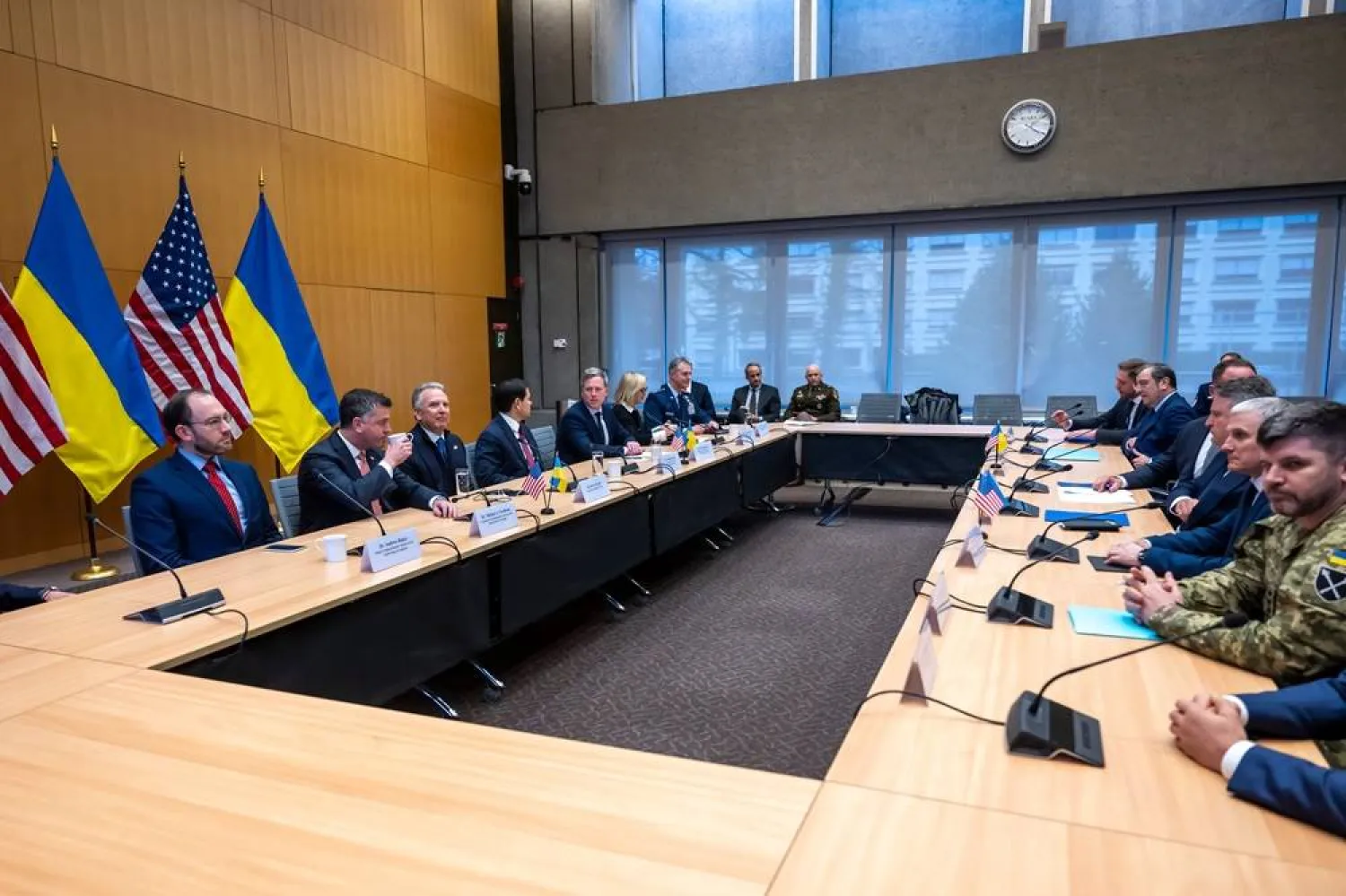
US, left, and Ukrainian, right, delegations at the beginning of their talks at the US Permanent Mission in Geneva, Switzerland, Sunday, Nov. 23, 2025. (Martial Trezzini/Keystone via AP)
TT

Ukraine and Western Allies Meet in Geneva to Discuss US Peace Plan

US, left, and Ukrainian, right, delegations at the beginning of their talks at the US Permanent Mission in Geneva, Switzerland, Sunday, Nov. 23, 2025. (Martial Trezzini/Keystone via AP)

Top Ukrainian envoys met with US Secretary of State Marco Rubio in Geneva Sunday to discuss President Donald Trump’s proposal to end Russia’s war on Ukraine. 

Speaking to journalists, Rubio described that first session of talks as “probably the most productive and meaningful meeting" since the Trump administration came to power. He also said that both delegations would meet again in a second meeting later on Sunday night. 

“This will ultimately have to be signed off by our presidents, although I feel very comfortable about that happening given the progress we’ve made,” said Rubio, who was joined at the talks by Army Secretary Dan Driscoll and Trump’s special envoy Steve Witkoff. 

Russia will also need to approve the final peace plan, Rubio said. 

The head of the Ukrainian delegation, presidential chief of staff Andrii Yermak, also confirmed an initial session of talks had concluded and that a second meeting would soon take place.  

“I want to confirm that we had a very productive first session with the distinguished American delegation. We have made very good progress and are moving forward to a just and lasting peace,” he said.  

“Very soon today the second meeting will take place, where we will continue to work on joint proposals with the engagement of our European partners. Final decisions will be taken by our Presidents.” 

Before the meeting, Trump on Sunday used a lengthy online post to blast Ukraine for a lack of gratitude for US military assistance, while notably shying away from criticizing Russia. 

“With strong and proper US and Ukrainian LEADERSHIP,” Trump wrote, Russia’s invasion of Ukraine “would have NEVER HAPPENED.” 

Trump also took a swipe at US allies in Europe, writing, “UKRAINE ‘LEADERSHIP’ HAS EXPRESSED ZERO GRATITUDE FOR OUR EFFORTS, AND EUROPE CONTINUES TO BUY OIL FROM RUSSIA.” 

After Trump's post, Ukrainian President Volodymyr Zelenskyy said he was “grateful” for US-led efforts on security, but stressed that “the crux of the entire diplomatic situation is that it was Russia, and only Russia, that started this war.” 

“Ukraine is grateful to the United States, to every American heart, and personally to President Trump for the assistance that – starting with the Javelins – has been saving Ukrainian lives. We thank everyone in Europe, in the G7, and in the G20 who is helping us defend life. It is important to preserve the support. 

“It is important not to forget the main goal – to stop Russia’s war and prevent it from ever igniting again.” 

“The leadership of the United States is important, we are grateful for everything that America and President Trump are doing for security, and we remain as constructive as possible,” Zelenskyy said in a post on Telegram. 

Ukraine and allies have ruled out territorial concessions  

The 28-point blueprint drawn up by the US to end the nearly four-year war has sparked alarm in Kyiv and European capitals. Zelenskyy has said his country could face a stark choice between standing up for its sovereign rights and preserving the American support it needs. 

The proposal, originating from negotiations between Washington and Moscow, acquiesces to many Russian demands that Zelenskyy has categorically rejected on dozens of occasions, including giving up large pieces of territory. 

The Ukrainian leader has vowed that his people “will always defend” their home. 

Before convening with US officials, Yermak and his team also met with national security advisers from the UK, France and Germany. The allies have rallied around Kyiv in a push to revise the plan, which is seen as favoring Moscow. 

Speaking before Sunday’s talks, Alice Rufo, France’s minister delegate at the Defense Ministry, told broadcaster France Info that key points of discussion would include the plan’s restrictions on the Ukrainian army, which she described as “a limitation on its sovereignty.” 

“Ukraine must be able to defend itself,” she said. “Russia wants war and waged war many times in fact over the past years.” 

On Sunday, Zelenskyy said that there was an understanding the US would take into account “a number of elements” in a peace deal that are important for Ukraine, but did not elaborate further. 

“There have already been brief reports from the team about the results of the first meetings and conversations,” he said. “There is now an understanding that the American proposals may take into account a number of elements based on the Ukrainian vision and are critically important for Ukraine’s national interests.” 

Previously, Trump said the US proposal was not his “final offer.” 

“I would like to get to peace. It should have happened a long time ago. The Ukraine war with Russia should have never happened,” Trump told reporters outside the White House on Saturday. “One way or the other, we have to get it ended.” 

Trump didn’t explain what he meant by the plan not being his final offer and the White House didn’t respond to a request for clarification. 

Rubio's reported comments cause confusion  

Polish Prime Minister Donald Tusk said Sunday that Warsaw was ready to work on the plan with the leaders of Europe, Canada and Japan, but also said that it “would be good to know for sure who is the author of the plan and where was it created.” 

Some US lawmakers said Saturday that Rubio had described the plan as a Russian “wish list” rather than a Washington-led proposal. 

The bipartisan group of senators told a news conference that they had spoken to Rubio about the peace plan after he reached out to some of them while on his way to Geneva. Independent Maine Sen. Angus King said Rubio told them the plan “was not the administration’s plan” but a “wish list of the Russians.” 

A State Department spokesperson denied their account, calling it “blatantly false.” 

Rubio himself then took the extraordinary step of suggesting online that the senators were mistaken, even though they said he was their source for the information. The secretary of state doubled down on the assertion that Washington was responsible for a proposal that had surprised many from the beginning for being so favorable to Moscow. 

On Sunday, the top Democrat on the US Senate Intelligence Committee said the peace plan appeared to be “almost a series of Russian talking points,” had made Europeans “feel like they’ve been totally left high and dry” and had led to “ferocious pushback.” 

US Sen. Mark Warner told ABC’s “This Week” that he thought Trump was “seeing this one-sided plan kind of blow up in his face.” 

“My hope is he’ll come back and be a bit more reasonable," Warner said. 

Possibility for additional talks  

Meanwhile, Turkish President Recep Tayyip Erdogan announced that he would hold a phone call with Russian President Vladimir Putin on Monday. He said he would talk to the Russian leader about reviving a previous deal from July 2022 that allowed Ukraine to safely ship exports of grain via the Black Sea. 

The agreement stayed in place until the following year, when Putin refused to extend it, saying that a parallel agreement promising to remove obstacles to Russian exports of food and fertilizer hadn’t been honored. 

“We had a grain corridor endeavor to open the path to peace,” Erdogan said, “Unfortunately we were only partially able to succeed. Tomorrow I will be asking Putin to revisit the endeavor.” 

Erdogan's new diplomatic push comes just days after he met with Zelenskyy in Ankara. 



Pentagon Reaches Deals with Defense Firms to Expand Munitions Production

A general view of the Pentagon in Washington, DC (AP) 
TT

Pentagon Reaches Deals with Defense Firms to Expand Munitions Production

A general view of the Pentagon in Washington, DC (AP) 

The Pentagon said on Wednesday it had reached framework agreements with BAE Systems, Lockheed and Honeywell to boost production of defense systems munitions as part of a push to put the US military on a “wartime footing.”

The ‌announcements come more than three weeks after US President Donald Trump and Israel launched a war on Iran. They also follow Trump's meeting earlier this month with executives from seven defense contractors as the Pentagon sought to replenish weapons stocks depleted by US strikes on Iran and other recent military operations.

The Pentagon also plans to send thousands of airborne troops to ⁠the Gulf to give Trump more options to order a ground assault, Reuters reported on Tuesday.

Under the agreements, Honeywell Aerospace will “surge production of critical components for America's munitions stockpile,” as part of a $500 million multi-year investment, the Pentagon said.

BAE Systems and Lockheed Martin will also quadruple production of seekers for the Terminal High Altitude Area Defense (THAAD) interceptor, while a new framework agreement with Lockheed will accelerate production of its Precision Strike Missile, the Pentagon added.

Honeywell said the agreement would support increased output of navigation systems, missile steering actuators and electronic warfare products used ‌across ⁠US military platforms.

Honeywell Aerospace CEO Jim Currier said the company was ready to help meet the urgent demand.

Lockheed Martin CEO Jim Taiclet also said the company was “working closely with the Department of War and the US Army to scale production to meet operational demand.”

Trump in January signed an executive order directing ⁠officials to identify contractors deemed to be underperforming on government contracts while continuing to return profits to shareholders. His administration has also stepped up pressure on defense companies to prioritize production over shareholder payouts.

“We discussed ⁠production and production schedules,” Trump said of the earlier meeting, which included executives from Lockheed Martin, RTX, BAE Systems, Boeing, Honeywell Aerospace, L3Harris Technologies and Northrop Grumman.

The United States has drawn ⁠down billions of dollars worth of weapons from its stockpiles since Russia invaded Ukraine in 2022, and during Israel's military operations in Gaza, including artillery systems, ammunition and anti-tank missiles.


Strikes Near Iran, Israel Nuclear Sites Risk ‘Unmitigated Catastrophe’, Says UN

 A drone view shows a damage in a residential neighborhood, following a night of Iranian missile strikes which injured dozens of Israelis, amid the US-Israel conflict with Iran, in Dimona, southern Israel March 22, 2026. (Reuters)
A drone view shows a damage in a residential neighborhood, following a night of Iranian missile strikes which injured dozens of Israelis, amid the US-Israel conflict with Iran, in Dimona, southern Israel March 22, 2026. (Reuters)
TT

Strikes Near Iran, Israel Nuclear Sites Risk ‘Unmitigated Catastrophe’, Says UN

 A drone view shows a damage in a residential neighborhood, following a night of Iranian missile strikes which injured dozens of Israelis, amid the US-Israel conflict with Iran, in Dimona, southern Israel March 22, 2026. (Reuters)
A drone view shows a damage in a residential neighborhood, following a night of Iranian missile strikes which injured dozens of Israelis, amid the US-Israel conflict with Iran, in Dimona, southern Israel March 22, 2026. (Reuters)

Strikes around Iran and Israel's nuclear sites risk unleashing an "unmitigated catastrophe", the United Nations rights chief said Wednesday, warning that the Middle East war had created an "extremely dangerous" situation.

Speaking before the UN Human Rights Council, where countries were holding an urgent debate on Tehran's attacks across the Gulf, Volker Turk warned that many of the strikes in the weeks-long war "raise serious concerns under international law".

In particular, Turk cautioned that "recent missile strikes near nuclear sites in both Israel and Iran underscore the immense danger of further escalation".

"States are flirting with unmitigated catastrophe."

His comments came after the UN nuclear watchdog said Iran had informed it that "another projectile hit the premises" of the Bushehr nuclear power plant on Tuesday, without damaging it.

Over the weekend, an Iranian strike hit the southern Israeli town of Dimona, home to a nuclear facility, in what Tehran said was in response to an earlier attack on its nuclear site at Natanz.

"The situation is extremely dangerous and unpredictable, and has created chaos across the region," Turk said, insisting that "we cannot go back to war as a tool of international relations".

The UN rights chief also warned that "this conflict has an unprecedented power to ensnare countries across borders and around the world".

"The complex dynamics could ignite further national, regional or global crises at any moment, with an appalling impact on civilians and people everywhere."


Hungary Says Will Phase Out Gas Deliveries to Ukraine

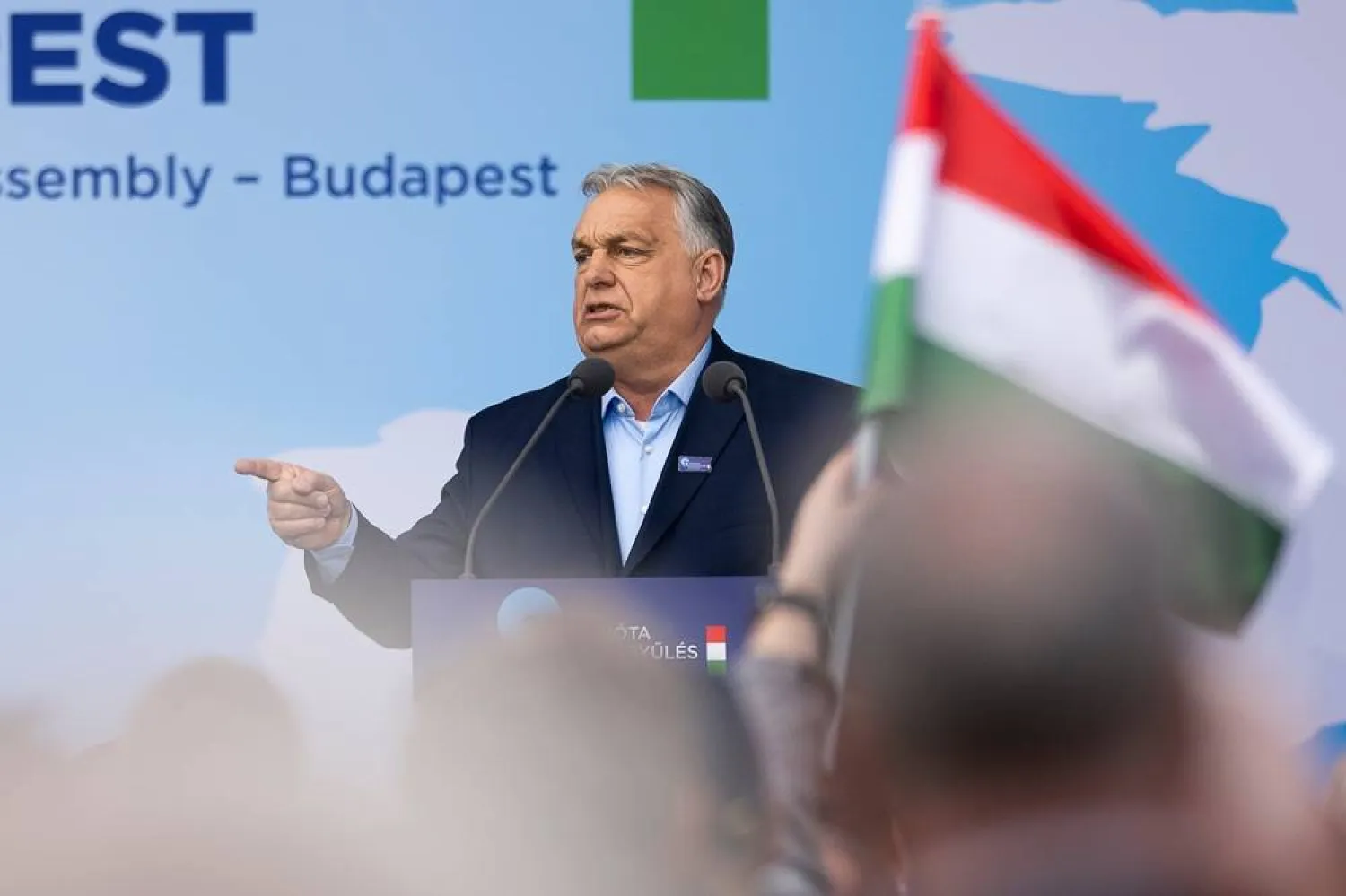
Hungarian Prime Minister Viktor Orban speaks during an assembly of European far-right parties with Orban’s Patriots for Europe group, in Budapest, Hungary, Monday, March 23, 2026. (AP)
TT

Hungary Says Will Phase Out Gas Deliveries to Ukraine

Hungarian Prime Minister Viktor Orban speaks during an assembly of European far-right parties with Orban’s Patriots for Europe group, in Budapest, Hungary, Monday, March 23, 2026. (AP)

Hungary's prime minister said on Wednesday that Budapest would phase out gas deliveries to Ukraine, the latest salvo in a bitter feud between the two countries over a damaged pipeline transporting Russian oil. 

Hungarian Prime Minister Viktor Orban, whose country is a major gas supplier to Ukraine, has accused Kyiv of delaying repairs on the pipeline, effectively stopping the flow of Russian oil to Hungary and its neighbor Slovakia. 

"To break the oil blockade and guarantee the security of Hungary's energy supply, new measures are now necessary," Orban said in a video posted on Facebook. 

"We are gradually halting gas shipments from Hungary to Ukraine and storing the gas that remains here domestically. Until Ukraine supplies oil, it will receive no gas from Hungary," he added. 

Ukrainian authorities have said that the Druzhba (Friendship) pipeline, which crosses its territory, was damaged by Russian airstrikes on January 27. 

Hungary and Slovakia, which have obtained exemptions from the European Union to continue purchasing Russian oil, accuse Kyiv of dragging their feet to repair it. 

In retaliation, Orban -- who is facing crucial parliamentary elections next month -- is blocking a European loan of 90 billion euros ($104 billion) to Ukraine. 

Last week, European Commission President Ursula von der Leyen announced that the EU would help reopen the Druzhba pipeline. 

Budapest and Bratislava are also blocking the official adoption of new economic sanctions against Russia, endorsed by other EU countries. 

According to analysts at the pro-government Hungarian Economic Research Foundation (Oeconomus), Hungary has become one of Ukraine's main gas suppliers. 

Ukraine imported 2.94 billion cubic meters of gas from Hungary in 2025, the top source for Ukrainian imports, accounting for 45.5 percent of all Ukrainian imports, Ukrainian consultancy ExPro said in a report. 

ExPro said separately that Ukraine's imports from Hungary were already slightly dropping as a share in 2026, down to 34 percent of Ukraine's import mix in March 2026. 

Ukraine's total gas consumption in 2025 was 21 billion cubic meters, the Dixi group consultancy said in a report in March, meaning Hungary accounted for 14 percent of Ukraine's total gas use in 2025.