

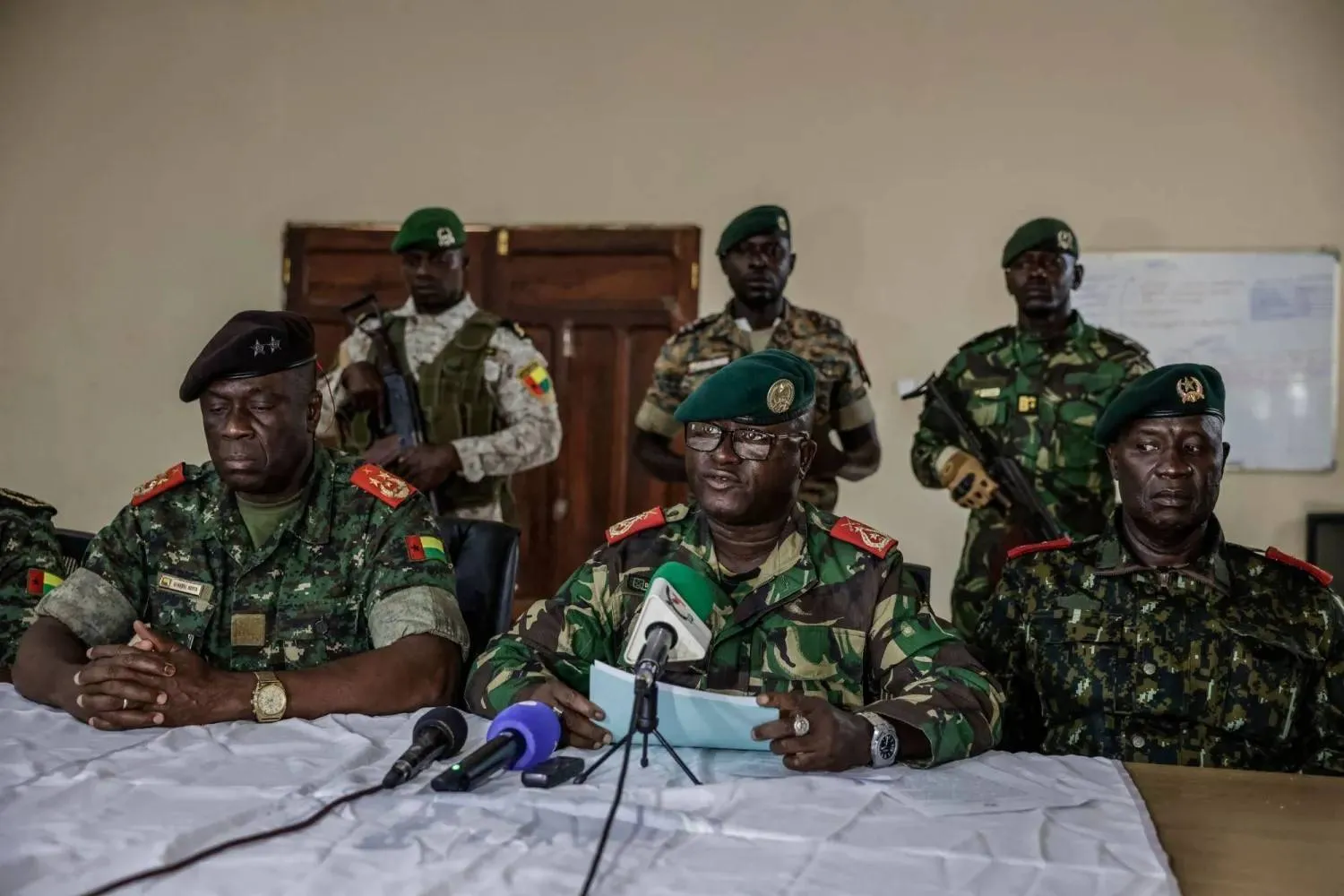

Military Announces ‘Total Control’ in Guinea-Bissau

Military officers said they had formed ‘the high military command for the restoration of order’ and would rule until further notice. (AFP) 
TT

Military Announces ‘Total Control’ in Guinea-Bissau

Military officers said they had formed ‘the high military command for the restoration of order’ and would rule until further notice. (AFP) 

Military officials in Guinea-Bissau said they seized “total control” of the West African nation on Wednesday, arresting the president, closing borders and suspending the electoral process held last Sunday.

“Representing the senior leaderships of the different branches of Armed Forces, the High Military Command for the Restoration of the National Security and the Public Order has assumed full powers of Guinea Bissau,” General Diniz N'Tchama, head of the presidential military office, said in a statement read on state television.

“The High Military Command is responding to an ongoing plan to destabilize our country. For the implementation of this plan, an operation structure was created involving certain national politicians,” N'Tchama announced.

President Umaro Sissoco Embalo, who had been favored to win re-election in last Sunday's polls, was arrested and being held at general-staff headquarters where he was being “well-treated,” a military source told AFP.

A senior officer who also confirmed the arrest added that Embalo had been detained along “with the chief of staff and the minister of the interior.”

The coup happened after heavy gunfire rang out near the presidential palace earlier in the day, with men in military uniform taking over the main road leading to the building.

The military officers read the announcement at the Military Command headquarters in the capital, Bissau, AFP correspondents said.

Shortly before the officers' announcement, gunfire rang out near the electoral commission headquarters, presidential palace and interior ministry, witnesses said. It lasted for about an hour but appeared to have stopped by 1400 GMT, a Reuters journalist said.

“People are running everywhere,” said a driver in Bissau who asked not to be named, describing scenes of panic. There was no word yet of any casualties.

The electoral commission had been due on Thursday to announce provisional results from Sunday's election in which Embalo faced off against Fernando Dias, Embalo's top challenger in the election.

Both sides had claimed victory in the first round of voting.

Embalo was seeking to become the first president in three decades to win a second consecutive term in Guinea-Bissau.

A spokesperson for Embalo, Antonio Yaya Seidy, told Reuters that unidentified gunmen attacked the election commission to prevent an announcement of the vote results.

He said the men were affiliated with Dias, without providing evidence.

Former Prime Minister Domingos Simoes Pereira, who lost to Embalo in a contested runoff in 2019 and has backed Dias in this election, told Reuters that Dias had nothing to do with the incident.

Dias was meeting election observers when “some people erupted in the room to announce that there were gunshots in the center of the town,” said Pereira, who was in the same meeting and spoke to Reuters before security sources said he had been detained.

Former colonial power Portugal called for government institutions to resume normal operations and for vote counting and the proclamation of results to go ahead.

It said all those involved in the unrest should “refrain from any act of institutional or civic violence.”

Guinea-Bissau had been shaken by at least nine coups and attempted coups between 1974, when it gained independence from Portugal, and 2020, when Embalo took office.

The most recent reported coup attempt came in late October, when authorities announced that a group of senior officers had been arrested on suspicion of trying to topple the government.


Leaders of Russia, China, Iran to Attend Summit in Kyrgyzstan

Putin and Xi have previously used SCO summits to promote their vision of a multipolar world. Vladimir SMIRNOV / POOL/AFP
TT

Leaders of Russia, China, Iran to Attend Summit in Kyrgyzstan

Putin and Xi have previously used SCO summits to promote their vision of a multipolar world. Vladimir SMIRNOV / POOL/AFP

Russia's Vladimir Putin and China's Xi Jinping are expected in Central Asia's Kyrgyzstan Monday for a two-day summit, also attended by Iran's and India's leaders, of a regional bloc seeking to be a counter-influence to the West.

Around a dozen heads of states will head to the Kyrgyz capital Bishkek to mark 25 years of the Shanghai Cooperation Group (SCO), said AFP.

The group brings together Russia, China, India, Pakistan, Iran, four Central Asian countries and Moscow-allied Belarus.

Putin and Xi have previously used SCO summits to promote their vision of a multipolar world and present a united front against the West.

It takes place four-and-a-half years into Moscow's Ukraine invasion and six months into the war between Washington and Tehran. Iran will be represented by its president, Masoud Pezeshkian.

Putin, Xi, Pezeshkian as well as India's Narendra Modi and Pakistan's Shehbaz Sharif are due to take part in a plenary session chaired by Kyrgyz leader Sadyr Japarov.

Putin is also expected to hold separate bilateral talks with Iran's Pezeshkian and China's Xi, among other leaders, Kremlin spokesman Yuri Ushakov said.

Russia and Iran -- among the most sanctioned states in the world -- have massively deepened their military and economic ties during the Ukraine war.

US President Donald Trump has warned Moscow and Beijing against arming Iran.

Putin's meeting with Pezeshkian comes days after the CIA's director John Ratcliffe made a rare trip to Moscow, with US media speculating he could have discussed Ukraine and Iran with his Russian counterparts.

The SCO has historically focused on economic issues. It gained momentum in recent years under Moscow's and Beijing's leadership.

The SCO's founding declaration says the group is "not an alliance directed against other states".

But Putin and Xi have repeatedly made anti-Western speeches during its summits.

At last year's gathering, Putin accused Western countries of provoking the Ukraine war, while Xi denounced "acts of intimidation", referring to US-Chinese tensions.

- Real and trade wars -

The Bishkek summit takes place as some SCO members are in the midst of real wars -- the Ukraine and Iran conflicts -- or trade wars, with the imposition of US tariffs on Chinese and Indian goods.

This month, the US slapped secondary sanctions on Iran's trading partners in the sectors of gold, technology, digital assets, aviation, and maritime transport, aiming to cripple the Iranian regime.

Washington also threatened Iran's allies with sanctions.

China, a major importer of Iranian oil, responded by saying it will "firmly defend" its interests.

Iran, living under sanctions since its 1979 revolution, has regularly said it will not cave to economic pressure.

But Pezeshkian has acknowledged his country faces "economic difficulties".

Iran only joined the bloc in 2023.

Mohammad Hassan Najmi, an international relations expert, told AFP that Tehran "believes its membership and active participation in these alliances can enable it to circumvent US and European sanctions".

But concrete benefits of the group are uncertain, he said, as "in times of crisis, these alliances have rarely allowed Iran to resolve its difficulties".

While the bloc claims to represent some 40 percent of the world's population and 25 percent of global GDP, it remains diverse, with some disagreements among members.

Russia and China compete for influence in Central Asia -- a resource-rich region crucial for the transport of goods between Europe and Asia -- while Beijing at times has had strained relations with India and Pakistan.


Nepal Says Death Toll in Flash Floods Climbs to 626 with 2,426 People Missing in the Country

A CCTV footage shows people running away as wall of mud and water destroys buildings in a valley at Nepal-China border, in Gyirong, Tibet region, China August 26, 2026, in this screengrab obtained from a social media video. SOCIAL MEDIA/via REUTERS
TT

Nepal Says Death Toll in Flash Floods Climbs to 626 with 2,426 People Missing in the Country

A CCTV footage shows people running away as wall of mud and water destroys buildings in a valley at Nepal-China border, in Gyirong, Tibet region, China August 26, 2026, in this screengrab obtained from a social media video. SOCIAL MEDIA/via REUTERS

Poor weather hampered aerial rescue operations in Nepal on Saturday as the search for hundreds of missing people in areas devastated by catastrophic flash floods along the border with China entered its fourth day.

Rescue workers and military personnel have been working around the clock since Wednesday’s disaster, which killed nearly 600 people and left almost 2,500 missing. Some survivors have been pulled from the mud, while crews continue searching several locations for those still missing.

But Brig. Gen. Raja Ram Basnet, a Nepali Army spokesperson, said Saturday that helicopter operations were on hold until weather conditions improved, The Associated Press said.

Search and rescue efforts continued at several locations in Nepal and China’s Tibet, including the Upper Trishuli-1 Hydropower Project in Nepal’s Rasuwa district and the severely damaged Gyirong border crossing on the Chinese side.

Nepali Army spokesperson Brig. Gen. Raja Ram Basnet said rescue efforts would continue at the hydropower construction site, where authorities believe more than 100 people are trapped in a tunnel filled with thick mud.

Basnet said rescuers had used baskets and ropes to reach some people, but the operation remained difficult because of 4 to 5 feet (1.2 to 1.5 meters) of mud and the limited number of places where helicopters could land.

He said rescue teams had also been forced to relocate temporarily when authorities issued warnings about possible further flooding.

Rescuers have been on high alert for more flooding from a new lake that formed high up in the Himalayan mountains after the initial floods Wednesday. Experts warned that the lake, created after a glacier collapse that triggered the floods, was starting to overflow.

Monitoring data from the Chinese Ministry of Water Resources showed late Friday that the lake had dwindled in size. The water level dropped by 10 meters (32 feet) from the high point on Thursday morning, Chinese broadcaster CCTV said.

Aid trucks could be seen traveling from Kathmandu, Nepal’s capital, toward the affected areas.

Families anxiously await news of missing loved ones In Nuwakot, one of the Nepali districts devastated by the floods, people waited anxiously Saturday for word about missing loved ones.

At a relief center, military personnel taped sheets of paper listing dozens of missing people to a wall, prompting families to crowd around and search for their relatives.

Some scanned the lists, took photos and wiped away tears as they looked through the names.

Search continues at devastated China-Nepal border crossing

The broadcaster was showing Saturday images of rescuers getting to Gyirong Port, the hard-hit border crossing with Nepal. Some reached the area by foot and via rafts. Some were dropped down from drones flown to the area. “Anyone, anyone?” rescuers yelled, according to footage by the broadcaster.

It was not immediately known how many people were at the border checkpoint building when the floods hit.

The floods have killed 579 in Nepal, the country's disaster-management authority said Friday. Nepali police later put the number of deaths at 553. There was little information on survivors on the Chinese side, where the death toll rose to seven Friday as state media showed evacuations of villages and leaders’ efforts to direct the relief response.

More than 3,700 people have been rescued in Nepal so far. Meanwhile, the number of people who were unaccounted for in the country nearly doubled to 1,924 as more local residents were added to the tally. China's state media said 554 people were missing on the Chinese side. Hundreds of the missing are foreigners who were in the area to work, trek or make a pilgrimage to a sacred peak.


Judge Deals Blow to Trump Moves to Deport Pro-Palestinian Activists

Columbia University graduate Mahmoud Khalil attends a pro-Palestinian protest outside Columbia University, on the two-year anniversary of the deadly October 7, 2023 attack on Israel by Hamas from Gaza, in Manhattan in New York City, US, October 7, 2025. REUTERS/Ryan Murphy
TT

Judge Deals Blow to Trump Moves to Deport Pro-Palestinian Activists

Columbia University graduate Mahmoud Khalil attends a pro-Palestinian protest outside Columbia University, on the two-year anniversary of the deadly October 7, 2023 attack on Israel by Hamas from Gaza, in Manhattan in New York City, US, October 7, 2025. REUTERS/Ryan Murphy

A federal judge on Friday ruled that laws that President Donald Trump's administration used to cancel visas and initiate deportation proceedings against noncitizen college students based on their pro-Palestinian advocacy and criticism of Israel are unconstitutional.

US District Judge Noel Wise in San Jose, California in a blistering ruling chastised the US State Department and US Department of Homeland Security for how they had deployed provisions of federal immigration law to target non-citizens for deportation for expressing views they wanted to suppress.

The judge, an appointee of Democratic President Joe Biden, said that in the United States, free speech, including the freedom to criticize the government and its leaders, ‌was evidence of the ‌strength of the country's democracy.

"That strength is diminished when members ‌of ⁠our society – citizens and ⁠noncitizens alike – must self-censor and 'behave' or suffer the government’s retaliation," she said.

The State Department and DHS did not immediately respond to requests for comment.

Wise's ruling focused on how the Trump administration, from March 2025, began revoking visas and detaining non-citizens who engaged in pro-Palestinian advocacy on campus, starting with the arrest of Columbia University graduate Mahmoud Khalil, who is fighting separately to avoid being deported.

Those arrests formed the basis of a lawsuit that was filed in August 2025 by Stanford University’s student newspaper, ⁠The Stanford Daily, which alleged that some of its writers with student ‌visas had refrained from covering pro-Palestinian student protests and topics ‌related to the Middle East conflict as a result of the administration's policies.

The newspaper's lawyers argued that ‌two provisions of the Immigration and Nationality Act that the administration relied upon to cancel student ‌visas and initiate deportation proceedings violated the US Constitution's First and Fifth Amendments as applied to constitutionally protected speech.

Those laws allowed Secretary of State Marco Rubio to render noncitizens deportable if he personally determined someone's action “compromises a compelling foreign policy interest" and allowed him to revoke someone's visa at his discretion.

Wise agreed with ‌the newspaper, saying that when a noncitizen's speech is the reason behind a visa revocation and deportation determination, "the government is singling out that speech ⁠for disfavored treatment ⁠based on its viewpoint or content."

Conor Fitzpatrick, whose group Foundation for Individual Rights and Expression represented the student newspaper, in a statement said the ruling "proves that free speech isn’t a privilege, but the inalienable right of every man, woman, and child."

The ruling was similar to a decision last year by Boston-based US District Judge William Young, who similarly found the administration had acted unconstitutionally by adopting a policy of revoking visas, arresting, detaining and deporting foreign students and faculty engaged in pro-Palestinian advocacy.

Wise in her ruling expressed concern the administration had moved on to target people for expressing other types of views it disfavored, saying eventually the "targets may include anyone in the United States who exercises their freedom of speech to simply express opinions the government does not like."

"This downward spiral is antithetical to our Constitution that recognizes our right to speak freely," she wrote. "Here you can simultaneously hate the content of a person’s speech and love the country that cherishes the freedom to allow it."
