


Tehran: Recognizing Our Rights is Only Solution to Nuclear Program

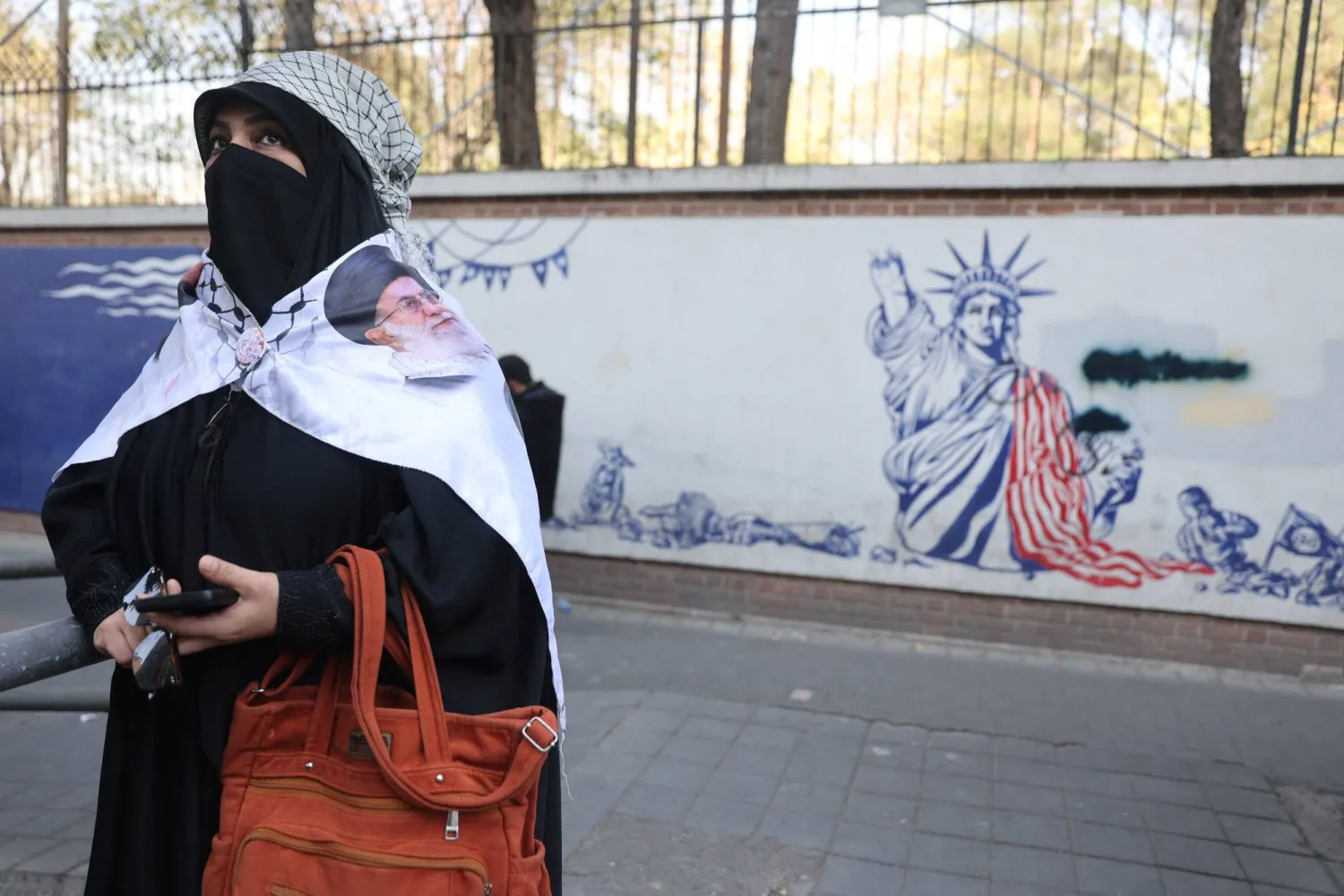
A woman stands next to an anti-US mural during the 46th anniversary of the US expulsion from Iran, in Tehran, November 4, 2025. Majid Asgaripour/WANA (West Asia News Agency) via REUTERS
TT

Tehran: Recognizing Our Rights is Only Solution to Nuclear Program

A woman stands next to an anti-US mural during the 46th anniversary of the US expulsion from Iran, in Tehran, November 4, 2025. Majid Asgaripour/WANA (West Asia News Agency) via REUTERS

Iranian Foreign Ministry spokesperson Esmail Baghaei said on Monday the only solution to preventing Iran's nuclear program from being treated as a problem lies in recognizing Iran's rights under the Non-Proliferation Treaty (NPT).

In his weekly press conference, Baghaei said as a signatory to the treaty, Iran has fulfilled its commitments and is determined to exercise its rights.

The Iranian spokesperson was asked about the US administration's contradictory policy, which is a mix of diplomacy and threats.

“This contradiction cannot be justified; it has no rational logic. It only confirms that the nuclear file was for the US a pretext to exert pressure on the Iranian people,” he said.

Baghaei noted that “all of Iran's nuclear facilities - such as Natanz, Fordow and Isfahan - have always been under IAEA supervision and inspections.”

He said the recent inspection disruption resulted from “military aggression and criminal actions by the US and the Zionist regime,” criticizing the IAEA Board of Governors and the UN Security Council for failing to acknowledge or condemn the attacks.

The spokesperson said the IAEA cannot ask to inspect facilities damaged by military attacks, and subject to radiation risks and leaks of radioactive material, noting that the Agency has no inspection protocol for such situations.

He added that Iran reached an understanding with the IAEA last September after three rounds of talks, but “the other side undermined the process.”

Responding to comments from a senior US Defense Department official warning that unilateral US actions risk collapsing the global non-proliferation regime, Baghaei said the statement reflected reality.

“The United States itself poses the greatest challenge to preserving the non-proliferation system due to its double-standard policies,” he said.

Concerning Iran’s nuclear talks with the UK, France, and Germany, Baghaei noted that several cases show that the European trio, under US pressure, reneged on its commitments under the nuclear agreement and took actions that were not at all supportive of the continuation of the negotiations.

“Repeating the phrase ‘We are ready to negotiate’, does not change the fact that the other side is not actually ready for talks,” he said.



IAEA: Status of Iran’s Nuclear Program Is Unclear

IAEA Director General Rafael Grossi (AP) 
TT

IAEA: Status of Iran’s Nuclear Program Is Unclear

IAEA Director General Rafael Grossi (AP) 

The status of a key part of Iran's nuclear program remains unknown while international inspectors have yet to gain access to nuclear facilities, the International Atomic Energy Agency reported on Tuesday, as the country’s six-month conflict with the United States shows no signs of resolution.

IAEA monitors cannot verify the location or status of Iran’s stockpile of near-bomb grade uranium, according to the 11-page restricted report that was sent to member states and cited by Bloomberg and Reuters.

“The agency’s lack of information about this nuclear material and access to facilities to verify it is a matter of proliferation concern,” IAEA Director General Rafael Grossi wrote in the report.

He added that Iran needs to allow inspectors back in “with the utmost urgency.”

The IAEA report on Iran followed Grossi's visit to Washington. It also came as the US launched a new wave of strikes against targets in Iran, increasing tensions as both countries compete for control of the Strait of Hormuz waterway.

Grossi repeated his demands for Iran to allow inspectors to resume their work and called for a negotiated resolution to the US-Iran conflict.

Stockpiles Cannot Be Verified

The report on Iran showed there had again been no progress. Inspectors have yet to return to nuclear sites the United States and Israel bombed in June 2025.

Until those attacks, the IAEA estimates Iran had 440.9 kg of uranium enriched to up to 60% purity, a short step from the roughly 90% of weapons-grade uranium. That is enough material, if enriched further, for 10 nuclear weapons, according to an IAEA yardstick, and Iran also had material enriched to lower levels.

Before the June 2025 strikes, the IAEA reported that Iran held approximately 8,599.6 kilograms of low-enriched uranium alongside over 440 kilograms of highly enriched uranium, according to Bloomberg.

How much of that remains is unclear.

“It is more than a year since the Agency lost continuity of knowledge in relation to the previously declared inventories of LEU (low-enriched uranium) and HEU (highly enriched ⁠uranium) enriched up to 60% U-235 at the declared nuclear facilities affected by the attacks of June 2025,” the report said.

“The Agency's lack of information about this nuclear material and access to facilities to verify it is a matter of proliferation concern ... and needs to be addressed with the utmost urgency,” it added.

IAEA inspections of Iran dropped by more than half last year after the country imposed new restrictions following a 12-day conflict in which Israel and the US attacked its nuclear sites.

Inspectors will be allowed to visit Iran's Bushehr nuclear power plant in mid-September, the IAEA reported.

A War that Disrupted the Nuclear Path

Uncertainty around Iran’s nuclear program has exasperated with the war that began on February 28, when the United States and Israel launched attacks on Iran.

Since then, Washington and Tehran witnessed several months of fighting and attempts to negotiate, before reaching a tentative understanding in June. The accord was supposed to allow the agency access to Iran’s nuclear sites and begin a new set of talks on Iran’s nuclear program, but that agreement quickly collapsed.

US President Donald Trump insists that military action is necessary to ensure Iran never acquires a nuclear weapon.

Iran has always denied seeking a nuclear weapon but has never satisfactorily explained to the agency why it has enriched uranium to 60%.

The IAEA report comes before a meeting next week of the agency’s board of governors in Vienna to consider a new resolution censuring Iran.


Trump Floats Renaming Strait of Hormuz as 'Trump Strait'

President Donald Trump walks from Marine One to board Air Force One at Cleveland Hopkins International Airport in Cleveland, Tuesday, Aug. 11, 2026. (AP Photo/Mark Schiefelbein)
TT

Trump Floats Renaming Strait of Hormuz as 'Trump Strait'

President Donald Trump walks from Marine One to board Air Force One at Cleveland Hopkins International Airport in Cleveland, Tuesday, Aug. 11, 2026. (AP Photo/Mark Schiefelbein)

US President Donald Trump on Wednesday suggested renaming the Strait of Hormuz as "Trump Strait" despite ongoing clashes with Iran -- then hours later implied he wasn't serious.

Trump has made a series of geographical name changes to international bodies of water in his second term, at least partly with the aim of trolling other countries.

The latest suggestion came as Trump insisted the US had full control of the crucial waterway, even as fresh clashes raged there with Iran, said AFP.

"Now that we have it under U.S.A. control, should we change the name Hormuz Strait to TRUMP STRAIT??? Like America itself, it would be 'hotter' than ever before!" Trump said on his Truth Social network.

The White House later posted a map of the Gulf on social media with his suggested name, adding: "It's got a nice ring to it."

Trump has in recent weeks repeatedly threatened to claim sovereignty over the Strait of Hormuz, even posting a map showing the waterway as a "new US territory."

Trump, however, later played down the idea of rebranding the Strait of Hormuz.

"It was just thrown out there," Trump said with a chuckle after an AFP reporter asked him in the Oval Office if he was serious about renaming it.

But a number of the 80-year-old Republican's previous suggestions have been dismissed as being humorous before they ended up happening for real.

Last week Trump signed an order renaming Lake Ontario as "Lake America" amid a trade war with neighboring Canada, just days after apparently raising the idea in jest.

- Iran war grinds on -

Trump also renamed the Gulf of Mexico as the "Gulf of America" on his first day back in the White House in January 2025. Neither Mexico nor Canada have accepted the changes.

He has also gone on a spree of renaming things after himself, including the Kennedy arts center in Washington, while the US Treasury meanwhile on Wednesday issued $1 coins featuring Trump's face to mark the 250th anniversary of US independence.

The Iran war remains a deadly serious issue, with no sign of ending more than six months after the initial US-Israeli assault.

Fighting has flared again after weeks of calm, with US forces launching fresh strikes near the Strait of Hormuz on Tuesday in response to what Trump said were new minelaying efforts by Iran.

Iran said one of the US strikes killed four people at a wedding, branding it a "war crime", and launched a wave of retaliatory strikes at US bases in Jordan, Kuwait, Bahrain and Iraq.

At home, Trump has presided over a steep rise in US fuel costs as a result of the war and his Republican Party looks likely to lose at least partial control of Congress in the November midterm elections.

Iran has effectively shut down the choke point, through which a fifth of the world's oil passes, in retaliation for the war Trump started along with Israel in late February.

Trump said on Wednesday that the United States was ready to attack Iran again -- while adding that the renewed campaign would not last "too long."

"It was a very heavy attack last night, and we're prepared to do another one any time we want," Trump told reporters in the Oval Office.


US Treasury Issues $1 Coin with Trump’s Face on It

The US Mint has started producing a new $1 coin featuring President Donald Trump's image. (AP Graphic/Treasury Department, File)
TT

US Treasury Issues $1 Coin with Trump’s Face on It

The US Mint has started producing a new $1 coin featuring President Donald Trump's image. (AP Graphic/Treasury Department, File)

The US Treasury on Wednesday issued $1 coins featuring the face of President Donald Trump, the latest move in an unprecedented campaign by the Republican billionaire to put his personal stamp on national institutions.

The coins were minted to mark the 250th anniversary of the founding of the United States celebrated this year.

A roll of 25 $1 coins was available for sale for $61 -- a mark-up of 144 percent -- with a 100-coin bag available for $154.50.

When the Treasury announced the plan it was unclear if the coins would have monetary value or would be purely commemorative, but on Wednesday the US Mint said the coins were "also in circulation."

The move to put Trump's countenance on a coin with monetary value runs counter to federal law that says no living president may appear on US currency.

Trump has aggressively defied precedent and legal challenges in his push to remake US institutions in his second term, putting his name on the Kennedy Center for the Arts and demolishing the East Wing of the White House to make room for a new ballroom, among other moves.

The new coin features Trump's face on one side, with the words "Liberty" and "In God We Trust." It also features the dates 1776-2026, marking 250 years of US independence.

The other side of the coin features a version of the US presidential seal, depicting an eagle clutching arrows and an olive branch while covered by a shield that says "250."

This is just the latest in Trump's campaign to put his face and name on US currency.

In May, Treasury Secretary Scott Bessent said his department was pursuing a plan to issue a new $250 bill with Trump's face on it.

He conceded that the move would require Congress to change the law barring living persons from appearing on currency.

The US Treasury did not immediately respond to a request for comment on whether the new $1 coin violates that law.

In March, the Treasury announced that US paper money would soon bear Trump's signature -- another first for a sitting US president.