

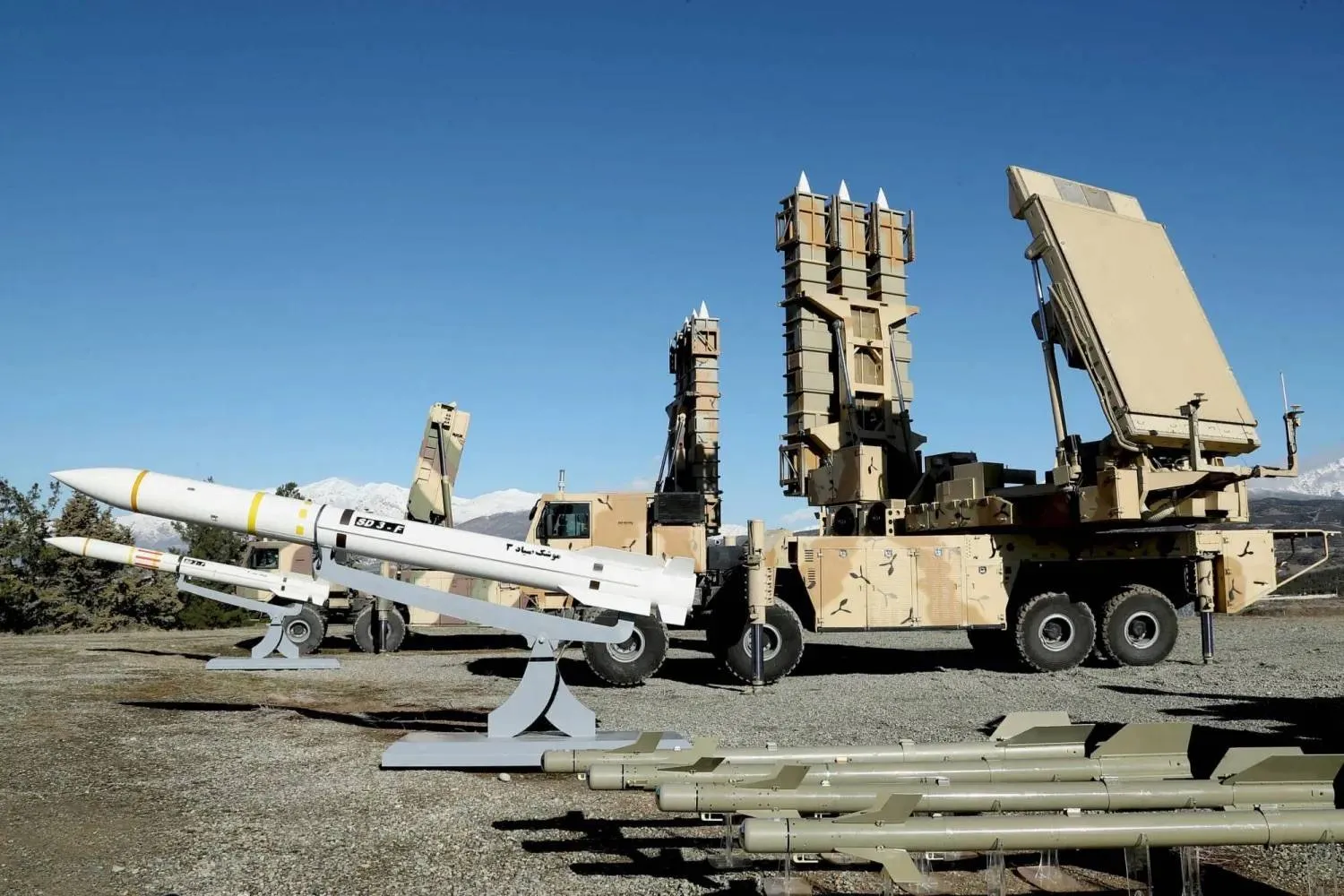

Conflicting Signals Emerge over Iran’s Efforts to Restore Defensive Capabilities  

Iran’s Ministry of Defense showcases the long-range Arman air-defense system at a ceremony in Tehran last February. (Reuters)
TT

Conflicting Signals Emerge over Iran’s Efforts to Restore Defensive Capabilities  

Iran’s Ministry of Defense showcases the long-range Arman air-defense system at a ceremony in Tehran last February. (Reuters)

Conflicting messages are coming out of Iran regarding the restoration of its defensive capacity along the country’s western frontier, where military infrastructure suffered extensive damage during the 12-day war with Israel.

While Tehran has announced large-scale defensive and ground maneuvers in the northwest and conducted live tests of air-defense systems in the south, it has simultaneously denied any offensive missile activity near the border with Iraq’s Kurdistan Region.

In the coastal district of Mahshahr in the southwest, the Iranian Revolutionary Guard Corps’ (IRGC) 3rd Naval Zone confirmed the start of air-defense tests running through Dec. 12, noting that any explosions heard by residents would be related to the drills.

Authorities urged locals to ignore rumors and refrain from sharing images or videos, a message intended to prevent panic in an area previously targeted by Israeli strikes during the recent conflict.

The IRGC statement emphasized that “the forces of the 3rd Naval Zone are ready to sacrifice their lives,” reflecting an effort to restore public confidence after domestic criticism of Iran’s air-defenses during the war.

Missile activity denied

At the same time, Iranian officials denied reports that ballistic missiles had been launched from Ilam or Kermanshah toward the Iraqi Kurdistan Region.

Local media and social media accounts had circulated claims that the IRGC had carried out a missile strike on Kurdish groups. Those reports followed a drone attack on the Khor Mor gas field - an essential energy facility - that caused power outages across Kurdistan.

Observers say the swift denial demonstrates Tehran’s desire to avoid opening a new front as it works to rebuild its defenses amid rising regional tensions with Israel, even as it sends signals that it is restoring its defense capabilities.

Sahand 2025 exercises

Separately, Iran announced that East Azerbaijan Province in the northwest will host Sahand 2025, counterterrorism exercises involving 18 delegations from member states of the Shanghai Cooperation Organization (SCO).

Iranian officials describe the drills as part of a push to shape a “new regional security architecture,” though they have yet to reveal which countries confirmed participation.

In a parliamentary address, Speaker Mohammad Bagher Ghalibaf said Iran’s defense cooperation with other states “continues to progress,” adding that the Sahand exercises send “an important message to domineering powers” that independent nations possess “the serious will to defend themselves.”

The statements are seen as an attempt to portray Iran as a state capable of forging eastern defense partnerships in the face of what Tehran calls “Western pressure” since the war.

It remains unclear whether Iran has genuinely restored its defensive capacity, particularly along the western border, which saw repeated Israeli attacks. Many analysts view Tehran’s activities as part of a broader psychological confrontation with Israel.

On the Israeli side, officials have issued increasingly stark assessments. Director General of the Israeli Defense Ministry Amir Baram said Iran is rapidly expanding its defensive and missile capabilities, warning that “all fronts remain open.”

He linked the rapid deployment of the Iron Beam laser system in October 2024 to a Hezbollah drone attack that killed several Golani Brigade soldiers.

Baram positioned Israel as a “defense-technology nation,” citing advances in the Arrow-4 and Arrow-5 systems, 21 government-to-government defense agreements signed in 2024 alone, and more than one billion shekels invested in defense startups during the war.

Israeli media assessments suggest both countries may be heading toward a wider confrontation than the 12-day conflict. Reports, citing Israeli officials, say the government may seek a strategic objective of “forcing the Iranian regime to respond or collapse” before the end of US President Donald Trump’s term.

Other Israeli reports warn that Iran could soon be capable of producing more than 2,000 missiles for simultaneous launch, a scenario Israel views as a potential threat to its defensive capacity.



Passenger Bus Crash in Indonesia Kills at Least 16 People, Official Says 

A handout photo made available by the Indonesian National Search and Rescue Agency (BASARNAS) shows rescuers carrying a survivor from the wreckage of a crashed bus in Semarang, Central Java, Indonesia, 22 December 2025. (EPA/BASARNAS/Handout)
TT

Passenger Bus Crash in Indonesia Kills at Least 16 People, Official Says 

A handout photo made available by the Indonesian National Search and Rescue Agency (BASARNAS) shows rescuers carrying a survivor from the wreckage of a crashed bus in Semarang, Central Java, Indonesia, 22 December 2025. (EPA/BASARNAS/Handout)

A passenger bus crash killed at least 16 people on Indonesia’s main island of Java just after midnight Monday, officials said.

The bus carrying 34 people lost control on a toll road and struck a concrete barrier before rolling onto its side, said Budiono, a search and rescue agency chief who goes by single name like many Indonesians.

The inter-province bus was traveling from the capital Jakarta to the country’s ancient royal city of Yogyakarta when it overturned while entering a curved exit ramp at the Krapyak toll way in Central Java's Semarang city, he said.

“The forceful impact threw several passengers and left them trapped against the bus body,” Budiono said.

Police and rescue teams arrived about 40 minutes after the accident and recovered the bodies of six passengers who died at the scene. Another 10 people died on the way to a hospital or while being treated, Budiono said.

The 18 victims being treated at two nearby hospitals included five people in critical condition and 13 in serious condition, he said.

Television news reports showed the yellow bus overturned on its side and surrounded by National Search and Rescue Agency personnel, police and passersby as ambulances transported victims and the dead away from the accident scene.

Witnesses told authorities the bus was traveling at high speed before the driver lost control, Central Java Police Chief Ribut Hari Wibowo said at Dr. Karyadi General Hospital in Semarang where the bodies were being identified.

The driver was a substitute who sustained serious injuries but was able to communicate while under medical care, he said.


Trump Set to Expand Immigration Crackdown in 2026 despite Brewing Backlash

A woman holds a poster as immigrants rights activists stage a traditional Mexican posada, reenacting Mary and Joseph’s search for shelter, to symbolize immigrants seeking refuge from Immigration and Customs Enforcement (ICE) agents during the ongoing immigration operation "Catahoula Crunch", in New Orleans, Louisiana, US, December 18, 2025. REUTERS/Seth Herald
TT

Trump Set to Expand Immigration Crackdown in 2026 despite Brewing Backlash

A woman holds a poster as immigrants rights activists stage a traditional Mexican posada, reenacting Mary and Joseph’s search for shelter, to symbolize immigrants seeking refuge from Immigration and Customs Enforcement (ICE) agents during the ongoing immigration operation "Catahoula Crunch", in New Orleans, Louisiana, US, December 18, 2025. REUTERS/Seth Herald

US President Donald Trump is preparing for a more aggressive immigration crackdown in 2026 with billions in new funding, including by raiding more workplaces — even as backlash builds ahead of next year’s midterm elections.

Trump has already surged immigration agents into major US cities, where they swept through neighborhoods and clashed with residents. While federal agents this year conducted some high-profile raids on businesses, they largely avoided raiding farms, factories and other businesses that are economically important but known to employ immigrants without legal status.

ICE and Border Patrol will get $170 billion in additional funds through September 2029 - a huge surge of funding over their existing annual budgets of about $19 billion after the Republican-controlled Congress passed a massive spending package in July.

Administration officials say they plan to hire thousands more agents, open new detention centers, pick up more immigrants in local jails and partner with outside companies to track down people without legal status, Reuters reported.

The expanded deportation plans come despite growing signs of political backlash ahead of next year’s midterm elections.

Miami, one of the cities most affected by Trump’s crackdown because of its large immigrant population, elected its first Democratic mayor in nearly three decades last week in what the mayor-elect said was, in part, a reaction to the president.

Other local elections and polling ‌have suggested rising concern among ‌voters wary of aggressive immigration tactics. "People are beginning to see this not as an immigration question anymore ‌as ⁠much as it ‌is a violation of rights, a violation of due process and militarizing neighborhoods extraconstitutionally," said Mike Madrid, a moderate Republican political strategist.

"There is no question that is a problem for the president and Republicans." Trump’s overall approval rating on immigration policy fell from 50% in March, before he launched crackdowns in several major US cities, to 41% in mid-December, for what had been his strongest issue.

Rising public unease has focused on masked federal agents using aggressive tactics such as deploying tear gas in residential neighborhoods and detaining US citizens.

'NUMBERS WILL EXPLODE'

In addition to expanding enforcement actions, Trump has stripped hundreds of thousands of Haitian, Venezuelan and Afghan immigrants of temporary legal status, expanding the pool of people who could be deported as the president promises to remove 1 million immigrants each year – a goal he almost certainly will miss this year. So far, some 622,000 immigrants ⁠have been deported since Trump took office in January.

White House border czar Tom Homan told Reuters Trump had delivered on his promise of a historic deportation operation and removing criminals while shutting down illegal immigration across ‌the US-Mexico border. Homan said the number of arrests will increase sharply as ICE hires more ‍officers and expands detention capacity with the new funding.

“I think you're going to ‍see the numbers explode greatly next year,” Homan said.

Homan said the plans “absolutely” include more enforcement actions at workplaces.

Sarah Pierce, director of social policy at the ‍center-left group Third Way, said US businesses have been reluctant to push back on Trump's immigration crackdown in the past year but could be prompted to speak up if the focus turns to employers.

Pierce said it will be interesting to see "whether or not businesses finally stand up to this administration."

Trump, a Republican, recaptured the White House promising record levels of deportations, saying it was needed after years of high levels of illegal immigration under his Democratic predecessor, Joe Biden. He kicked off a campaign that dispatched federal agents to US cities in search of possible immigration offenders, sparking protests and lawsuits over racial profiling and violent tactics.

Some businesses shut down to avoid raids or because of a lack of customers. Parents vulnerable to arrest kept their children home from school or had neighbors ⁠walk them. Some US citizens started carrying passports. Despite the focus on criminals in its public statements, government data shows that the Trump administration has been arresting more people who have not been charged with any crimes beyond their alleged immigration violations than previous administrations.

Some 41% of the roughly 54,000 people arrested by ICE and detained by late November had no criminal record beyond a suspected immigration violation, agency figures show.

In the first few weeks in January, before Trump took office, just 6% of those arrested and detained by ICE were not facing charges for other crimes or previously convicted.

The Trump administration has taken aim at legal immigrants as well. Agents have arrested spouses of US citizens at their green card interviews, pulled people from certain countries out of their naturalization ceremonies, moments before they were to become citizens, and revoked thousands of student visas.

PLANS TO TARGET EMPLOYERS

The administration’s planned focus on job sites in the coming year could generate many more arrests and affect the US economy and Republican-leaning business owners.

Replacing immigrants arrested during workplace raids could lead to higher labor costs, undermining Trump’s fight against inflation, which analysts expect to be a major issue in the closely watched November elections, determining control of Congress. Administration officials earlier this year exempted such businesses from enforcement on Trump’s orders, then quickly reversed, Reuters reported at the time.

Some immigration hardliners have ‌called for more workplace enforcement.

"Eventually you’re going to have to go after these employers,” said Jessica Vaughan, policy director for the Center for Immigration Studies, which backs lower levels of immigration. “When that starts happening the employers will start cleaning up their acts on their own.”


At Least 16 Files Have Disappeared from the DOJ Webpage for Documents Related to Jeffrey Epstein

Ghislaine Maxwell and Jeffrey Epstein are seen in this image released by the Department of Justice in Washington, D.C., US, on December 19, 2025 as part of a new trove of documents from its investigations into the late financier and convicted sex offender Jeffrey Epstein. US Justice Department/Handout via REUTERS
TT

At Least 16 Files Have Disappeared from the DOJ Webpage for Documents Related to Jeffrey Epstein

Ghislaine Maxwell and Jeffrey Epstein are seen in this image released by the Department of Justice in Washington, D.C., US, on December 19, 2025 as part of a new trove of documents from its investigations into the late financier and convicted sex offender Jeffrey Epstein. US Justice Department/Handout via REUTERS

At least 16 files disappeared from the Justice Department’s public webpage for documents related to Jeffrey Epstein — including a photograph showing President Donald Trump — less than a day after they were posted, with no explanation from the government and no notice to the public.

The missing files, which were available Friday and no longer accessible by Saturday, included images of paintings depicting nude women, and one showing a series of photographs along a credenza and in drawers. In that image, inside a drawer among other photos, was a photograph of Trump, alongside Epstein, Melania Trump and Epstein's longtime associate Ghislaine Maxwell.

The Justice Department did not say why the files were removed or whether their disappearance was intentional. A spokesperson for the department did not immediately respond to a request for comment.

Online, the unexplained missing files fueled speculation about what was taken down and why the public was not notified, compounding long-standing intrigue about Epstein and the powerful figures who surrounded him. Democrats on the House Oversight Committee pointed to the missing image featuring a Trump photo in a post on X, writing: “What else is being covered up? We need transparency for the American public.”

The episode deepened concerns that had already emerged from the Justice Department’s much-anticipated document release. The tens of thousands of pages made public offered little new insight into Epstein’s crimes or the prosecutorial decisions that allowed him to avoid serious federal charges for years, while omitting some of the most closely watched materials, including FBI interviews with victims and internal Justice Department memos on charging decisions.

Scant new insight in the initial disclosures

Some of the most consequential records expected about Epstein are nowhere to be found in the Justice Department's initial disclosures, which span tens of thousands of pages.

Missing are FBI interviews with survivors and internal Justice Department memos examining charging decisions — records that could have helped explain how investigators viewed the case and why Epstein was allowed in 2008 to plead guilty to a relatively minor state-level prostitution charge.

The gaps go further.

The records, required to be released under a recent law passed by Congress, hardly reference several powerful figures long associated with Epstein, including Britain’s former Prince Andrew, renewing questions about who was scrutinized, who was not, and how much the disclosures truly advance public accountability

Among the fresh nuggets: insight into the Justice Department’s decision to abandon an investigation into Epstein in the 2000s, which enabled him to plead guilty to that state-level charge, and a previously unseen 1996 complaint accusing Epstein of stealing photographs of children.

The releases so far have been heavy on images of Epstein’s homes in New York City and the US Virgin Islands, with some photos of celebrities and politicians.

There was a series of never-before-seen photos of former President Bill Clinton but fleetingly few of Trump. Both have been associated with Epstein, but both have since disowned those friendships. Neither has been accused of any wrongdoing in connection with Epstein and there was no indication the photos played a role in the criminal cases brought against him.

Despite a Friday deadline set by Congress to make everything public, the Justice Department said it plans to release records on a rolling basis. It blamed the delay on the time-consuming process of obscuring survivors' names and other identifying information. The department has not given any notice when more records might arrive.

That approach angered some Epstein accusers and members of Congress who fought to pass the law forced the department to act. Instead of marking the end of a yearslong battle for transparency, the document release Friday was merely the beginning of an indefinite wait for a complete picture of Epstein’s crimes and the steps taken to investigate them.

“I feel like again the DOJ, the justice system is failing us,” said Marina Lacerda, who alleges Epstein started sexually abusing her at his New York City mansion when she was 14.

Many of the long-anticipated records were redacted or lacked context Federal prosecutors in New York brought sex trafficking charges against Epstein in 2019, but he killed himself in jail after his arrest.

The documents just made public were a sliver of potentially millions of pages records in the department’s possession. In one example, Deputy Attorney General Todd Blanche said Manhattan federal prosecutors had more than 3.6 million records from sex trafficking investigations into Epstein and Maxwell, though many duplicated material already turned over by the FBI.

Many of the records released so far had been made public in court filings, congressional releases or freedom of information requests, though, for the first time, they were all in one place and available for the public to search for free.

Ones that were new were often lacking necessary context or heavily blacked out. A 119-page document marked “Grand Jury-NY," likely from one of the federal sex trafficking investigations that led to the charges against Epstein in 2019 or Maxwell in 2021, was entirely blacked out.

Trump’s Republican allies seized on the Clinton images, including photos of the Democrat with singers Michael Jackson and Diana Ross. There were also photos of Epstein with actors Chris Tucker and Kevin Spacey, and even Epstein with TV newscaster Walter Cronkite. But none of the photos had captions and was no explanation given for why any of them were together.

The meatiest records released so far showed that federal prosecutors had what appeared to be a strong case against Epstein in 2007 yet never charged him.

Transcripts of grand jury proceedings, released publicly for the first time, included testimony from FBI agents who described interviews they had with several girls and young women who described being paid to perform sex acts for Epstein. The youngest was 14 and in ninth grade.

One had told investigators about being sexually assaulted by Epstein when she initially resisted his advances during a massage.

Another, then 21, testified before the grand jury about how Epstein had hired her when she was 16 to perform a sexual massage and how she had gone on to recruit other girls to do the same.

“For every girl that I brought to the table he would give me $200,” she said. They were mostly people she knew from high school, she said. “I also told them that if they are under age, just lie about it and tell him that you are 18.”

The documents also contain a transcript of an interview Justice Department lawyers did more than a decade later with the US attorney who oversaw the case, Alexander Acosta, about his ultimate decision not to bring federal charges.

Acosta, who was labor secretary during Trump’s first term, cited concerns about whether a jury would believe Epstein’s accusers.

He also said the Justice Department might have been more reluctant to make a federal prosecution out of a case that straddled the legal border between sex trafficking and soliciting prostitution, something more commonly handled by state prosecutors.

“I’m not saying it was the right view,” Acosta added. He also said that the public today would likely view the survivors differently.

“There’s been a lot of changes in victim shaming,” Acosta said.