


US Slaps Sanctions on Maduro Relatives as Venezuela War Fears Build

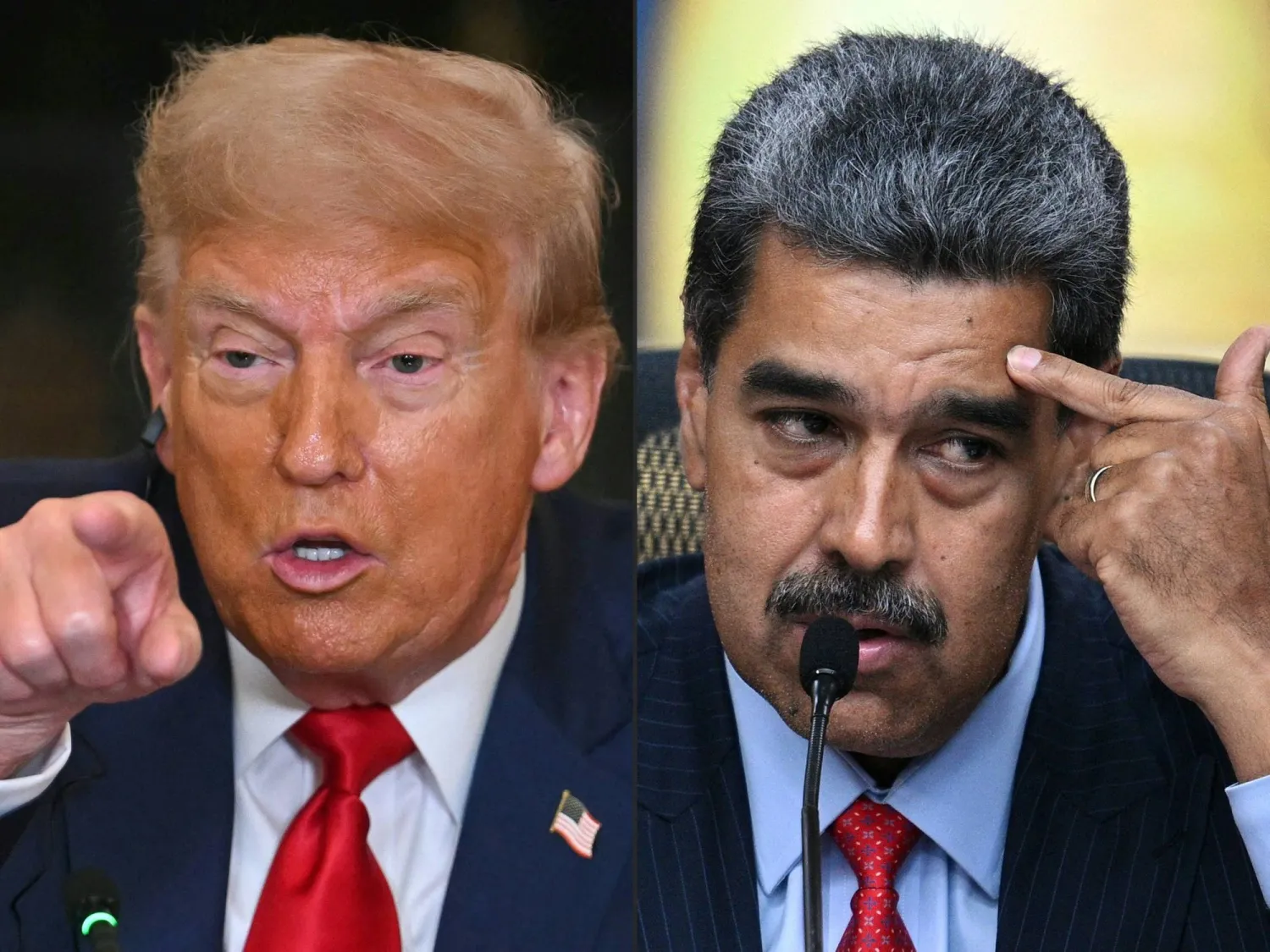
(COMBO) This combination of pictures created on August 7, 2025 shows US President Donald Trump (L) in Washington, DC, on July 9, 2025, and Venezuelan President Nicolas Maduro (R) in Caracas on July 31, 2024.  (Photo by Jim WATSON and Federico PARRA / AFP)
(COMBO) This combination of pictures created on August 7, 2025 shows US President Donald Trump (L) in Washington, DC, on July 9, 2025, and Venezuelan President Nicolas Maduro (R) in Caracas on July 31, 2024. (Photo by Jim WATSON and Federico PARRA / AFP)
TT

US Slaps Sanctions on Maduro Relatives as Venezuela War Fears Build

(COMBO) This combination of pictures created on August 7, 2025 shows US President Donald Trump (L) in Washington, DC, on July 9, 2025, and Venezuelan President Nicolas Maduro (R) in Caracas on July 31, 2024.  (Photo by Jim WATSON and Federico PARRA / AFP)
(COMBO) This combination of pictures created on August 7, 2025 shows US President Donald Trump (L) in Washington, DC, on July 9, 2025, and Venezuelan President Nicolas Maduro (R) in Caracas on July 31, 2024. (Photo by Jim WATSON and Federico PARRA / AFP)

The US Treasury imposed new sanctions Thursday against three of Venezuelan leader Nicolas Maduro's relatives as well as six companies shipping the South American country's oil.

The move came as the White House said it will bring an oil tanker seized by American forces off the Venezuelan coast to a port in the United States, adding to growing fears of open conflict between the two countries, reported AFP6.

Washington took control of the tanker in a dramatic raid that saw US forces rope down from a helicopter onto the vessel in an operation that Homeland Security Secretary Kristi Noem said was aimed at Maduro's "regime."

Treasury officials said three nephews of Maduro's wife, Cilia Flores, were being slapped with sanctions, labeling two of the men "narco-traffickers operating in Venezuela."

"Nicolas Maduro and his criminal associates in Venezuela are flooding the United States with drugs that are poisoning the American people," Treasury Secretary Scott Bessent said in a statement.

President Donald Trump's administration has been piling pressure on Venezuela for months with a major naval buildup in the region that has been accompanied by strikes on alleged drug-trafficking boats that have killed close to 90 people.

Russian leader Vladimir Putin on Thursday expressed support during a phone call with his ally Maduro, but with Moscow's forces tied down in a grinding war in Ukraine, its capacity to provide aid is limited.

"The vessel will go to a US port and the United States does intend to seize the oil," White House Press Secretary Karoline Leavitt told journalists of the tanker.

"We're not going to stand by and watch sanctioned vessels sail the seas with black-market oil, the proceeds of which will fuel narco-terrorism of rogue and illegitimate regimes around the world."

Earlier on Thursday, Noem told a congressional hearing that the tanker operation was "pushing back on a regime that is systematically covering and flooding our country with deadly drugs" -- a reference to US allegations of narcotics smuggling by Maduro's government.

A video released Wednesday by US Attorney General Pam Bondi showed American forces descending from a helicopter onto the tanker's deck, then entering the ship's bridge with weapons raised.

Bondi said the ship was part of an "illicit oil shipping network" that was used to carry sanctioned oil.

- 'Blatant theft' -

Venezuela's foreign ministry said it "strongly denounces and condemns what constitutes blatant theft and an act of international piracy."

"They kidnapped the crew, stole the ship and have inaugurated a new era, the era of criminal naval piracy in the Caribbean," Maduro said at a presidential event on Thursday, adding: "Venezuela will secure all ships to guarantee the free trade of its oil around the world."

UN Secretary-General Antonio Guterres on Thursday expressed concern over the escalating tensions and urged restraint.

"We are calling on all actors to refrain from action that could further escalate bilateral tensions and destabilize Venezuela and the region," his spokesperson said.

US media reported that the tanker had been heading for Cuba -- another American rival -- and that the ship was stopped by the US Coast Guard.

Dick Durbin, the top Democrat on the Senate Judiciary Committee, said Thursday he questioned the legality of the tanker seizure and that "any president, before he engages in an act of war, has to have the authorization of the American people through Congress."

"This president is preparing for an invasion of Venezuela, simply said. And if the American people are in favor of that, I'd be surprised," Durbin told CNN.

Washington has accused Maduro of leading the alleged "Cartel of the Suns," which it declared a "narco-terrorist" organization last month, and has offered a $50 million reward for information leading to his capture.

Trump told Politico on Monday that Maduro's "days are numbered" and declined to rule out a US ground invasion of Venezuela.

The Trump administration alleges that Maduro's hold on power is illegitimate and that he stole Venezuela's July 2024 election.

Maduro -- the political heir to leftist leader Hugo Chavez -- says the United States is bent on regime change and wants to seize Venezuela's oil reserves.



Trump Tells Fox News It's Possible He Would Talk with Iran

US President Donald Trump delivers remarks to members of the Republican Party, at Trump National Doral Miami in Miami, Florida, US, March 9, 2026. REUTERS/Kevin Lamarque
TT

Trump Tells Fox News It's Possible He Would Talk with Iran

US President Donald Trump delivers remarks to members of the Republican Party, at Trump National Doral Miami in Miami, Florida, US, March 9, 2026. REUTERS/Kevin Lamarque

US President Donald Trump told Fox News that it's possible he would be willing to talk with Iran but that it depends on the terms, the ‌cable news network ‌said on Tuesday.

Asked ‌in ⁠an interview on ⁠Monday evening about the possibility of negotiations with Tehran, Trump told Fox he heard Tehran wanted to talk badly, ⁠according to the news ‌network.

The ‌Republican president also reiterated ‌his unhappiness with Iran's new ‌Supreme Leader Mojtaba Khamenei, telling Fox: "I don’t believe he can live in peace."

Trump also ‌echoed his comments at a press conference ⁠earlier on ⁠Monday, telling Fox the results of the US military operation in Iran were "way beyond expectation." Trump added that he was surprised that Iran was striking Gulf countries with missiles and drones, according to the network.


Iran Launches New Attacks Targeting Israel as It Seeks to Ramp up Pressure on US

 10 March 2026, Iran, Tehran: Members of the Iranian Red Crescent Society (IRCS) rescue teams work at the site of a building damaged in a US-Israeli airstrike in Resalat Square. (dpa)
10 March 2026, Iran, Tehran: Members of the Iranian Red Crescent Society (IRCS) rescue teams work at the site of a building damaged in a US-Israeli airstrike in Resalat Square. (dpa)
TT

Iran Launches New Attacks Targeting Israel as It Seeks to Ramp up Pressure on US

 10 March 2026, Iran, Tehran: Members of the Iranian Red Crescent Society (IRCS) rescue teams work at the site of a building damaged in a US-Israeli airstrike in Resalat Square. (dpa)
10 March 2026, Iran, Tehran: Members of the Iranian Red Crescent Society (IRCS) rescue teams work at the site of a building damaged in a US-Israeli airstrike in Resalat Square. (dpa)

Iran launched new attacks on Tuesday at Israel and Gulf Arab countries as it kept up pressure on the Middle East in a war started by Israel and the United States that has sent oil prices surging and stunned global economies.

Sirens warned of incoming missiles in the futuristic business hub of Dubai, and in Bahrain, authorities said an Iranian attack hit a residential building in the capital, killing a 29-year-old woman and wounding eight others. Saudi Arabia said it destroyed two drones over the Eastern Region and Kuwait's National Guard said it shot down six drones.

Later in the morning, sirens also sounded in Jerusalem, and sounds of explosions could be heard in Tel Aviv as Israel's defense systems worked to intercept incoming fire, not long after the military said it detected an Iranian missile launch.

“We are definitely not looking for a ceasefire,” Iran's parliament speaker, Mohammad Bagher Qalibaf, wrote on X. “We believe that the aggressor should be punched in the mouth so that he learns a lesson so that he will never think of attacking our beloved Iran again.”

Another top Iranian security official, Ali Larijani, appeared to threaten US President Donald Trump himself, writing on X that “Iran doesn’t fear your empty threats. Even those bigger than you couldn’t eliminate Iran. Be careful not to get eliminated yourself.” Iran has been accused of plotting attempts to kill Trump in the past.

Witnesses reported hearing several explosions in Tehran in the afternoon as Israel commenced a new wave of airstrikes.

Attacks aimed at pressuring the US

Along with firing missiles and drones at Israel and at American bases in the region, Iran has also been targeting energy infrastructure and traffic through the Strait of Hormuz, a vital waterway for traded oil, sending oil prices soaring. The attacks appear aimed at generating enough global economic pain to pressure the US and Israel to end their strikes.

Brent crude, the international standard, spiked to nearly $120 on Monday before falling back but was still at around $90 a barrel on Tuesday, nearly 24% higher than when the war started on Feb. 28.

Trump, who has previously said that the war could last for a month or longer, sought to downplay growing fears that it could take even longer, saying it was “going to be a short-term excursion.”

Still, Israeli Prime Minister Benjamin Netanyahu vowed the strikes on Iran would continue.

“Our aim is to bring the Iranian people to cast off the yoke of tyranny, (but) ultimately it depends on them,” Netanyahu said during a meeting with Israel’s hospital and health system leaders. “There is no doubt that with the actions taken so far, we are breaking their bones.”

Oil is rerouted

Iran has effectively stopped tankers from using the Strait of Hormuz, which connects the Gulf and the Gulf of Oman — the gateway to the Indian Ocean — through which 20% of the world's oil is carried. Attacks on merchant ships near the strait have killed at least seven sailors, according to the International Maritime Organization.

A bulk carrier likely came under attack in the Gulf on Tuesday off the coast of the United Arab Emirates, with the captain reporting a splash and a loud bang nearby, according to a monitoring center run by the British military.

In a post on social media, Trump seemed not to acknowledge that, saying that “If Iran does anything that stops the flow of Oil within the Strait of Hormuz, they will be hit by the United States of America TWENTY TIMES HARDER than they have been hit thus far.”

Iran's paramilitary Revolutionary Guard doubled down, saying in a statement that it “will not allow the export of even a single liter of oil from the region to the hostile side and its partners until further notice.”

Meanwhile, Amin Nasser, the president and CEO of Saudi Arabia’s oil giant Aramco, said tankers were being rerouted to avoid the Strait of Hormuz, and that its East-West pipeline would reach its full capacity of 7 million barrels a day being brought to the Red Sea port of the Yanbu this week.

“The situation at the Strait of Hormuz is blocking sizable volumes of oil from the whole region,” he said, adding that tighter supplies would likely push the price per barrel globally even higher, translating to higher costs for gasoline and jet fuel.

“If this takes a long time, that will have serious impact on the global economy,” Nasser said.

Airstrike on Iran-linked militia in Iraq kills 5

As the conflict spread across the region, Israel launched multiple attacks on the Hezbollah group in Lebanon, which responded by firing missiles into Israel.

Iran-backed militias in Iraq have also launched attacks at US bases in the country since the beginning of the conflict.

Early Tuesday, one such militia — the 40th Brigade of the Popular Mobilization Forces in the city of Kirkuk — was hit with an airstrike that killed at least five militiamen and wounded four, according to officials who spoke on condition of anonymity because they were not authorized to talk to reporters.

It was not immediately clear who was behind the strikes.

Israel's military meanwhile reiterated a call for all residents of southern Lebanon to evacuate their homes, saying it planned to “operate forcefully” there against Hezbollah.

Since the war began, at least 1,230 people have been killed in Iran, at least 397 in Lebanon and 11 in Israel, according to officials.

A total of seven US service members have been killed.


Kremlin Says Putin’s Proposals on Iran Are Still on the Table

 Russian President Vladimir Putin chairs a government meeting focused on the situation on the global energy market at the Kremlin, in Moscow, Monday, March 9, 2026. (Gavriil Grigorov/Sputnik, Kremlin Pool Photo via AP)
Russian President Vladimir Putin chairs a government meeting focused on the situation on the global energy market at the Kremlin, in Moscow, Monday, March 9, 2026. (Gavriil Grigorov/Sputnik, Kremlin Pool Photo via AP)
TT

Kremlin Says Putin’s Proposals on Iran Are Still on the Table

 Russian President Vladimir Putin chairs a government meeting focused on the situation on the global energy market at the Kremlin, in Moscow, Monday, March 9, 2026. (Gavriil Grigorov/Sputnik, Kremlin Pool Photo via AP)
Russian President Vladimir Putin chairs a government meeting focused on the situation on the global energy market at the Kremlin, in Moscow, Monday, March 9, 2026. (Gavriil Grigorov/Sputnik, Kremlin Pool Photo via AP)

Russian President Vladimir Putin has offered different options to mediate and ways to reduce tensions in the Iran ‌conflict and ‌these proposals ‌are still ⁠on the table, ⁠the Kremlin said on Tuesday.

Moscow is ready to provide any ⁠assistance it ‌can ‌to reduce the tensions ‌in the ‌Middle East, Kremlin spokesman Dmitry Peskov told reporters.

He declined ‌to provide additional details on the ⁠specifics of ⁠the "considerations" on Iran that Putin raised on a call with US President Donald Trump.