


US Police: Person of Interest Detained in Deadly Brown University Shooting

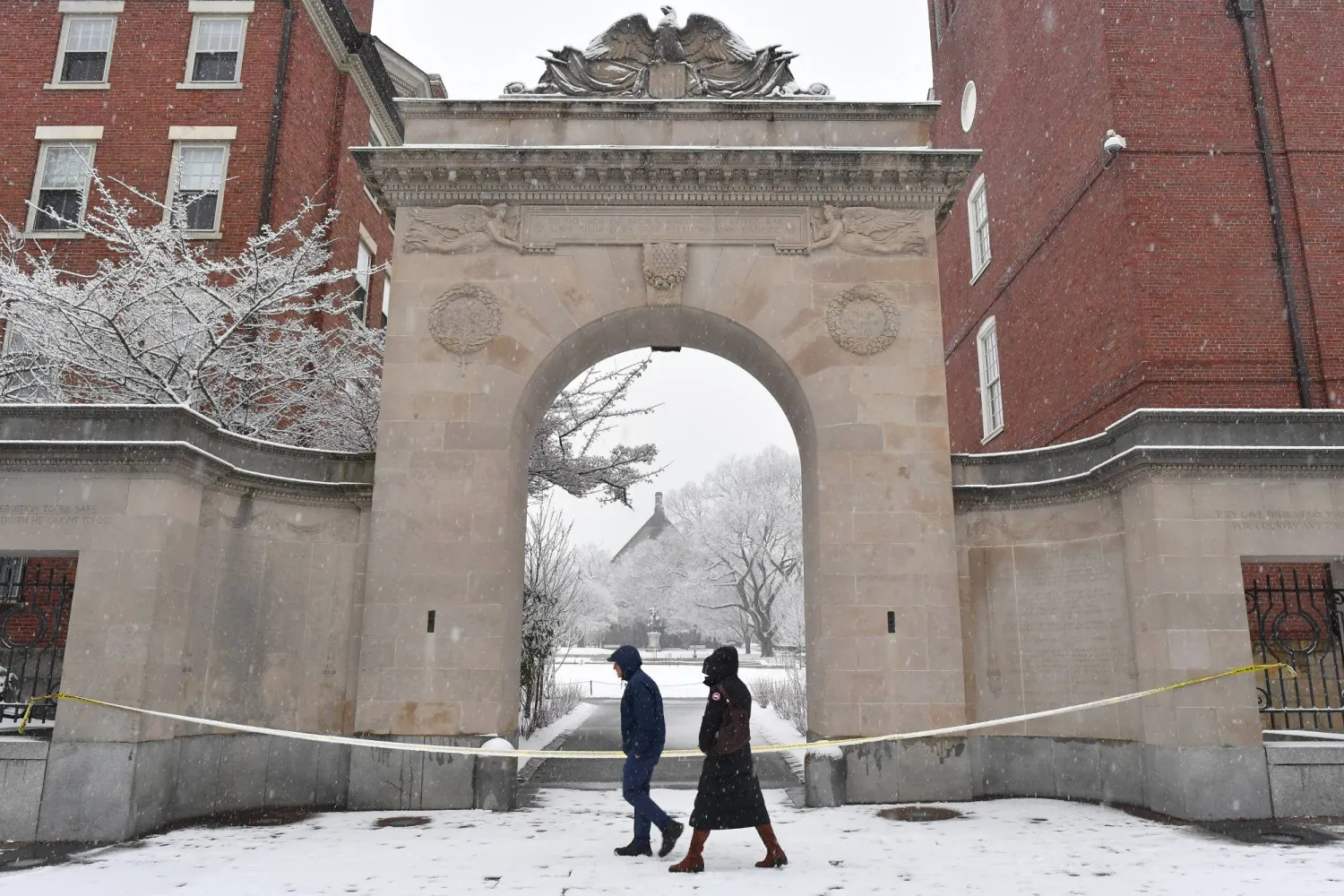
Passers-by walk past crime scene tape at an entrance to Brown University, Sunday, Dec. 14, 2025, in Providence, R.I., following the Saturday, Dec. 13, shooting at the university. (AP Photo/Steven Senne)
TT

US Police: Person of Interest Detained in Deadly Brown University Shooting

Passers-by walk past crime scene tape at an entrance to Brown University, Sunday, Dec. 14, 2025, in Providence, R.I., following the Saturday, Dec. 13, shooting at the university. (AP Photo/Steven Senne)

A person of interest was in custody Sunday after a shooting during final exams at Brown University that killed two students and wounded nine others, though key questions remained unanswered more than 12 hours after the attack.

The attack on Saturday afternoon set off hours of chaos across the Ivy League campus and surrounding Providence neighborhoods as hundreds of officers searched for the shooter and urged students and staff to shelter in place. The lockdown, which stretched into the night, was lifted early Sunday, but authorities had not yet released information about a potential motive.

Col. Oscar Perez, the Providence police chief, said that the person in custody was in their 30s and that investigators were not searching for anyone else but that no one has been charged yet. He declined to say whether the detained person had any connection to Brown.

The person was taken into custody at a Hampton Inn hotel in Coventry, Rhode Island, about 20 miles (32 kilometers) from Providence, where police officers and FBI agents remained Sunday, blocking off a hallway with crime scene tape as they searched the area.

The shooting occurred during one of the busiest moments of the academic calendar, as final exams were underway. Brown canceled all remaining classes, exams, papers and projects for the semester and told students they were free to leave campus, underscoring the scale of the disruption and the gravity of the attack.

The gunman opened fire inside a classroom in the university’s engineering building, firing more than 40 rounds from a 9 mm handgun, a law enforcement official told The Associated Press. As of Sunday morning, authorities had not recovered a firearm but did find two loaded 30-round magazines, the official said. The official was not authorized to discuss the investigation publicly and spoke to AP on the condition of anonymity.

“Everybody’s reeling, and we have a lot of recovery ahead of us,” Brown University President Christina Paxson said at a news conference.

“Our community’s strong and we’ll get through it, but it’s devastating.”

As of Sunday morning, one student had been released from the hospital, said Paxson. Seven others were in critical but stable condition and one was in critical condition.

Some business remain closed in shocked city Many area businesses announced Sunday that they would remain closed. A scheduled 5K run was postponed until next weekend. Providence leaders said residents would notice a heavier police presence.

“We all, intellectually, knew it could happen anywhere, including here, but that’s not the same as it happening in our community, and so this is an incredibly upsetting and emotional time for Providence, for Brown, for all of us," Mayor Brett Smiley said at the news conference. “It's not something that we should have to train for, but we have.”

Investigators were not immediately sure how the shooter got inside the first-floor classroom at the Barus & Holley building, a seven-story complex that houses the School of Engineering and physics department. The building includes more than 100 laboratories, dozens of classrooms and offices, according to the university’s website.

Engineering design exams were underway. Outer doors of the building were unlocked but rooms being used for final exams required badge access, Smiley said.

Brown, the seventh-oldest higher education institution in the U.S., is one of the nation’s most prestigious colleges with roughly 7,300 undergraduates and more than 3,000 graduate students.



Iran-US-Israel Conflict Enters Phase of Prolonged Attrition

Smoke rises from a building in Kuwait following Iranian attacks (AFP). 
TT

Iran-US-Israel Conflict Enters Phase of Prolonged Attrition

Smoke rises from a building in Kuwait following Iranian attacks (AFP). 

The confrontation between Iran on one side and the United States and Israel on the other has entered a phase of mutual attrition, shifting from temporary military escalation to a sustained pattern of operations, deterrence and endurance.

According to a report released Wednesday by the Gulf Research Center, based in Jeddah, the United States is building a long-term campaign aimed at degrading Iran’s missile capabilities and restoring confidence in maritime shipping routes.

Iran, meanwhile, is relying on its geography, security infrastructure and the strategic leverage of the Strait of Hormuz to prevent its adversaries from turning operational superiority into lasting strategic stability.

Rear Admiral Abdullah Al-Zaidi, senior adviser for security and defense studies at the center and author of the report, said the crisis has entered a stage of extended confrontation.

In this phase, the US effort has shifted from merely containing the Iranian threat to reducing Tehran’s capacity to regenerate and sustain its military capabilities by targeting missiles, drones and the military-industrial infrastructure that supports them.

A War of Attrition

The report said one of the most notable developments is the expansion of the US campaign from exhausting Iranian operational capabilities to striking the broader military-industrial base.

The chairman of the US Joint Chiefs of Staff has indicated that the campaign now focuses on destroying Iran’s missile and drone capabilities and degrading its naval forces in order to safeguard freedom of navigation through the Strait of Hormuz.

The report also noted that after national energy authorities in Qatar, Kuwait and Bahrain declared force majeure, the conflict could no longer be viewed as purely military. Its repercussions have now extended into the global energy sector.

Strait of Hormuz Pressure

Developments in the Strait of Hormuz, the report argued, show that Iran remains capable of generating significant strategic impact without formally closing the waterway. By reducing shipping traffic, raising operational risks and undermining confidence in maritime routes, Tehran can disrupt the flow of commerce without declaring a blockade.

The report added that from a Gulf perspective, the crisis is no longer simply an external escalation affecting global markets, but rather a direct challenge to national and energy securities and freedom of navigation.

Military Campaign Expands

Militarily, the report stated that the US campaign has shifted from reducing the tempo of Iranian attacks to systematically targeting the sources of Iranian military power. This includes destroying missile stockpiles and launch platforms, weakening Iran’s naval capabilities and expanding strikes to facilities involved in drone production.

Iran’s Strategic Depth

According to the report, Iran’s geography provides Tehran with natural strategic depth and a layered defensive capability. The country relies on rugged terrain, underground fortifications, tunnel networks and buried facilities to protect critical military assets.

Israeli estimates cited in the report suggest that more than 60 percent of Iran’s ballistic missile launchers have been disabled, with operational launch platforms declining from roughly 400 to about 150.

Nevertheless, current indicators suggest Tehran is pursuing a strategy of prolonged attrition based on absorbing strikes while extending the duration of the confrontation.

Disruption Without Closure

More than 20 million barrels of oil per day pass through the Strait of Hormuz, along with roughly one-fifth of global liquefied natural gas trade. Yet the report stressed that disrupting shipping does not require a full closure of the waterway.

Recent developments have shown that traffic can be significantly impeded without a formal blockade, it says.

The report also warned of rising risks in the strait, including the possibility that naval mines could be deployed as a direct tool of pressure.

Restoring Shipping Confidence

The contest over Hormuz is no longer solely military but also economic. The report said the central challenge now lies in persuading shipping companies and insurers to resume normal operations in the corridor.

Key Risks

Among the main risks identified are the possibility that the Strait of Hormuz crisis could evolve from a price shock into a supply crisis.

Other risks include potential direct confrontations during naval escort operations, the normalization of shipping disruption without a declared blockade, and the introduction of naval mines into the strategic equation.

The report also highlighted the continued external supply of Iranian missile capabilities, along with expanding international intelligence activity and growing cyber threats.

Outlook

The Gulf Research Center report concluded that the most likely short-term scenario is the continued disruption of traffic in the Strait of Hormuz without a full closure, a strategy that raises operational costs while avoiding the political consequences of an openly declared blockade.

It also expected Iran’s missile-based attrition strategy to continue without a rapid collapse, given the country’s geographic advantages and defensive infrastructure, which could prolong the confrontation.


Pezeshkian Puts Conditions to End the War as Trump Insists Iran is ‘at the End of the Line’

This satellite image taken and released on March 11, 2026 courtesy of Vantor shows a view of damaged buildings after airstrikes at Hakimabad garrison, some 30 kms (20 miles) south of Tehran, Iran. MANDATORY CREDIT "AFP PHOTO / Satellite image 2026 Vantor
TT

Pezeshkian Puts Conditions to End the War as Trump Insists Iran is ‘at the End of the Line’

This satellite image taken and released on March 11, 2026 courtesy of Vantor shows a view of damaged buildings after airstrikes at Hakimabad garrison, some 30 kms (20 miles) south of Tehran, Iran. MANDATORY CREDIT "AFP PHOTO / Satellite image 2026 Vantor

American and Israeli strikes on Thursday pounded Iran with no sign of an end to the war in sight as unrelenting Iranian attacks on shipping traffic and energy infrastructure pushed oil above $100 a barrel.

Iranian Supreme Leader Mojtaba Khamenei hasn't yet made a statement or been seen since being chosen to succeed his father Ali Khamenei, who was killed in the opening day of the conflict.

But Iranian President Masoud Pezeshkian has suggested that Tehran sought the world to recognize Iran’s “legitimate rights, payment of reparations” and international guarantees against future attacks to see an end of the war.

His comment came as US President Donald Trump reiterated his insistence that US-Israeli strikes had already practically defeated Iran.

"They are pretty much at the end of the line," he told reporters, after delivering a speech to supporters in which he declared: "We've won... we won -- in the first hour it was over."

Trump suggested that Iran’s halting of attacks was not imminent, however, promising to “finish the job” even though he claimed Iran is “virtually destroyed.”

“We don’t want to leave early do we? We’ve got to finish the job," he said at an event Wednesday in Kentucky.

In addition to attacking energy infrastructure around the region, Iran has a stranglehold on the Strait of Hormuz, the waterway leading from the Arabian Gulf toward the Indian Ocean through which a fifth of the world's oil is transported.

With traffic in the strait effectively stopped, the price of Brent crude oil, the international standard, rose another 9% to more than $100 a barrel, up some 38% over what it cost when the war started.


CENTCOM Warns Civilians to Avoid Iranian Ports Used for Military Purposes

A photo shows an Iranian vessel before a strike near the Strait of Hormuz (Photo by US Central Command/AFP) 
TT

CENTCOM Warns Civilians to Avoid Iranian Ports Used for Military Purposes

A photo shows an Iranian vessel before a strike near the Strait of Hormuz (Photo by US Central Command/AFP) 

The US Central Command (CENTCOM) on Wednesday warned civilians to avoid using ports along the Strait of Hormuz where Iranian forces conduct military operations that threaten international shipping.

“This dangerous action risks the lives of innocent people,” it said in a statement issued from its headquarters in Tampa, Florida. “Civilian ports used for military purposes lose protected status and become legitimate military targets under international law.”

CENTCOM also urged civilians in Iran to immediately avoid all port facilities where Iranian naval forces are operating. Iranian dockworkers, administrative personnel, and commercial vessel crews should avoid Iranian naval vessels and military equipment.

It said Iranian naval forces have positioned military vessels and equipment within civilian ports serving commercial maritime traffic.

Although the US military also cannot guarantee civilian safety in or near facilities used by the Iranian regime for military purposes, CENTCOM said US forces will continue taking every feasible precaution to minimize harm to civilians.

On Wednesday, spokesperson of Iran’s armed forces, Abolfazl Shekarchi, warned that his forces would target ports across the region if Iranian maritime infrastructure is attacked, urging neighboring states to expel US forces.

Quoted by state TV, Shekarchi said, “If our ports and docks are threatened, all ports and docks in the region will be our legitimate targets.”

He officially denied accusations that naval vessels from the Iranian Revolutionary Guard Corps (IRGC) were hiding in commercial or economic ports.