


Trump Orders 'Blockade' of Sanctioned Oil Tankers Leaving, Entering Venezuela

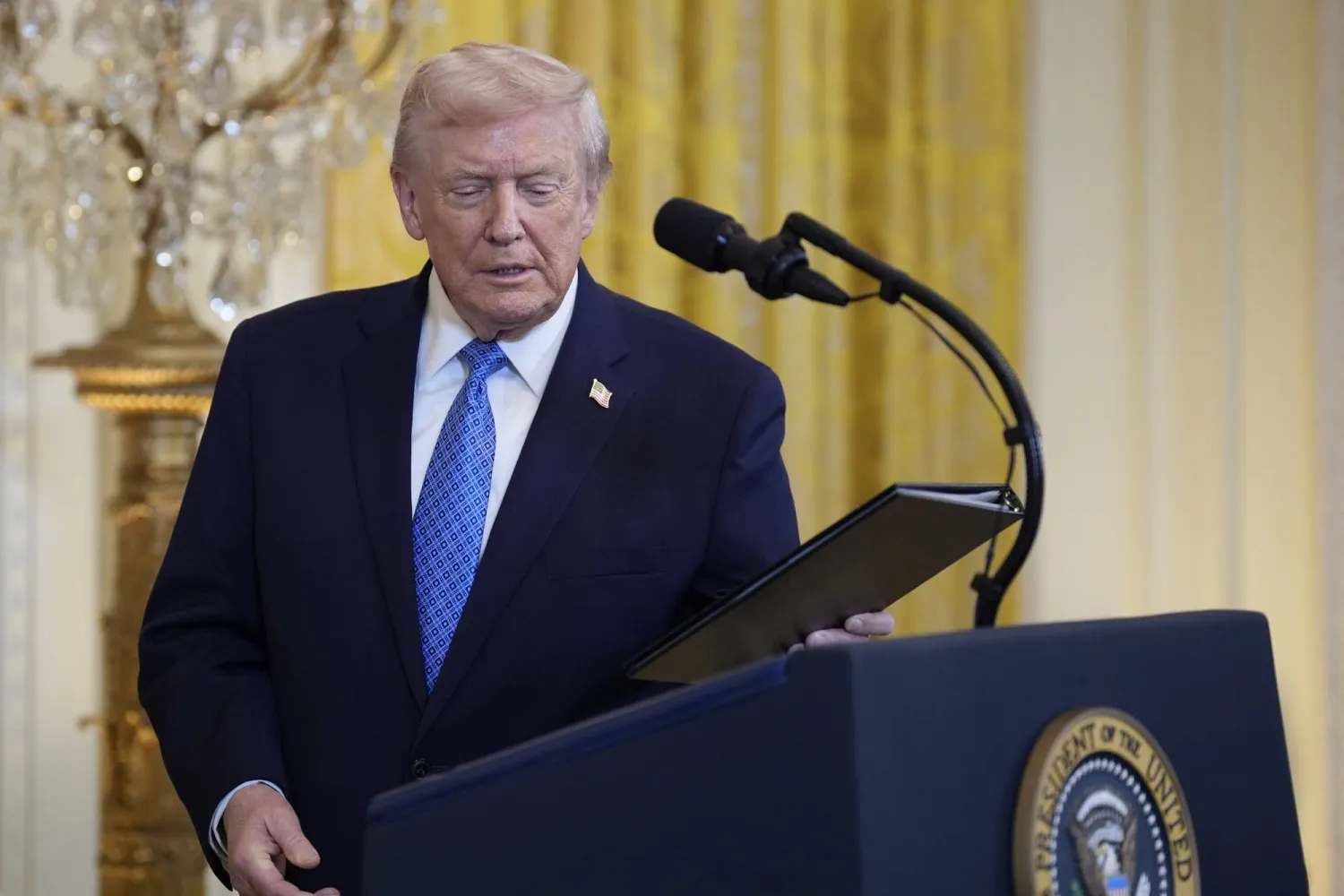
US President Donald Trump participates in a Hanukkah reception in the East Room at the White House in Washington, DC, USA, 16 December 2025. EPA/YURI GRIPAS / POOL
TT

Trump Orders 'Blockade' of Sanctioned Oil Tankers Leaving, Entering Venezuela

US President Donald Trump participates in a Hanukkah reception in the East Room at the White House in Washington, DC, USA, 16 December 2025. EPA/YURI GRIPAS / POOL

US President Donald Trump ordered on Tuesday a "blockade" of all sanctioned oil tankers entering and leaving Venezuela, in Washington's latest move to increase pressure on Nicolas Maduro's government, targeting its main source of income.

It is unclear how Trump will impose the move against the sanctioned vessels, and whether he will turn to the Coast Guard to interdict vessels like he did last week, Reuters reported. The administration has moved thousands of troops and nearly a dozen warships - including an aircraft carrier - to the region.

"For the theft of our Assets, and many other reasons, including Terrorism, Drug Smuggling, and Human Trafficking, the Venezuelan Regime has been designated a FOREIGN TERRORIST ORGANIZATION," Trump wrote on Truth Social. "Therefore, today, I am ordering A TOTAL AND COMPLETE BLOCKADE OF ALL SANCTIONED OIL TANKERS going into, and out of, Venezuela."

In a statement, Venezuela's government said it rejected Trump's "grotesque threat."

Oil prices rose more than 1% in Asian trade on Wednesday. Brent crude futures LCOc1 were up 70 cents, or 1.2%, at $59.62 a barrel at 0245 GMT, while US West Texas Intermediate crude CLc1 rose 73 cents, or 1.3%, to $56.00 a barrel.

US crude futures climbed over 1% to $55.96 a barrel in Asian trading after Trump's announcement. Oil prices settled at $55.27 a barrel on Tuesday, the lowest close since February 2021.

Oil market participants said prices were rising in anticipation of a potential reduction in Venezuelan exports, although they were still waiting to see how Trump’s blockade would be enforced and whether it would extend to include non-sanctioned vessels.

LEGAL QUESTIONS. American presidents have broad discretion to deploy US forces abroad, but Trump’s asserted blockade marks a new test of presidential authority, said international law scholar Elena Chachko of UC Berkeley Law School. Blockades have traditionally been treated as permissible “instruments of war,” but only under strict conditions, Chachko said. “There are serious questions on both the domestic law front and international law front,” she added.

US Representative Joaquin Castro, a Texas Democrat, called the blockade "unquestionably an act of war."

"A war that the Congress never authorized and the American people do not want," Castro added on X. There has been an effective embargo in place after the .S seized a sanctioned oil tanker off the coast of Venezuela last week, with loaded vessels carrying millions of barrels of oil staying in Venezuelan waters rather than risk seizure.

Since the seizure, Venezuelan crude exports have fallen sharply, a situation worsened by a cyberattack that knocked down state-run PDVSA's administrative systems this week.

While many vessels picking up oil in Venezuela are under sanctions, others transporting the country's oil and crude from Iran and Russia have not been sanctioned, and some companies, particularly the US' Chevron, transport Venezuelan oil in their own authorized ships.

China is the biggest buyer of Venezuelan crude, which accounts for roughly 4% of its imports, with shipments in December on track to average more than 600,000 barrels per day, analysts have said.

Since the US imposed energy sanctions on Venezuela in 2019, traders and refiners buying Venezuelan oil have resorted to a "shadow fleet" of tankers that disguise their location and to vessels sanctioned for transporting Iranian or Russian oil.

As of last week, more than 30 of the 80 ships in Venezuelan waters or approaching the country were under US sanctions, according to data compiled by TankerTrackers.com.

Trump's pressure campaign on Maduro has included a ramped-up military presence in the region and more than two dozen military strikes on vessels in the Pacific Ocean and Caribbean Sea near Venezuela, which have killed at least 90 people. Trump has also said that US land strikes on the South American country will soon start.

Maduro has alleged that the US military build-up is aimed at overthrowing him and gaining control of the OPEC nation's oil resources, which are the world's largest crude reserves. In wide-ranging interviews with Vanity Fair, Susie Wiles, Trump's chief of staff, said Trump "wants to keep on blowing boats up until Maduro cries uncle."

The Pentagon and Coast Guard referred questions to the White House.

The Trump administration has formally designated Venezuela's Cartel de los Soles as a foreign terrorist organization, saying the group includes Maduro and other high-ranking officials.

Maduro, speaking Tuesday before Trump's post, said, "Imperialism and the fascist right want to colonize Venezuela to take over its wealth of oil, gas, gold, among other minerals. We have sworn absolutely to defend our homeland and in Venezuela peace will triumph."



Kremlin Accuses Ukraine of 'Reckless' Strikes on Major Gas Pipeline

File photo: Pipes at the landfall facilities of the Nord Stream 1 gas pipeline are pictured in Lubmin, Germany, March 8, 2022. (Reuters)
TT

Kremlin Accuses Ukraine of 'Reckless' Strikes on Major Gas Pipeline

File photo: Pipes at the landfall facilities of the Nord Stream 1 gas pipeline are pictured in Lubmin, Germany, March 8, 2022. (Reuters)

The Kremlin accused Ukraine on Thursday of targeting a major gas pipeline in southern Russia that leads to Türkiye with "reckless" drone strikes.

Ukraine has hit Russian energy targets throughout Moscow's four-year offensive, a war that has killed thousands and displaced millions.

"At night, there were renewed attempts to attack the Russkaya compressor station with drones," Kremlin spokesman Dmitry Peskov said, calling the pipeline an "international facility" that "ensures energy security for Türkiye".

"These are absolutely reckless actions by the Kyiv regime," Peskov said.

Russia's defense ministry said it had downed 10 Ukrainian-launched drones in the early hours of Thursday "above the gas compressor station that supplies gas to the TurkStream pipeline".

The station lies in Russia's southern Krasnodar region, which is regularly targeted by Ukrainian drone strikes.

State-owned Russian gas producer Gazprom earlier said that the Russkaya and Beregovaya stations were targeted.

It called them "critical energy infrastructure facilities ensuring the reliability of gas exports via the TurkStream and Blue Stream gas pipelines."

Russia has decimated much of Ukraine's energy infrastructure in more than four years of war.


First Passenger Train in Six Years Arrives in Pyongyang from China

A passenger train with cross-border service to North Korea's Pyongyang leaves Beijing Railway Station in Beijing, China March 12, 2026. REUTERS/Florence Lo
TT

First Passenger Train in Six Years Arrives in Pyongyang from China

A passenger train with cross-border service to North Korea's Pyongyang leaves Beijing Railway Station in Beijing, China March 12, 2026. REUTERS/Florence Lo

A passenger train that departed from the northeastern Chinese city of Dandong arrived in the North Korean capital Pyongyang on Thursday, as rail service between the neighboring countries resumed after six years.

The train arrived at a railway station in central Pyongyang, state news agency Xinhua said, after reporters from South Korea's Yonhap reported seeing a train crossing the Sino-Korean Friendship Bridge over the Yalu River.

China and ⁠North Korea are "friendly neighbours" and a cross-border passenger train service facilitates people-to-people exchanges, a foreign ministry spokesperson told reporters on Thursday.

China also backs stronger communication between both sides to ease such exchanges, the spokesperson added.

The service was suspended when the COVID-19 pandemic broke out ⁠in 2020.

North Korea is largely closed ‌to foreign tourism, with ‌few exceptions, largely for Russian tour ​groups under restricted arrangements, say ‌travel agencies organizing trips to the country.


NYT: US Says Iran Campaign Cost $11 Billion in Six Days

FILE PHOTO: A map showing the Strait of Hormuz and Iran is seen in this illustration taken June 22, 2025. REUTERS/Dado Ruvic/Illustration/File Photo
TT

NYT: US Says Iran Campaign Cost $11 Billion in Six Days

FILE PHOTO: A map showing the Strait of Hormuz and Iran is seen in this illustration taken June 22, 2025. REUTERS/Dado Ruvic/Illustration/File Photo

The opening week of the war against Iran cost the United States more than $11.3 billion, lawmakers were told in a Pentagon briefing, according to a New York Times report underscoring the pace at which the conflict is consuming weapons and resources.

The Times, citing unnamed sources familiar with Tuesday's closed-door briefing, said members of Congress were told that the figure excludes many costs connected with the buildup to the strikes -- suggesting the final tally for the first week could rise substantially.

Defense officials had previously told Congress that roughly $5.6 billion worth of munitions were expended in just the first two days of fighting, according to US media -- a burn rate far higher than earlier public estimates.

The Center for Strategic and International Studies (CSIS) independent think tank in Washington estimated that the first 100 hours of Operation Epic Fury cost $3.7 billion -- or more than $891 million per day.

Most of these costs, $3.5 billion, had not already been budgeted, the CSIS said.

The Iran War Cost Tracker website, which estimates the cost of the conflict in real time, showed a figure of more than $17 billion on its counter at around 08:00 GMT on Thursday.

According to the site, the United States is spending $1 billion per day on the war.

However, it points out the true cost of the war is likely higher, as the figures do not take into account long-term expenses such as veteran healthcare.