US Intelligence Indicates Putin's War Aims in Ukraine are Unchanged

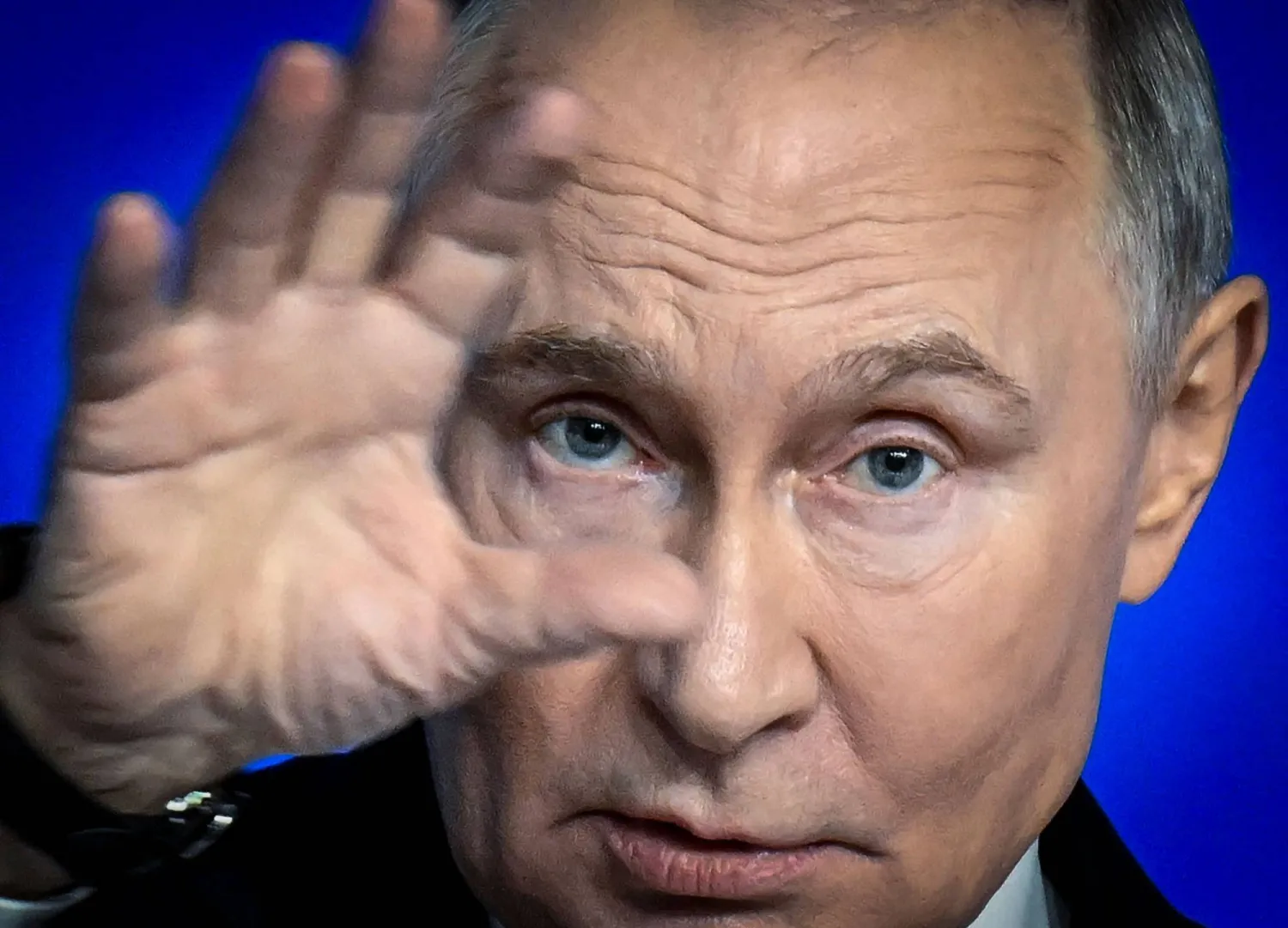
TOPSHOT - Russia's President Vladimir Putin gestures as he speaks during his annual end-of-year press conference, in Moscow, on December 19, 2025.  (Photo by Alexander NEMENOV / AFP)
TOPSHOT - Russia's President Vladimir Putin gestures as he speaks during his annual end-of-year press conference, in Moscow, on December 19, 2025. (Photo by Alexander NEMENOV / AFP)
TT

US Intelligence Indicates Putin's War Aims in Ukraine are Unchanged

TOPSHOT - Russia's President Vladimir Putin gestures as he speaks during his annual end-of-year press conference, in Moscow, on December 19, 2025.  (Photo by Alexander NEMENOV / AFP)
TOPSHOT - Russia's President Vladimir Putin gestures as he speaks during his annual end-of-year press conference, in Moscow, on December 19, 2025. (Photo by Alexander NEMENOV / AFP)

US intelligence reports continue to warn that Russian President Vladimir Putin has not abandoned his aims of capturing all of Ukraine and reclaiming parts of Europe that belonged to the former Soviet empire, six sources familiar with US intelligence said, even as negotiators seek an end to the war that would leave Russia with far less territory.
The reports present a starkly different picture from that painted by US President Donald Trump and his Ukraine peace negotiators, who have said Putin wants to end the conflict. The most recent of the reports dates from late September, according to one of the sources.
The intelligence also contradicts the Russian leader’s denials that he is a threat to Europe.
The US findings have been consistent since Putin launched his full-scale invasion in 2022. They largely align with the views of European leaders and spy agencies that he covets all of Ukraine and territories of former Soviet bloc states, including members of the NATO alliance, according to the sources.
"The intelligence has always been that Putin wants more," Mike Quigley, a Democratic member of the House Intelligence Committee, said in a Reuters ‌interview. "The Europeans are convinced ‌of it. The Poles are absolutely convinced of it. The Baltics think they're first.”
Russia controls about 20% ‌of ⁠Ukraine’s territory, including the bulk ‌of Luhansk and Donetsk, the provinces that comprise the industrial heartland of the Donbas, parts of Zaporizhzhia and Kherson provinces and Crimea, the strategic Black Sea peninsula.
Putin claims Crimea and all four provinces as belonging to Russia. Trump is pressuring Kyiv to withdraw its forces from the small part of Donetsk they control as part of a proposed peace deal, according to two sources familiar with the matter, a demand that Ukrainian President Volodymyr Zelenskiy and most Ukrainians reject.
“The president’s team has made tremendous progress with respect to ending the war" and Trump has stated that a peace deal "is closer than ever before," said a White House official without addressing the intelligence reports.
In an X post on Saturday, Director of National Intelligence Tulsi Gabbard said intelligence officers have briefed lawmakers that "Russia seeks to avoid a larger war with Europe" and that its ⁠troops' performance in Ukraine shows it currently lacks the capacity to overrun "all of Ukraine, let alone Europe."
The Office of the Director of National Intelligence, the CIA and the Russian embassy did not immediately respond ‌to requests for comment.
PROGRESS ON SECURITY GUARANTEES
Trump’s negotiators - his son-in-law Jared Kushner and billionaire real estate developer ‍Steve Witkoff - have for weeks been negotiating the 20-point peace plan with ‍Ukrainian, Russian and European officials.
While US officials say they have made progress, major differences remain on the issues of territory.
Kushner and Witkoff were meeting on ‍Friday with Ukrainian negotiators in Miami and were to hold talks with Russian representatives this weekend, said a White House official.
US, Ukrainian and European negotiators reached a broad consensus on Monday in talks in Berlin on what four European diplomats and the two sources familiar with the matter said are robust US-backed guarantees of Ukraine’s security against future Russian aggression.
One source and a diplomat said that those guarantees hinge on Zelenskiy agreeing to cede territory to Russia. But other diplomats said that was not the case and alternatives were still being examined as Zelenskiy has ruled out ceding territory.
The diplomats said the guarantees, which would take effect after the signing of a peace agreement, call for the deployment of a mostly European security force in neighboring countries and in Ukraine away from the ⁠front lines to aid in repulsing any future Russian attack.
Ukraine's military would be capped at 800,000, said the source. But several diplomats said Russia seeks a lower cap to which the Americans are open.
The US would provide intelligence and other support, and the package would be ratified by the US Senate, they said. According to two sources familiar with the talks, Washington's plan would also include US-backed air patrols over Ukraine.
Zelenskiy on Thursday appeared cautious on the proposals, saying "There's a question I still can't get an answer to: What will these security guarantees actually do?"
And it is deeply uncertain whether Putin will agree to such guarantees as he has repeatedly rejected the deployment of foreign troops in Ukraine.
RUSSIA STILL PUSHING TERRITORIAL DEMANDS
Putin on Friday offered no compromises, although he told an annual news conference that he was ready to discuss peace.
He said his terms would have to be met as his forces have advanced 6,000 square km (2,300 square miles) this year.
It is unclear how US officials have responded to Putin's demands. Witkoff has previously suggested that Russia has a right to claim the four provinces and Crimea.
Some Trump administration officials have acknowledged that Putin may be unwilling to settle for less than his initial goal of conquering Ukraine.
"I don't know if Putin wants to do a deal or Putin wants to take ‌the whole country. These are things that he has said openly," Secretary of State Marco Rubio said on Friday at a press conference.
"We know what they wanted to achieve initially when the war began. They haven't achieved those objectives."



US Navy Turns to AI Firm Domino for Options to Counter Iranian Mines

Ships and boats in the Strait of Hormuz, Musandam, Oman, May 1, 2026. REUTERS/Stringer
TT

US Navy Turns to AI Firm Domino for Options to Counter Iranian Mines

Ships and boats in the Strait of Hormuz, Musandam, Oman, May 1, 2026. REUTERS/Stringer

The US Navy is ramping up its AI capabilities to hunt for Iranian mines in the Strait of Hormuz, one of the world's most critical shipping lanes, a recently awarded contract shows.

President Donald Trump has said the US Navy is clearing Iranian mines from the strait, a vital sea route for oil shipments, whose disruption is increasingly threatening the global economy.

Sweeping for underwater explosives could take months despite a tenuous ceasefire between the US and ⁠Iran in their weeks-long ⁠war.

The up to $100 million contract for the San Francisco artificial intelligence company Domino Data Lab could quicken this process with software that can teach underwater drones to identify new types of mines in a matter of days.

"Mine-hunting used to be a job for ships," Thomas Robinson, Domino's chief operating officer, said in an interview with Reuters. "It's becoming a job for AI.

⁠The Navy is paying for the platform that lets it train, govern, and field that AI at a speed required for contested waters that block global trade and imperil sailors."

Last week, the US Navy awarded the up to $99.7 million contract to expand Domino's role as the AI backbone of the Navy's Project AMMO - Accelerated Machine Learning for Maritime Operations - a program to make underwater mine detection faster, more accurate, and less dependent on human sailors.

The software integrates data from multiple sensor types, including side-scan sonar and visual imaging systems, and allows the Navy to monitor how well various AI ⁠detection models ⁠are performing in the field, identify failures, and push corrections to improve performance.

The core of Domino's pitch - and the Navy's wager - is speed. Before the company's involvement, updating the AI models that power the Navy's unmanned underwater vehicles (UUVs) to recognize new or previously unseen mines could take up to six months. Domino says it has cut that cycle to days.

Robinson illustrated the relevance to the Middle East crisis: "If there were UUVs in the Baltic Sea trained on Russian mines, and then they needed to be deployed to the Strait of Hormuz to detect Iranian mines, with Domino's technology, the Navy could be ready in a week rather than a year."

A Navy spokesman was not immediately able to provide comment.


Magnitude 4.9 Quake Hits Nevada

People walk near Caesars Palace along the Las Vegas Strip, Thursday, April 30, 2026, in Las Vegas, Nevada. (AP Photo/John Locher)
TT

Magnitude 4.9 Quake Hits Nevada

People walk near Caesars Palace along the Las Vegas Strip, Thursday, April 30, 2026, in Las Vegas, Nevada. (AP Photo/John Locher)

A 4.9-magnitude earthquake struck Nevada on Friday, the US Geological Survey (USGS) reported.

The tremor hit at a depth of about 12 kilometers (7 miles), around 19 kilometers southeast of Silver Springs.

It struck at about 01:17 am (0817 GMT), the USGS said.

The earthquake probably caused light to moderate shaking, according to the USGS.

It was unlikely that the tremor caused any fatalities or significant economic damage.

Silver Springs has a population of around 5,000.


Turkish Police Fire Tear Gas, Arrest Dozens at May Day Rallies

 Turkish police detain a protestor during a May Day (Labor Day) rally, marking international Workers' Day, in Besiktas, a district of Istanbul, on May 1, 2026. (AFP)
Turkish police detain a protestor during a May Day (Labor Day) rally, marking international Workers' Day, in Besiktas, a district of Istanbul, on May 1, 2026. (AFP)
TT

Turkish Police Fire Tear Gas, Arrest Dozens at May Day Rallies

 Turkish police detain a protestor during a May Day (Labor Day) rally, marking international Workers' Day, in Besiktas, a district of Istanbul, on May 1, 2026. (AFP)
Turkish police detain a protestor during a May Day (Labor Day) rally, marking international Workers' Day, in Besiktas, a district of Istanbul, on May 1, 2026. (AFP)

Turkish police on Friday fired tear gas and arrested dozens of people holding May Day demonstrations in Istanbul, AFP journalists said.

Two groups were specially singled out in the city's European side after signaling their intention to march to Taksim square -- the scene of several anti-government protests in the past -- which was sealed off overnight by police.

Turkish media, including the opposition website Bir Gun, counted at least 57 arrests.

May 1, which celebrates workers and the working classes, sees a major police deployment in Türkiye every year, with a large area in the heart of Istanbul around Taksim Square sealed off.

Last year, protests moved to the Kadikoy area of the city and more than 400 people were arrested.

On Friday, a large deployment of police, many in riot gear, and metal barricades were seen choking access to central neighborhoods of Istanbul.

In the Mecidiyekoy district, police were seen by AFP using tear gas on the crowd, which included members of a Marxist party, the HKP, who tried to push through while chanting "USA murderer, (Türkiye’s ruling party) AKP accomplice".

Police encircling the Besiktas neighborhood stepped in -- sometimes violently -- whenever a chant was taken up by the demonstrators. AFP saw several protesters thrown to the ground.

Unions and civil society associations had called for the May 1 demonstrations under the slogan "Bread. Peace. Freedom".

Earlier this week, Turkish authorities issued arrest and search warrants against 62 people, of whom they deemed 46 -- including journalists, trade unionists and opposition figures -- were "likely to carry out attacks".