


Alleged Bondi Shooters Conducted ‘Tactical’ Training in Countryside, Police Say 

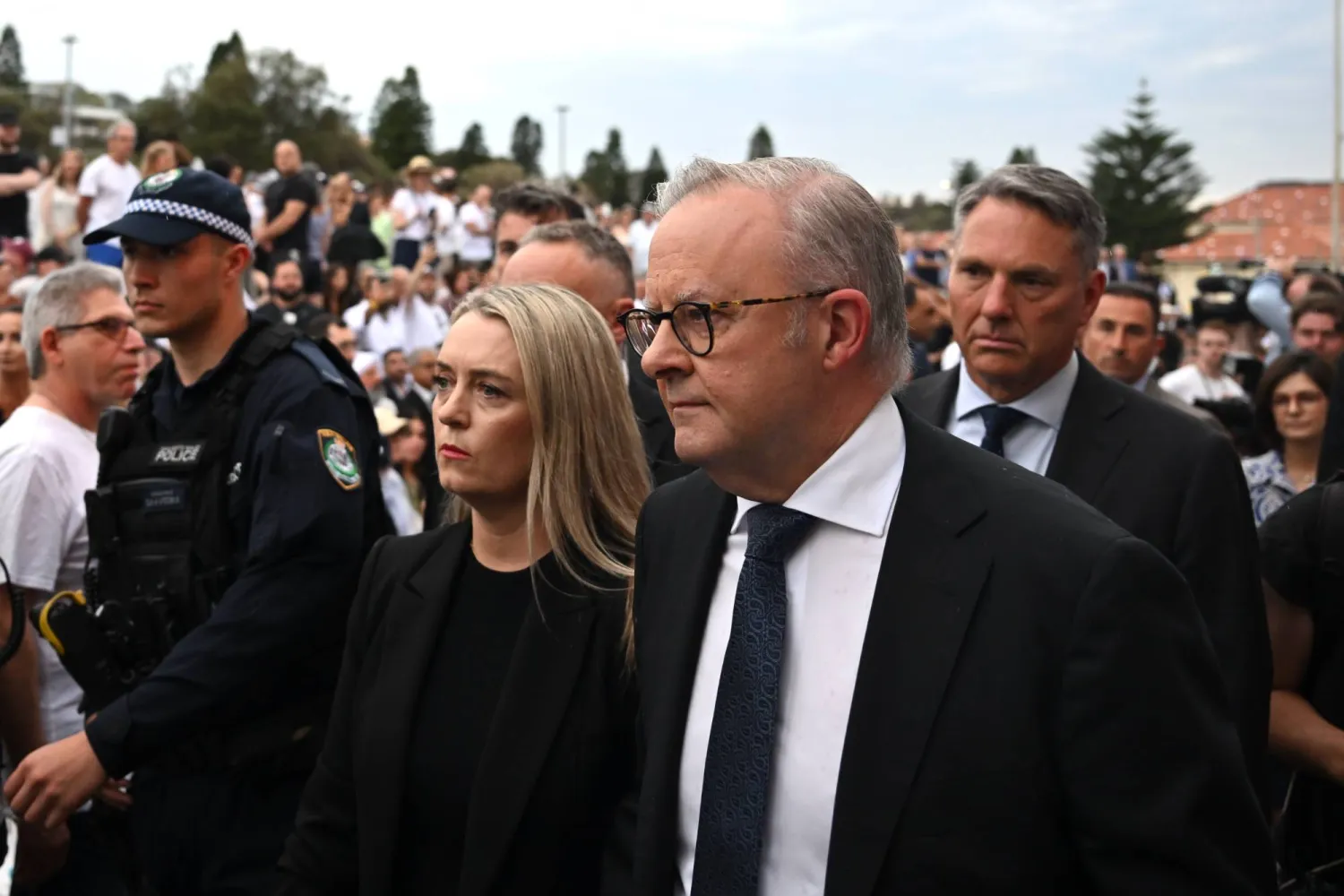
21 December 2025, Australia, Sydney: Australian Prime Minister Anthony Albanese (R) and his wife Jodie Haydon attend a National Day of Reflection vigil and commemoration for the victims and survivors of the Bondi Massacre at Bondi Beach in Sydney. (Dean Lewins/AAP/dpa)
TT

Alleged Bondi Shooters Conducted ‘Tactical’ Training in Countryside, Police Say 

21 December 2025, Australia, Sydney: Australian Prime Minister Anthony Albanese (R) and his wife Jodie Haydon attend a National Day of Reflection vigil and commemoration for the victims and survivors of the Bondi Massacre at Bondi Beach in Sydney. (Dean Lewins/AAP/dpa)

Two suspects in last week's deadly mass shooting at Australia's Bondi Beach trained for the attack in the countryside, police alleged in court documents Monday, as Prime Minister Anthony Albanese vowed tougher laws against hate speech and extremism.

Father and son Sajid Akram and Naveed are accused of targeting a Hanukkah event on Bondi Beach, killing 15 people in the nation's deadliest mass shooting in almost three decades.

Police documents released Monday said the two had carried out "firearms training" in what was believed to be the New South Wales countryside prior to the shooting.

Pictures were released showing the accused firing shotguns and moving in what authorities described as a "tactical manner".

The pair also recorded a video in October railing against "Zionists" while sitting in front of a flag of the ISIS group and detailing their motivations for the attack, police said.

And they made a nighttime "reconnaissance" trip to Bondi Beach just days before the killings, documents showed.

Australia observed a minute's silence at 6:47 pm (0747 GMT) on Sunday -- exactly a week since the first reports of gunfire.

On Monday, Albanese said he would push for tough new laws creating "an aggravated offense for hate preaching".

"We're not going to let the ISIS inspired terrorists win. We won't let them divide our society, and we'll get through this together," Albanese told reporters.

"As Prime Minister, I feel the weight of responsibility for an atrocity that happened whilst I'm Prime Minister, and I'm sorry for what the Jewish community and our nation as a whole has experienced," he said.

"The government will work every day to protect Jewish Australians, to protect the fundamental right as Australians that they have to be proud of who they are, to practice their faith, to educate their children and to engage in Australian society in the fullest way possible," he added.

- Crackdown on guns, 'terrorist symbols' -

Australia's federal government has flagged a suite of reforms to gun ownership and hate speech laws, as well as a review of police and intelligence services.

Albanese also announced last week a sweeping buyback scheme to "get guns off our streets".

It is the largest gun buyback since 1996, when Australia cracked down on firearms in the wake of a mass shooting that killed 35 people at Port Arthur.

And the government of New South Wales -- where the shooting took place -- recalled its parliament for two days on Monday to introduce what it called the "toughest firearm reforms in the country".

"We can't pretend that the world is the same as it was before that terrorist incident on Sunday," New South Wales Premier Chris Minns told reporters.

"I'd give anything to go back a week, a month, two years, to ensure that didn't happen, but we need to make sure that we take steps so that it never happens again."

The new rules will cap the number of guns an individual can own to four, or ten for exempted individuals like farmers.

There are more than 1.1 million firearms in the state, officials said.

The legislation would also ban the display of "terrorist symbols", including the flag of the ISIS, which was found in a car linked to one of the alleged shooters.

Authorities will also be able to prohibit protests for up to three months following a terrorism incident.

One of the alleged gunmen, Sajid Akram, 50, was shot and killed by police during the attack. An Indian national, he entered Australia on a visa in 1998.

His 24-year-old son Naveed, an Australian-born citizen, was moved from hospital to jail on Monday, police said.

Minns said Monday he would also look into stricter hate speech legislation next year.


Israel Says it Is Facing an ‘Existential Threat’ as Iran Builds up its Military Capacities  

Israeli defenses intercept Iranian missiles over Tel Aviv on June 22. (AFP)
TT

Israel Says it Is Facing an ‘Existential Threat’ as Iran Builds up its Military Capacities  

Israeli defenses intercept Iranian missiles over Tel Aviv on June 22. (AFP)

Iran is making “hysteric” efforts to produce up to 3,000 ballistic missiles per month, Israel's Maariv newspaper reported on Sunday.

“Although such missiles are considered old-fashioned, imprecise, and can be shot down before they reach their targets, the time they reach their targets is enough to cause serious damage,” the newspaper said quoting Israeli security sources.

In an article published in Maariv, writer Anna Persky said Iran is reviving its nuclear program and is resuming the production of ballistic missiles, but not yet its uranium enrichment.

Quoting Israeli security sources, she wrote: “There has been an ongoing movement in recent weeks around the nuclear reactors that were destroyed in the recent Israeli-US attacks on Iran.”

The sources stressed that the Israeli army’s new military doctrine is based on preemptive strikes to prevent threats before they materialize, but at the same time, they did not rule out a preemptive attack from Tehran.

Persky wrote that Iran is restoring facilities related to the production of ballistic missiles and nuclear facilities damaged by strikes during the 12-day war in June.

For Israel, Iran's nuclear program still remains a serious concern.

“Israeli Prime Minister Benjamin Netanyahu plans to present the Iranian threat during his scheduled meeting with US President Donald Trump” on December 29. “He will try to figure out if Trump is willing to participate in a new war against Iran,” she said.

Persky wrote that Netanyahu will present to the US President with a number of alternatives, including an independent Israeli attack with limited US assistance, a joint strike or a full-scale US operation.

“At the meeting, the main issue will not be what Israel wants to do, but what the United States is willing to offer,” she noted.

In Israel, the “inevitability of a war with Iran” was the headline of all Israeli newspapers over the weekend.

“Iran ramps up missile tests and military drills, renews threats toward Israel,” wrote Yedioth Ahronoth in its headline on Sunday.

It said amid recent reports that Tehran is producing ballistic missiles at a rapid pace and in large quantities, Iran has returned to threatening Israel and showcasing its military capabilities, much as it did before the June war.

But Maariv said the war initiative will rather come from Israel, which perceives Iran’s nuclear program as an existential threat.

Israel is worried about missing the current opportunity. “Today, Iran is still in the midst of reconstruction, but tomorrow it will be more protected, more distributed, and its offensive capability will be more expensive and more dangerous,” Persky wrote.


Moscow Car Blast Kills Russian General 

An investigator works at the scene where Lieutenant General Fanil Sarvarov, head of the Russian General Staff's army operational training directorate, was reportedly killed in a car bomb in Moscow, Russia, December 22, 2025. (Russia's Investigative Committee/Handout via Reuters)
TT

Moscow Car Blast Kills Russian General 

An investigator works at the scene where Lieutenant General Fanil Sarvarov, head of the Russian General Staff's army operational training directorate, was reportedly killed in a car bomb in Moscow, Russia, December 22, 2025. (Russia's Investigative Committee/Handout via Reuters)

A senior Russian general was killed in southern Moscow on Monday after an explosive device placed under his car went off, investigators said in a statement.

Russia's Investigative Committee, which examines major crimes, said it had opened a probe into the "murder" of Lieutenant General Fanil Sarvarov, head of the training department within the General Staff.

The possibility that the attack was "linked" to "Ukrainian special forces" was among the lines of inquiry, it said.

Since Moscow sent troops into Ukraine in February 2022, Kyiv has been blamed for several attacks targeting Russian military officials and pro-Kremlin personalities in Russia and in Russian-controlled Ukrainian regions.

General Yaroslav Moskalik, a deputy of the General Staff, was killed in a car blast near Moscow in April.

In December 2024, Igor Kirillov, the head of the Russian radiological, chemical and biological defense forces, was killed when a booby-trapped electric scooter exploded in Moscow, an attack claimed by Ukraine's SBU security service.

A Russian military blogger, Maxim Fomin, was killed when a statuette exploded in a Saint Petersburg cafe in April 2023.

And in August 2022, a car bomb killed Daria Dugina, the daughter of ultranationalist ideologue Alexander Dugin.


Iran Does Not Rule Out New Israeli Attacks against it

Russian Foreign Minister Sergei Lavrov, right, and Iranian Foreign Minister Abbas Araghchi shake hands after a joint news conference at Zinaida Morozova's Mansion in Moscow, Wednesday, Dec. 17, 2025. (Ramil Sitdikov/Pool Photo via AP)
TT

Iran Does Not Rule Out New Israeli Attacks against it

Russian Foreign Minister Sergei Lavrov, right, and Iranian Foreign Minister Abbas Araghchi shake hands after a joint news conference at Zinaida Morozova's Mansion in Moscow, Wednesday, Dec. 17, 2025. (Ramil Sitdikov/Pool Photo via AP)

Iran's Foreign Minister Abbas Araghchi on Sunday said Tehran “does not rule out” the possibility of a new Israeli or US attack on its nuclear facilities, but remains “fully prepared, even more than before.”

“This doesn't mean that we welcome another war, but it is exactly to prevent a war. And the best way to prevent war is to be prepared for that. And we are fully prepared,” Araghchi said in an interview with Russia Today (RT).

The minister said Iran has rebuilt everything that was damaged by Israeli and US strikes during the 12-day war in June.

“If they want to repeat the same failed experience, they will not achieve a better result,” he stressed.

Araghchi made the remarks during a visit last week to Moscow, where he held political and diplomatic talks with Russian officials, including his counterpart, Sergei Lavrov.

Araghchi said he is no longer in contact with US Special Envoy for the Middle East Steve Witkoff, revealing that their communication channel has been inactive for months.

Iran and the envoy had held five rounds of talks between April and June. A sixth round, scheduled for June 15, was canceled after Israel launched its strikes on Iran.

Araghchi said that following the war, he maintained contacts with Witkoff. He said that while the US insisted on resuming negotiations, it had adopted what he described as a “very wrong” approach.

Commenting on the US strikes on Iran's nuclear facilities in Natanz and Fordow in June, the FM acknowledged: “Our facilities have been damaged, seriously damaged.”

However, he added: “There is also another fact, that our technology is still there, and technology cannot be bombed. And our determination is also there. We have a very legitimate right to peaceful use of nuclear technology, including enrichment.”

Araghchi reiterated that Iran is ready to provide full assurance that its nuclear program is peaceful as it did in 2015 when Tehran agreed to build confidence over the peaceful nature of its program in exchange of the lifting of sanctions.

He noted that military operations have failed to achieve their goals, while diplomacy was a successful experience.

Asked if he expects Israel will maintain its approach in 2026, the FM replied: “They will continue their aggressive behavior in 2026 due to the full impunity which is given to them by the US and Europeans.”

NBC News reported last week that Israeli officials have grown increasingly concerned that Iran is expanding production of its ballistic missile program, which was damaged by Israeli strikes in June, and are preparing to brief President Donald Trump about options for attacking it again, according to a person with direct knowledge of the plans and four former US officials briefed on the plans.

On Iran’s relations with the International Atomic Energy Agency (IAEA), Araghchi said: “We remain a committed member of the Non-Proliferation Treaty (NPT) and are ready to cooperate with the Agency.”

“We have a simple question for the Agency: Please tell us, how should a nuclear facility that has been attacked be inspected? And there is no answer to this question, because there is no precedent to this,” he added.
