


North Korea's Kim Orders Factories to Make More Missiles in 2026

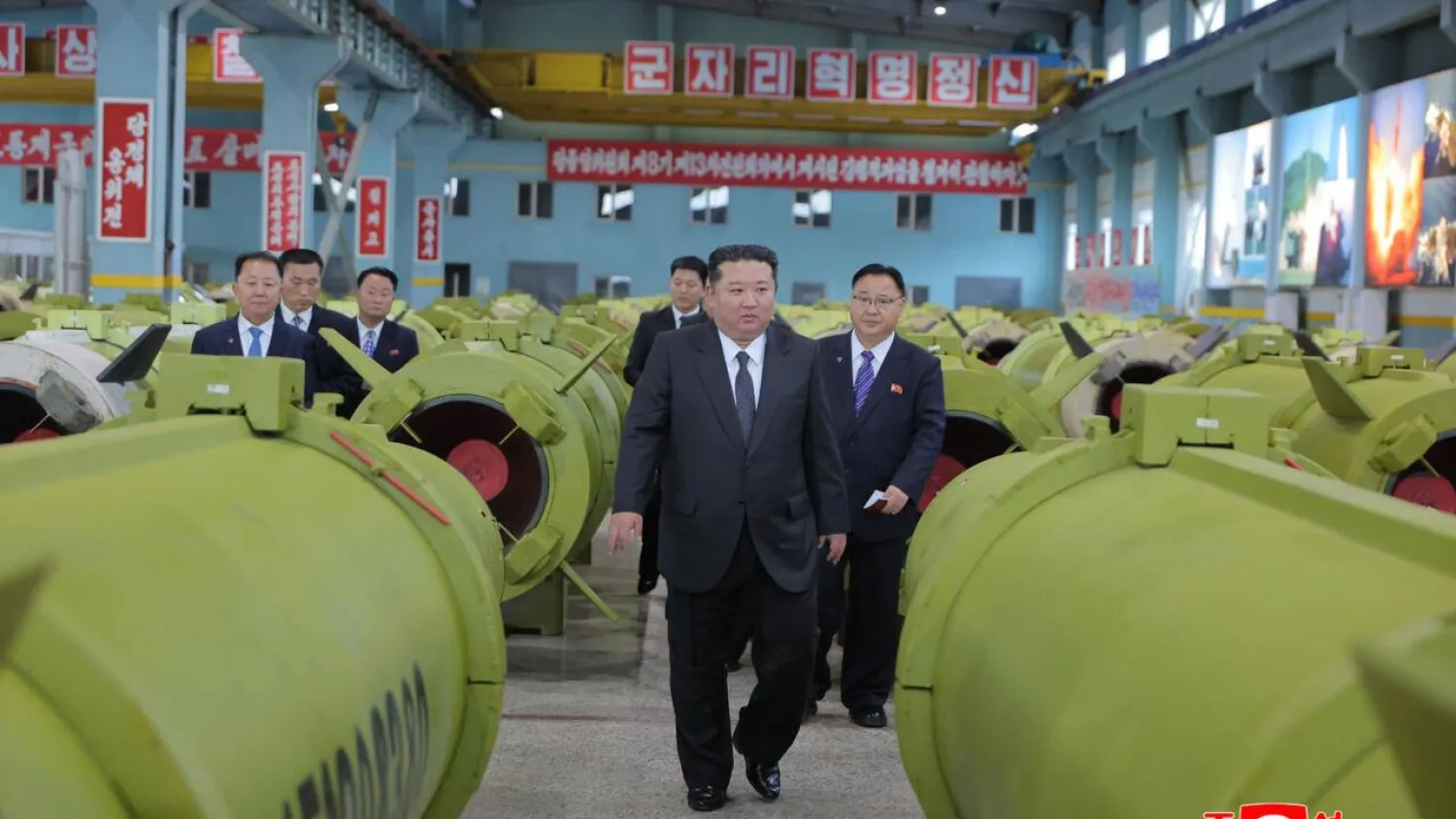
In a visit to munitions factories accompanied by top officials, the state-run Korean Central News Agency (KCNA) said Kim ordered the factories to prepare for a busy year ahead. STR / KCNA VIA KNS/AFP
TT

North Korea's Kim Orders Factories to Make More Missiles in 2026

In a visit to munitions factories accompanied by top officials, the state-run Korean Central News Agency (KCNA) said Kim ordered the factories to prepare for a busy year ahead. STR / KCNA VIA KNS/AFP

North Korean leader Kim Jong Un has ordered officials to step up production of missiles and construct more factories to meet his military's growing need for the projectiles, state media said Friday.

Pyongyang has significantly increased missile testing in recent years -- aimed, analysts say, at improving precision strike capabilities, challenging the United States as well as South Korea, and testing weapons before exporting them to key ally Russia.

In a visit to munitions factories accompanied by top officials, the state-run Korean Central News Agency (KCNA) said Kim had ordered the factories to prepare for a busy year ahead.

The North Korean leader said they needed "to further expand the overall production capacity" to keep pace with demand from Pyongyang's armed forces and ordered the building of new munitions plants, KCNA reported.

"The missile and shell production sector is of paramount importance in bolstering up the war deterrent," Kim said.

North Korea and Russia have drawn closer since Moscow launched its invasion of Ukraine nearly four years ago, and Pyongyang has sent troops to fight for Russia, along with artillery shells, missiles and long-range rocket systems.

In return, Russia is sending North Korea financial aid, military technology and food and energy supplies, analysts say.

Washington has also pointed to evidence that Russia is stepping up support for North Korea, including providing help on advanced space and satellite technology, in return for its assistance in fighting Ukraine.

Analysts say satellite launchers and intercontinental ballistic missiles (ICBMs) share much of the same underlying technology.

"With its ICBM program already at a stage widely seen as having achieved core objectives, Pyongyang is likely to further accelerate development next year," said Ahn Chan-il, a researcher originally from North Korea.

The country is likely to shift "focus toward testing and producing systems linked to potential exports to Russia -- including medium- and intermediate-range missiles," he added.

Nuclear-powered sub

Kim's visit was reported a day after state media said he had toured a nuclear submarine factory and vowed to counter the "threat" of South Korea producing its own such vessels with Washington's backing.

The North Korean leader also learned about research into "new underwater secret weapons", KCNA said.

North Korea is expected to "seek advanced military technologies from Russia, including nuclear-powered submarine capabilities and fighter jets, as it looks to address its air force's relative weakness," analyst Ahn told AFP.

Kim was reported Thursday to have overseen the test launch of new-type high-altitude long-range anti-air missiles over the Sea of Japan.

And he said that "new modernization and production plans" would be unveiled at his ruling Korean Workers Party's first congress in half a decade, expected in early 2026.



France’s Macron Slams Migrant ‘Return-Hubs’, EU Funding Push

French President Emmanuel Macron addresses a press conference during a European Council summit in Brussels, Belgium, 19 June 2026. (EPA)
TT

France’s Macron Slams Migrant ‘Return-Hubs’, EU Funding Push

French President Emmanuel Macron addresses a press conference during a European Council summit in Brussels, Belgium, 19 June 2026. (EPA)

French President Emmanuel Macron on Friday slammed the idea of creating deportation centers for irregular migrants outside the EU, saying Paris will oppose efforts to have the bloc fund them.

So-called "return hubs" outside the EU's borders are one of the main features of a tightening of migration rules criticized by human rights groups that won the final approval of the European Parliament this week.

"France does not support that policy," Macron told journalists after a summit of European leaders in Brussels, noting the new rules allowed for people to be sent to countries they had no ties to -- which could receive money in turn.

"I'm not sure that's the Europe we want. I'm not sure those are the fundamental principles on which our Europe was built. And I don't believe, for that matter, that it's effective. The proof is that, so far, I haven't seen anyone make it work."

France was in favor of stricter rules to boost returns of people with no right to stay to their country of origin, but would not be building return hubs, he added.

"I don't believe that this is either effective or in line with our principles," Macron said.

While other EU members were free to go ahead with such plans, Paris was against a move supported by many other member states to have EU money help pay for them, Macron said.

Proponents say return hubs -- which would serve either as the final destination or as transfer centers for those expelled -- could facilitate repatriations and act as a deterrent for would-be irregular migrants

But rights groups have criticized them as "legal black holes" that could see migrants stranded in limbo with little oversight.

Britain abandoned a scheme to deport undocumented migrants to Rwanda, while Italian-run facilities to process migrants in Albania have faced legal challenges and a slow uptake.


EU Leaders Squabble Over Outreach to Moscow as Ukraine War Rages on

European Council President Antonio Costa speaks during a press conference at the end of European Council summit in Brussels, Belgium, 19 June 2026. (EPA)
TT

EU Leaders Squabble Over Outreach to Moscow as Ukraine War Rages on

European Council President Antonio Costa speaks during a press conference at the end of European Council summit in Brussels, Belgium, 19 June 2026. (EPA)

European Union leaders have been unable to agree on setting up a back-channel with Moscow to ensure that the bloc’s interests are protected should progress be made in negotiations to end Russia’s war on Ukraine, some of them said on Friday.

European Council President Antonio Costa, who chaired their two-day summit, had directed his office to reach out to the Kremlin and proposed a senior official to make contact. Costa said his aim was not to mediate or set up a parallel negotiating track to the one led by the United States, which is making little progress.

Debate has been swirling around Europe in recent months about whether to appoint a mediator for talks with Russia to help get things moving again, but this has been largely rejected as many believe that Russian President Vladimir Putin would be unlikely to negotiate anyway.

Instead, the 27 EU countries have focused on concessions that Russia should make to secure peace.

Speaking to reporters, Czech Prime Minister Andrej Babiš said the leaders had failed to resolve their differences over the approach overnight. “Europe is unable to agree even on whether there will be negotiations or who will lead them,” he said.

Irish Prime Minister Micheál Martin said that “opening up a channel is not a mistake in our view, and I trust António Costa.”

“What was very clear last evening is that any negotiations would have to be first and foremost between Ukraine and Russia, but there are no indications that Russia is coming to the table at all,” he said.

German Chancellor Friedrich Merz stressed that peace negotiations must ultimately be conducted by Ukraine, Russia, Europe and the US.

“Who speaks for the European Union is something we don’t need to decide on today,” he said. “We will decide on that when talks come about.”

He added that Costa has “an important to role to play” as president of the European Council, representing the EU, preparing and organizing summits, and “we don’t need to make decisions going beyond that at the moment.”

Merz highlighted efforts to coordinate diplomacy by the so-called E3 group of countries — Germany, France and Britain — a format that he said came about “at the explicit wish of Ukraine.”

Putin has tried to cut out Europe and Kyiv from negotiations with the US over Ukraine’s future. But the Kremlin said on Friday it was “ready for contact” with Europe, on the condition it abandon its desire to talk to Moscow from the position of force.

At the same time, Russian Foreign Minister Sergei Lavrov argued that the EU can not be an impartial peace broker. He again rejected Western claims that Moscow was harboring plants to attack Europe as “provocation” and “nonsense” while warning that Europe’s military buildup poses growing security threats.

“A direct confrontation between NATO and Russia could rapidly escalate into an exchange of nuclear strikes, with catastrophic consequences,” Lavrov said in an essay released by the Russian Foreign Ministry.

As the leaders left their meeting overnight, Belgian Prime Minister Bart De Wever joked that Costa would be the envoy to Moscow.

“I was just talking about you, António,” De Wever said while laughing and shaking Costa’s hand. “I was full of praise, saying you are the only one who can represent us and that we will send you to Moscow.”

Margus Tsahkna, foreign minister of Estonia — a nation on the EU’s eastern flank that has faced drone incursions and was once occupied by the Soviet Union — said that “Europe must not assume the role of a neutral mediator” and instead buttress Ukraine’s position to “force the Kremlin into serious negotiations.”


UK's Starmer Renews Vow to Fight any Leadership Challenge

Britain's Prime Minister Keir Starmer speaks to the members of the media on the sidelines of the G7 summit, in Thonon-les-Bains, France, Wednesday, June 17, 2026. (Isabel Infantes/Pool Photo via AP)
TT

UK's Starmer Renews Vow to Fight any Leadership Challenge

Britain's Prime Minister Keir Starmer speaks to the members of the media on the sidelines of the G7 summit, in Thonon-les-Bains, France, Wednesday, June 17, 2026. (Isabel Infantes/Pool Photo via AP)

UK Prime Minister Keir Starmer renewed his vow Friday to fight any challenge to his Labor party leadership, after his rival carved a path to Downing Street by winning a key by-election, AFP reported.

"If there is a contest then yes I will run, I will stand. I've said repeatedly, I'm not going to walk away from that," he told reporters in London after Andy Burnham was elected an MP in a northwest English constituency.