


Global ‘Fragmentation’ Fueling World’s Crises, Warns UN Refugee Chief

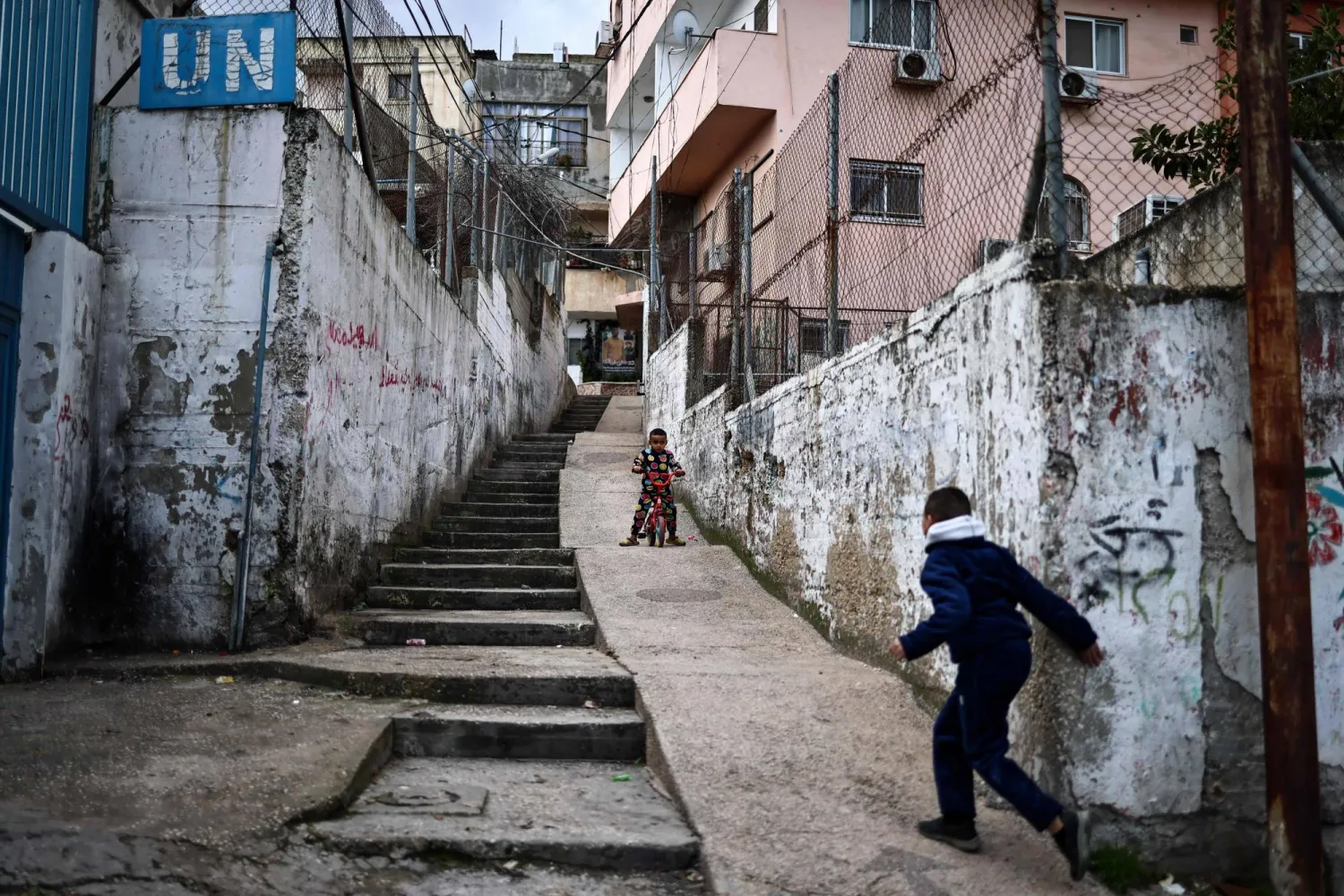
Children play at the Balata camp for Palestinian refugees, east of Nablus in the occupied West Bank on December 30, 2025. (AFP)
TT

Global ‘Fragmentation’ Fueling World’s Crises, Warns UN Refugee Chief

Children play at the Balata camp for Palestinian refugees, east of Nablus in the occupied West Bank on December 30, 2025. (AFP)

The outgoing United Nations refugee chief fears an increasingly fragmented world is fueling global conflicts and crises, and inflaming hostility towards people desperately fleeing for safety.

Reflecting on his decade at the helm of the UNHCR, Filippo Grandi told AFP that one of the most worrying developments had been how divisions had left the world seemingly incapable of resolving conflicts -- and increasingly unwilling to deal with the repercussions.

"This fragmentation of geopolitics that has caused the emergence of so many crises is perhaps the most worrying thing," the Italian diplomat said in his final interview as UN High Commissioner for Refugees.

"This world is unable to make peace; has become totally unable to make peace."

Grandi meanwhile lamented a "race to the bottom" in terms of countries tightening laws and practices to keep asylum seekers and refugees out.

He noted "a growing hostility, a rhetoric by the populist politicians targeting and scapegoating people on the move".

- 'Horrifying violations' -

Speaking at UNHCR's Geneva headquarters a day before the end of his tenure, Grandi said he had been inspired over the past decade by how regular people worldwide showed kindness and hospitality to people on the move.

"In spite of all the politics, in spite of the real challenges that these movements represent," he said, there is still a "deeply entrenched sense that if somebody flees from danger, one has the responsibility to help".

He also highlighted inspiring moments, including in 2021 when he witnessed former Colombian president Ivan Duque grant legal status to 1.7 million Venezuelans.

And more recently, "at the border between Lebanon and Syria and talking to people who had made the choice to go back just a few weeks after the fall of the Assad regime".

But the exhilaration felt in such moments had been matched by the "anger and profound sadness" felt in others.

"The worst is always when you witness an exodus that is caused by the most horrifying violations of human rights," he said, pointing to Myanmar and Sudan.

On Thursday, Grandi, 68, will be handing over the UNHCR reins to Barham Salih, 65, Iraq's president from 2018 to 2022, who was once a refugee himself.

"He will be an excellent leader for this organization," Grandi said, adding though that he had warned Salih: "It will be tough".

- 'Very painful' -

Grandi acknowledged it was "very painful" to be leaving when his agency is going through a profound crisis.

The UNHCR, like many other UN agencies, has been clobbered by international aid cuts since US President Donald Trump returned to office in January, and numerous other leading donors have also tightened their purse-strings.

The deep cuts have forced the agency to reduce aid and shutter services -- at a time when global displacement is surging.

In June, the UNHCR estimated that more than 117 million people have fled from their homes -- a figure that has nearly doubled in the past decade.

"We had to reduce the organization by about a third," Grandi said, adding that "even more painful" was that the agency "had to reduce what we deliver to refugees, to displaced people, to stateless people around the world significantly".

Washington, traditionally the UN's biggest donor, has branded the United Nations bloated and inefficient, and on Monday warned its agencies to "adapt, shrink or die".

Grandi said reforms could be beneficial but fears that the current "criticism of multilateralism and the UN focuses on the wrong target".

"States need institutions that help them work together," he said, warning that the very concept of international cooperation appeared to be evaporating.

"What worries me most is this 'my country first' rhetoric," he said, stressing: "It's not just Washington -- it's global".

"When that slogan is applied to international challenges, it is weak."

Grandi insisted that "no country can do any of this alone, not even the United States".

"The challenges will hit us all, including those countries first... We need to work together."


Iran Hangs 18-Year-Old Over Protests in Latest Wartime Execution, Say Activists

Iranians walk at a park on Nature Day, amid the US-Israeli conflict with Iran, in Tehran, Iran, April 2, 2026. Majid Asgaripour/WANA (West Asia News Agency) via Reuters
TT

Iran Hangs 18-Year-Old Over Protests in Latest Wartime Execution, Say Activists

Iranians walk at a park on Nature Day, amid the US-Israeli conflict with Iran, in Tehran, Iran, April 2, 2026. Majid Asgaripour/WANA (West Asia News Agency) via Reuters

Iranian authorities Thursday executed a teenager convicted over January protests after a fast-track trial rights groups labelled as "grossly unfair", as the country ramps up executions during the war with the US and Israel.

Amir Hossein Hatami, 18, was sentenced to death in February along with six others by a Tehran revolutionary court and was hanged at dawn in the notorious Ghezel Hesar prison outside the capital, according to Norway-based NGO Iran Human Rights.

The Iranian judiciary's Mizan Online website said he acted "against national security" on behalf of Israel and the United States by breaking into "a military center and destroying it in order to seize the weapons stored there" during the protests.

But Amnesty International said it was "outraged by the arbitrary execution of the teenage protester", adding the trial was "grossly unfair" and that he had been sentenced to death less than a month after his arrest.

Hatami is the fourth man to be executed over protests that broke out in Iran in late December against the rising cost of living before evolving into nationwide anti-government demonstrations. The protests peaked on January 8 and 9 and were met with a crackdown that activists say left thousands dead.

On March 19, authorities executed three men convicted of killing police in the protests, including 19-year-old Saleh Mohammadi, a wrestler who took part in international competitions.

This week, authorities have hanged four men convicted on charges of rebellion for membership in the banned People's Mujahedin of Iran (MEK) after their sentences were upheld by the supreme court.

Hatami "was subjected to torture and sentenced based on forced confessions in a grossly unfair trial before the revolutionary Court," said IHR director Mahmood Amiry-Moghaddam.

"In the past two weeks alone, three protesters and four political prisoners have been executed, and hundreds more remain at imminent risk," he added. IHR said that just 84 days had elapsed between his arrest and execution.

- 'Tool of repression' -

The seven were accused of setting fire to a base belonging to the Basij militia -- a volunteer force of the Revolutionary Guards -- in Tehran during the protests.

But defense lawyers accused plainclothes forces of trapping protesters inside a building, locking the doors, and themselves starting the fire.

Amnesty International said that the execution showed the judiciary is "a tool of repression sending individuals to the gallows to spread fear and exacting revenge on those demanding fundamental political change".

IHR said the seven men had been convicted in the fast track-trial -- just a month after their arrest -- by the court presided over by the notorious judge Abolqasem Salavati.

Salavati was sanctioned in 2019 by the United States, which said he is known as the "Judge of Death" for his frequent death sentences.

The executions came amid Iran's war with Israel and the United States which erupted on February 28 with strikes that killed the Islamic republic's supreme leader, Ali Khamenei.

"Hundreds more now face imminent executions in the coming days and weeks," warned Amiry-Moghaddam.


Austria Denies US Use of Airspace for Iran Military Operations

18 March 2026, ---: A US Navy F/A-18E Super Hornet with the Tomcatters of Strike Fighter Squadron 31 launches from the flight deck of the Ford-class aircraft carrier USS Gerald R. Ford in support of Operation Epic Fury. (Navy Handout/US Navy/Planet Pix via ZUMA Press Wire/dpa)
TT

Austria Denies US Use of Airspace for Iran Military Operations

18 March 2026, ---: A US Navy F/A-18E Super Hornet with the Tomcatters of Strike Fighter Squadron 31 launches from the flight deck of the Ford-class aircraft carrier USS Gerald R. Ford in support of Operation Epic Fury. (Navy Handout/US Navy/Planet Pix via ZUMA Press Wire/dpa)

Austria has denied the United States use of its airspace for military operations against Iran due to Austria's neutrality law, the country's defense ‌ministry said ‌on Thursday.

A spokesperson ‌for ⁠the ministry confirmed ⁠a report from Austrian news agency APA that the US had made "several" flyover requests to ⁠Austria, without specifying ‌how ‌many.

All US flyover requests ‌of a military ‌nature relating to the conflict in Iran had been rejected, the spokesperson ‌said.

Austria applies the same principle to ⁠other ⁠countries that are engaged in military conflict, the spokesperson added.

Individual cases were reviewed in consultation with the Austrian foreign ministry, the APA report noted.


Iran Fires on Israel as Trump Claims Threat from Tehran Nearly Eliminated

Iranian women clad in black chadors wave national flags and hold posters of Iranian Supreme Leader Mojtaba Khamenei (C) and of his late father, former Iranian Supreme Leader Ali Khamenei (R), during the annual Nature Day festival in Tehran, Iran, 02 April 2026. (EPA)
TT

Iran Fires on Israel as Trump Claims Threat from Tehran Nearly Eliminated

Iranian women clad in black chadors wave national flags and hold posters of Iranian Supreme Leader Mojtaba Khamenei (C) and of his late father, former Iranian Supreme Leader Ali Khamenei (R), during the annual Nature Day festival in Tehran, Iran, 02 April 2026. (EPA)

Iran fired more missiles at Israel and Gulf Arab states Thursday, demonstrating Tehran’s continued ability to strike its neighbors even as US President Donald Trump claimed the threat from the country was nearly eliminated.

Iran’s attacks on Gulf states along with its chokehold on the Strait of Hormuz have disrupted the world’s energy supplies with effects far beyond the Middle East. That has proved to be Iran’s greatest strategic advantage in the war. Britain held a call with nearly three dozen countries about how to reopen the strait once the fighting is over.

Trump has insisted the strait can be taken by force — but said it is not up to the US to do that. In an address to the American people Wednesday night, he encouraged countries that depend on oil from Hormuz to “build some delayed courage” and go “take it.”

Before the US and Israel started the war on Feb. 28 with strikes on Iran, the waterway was open to traffic and 20% of all traded oil passed through it.

Iran continues to strike Israel

Iran responded defiantly to Trump’s speech, in which the American president claimed US military action had been so decisive that “one of the most powerful countries” is “really no longer a threat.”

A spokesman for Iran’s military, Lt. Col. Ebrahim Zolfaghari, insisted Thursday that Tehran maintains hidden stockpiles of arms, munitions and production facilities. He said facilities targeted so far by US strikes are “insignificant.”

Just before Trump began his address — in which he said US “core strategic objectives are nearing completion” — explosions were heard in Dubai as air defenses worked to intercept an Iranian missile barrage.

Less than a half-hour after the president was done, Israel said its military was also working to intercept incoming missiles. Sirens sounded in Bahrain immediately after the speech.

Attacks continued across Iran on Thursday, with strikes reported in multiple cities.

Even amid the conflict, families went to a park in Tehran to play games and grill food to mark the last day of Iranian New Year, or Nowruz.

In Lebanon — home to Iran-backed Hezbollah who is fighting Israel, which has launched a ground invasion — an Israeli strike killed four people in the south, the Health Ministry said.

More than 1,900 people have been killed in Iran during the war, while 19 have been reported dead in Israel. More than two dozen people have died in Gulf states and the occupied West Bank, while 13 US service members have been killed.

More than 1,300 people have been killed and more than 1 million displaced in Lebanon. Ten Israeli soldiers have also died there.

Nearly three dozen nations talk about securing the Strait of Hormuz

Iranian attacks on about two dozen commercial ships, and the threat of more, have halted nearly all traffic in the waterway that connects the Gulf to the open ocean.

Since March 1, traffic through the strait has dropped 94% over the same period last year, according to the Lloyds List Intelligence shipping data firm. Two ships are confirmed to have paid a fee, the firm said, while others were allowed through based on agreements with their home governments.

Saudi Arabia piped about 1 billion barrels of oil away from the Strait of Hormuz in March, according to maritime data firm Kpler, while Iraq said Thursday that it had started to truck oil across Syria to avoid the strait.

The 35 countries that spoke Thursday, including all G7 countries except the US, as well as the United Arab Emirates and Bahrain, signed a declaration last month demanding Iran stop blocking the strait.

Thursday’s talks were focused on political and diplomatic measures, but British Foreign Secretary Yvette Cooper said military planners from an unspecified number of countries will also plot ways to ensure security once fighting ends, including potential mine-clearing work and “reassurance” for commercial shipping.

No country appears willing to try to open the strait by force while the war is raging. French President Emmanuel Macron, while on a visit to South Korea, called a military operation to secure the waterway “unrealistic.”

But there is a concern that Iran might limit traffic through the waterway even after US and Israeli attacks cease.

The idea of an international effort has echoes of the “coalition of the willing,” led by the UK and France, that was assembled to underpin Ukraine’s security in the event of a ceasefire in that war. The coalition is, in part, an attempt to demonstrate to Washington that Europe is doing more for its own security in the face of frequent criticism from Trump.

Oil prices rise again

The conflict is driving up prices for oil and natural gas, roiling stock markets, pushing up the cost of gasoline and threatening to make a range of goods, including food, more expensive.

On Thursday, Brent crude, the international standard, rose again and was around $108, up about 50% from Feb. 28.

Though the oil and gas that typically transits the strait is primarily sold to Asian nations, Japan and South Korea were the only two countries from the region joining Thursday's call about the strait. The supply of jet fuel has also been interrupted, with consequences for travel worldwide.
