


Police in Finland Arrest 2 in Connection with Damage to Undersea Telecom Cable

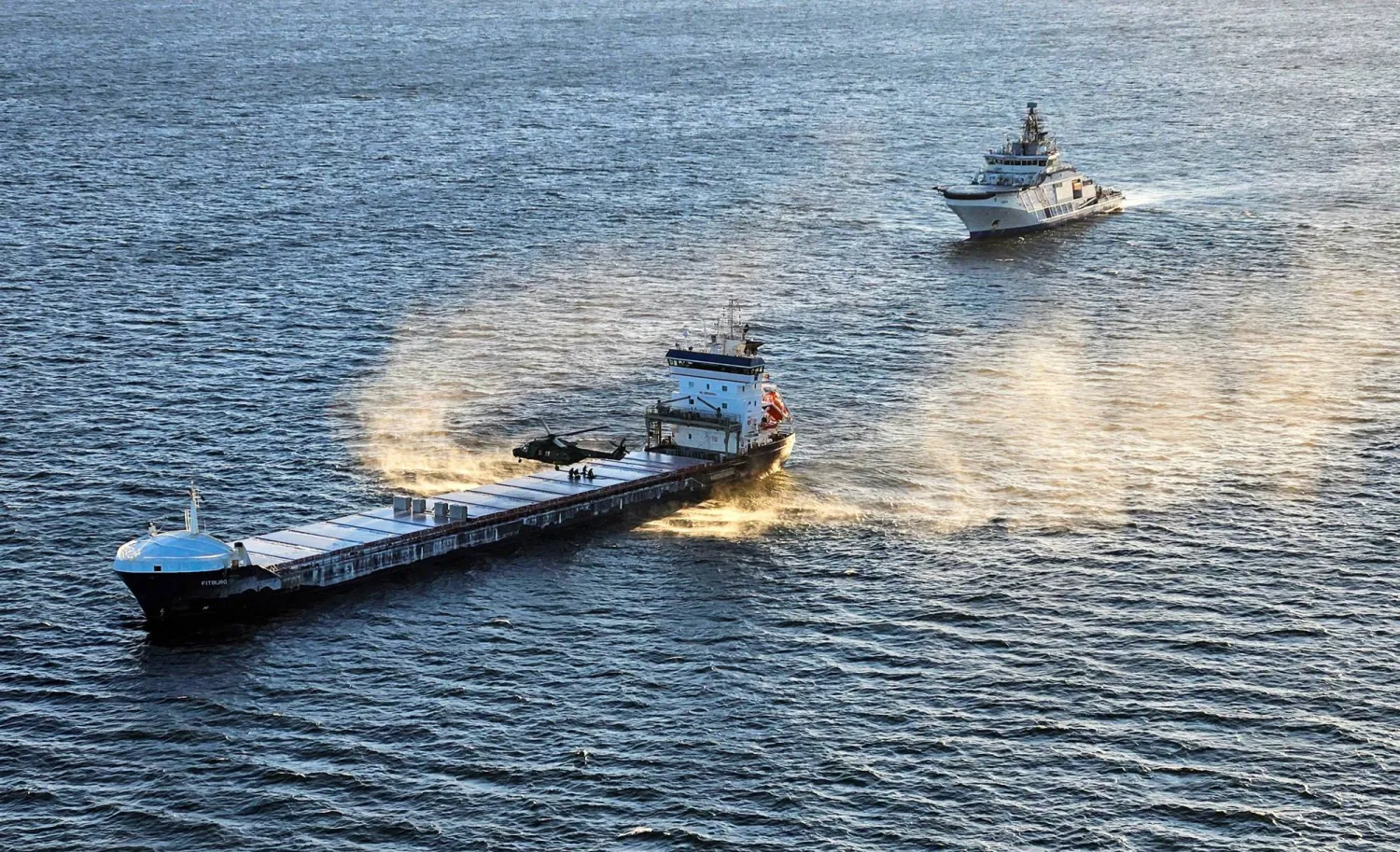
A Border Guard helicopter and a Coast Guard patrol ship Turva seize the Fitburg vessel suspected of a subsea cable breach in the Gulf of Finland on 31 December 2025, in this handout picture obtained on January 1, 2026. Finnish Police/Handout via REUTERS
TT

Police in Finland Arrest 2 in Connection with Damage to Undersea Telecom Cable

A Border Guard helicopter and a Coast Guard patrol ship Turva seize the Fitburg vessel suspected of a subsea cable breach in the Gulf of Finland on 31 December 2025, in this handout picture obtained on January 1, 2026. Finnish Police/Handout via REUTERS

Finnish authorities have arrested two people in connection with damage to an undersea telecommunications cable in the Gulf of Finland that occurred earlier this week between the capitals of Finland and Estonia, police said Thursday.

The damage was discovered early Wednesday in Estonia’s exclusive economic zone. The cable belongs to Finnish telecommunications service provider Elisa and is considered to be critical underwater infrastructure, The Associated Press said.

Helsinki police have opened an investigation into aggravated criminal damage and aggravated interference with telecommunications.

Officials placed two other people under travel bans as a result of the ongoing investigation, Helsinki police said in a statement Thursday.

The individuals’ connections to the ship was not immediately clear and police would not release their nationalities or other details.

The ship, named the Fitburg, was flagged in St. Vincent and the Grenadines. It had been traveling from Russia to Israel. The 14 crew members hail from Russia, Georgia, Azerbaijan and Kazakhstan and were detained by Finnish authorities.

Finnish National Police Commissioner Ilkka Koskimäki said earlier this week that the ship was dragging its anchor for hours when it was discovered in Finland’s exclusive economic zone. He noted investigators are not speculating on whether a state-level actor was behind the damage.

Finnish Customs discovered structural steel in the cargo that originated in Russia and falls under sanctions imposed by the European Union, the agency said in a statement.

"Import of such sanctioned goods into the EU is prohibited under EU sanctions regulations," the statement said. “Finnish Customs continues to investigate the sequence of events and the applicability of EU sanctions legislation to this case.”

The undersea cables and pipelines that crisscross one of the busiest shipping lanes in Europe link Nordic, Baltic and central European countries. They promote trade and energy security and, in some cases, reduce dependence on Russian energy resources.

Finnish authorities last year charged the captain and two senior officers of a Russia-linked vessel, the Eagle S, that damaged undersea cables between Finland and Estonia on Christmas Day in 2024.

The Finnish deputy prosecutor general said in an August statement that charges of aggravated criminal mischief and aggravated interference with communications were filed against the captain and first and second officers of the oil tanker. The officers, whose names were not made public, denied the allegations, the statement said.

The Kremlin previously denied involvement in damaging the infrastructure, which provides power and communication for thousands of Europeans.

The Eagle S was flagged in the Cook Islands but had been described by Finnish customs officials and the European Union’s executive commission as part of Russia’s shadow fleet of fuel tankers. Those are aging vessels with obscure ownership, acquired to evade Western sanctions during the war in Ukraine and operating without Western-regulated insurance.

For the West, such incidents are believed to be part of widespread sabotage attacks in Europe allegedly linked to Moscow following its full-scale invasion of Ukraine in 2022.



Iran Judicial Chief Says Protest Instigators to Receive No Leniency

In this photo obtained by The Associated Press, Iranians attend an anti-government protest in Tehran, Iran, Jan. 9, 2026. (UGC via AP, File)
TT

Iran Judicial Chief Says Protest Instigators to Receive No Leniency

In this photo obtained by The Associated Press, Iranians attend an anti-government protest in Tehran, Iran, Jan. 9, 2026. (UGC via AP, File)

The head of Iran's judiciary warned on Sunday that those behind a recent wave of anti-government protests could expect punishment "without the slightest leniency".

What began earlier this month as demonstrations against the high cost of living boiled over into a broader protest movement that represented the gravest challenge to the country's clerical leadership in years.

The protests have abated following a government crackdown, carried out under an internet blackout that left the country largely cut off from the outside world.

"The people rightly demand that the accused and the main instigators of the riots and the acts of terrorism and violence be tried as quickly as possible and punished if found guilty," judicial chief Gholamhossein Mohseni Ejei was quoted as saying by the official Mizan online news portal.

He went on to say "the greatest rigor must be applied in the investigations," but insisted that "justice entails judging and punishing without the slightest leniency the criminals who took up arms and killed people, or committed arson, destruction and massacres".

The Iranian government has put the death toll from the protests at 3,117, including 2,427 people it has labelled "martyrs" -- a term used to distinguish members of the security forces and innocent bystanders from those described by authorities as "rioters" incited by the US and Israel.

Rights groups, however, have said protesters account for the vast majority of the deaths, documenting several thousand killed, with the Norway-based NGO Iran Human Rights saying the final figure could top 25,000 dead.

- 'Just in case' -

The US-based Human Rights Activists News Agency (HRANA) has said more than 26,000 people have been arrested in relation to the demonstrations.

Iran is the world's second most prolific user of the death penalty after China, and the soaring number of arrests and vows of stiff punishment have raised fears it could use executions to repress dissent.

US President Donald Trump has threatened to intervene militarily should Iran begin putting protest suspects to death, but has recently softened his rhetoric after claiming Tehran had suspended planned executions.

On Thursday, he told reporters on the way back from Davos that the United States was nonetheless sending a "massive fleet" toward Iran "just in case".

The United States carried out strikes on Iranian nuclear facilities in June when it briefly joined Israel's 12-day war against the country.

Rights groups have accused authorities of repeatedly using live ammunition on protesters, but Colonel Mehdi Sharif Kazemi, commander of Iran's special police, maintained authorities had used only non-lethal measures such as water cannons to quell the unrest.

"The use of weapons (by the police) during this operation has sparked some criticism, but in fact, the police did not resort to using any firearms," he was quoted as saying by the Mehr news agency on Sunday.

"We used non-lethal means in order to guarantee the safety of the population and avoid any killings."


Iran Unveils Mural Warning of Retaliation if US Conducts a Military Strike

A billboard depicting a damaged US aircraft carrier with disabled fighter jets on its deck and a sign reading in Farsi and English, "If you sow the wind, you'll reap the whirlwind," is seen at Enqelab-e-Eslami Square in Tehran, Iran, Sunday, Jan. 25, 2026. (AP)
TT

Iran Unveils Mural Warning of Retaliation if US Conducts a Military Strike

A billboard depicting a damaged US aircraft carrier with disabled fighter jets on its deck and a sign reading in Farsi and English, "If you sow the wind, you'll reap the whirlwind," is seen at Enqelab-e-Eslami Square in Tehran, Iran, Sunday, Jan. 25, 2026. (AP)

Iranian authorities unveiled a new mural on a giant billboard in a central Tehran square on Sunday with a direct warning to the United States to not attempt a military strike on the country, as US warships head to the region.

The image shows a bird's-eye view of an aircraft carrier with damaged and exploding fighter planes on its flight deck. The deck is strewn with bodies and streaked with blood that trails into the water behind the ship to form a pattern reminiscent of the stripes of the American flag. A slogan is emblazoned across one corner: “If you sow the wind, you will reap the whirlwind.”

The unveiling of the mural in Enghelab Square comes as the USS Abraham Lincoln aircraft carrier and accompanying warships move toward the region. US President Donald Trump has said the ships are being moved “just in case” he decides to take action.

“We have a massive fleet heading in that direction and maybe we won’t have to use it,” Trump said Thursday.

Enghelab Square is used for gatherings called by the state and authorities change its mural based on national occasions. On Saturday, the commander of Iran’s paramilitary Revolutionary Guard warned that his force is “more ready than ever, finger on the trigger.”

Tension between the US and Iran has spiked in the wake of a brutal crackdown on nationwide protests that saw thousands of people killed and tens of thousands arrested. Trump had threatened military action if Iran continued to kill peaceful protesters or carried out mass executions of those detained.

There have been no further protests for days and Trump claimed recently that Tehran had halted the planned execution of about 800 arrested protesters — a claim Iran’s top prosecutor called “completely false.”

But Trump has indicated he is keeping his options open, saying on Thursday that any military action would make last June’s US strikes on Iranian nuclear sites “look like peanuts.”

US Central Command said on social media that its Air Force F-15E Strike Eagle now has a presence in the Middle East, noting the fighter jet “enhances combat readiness and promotes regional security and stability.”

Similarly, the UK Ministry of Defense said Thursday that it deployed its Typhoon fighter jets to Qatar “in a defensive capacity.”

The protests in Iran began on Dec. 28, sparked by the fall of the Iranian currency, the rial, and quickly spread across the country. They were met by a violent crackdown by Iran’s theocracy, which does not tolerate dissent.

The death toll reported by activists has continued to rise since the end of the demonstrations, as information trickles out despite a more than two-week internet blackout — the most comprehensive in Iran’s history.

The US-based Human Rights Activists News Agency on Sunday put the death toll at 5,529, with the number expected to increase. It says more than 41,200 people have been arrested.

The group’s figures have been accurate in previous unrest and rely on a network of activists in Iran to verify deaths. That death toll exceeds that of any other round of protest or unrest there in decades, and recalls the chaos surrounding Iran’s 1979 revolution. The Associated Press has not been able to independently verify the toll.

Iran’s government has put the death toll at a far lower 3,117, saying 2,427 were civilians and security forces, and labeled the rest “terrorists.” In the past, Iran’s theocracy has undercounted or not reported fatalities from unrest.


France Detains Captain of Suspected Russian ‘Shadow Fleet’ Tanker Seized in Mediterranean

The silhouette of a French navy boat surrounding the GRINCH oil tanker, intercepted by France in the Alboran Sea on suspicion of operating under a false flag and belonging to Russia's shadow fleet that enables Russia to export oil despite sanctions, and diverted to the port of Marseille-Fos, in the Gulf of Fos-sur-Mer, - Reuters
TT

France Detains Captain of Suspected Russian ‘Shadow Fleet’ Tanker Seized in Mediterranean

The silhouette of a French navy boat surrounding the GRINCH oil tanker, intercepted by France in the Alboran Sea on suspicion of operating under a false flag and belonging to Russia's shadow fleet that enables Russia to export oil despite sanctions, and diverted to the port of Marseille-Fos, in the Gulf of Fos-sur-Mer, - Reuters

The captain of a tanker intercepted in the Mediterranean Sea by the French navy on suspicion of shipping oil in violation of sanctions against Russia was reported Sunday as being held in custody for questioning.

The ship’s Indian captain was handed to judicial authorities following the diversion of the oil tanker, Grinch, and its arrival at anchorage in the Gulf of Fos-sur-Mer, French media reported, citing a statement by the Marseille prosecutor’s office.

The Ici Provence radio broadcaster reported that the crew, also of Indian nationality, was being kept on board. A preliminary investigation was opened on charges of failure to fly a flag, according to Reuters.

The Grinch came from Murmansk in northwestern Russia and is suspected of being part of the sanctioned Russian “shadow fleet." A video provided by the French military showed members of the navy boarding the ship from a helicopter earlier this week.

Russia is believed to be using a fleet of over 400 ships to evade sanctions over its war on Ukraine. France and other countries have vowed to crack down.

The fleet comprises aging vessels and tankers owned by nontransparent entities with addresses in non-sanctioning countries, and sailing under flags from such countries.

Last September, French naval forces boarded another oil tanker off the French Atlantic coast that President Emmanuel Macron also linked to the shadow fleet. Putin denounced that interception as an act of piracy.

That tanker’s captain will go on trial in February over the crew’s alleged refusal to cooperate, according to French judicial authorities.