


Iran Supreme Leader Says Will Not Yield as Protests Simmer and US Threatens

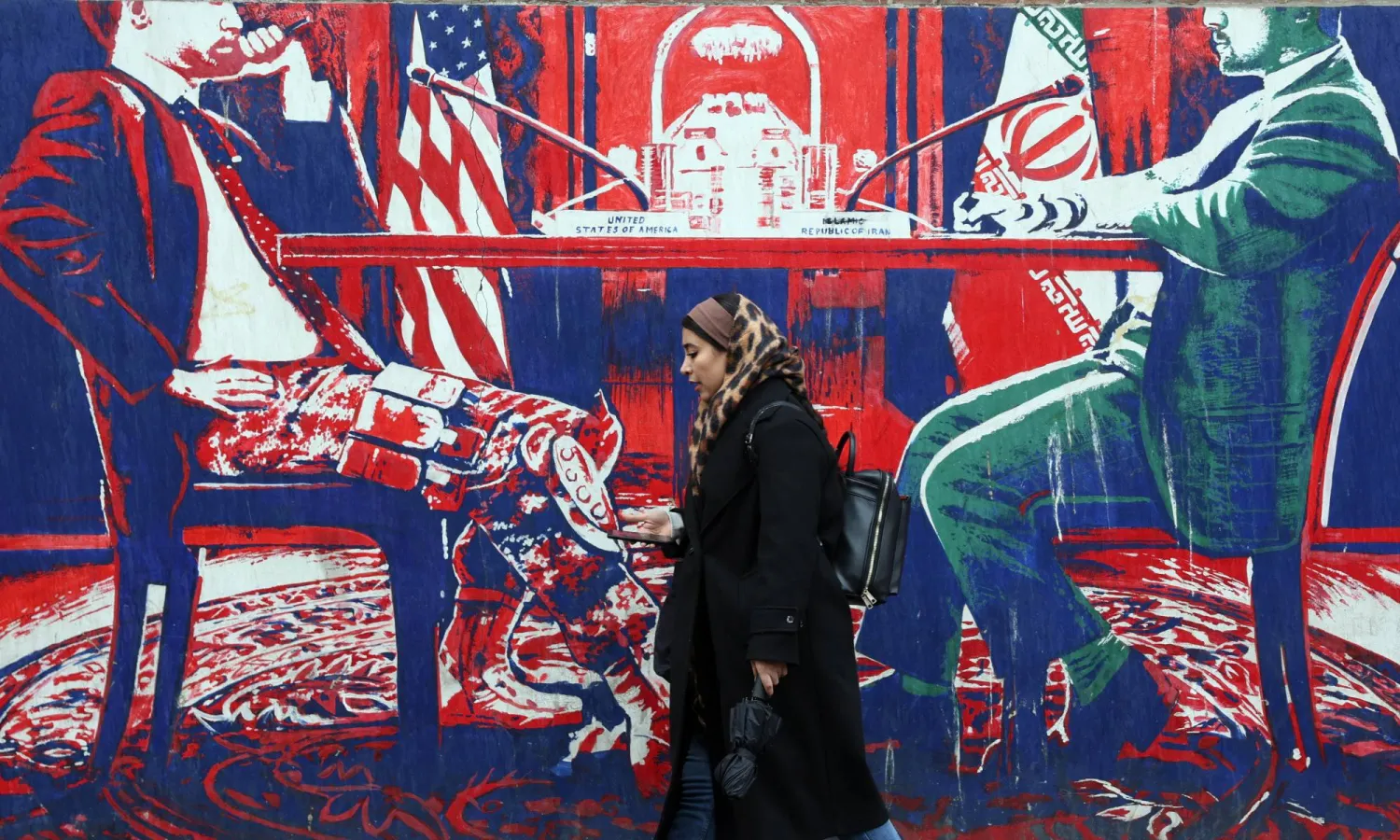
An Iranian woman walks past an anti-US mural on a street in Tehran, Iran, 03 January 2026. EPA/ABEDIN TAHERKENAREH
TT

Iran Supreme Leader Says Will Not Yield as Protests Simmer and US Threatens

An Iranian woman walks past an anti-US mural on a street in Tehran, Iran, 03 January 2026. EPA/ABEDIN TAHERKENAREH

Iran's Supreme Leader Ali Khamenei vowed not to yield after US President Donald Trump threatened to come to the aid of protesters, as ​rights groups reported a sharp rise in arrests following days of unrest sparked by soaring inflation.

Speaking in a recorded appearance on television on Saturday, Khamenei said the Islamic Republic "will not yield to the enemy" and said rioters should be "put in their place".

ECONOMIC CRISIS

Authorities have attempted to maintain a dual approach to the unrest, saying protests over the economy are legitimate and will be met ‌by dialogue, while ‌meeting some demonstrations with tear gas amid violent street confrontations.

"The ‌bazaaris ⁠were ​right. They ‌are right to say they cannot do business in these conditions," said Khamenei, referring to market traders' concerns over the currency slide.

"We will speak with the protesters but talking to rioters is useless. Rioters should be put in their place," he added.

The weeklong protests, have become the biggest in Iran since 2022, when the death of 22-year-old Mahsa Amini in police custody triggered nationwide demonstrations. However, the protests have yet to be as widespread and intense as those surrounding the death of Amini, who was detained over not wearing her hijab, or headscarf, to the liking of authorities.

Reports of violence have centered on small cities in Iran's western provinces, where several people have been killed. Authorities have said two members of the security services had died and more than a dozen were injured in the unrest. 

Rights groups say more than 10 people have been killed so far.

Hengaw, a Kurdish rights group, said ⁠late on Friday that it had identified 133 people arrested, an increase of 77 from the previous day.

The deaths overnight into Saturday involved a new level of violence. In Qom, a grenade exploded, killing a man there, the state-owned IRAN newspaper reported.

Online videos from Qom purportedly showed fires in the street overnight.

The second death happened in the town of Harsin, some 370 kilometers (230 miles) southwest of Tehran. There, the newspaper said a member of the Basij, the all-volunteer arm of Iran's Revolutionary Guard, died in a gun and knife attack in the town in Kermanshah province.

Demonstrations have reached over 100 locations in 22 of Iran’s 31 provinces, the US-based Human Rights Activists News Agency reported.



Türkiye Says US Patriot System Deployed to Boost Air Defense amid Iran War

A Turkish soldier stands guard as army and security personnel search a field after a piece of ammunition fell following the interception of a missile launched from Iran by a NATO air defense system, in Diyarbakir, Türkiye, March 9, 2026. REUTERS/Sertac Kayar
TT

Türkiye Says US Patriot System Deployed to Boost Air Defense amid Iran War

A Turkish soldier stands guard as army and security personnel search a field after a piece of ammunition fell following the interception of a missile launched from Iran by a NATO air defense system, in Diyarbakir, Türkiye, March 9, 2026. REUTERS/Sertac Kayar

Türkiye said on Tuesday that a US Patriot air defense system was deployed to its southeast, near a NATO radar base, as part of steps by the alliance to boost air defenses in the face of missile threats from the Iran war.

It is being deployed to Malatya province, the location of the Kurecik NATO radar base, which provides vital data for the alliance ‌and helped ‌identify two Iranian ballistic missiles heading toward ‌ Türkiye ⁠over the last ⁠week, said Reuters.

Iran has said it is not at war with regional countries and denies explicitly targeting its neighbor Türkiye. Ankara has warned Tehran against firing any more missiles towards it and the two countries' presidents discussed the issue on Monday.

"In addition to ⁠the measures we take on a ‌national level, air and missile ‌defense measures by NATO have been increased. In that ‌framework, one Patriot System is being deployed to ‌Malatya to contribute to defending our air space," the defense ministry said.

It added that Türkiye would continue to evaluate regional developments and cooperate with NATO allies.

The deployment comes ‌amid reports that Washington is looking into redeploying its military assets, including Patriot ⁠systems, currently stationed ⁠in South Korea.

It was not immediately clear where the Patriot system or its batteries were being redeployed from.

Türkiye, an emerging leader in the global defense industry that has the alliance's second-largest army, lacks its own fully fledged air defenses despite development efforts, and has relied on NATO air defenses stationed in the eastern Mediterranean Sea in both missile incidents in the last week.

There is currently one Patriot system, from Spain, deployed in Türkiye as part of NATO defens es.


Israel’s Netanyahu Warns ‘We Are Not Done Yet’ in Iran

A person holds a sign supporting Israeli Prime Minister Benjamin Netanyahu and US President Donald Trump during a gathering of Iranian community members showing support for Israel and the United States, outside the Consulate General of Israel in Los Angeles, on March 5, 2026. (AFP)
TT

Israel’s Netanyahu Warns ‘We Are Not Done Yet’ in Iran

A person holds a sign supporting Israeli Prime Minister Benjamin Netanyahu and US President Donald Trump during a gathering of Iranian community members showing support for Israel and the United States, outside the Consulate General of Israel in Los Angeles, on March 5, 2026. (AFP)

Prime Minister Benjamin Netanyahu warned that Israel's military offensive against Iran was "not done yet", saying the operation was degrading Iran's clerical leadership.

"Our aspiration is to bring the Iranian people to cast off the yoke of tyranny; ultimately, it depends on them. But there is no doubt that with the actions taken so far, we are breaking their bones -- and we are not done yet," Netanyahu said during a visit to the National Health Command Center on Monday night, according to a statement published Tuesday.


Attacks against Israel Intensify as New Supreme Leader Takes over in Iran

 08 March 2026, Israel, Tel Aviv: Israelis inspect the damage of a site hit by an Iranian ballistic missile in central Israel. (dpa)
08 March 2026, Israel, Tel Aviv: Israelis inspect the damage of a site hit by an Iranian ballistic missile in central Israel. (dpa)
TT

Attacks against Israel Intensify as New Supreme Leader Takes over in Iran

 08 March 2026, Israel, Tel Aviv: Israelis inspect the damage of a site hit by an Iranian ballistic missile in central Israel. (dpa)
08 March 2026, Israel, Tel Aviv: Israelis inspect the damage of a site hit by an Iranian ballistic missile in central Israel. (dpa)

Iran and Hezbollah intensified their attacks against Israel after Tehran appointed Mojtaba Khamenei to replace his slain father as Iran's supreme leader.

On Monday, reports said Iran launched seven missile barrages at Israel while Lebanon’s Hezbollah conducted seven waves of rocket, mortar, and drone attacks targeting Israeli forces at the border and inside Israel.

In Tel Aviv, analysts said the escalation came as a message from the new supreme leader that he was avenging his father's murder.

The attacks sent five million residents running to bomb shelters throughout Sunday evening and Monday afternoon, reported Israeli media.

Emergency responders and news outlets have repeatedly documented injuries sustained while civilians ran for cover, including the death of a 102-year-old man who fell on his way to a protected space in Ramat Gan and later died of his wounds.

Two workers at a construction site were killed and tens of accidents were reported due to the fall of rocket debris in two separate locations following several rocket barrages launched by Iran.

The Israeli army, which has maintained strict secrecy regarding the outcome of Iran and Hezbollah bombings against its sensitive military positions, affirms that along its US partners, is engaged in an intensive operation aimed at degrading Iranian missile capabilities and targeting Hezbollah infrastructure in Lebanon.

The army even boasted that its forces have launched more strikes than the US against Iran, despite being occupied in a second front against Hezbollah at the Lebanese borders.

More Israeli strikes

The Tel Aviv-based Institute for National Security Studies (INSS) said that early in the war, US forces carried out over three times as many strikes in Iran, but since the shift to the "next phase," Israel has dramatically increased its attacks, potentially reflecting strategy, munitions limits and political calculations.

During the first five days of the war, US forces struck about 2,000 targets in Iran, compared with roughly 600 Israeli strikes.

Over the weekend, however, after both Israel and the United States announced a transition to the “next phase” of Operation Roaring Lion, the trend shifted. Since then, the Israeli army has carried out nearly three times as many strikes as the US military, hitting about 2,800 targets compared with roughly 1,000 US strikes.

Overall, according to INSS figures, the United States has attacked about 3,000 targets in Iran since the start of the operation. Israel has struck around 3,400 targets in Iran, in addition to about 600 more in Lebanon.

According to the Yedioth Ahronoth daily, the data suggest that after the transition to the new phase of the campaign, Israel sharply accelerated its strikes in Iran, while the US has largely maintained the operational tempo it set earlier in the war.

Behind the numbers may lie a broader story reflecting different approaches by Israel and the US to managing the conflict.

It said that one possible reason Washington has not significantly increased its strike rate may involve munitions supplies and interceptor inventories.

Also, the US has moved additional military assets toward the Middle East, some of which are still en route.

These include the aircraft carrier USS George Bush and its strike group, which includes three destroyers. In recent days, four US B-1 bombers have also arrived in Britain.

From Israel’s perspective, the shift in strike tempo as the campaign enters its next phase may reflect progress in the fighting. It may also indicate concern that Trump could halt the operation due to public opinion in the United States.

Israeli officials reportedly understood early in the war that it would be important to maximize operational gains quickly.

At the same time, Trump has said several times that the war could last a month or even longer, and there are signs the campaign is far from over.

Trump also said the final decision on when the war ends will ultimately rest with him, although Israeli Prime Minister Benjamin Netanyahu will have influence over the timing.

Meanwhile, reports said Trump and his administration have so far offered mixed messages and contradictory explanations on the joint US-Israeli military campaign against Iran.

According to polls, most Americans still ignore why they are at war that has immediately impacted the US economy and energy prices.

According to the right-wing Israel Hayom newspaper, Israelis estimate that despite the wave of large-scale Iranian attacks against Israel, Tehran has not altered its tactics, continuing to bet on the US to intervene and stop the war.