

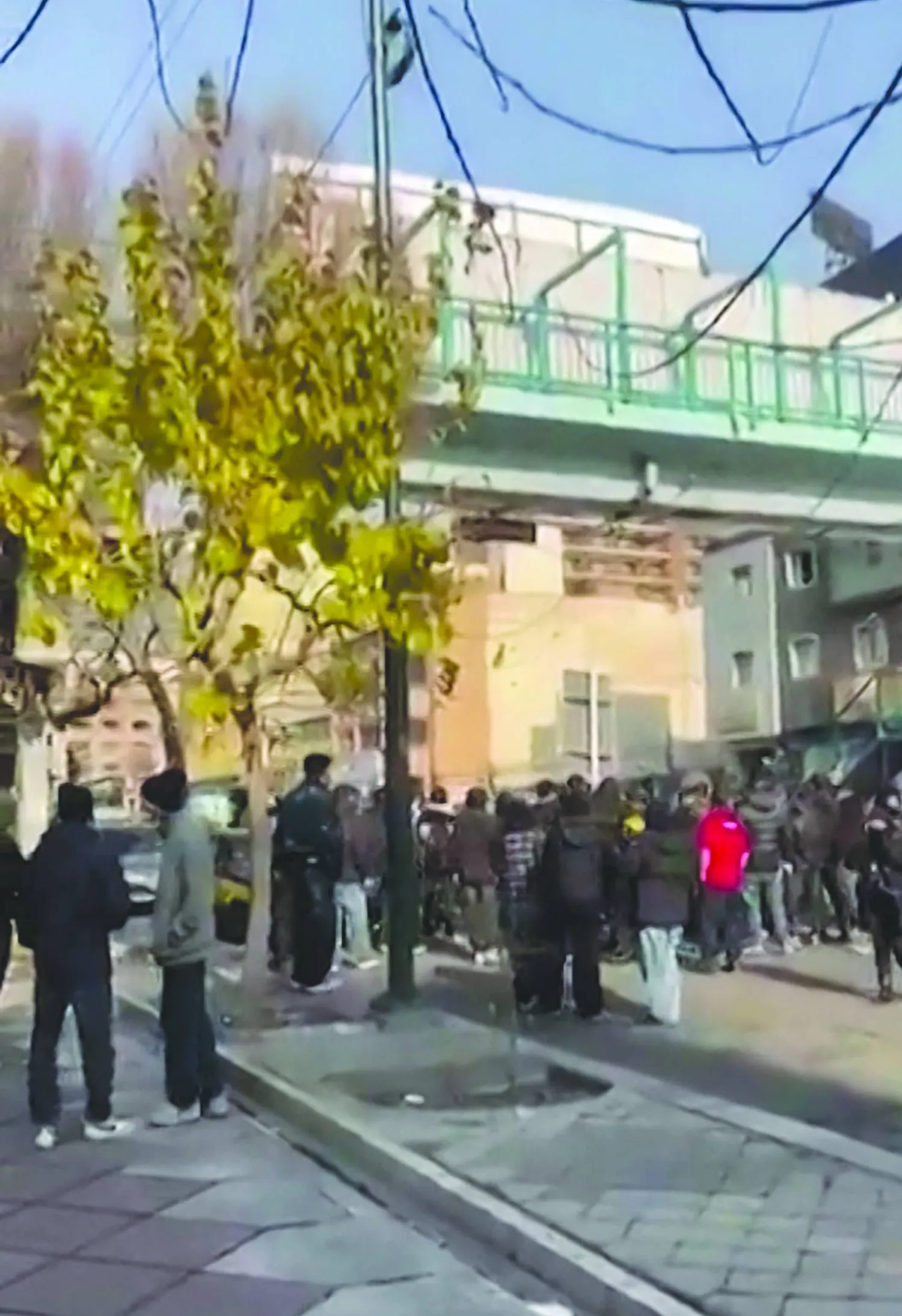

Security Forces Clash with Protesters in Iran’s Main Market as at Least 36 Killed in Demonstrations

This video grab taken from UGC images and posted online on January 4, 2026, show Iranian security forces dispersing protesters with tear gas in central Tehran, as demonstrations first sparked by anger over the rising cost of living entered a second week. (Photo by UGC / AFP)
TT

Security Forces Clash with Protesters in Iran’s Main Market as at Least 36 Killed in Demonstrations

This video grab taken from UGC images and posted online on January 4, 2026, show Iranian security forces dispersing protesters with tear gas in central Tehran, as demonstrations first sparked by anger over the rising cost of living entered a second week. (Photo by UGC / AFP)

Protesters angry over Iran's ailing economy conducted a sit-in Tuesday at Tehran's Grand Bazaar, witnesses said, with security forces ultimately firing tear gas and dispersing demonstrators as the rest of the market shut down. 

The protest at the Grand Bazaar, the beating heart for centuries of both Iran's economic and political life, represented the latest signal that the demonstrations likely are to continue as the country's rial currency fell to a record low Tuesday. Already, violence surrounding the protests has killed at least 36 people with authorities detaining more than 1,200 others, activists abroad say. 

Meanwhile, the situation was likely to worsen as Iran's Central Bank drastically reduced the subsidized exchange rates for dollars it offers to importers and producers in the country. That likely will see merchants pass on price hikes in the coming days for goods directly onto consumers, whose life savings already have dwindled over years of international sanctions targeting the country. 

Iran's reformist President Masoud Pezeshkian, while ordering a government investigation into one incident involving the protests, otherwise signaled Tuesday that the crisis may be rapidly moving beyond the control of officials. 

"We should not expect the government to handle all of this alone," Pezeshkian said in a televised speech. "The government simply does not have that capacity." 

Turmoil shakes Grand Bazaar 

In the Grand Bazaar, a labyrinth-like warren of covered passages and alleyways, demonstrators sat down in one passage in front of security forces as other shops nearby shut down on Tuesday, online videos showed and witnesses said. Other demonstrations similarly have seen people sit down in front of police after a photo circulated earlier of a man seen sitting alone in front of security forces. 

Authorities later fired tear gas to disperse the protesters. Iranian state-run media did not immediately acknowledge the incident, which has been common in the days since the demonstrations began on Dec. 28. Later footage purportedly showed tear gas at a hospital and a metro station in Tehran. 

Iran has faced rounds of nationwide protests in recent years. As sanctions tightened and Iran struggled after a 12-day war with Israel in June, its rial currency collapsed in December, reaching 1.4 million to $1. Protests began soon after, with demonstrators chanting against Iran’s theocracy. 

On Tuesday, $1 traded at 1.46 million rials, a new low, with no signs of slowing. Prior to Iran’s 1979 revolution, the rial was broadly stable, trading at around 70 to $1. At the time of Iran’s 2015 nuclear deal with world powers, $1 traded for 32,000 rials. 

Exchange rate change points to more pain coming  

More pain may be coming for Iranian consumers. Iran’s Central Bank in recent days ended a preferential, subsidized dollar-rial exchange rate for all products except medicine and wheat. Iran’s government had offered that rate to importers and producers to try to ensure the flow of essential goods despite international sanctions over its nuclear program and other issues. 

However, many of those firms took advantage of the difference in rates, pocketing ever-greater profits as normal Iranians watched their savings rapidly lose value against the dollar. 

The currency and rate depreciation has directly impacted what's available in stores — and at what price. The average bottle of cooking oil just doubled in price, the state-run IRNA news agency reported. Many have complained about shelves being empty in stores, likely as suppliers and merchants fear selling cooking oil at a loss. Cheese and chicken prices also spiked, while imported rice hasn't been available in some shops. 

Pezeshkian in his speech blamed inflation, sanctions and other woes for causing the depreciation and warned tougher times may be coming. 

"If we do not make realistic decisions, we ourselves will push the country toward crisis and then complain about the consequences," he warned. 

Iran promises Ilam investigation  

Late Monday, Pezeshkian assigned the interior ministry to form a special team for a "full-fledged investigation" of what had been happening in Ilam province. Protesters in Malekshahi County in Iran’s Ilam province, some 515 kilometers (320 miles) southwest of Iran's capital, Tehran, were killed as online videos purported to show security forces firing on civilians. 

The presidency also acknowledged an "incident in a hospital in the city of Ilam." Online video showed security forces wearing riot gear raiding a hospital, where activists said they were seeking demonstrators. 

The hospital assault drew criticism from the US State Department, which in Iran's Farsi language called the incident "a crime." 

"Storming the wards, beating medical staff and attacking the wounded with tear gas and ammunition is an clear crime against humanity," a post on the social platform X read. "Hospitals are not battlefields." 

A report by the semiofficial Fars news agency earlier alleged without offering evidence that demonstrators carried firearms and grenades. Tuesday night, Fars reported that an angry crowd from a funeral for two of the dead stormed and damaged three banks in Malekshahi, leading to one person being killed and several wounded. 

Ilam province is mainly home to the country's Kurdish and Lur ethnic groups and faces severe economic hardship. 

Protester deaths a focus of Trump  

The US-based Human Rights Activists News Agency offered the latest death toll of 36 for the demonstrations. It said 29 protesters, four children and two members of Iran’s security forces have been killed. Demonstrations have reached over 270 locations in 27 of Iran’s 31 provinces, 

The group, which relies on an activist network inside of Iran for its reporting, has been accurate in past unrest. 

Fars, believed close to Iran’s paramilitary Revolutionary Guard, reported late Monday that some 250 police officers and 45 members of the Guard’s all-volunteer Basij force have been hurt in the demonstrations. 

The growing death toll carries with it the chance of American intervention. US President Donald Trump warned Iran on Friday that if Tehran "violently kills peaceful protesters," the United States "will come to their rescue." Supreme Leader Ali Khamenei on Saturday said "rioters must be put in their place." 

While it remains unclear how and if Trump will intervene, his comments sparked an immediate, angry response, with officials within the theocracy threatening to target American troops in the Middle East. The comments took on new importance after the US military on Saturday captured Venezuelan President Nicolas Maduro, a longtime ally of Tehran. 


US Needs to Control Venezuelan Oil Sales, Revenue to Drive Change, Says Energy Secretary

The city of Caracas, days after the US launched a strike on Venezuela and captured President Nicolas Maduro and his wife Cilia Flores, Venezuela January 7, 2026. (Reuters)
TT

US Needs to Control Venezuelan Oil Sales, Revenue to Drive Change, Says Energy Secretary

The city of Caracas, days after the US launched a strike on Venezuela and captured President Nicolas Maduro and his wife Cilia Flores, Venezuela January 7, 2026. (Reuters)

The United States needs to control Venezuela's oil sales and revenue to drive the changes it wants to see in the country, Energy Secretary Chris Wright said on Wednesday.

Wright said he was speaking to US oil companies to learn what conditions would enable them to enter the South American country and added that he wanted to sell Venezuelan oil to US refineries.

Over the weekend, President Donald Trump said the US would "take control" of Venezuela after US forces ousted Venezuelan President Nicolas Maduro, a step that could give US energy companies access to the country's vast oil reserves.

"Instead ‌of the oil ‌being blockaded as it is right now, we're ‌going ⁠to let the ‌oil flow," Wright said, adding that the government would sell it to buyers in the US and around the world.

The US would sell the production coming out of Venezuela indefinitely, he said. The sales would be controlled by the US government, Wright added, with revenues collected from them "deposited into accounts controlled by the US government."

On Tuesday, Caracas and Washington reached a deal to export up ⁠to $2 billion worth of Venezuelan crude to the United States, under which Venezuela will be "turning over" between ‌30 and 50 million barrels of "sanctioned oil" to ‍the US.

"If we control the ‍flow of oil, the sales of that oil, and the flow of ‍the cash that comes from those sales, we have large leverage. But without large leverage...you don't get change."

Wright was speaking at the Goldman Sachs Energy, CleanTech & Utilities Conference in Miami.

Shares of US refiners Marathon Petroleum, Phillips 66 and Valero Energy were up between 2.5% and 5%.

Raising crude output from Venezuela is a top objective for Trump. Venezuela was producing as much as 3.5 million ⁠barrels per day (bpd) in the 1970s. But mismanagement and limited foreign investment led to a huge drop in annual production, which averaged about 1.1 million bpd last year.

"We could get several hundred thousand barrels a day of additional production in the short to medium term if the conditions are there for just small capital deployments," Wright said.

The South American country sits atop the world's largest oil reserves but accounts only for about 1% of global supply.

US oil executives are expected to visit the White House later this week to discuss ways to revive Venezuela's tattered oil sector, Reuters reported on Tuesday.

Chevron has been invited to ‌the meeting, a source familiar with the matter said on Wednesday.


Netanyahu Tries to Calm Tensions After Israeli Bus Runs Over and Kills Ultra-Orthodox Teen

Israeli Prime Minister Benjamin Netanyahu (C) attends a debate initiated by the opposition as part of a plenary session in the Knesset, the Israeli parliament, in Jerusalem, 05 January 2026. (EPA)
TT

Netanyahu Tries to Calm Tensions After Israeli Bus Runs Over and Kills Ultra-Orthodox Teen

Israeli Prime Minister Benjamin Netanyahu (C) attends a debate initiated by the opposition as part of a plenary session in the Knesset, the Israeli parliament, in Jerusalem, 05 January 2026. (EPA)

Israel's Prime Minister Benjamin Netanyahu urged calm on Wednesday after a bus driver ran over and killed a teenage boy during a protest by thousands of ultra-Orthodox Jewish demonstrators against a law seeking to draft them into Israel’s military.

“I call for restraint to prevent the mood from becoming further inflamed so that, heaven forbid, we do not have additional tragedies,” Netanyahu said in a statement, adding that the death would be thoroughly investigated.

The incident on Tuesday evening killed yeshiva student Yosef Eisenthal, who police said was 14. Video from the protest obtained by The Associated Press showed the boy being trapped under the vehicle while the driver continued to drive on for several meters as onlookers jostled and screamed.

Police officers arrested and questioned the bus driver, who told investigators he was attacked by protesters before his vehicle hit the boy. Police said Wednesday that the driver's arrest had been extended until Jan. 15. He has not yet been charged.

Protesters had been blocking the road and acting violently toward police officers, throwing eggs and other objects at them, a police spokesperson said.

The violence reflected growing tensions between the Israeli authorities and the ultra-Orthodox, known as Haredim, as the government mulls plans to draft them into the military.

When Israel was founded in 1948, a small number of gifted ultra-Orthodox scholars were granted exemptions from the draft, which is compulsory for most Jews in the country. But with a push from politically powerful religious parties, those numbers have swelled over the decades.

There is support for rolling back the ultra-Orthodox exemption among many secular Israelis, especially those who have served multiple rounds of duty in the latest war between Israel and the Palestinian Hamas group in Gaza.

Measures to draft the ultra-Orthodox have been met with staunch opposition and occasional violence from religious protesters who claim serving in the military will destroy their way of life. The pushback has created a political problem for Netanyahu, who relies on the support of religious parties in the Israeli Parliament.


Iran Army Chief Threatens Preemptive Attack Over ‘Rhetoric’ Targeting Country After Trump’s Comments

In this photograph released on Wednesday, Jan. 7, 2026, by the official website of the Iranian Army, Iran's army chief Maj. Gen. Amir Hatami speaks to military academy students, in Tehran, Iran. (Masoud Nazari Mehrabi/Iranian Army via AP)
TT

Iran Army Chief Threatens Preemptive Attack Over ‘Rhetoric’ Targeting Country After Trump’s Comments

In this photograph released on Wednesday, Jan. 7, 2026, by the official website of the Iranian Army, Iran's army chief Maj. Gen. Amir Hatami speaks to military academy students, in Tehran, Iran. (Masoud Nazari Mehrabi/Iranian Army via AP)

Iran's army chief threatened preemptive military action Wednesday over the “rhetoric” targeting the country, likely referring to US President Donald Trump's warning that if Tehran “violently kills peaceful protesters,” America “will come to their rescue."

The comments by Maj. Gen. Amir Hatami come as Iran tries to respond to what it sees as a dual threat posed by Israel and the United States, as well as the protests sparked by its economic woes that have grown into a direct challenge to its theocracy.

Seeking to halt the anger, Iran's government began Wednesday paying the equivalent of $7 a month to subsidize rising costs for dinner-table essentials like rice, meat and pastas.

Shopkeepers warn prices for items as basic as cooking oil likely will triple under pressure from the collapse of Iran's rial currency and the end of a preferential subsidized dollar-rial exchange rate for importers and manufacturers — likely fueling further popular anger.

“More than a week of protests in Iran reflects not only worsening economic conditions, but longstanding anger at government repression and regime policies that have led to Iran’s global isolation,” the New York-based Soufan Center think tank said.

Hatami spoke to military academy students. He took over as commander-in-chief of the Iran's army, known by the Farsi word "Artesh," after Israel killed a slew of the country's top military commanders in June's 12-day war. He is the first regular military officer in decades to hold a position long controlled by Iran's paramilitary Revolutionary Guard.

Iran "considers the intensification of such rhetoric against the Iranian nation as a threat and will not leave its continuation without a response," Hatami said, according to the state-run IRNA news agency.

He added: “I can say with confidence that today the readiness of Iran’s armed forces is far greater than before the war. If the enemy commits an error, it will face a more decisive response, and we will cut off the hand of any aggressor.”

Iranian officials including Supreme Leader Ali Khamenei have been responding to Trump's comments, which took on more significance after the US military raid that seized Venezuelan President Nicolas Maduro, a longtime ally of Tehran, over the weekend. But there's been no immediate public sign of Iran preparing for an attack in the region.

New subsidy payment begins

Iranian state television reported on the start of a new subsidy of the equivalent of $7, put into the bank accounts of heads of households across the country. More than 71 million people will receive the benefit, which is 10 million Iranian rials, it reported. The rial now trades at over 1.4 million to $1 and continues to depreciate.

The subsidy is more than double than the 4.5 million rial people previously received. But already, Iranian media report sharp rises in the cost of basic goods, including cooking oil, poultry and cheese, placing additional strain on households already burdened by international sanctions targeting the country and inflation.

Iran's vice president in charge of executive affairs, Mohammad Jafar Ghaempanah, told reporters Wednesday that the country was in a “full-fledged economic war.” He called for “economic surgery” to eliminate rentier policies and corruption within the country.

Iran has faced rounds of nationwide protests in recent years. As sanctions tightened and Iran struggled after the June war with Israel, its rial currency sharply fell in December. Protests began soon after on Dec. 28. They reached their 11th day on Wednesday and did not appear to be stopping.

The US-based Human Rights Activists News Agency offered the latest death toll of 36 for the demonstrations. It said 30 protesters, four children and two members of Iran’s security forces have been killed. Demonstrations have reached over 280 locations in 27 of Iran’s 31 provinces.
