
Trump Says US Oversight of Venezuela Could Last Years

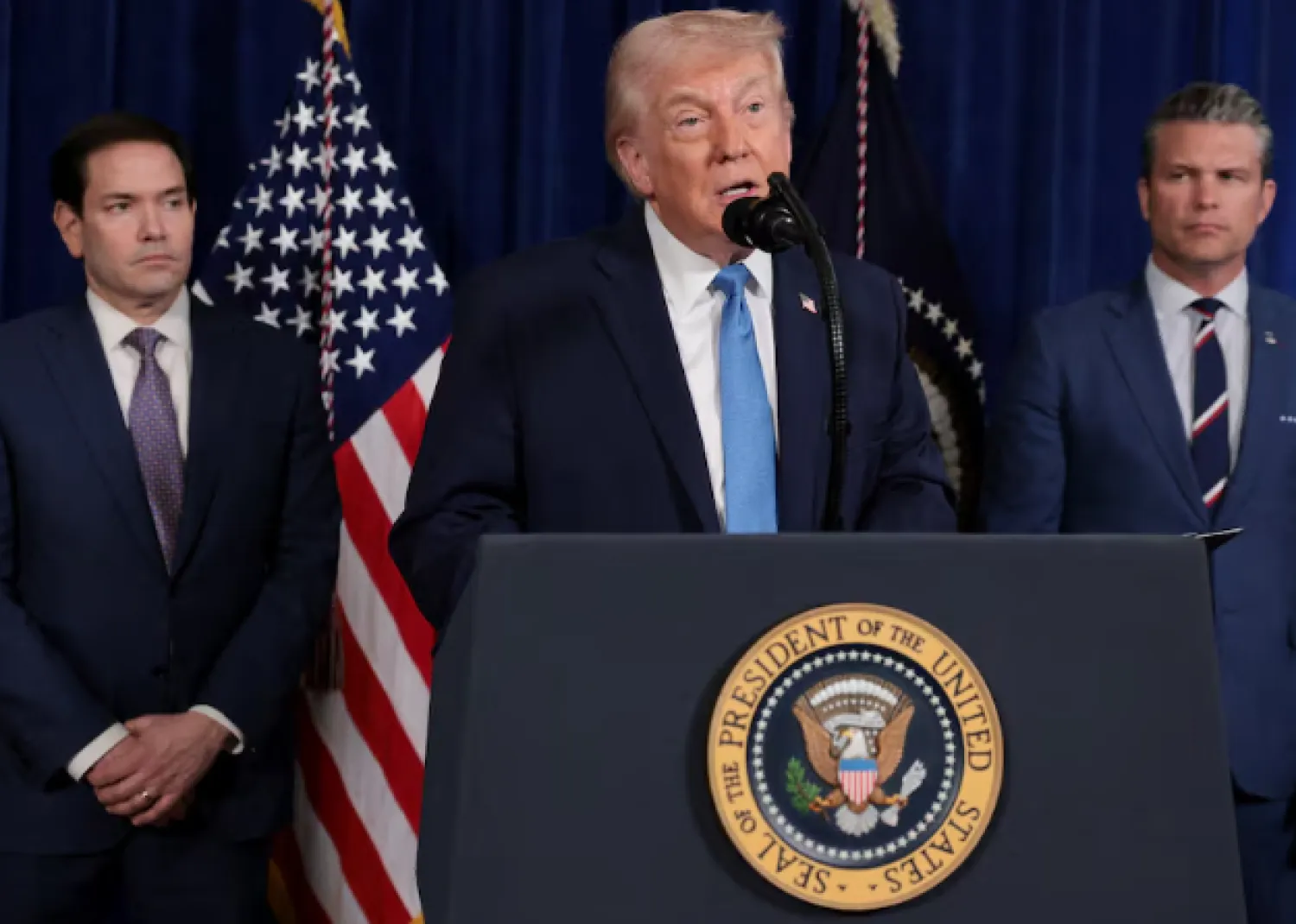
US President Donald Trump speaks as Secretary of State Marco Rubio and Secretary of Defense Pete Hegseth look on during a press conference following a US strike on Venezuela where President Nicolas Maduro and his wife, Cilia Flores, were captured, from Trump's Mar-a-Lago club in Palm Beach - Reuters
TT

Trump Says US Oversight of Venezuela Could Last Years

US President Donald Trump speaks as Secretary of State Marco Rubio and Secretary of Defense Pete Hegseth look on during a press conference following a US strike on Venezuela where President Nicolas Maduro and his wife, Cilia Flores, were captured, from Trump's Mar-a-Lago club in Palm Beach - Reuters

The United States could oversee Venezuela and control its oil revenue for years, President Donald Trump said in an interview ​published on Thursday.

During what the New York Times described as a wide-ranging, two-hour interview, the paper said Trump also appeared to lift a threat to take military action against Venezuela's neighbor Colombia. Trump invited Colombia's leftist leader, whom he had previously called a "sick man", to visit Washington.

"Only time will tell" how long the United States will oversee Venezuela, Trump said. When asked by the newspaper if it would be three months, six months, a year or longer, Trump said: "I would say much longer."

"We will rebuild it in a very profitable way," Trump said of Venezuela, where he sent troops to seize President Nicolas Maduro in a night raid on January 3.

"We're going to be using oil, and we're going to be taking oil. We're getting oil prices down, and we're going to be giving money to Venezuela, which ‌they desperately need."

Trump ‌added that the US was "getting along very well" with the government of the interim president, ‌Delcy ⁠Rodriguez, ​a longstanding Maduro ‌loyalist who had served as the ousted leader's vice president.

'MARCO SPEAKS TO HER ALL THE TIME'

The Times said Trump declined to answer questions about why he had decided not to give power in Venezuela instead to the opposition, which Washington had previously considered the legitimate winner of an election in 2024.

Trump on Tuesday unveiled a plan to refine and sell up to 50 million barrels of Venezuelan oil that had been stuck in Venezuela under US blockade.

"They're giving us everything that we feel is necessary," Trump said, referring to the Venezuelan government.

He declined to comment when asked if he had personally spoken to Rodriguez.

"But Marco speaks to her all the time," he said, referring to Secretary of State Marco Rubio. "I will tell you ⁠that we are in constant communication with her and the administration."

COLOMBIA THREAT APPEARS TO DISSIPATE

The Times said its reporters were permitted to sit in during a phone call between Trump and ‌Colombia's President Gustavo Petro, provided the contents of the call were off the record.

In ‍a post on social media, Trump said: "It was a great ‍honor to speak with the President of Colombia, Gustavo Petro, who called to explain the situation of drugs and other disagreements that we ‍have had. I appreciated his call and tone, and look forward to meeting him in the near future."

Petro described the call, his first with Trump, as cordial.

On Sunday Trump had threatened to carry out military action against Colombia, calling Petro "a sick man who likes making cocaine and selling it to the United States, and he's not going to be doing it very long".

The Times said Trump's phone call with Petro lasted about an hour and "appeared to dissipate ​any immediate threat of US military action".

Trump's use of force in Venezuela has made some members of his own Republican Party wary, after he long criticised US military ventures abroad. The Senate is due to consider a resolution on ⁠Thursday to block Trump from taking further action without congressional authorization.

Republicans, who control the Senate with 53 seats, have defeated several such measures since Trump began military action around Venezuela late last year, but the last vote in November was a close 49-51 after two Republicans backed it. Senator Rand Paul, a Kentucky Republican co-sponsoring the resolution, said he had spoken to at least two additional Republicans now "thinking about it".

MEETING PLANNED WITH OIL COMPANIES

Trump has said the United States intends to "run" Venezuela. US officials have indicated their plan for now is to exert influence without a military occupation.

Venezuela, with the world's biggest proven oil reserves, has become impoverished in recent decades, with eight million people fleeing abroad in one of the world's biggest migration crises.

Washington and the Venezuelan opposition have long blamed corruption, mismanagement and brutality by the ruling Socialist Party. Maduro blamed the economic damage on US sanctions.

Several senior US officials said on Wednesday that the United States needs to control Venezuela's oil sales and revenues indefinitely in order to restore the country's oil industry and rebuild its economy.

Trump is scheduled to meet with the heads of major oil companies at the White House on Friday ‌to discuss ways of raising Venezuela's oil production. Representatives from the top three US oil companies, Exxon Mobil, ConocoPhillips and Chevron , would be present, according to a source familiar with the planning.

The companies, all of which have experience in Venezuela, have declined to comment.


Iran's Supreme Leader Says Protesters are 'Ruining their Own Streets' to Please Trump

FILE PHOTO: Iran's Supreme Leader Ali Khamenei speaks during a meeting in Tehran, Iran January 3, 2026. Office of the Iranian Supreme Leader/WANA (West Asia News Agency)/Handout via REUTERS
TT

Iran's Supreme Leader Says Protesters are 'Ruining their Own Streets' to Please Trump

FILE PHOTO: Iran's Supreme Leader Ali Khamenei speaks during a meeting in Tehran, Iran January 3, 2026. Office of the Iranian Supreme Leader/WANA (West Asia News Agency)/Handout via REUTERS

Iranian protesters shouted and marched through the streets into Friday morning after a call by the country’s exiled crown prince for demonstrations, despite Iran’s theocracy cutting off the nation from the internet and international telephone calls.

Short online videos shared by activists purported to show protesters chanting against Iran’s government around bonfires as debris littered the streets in the capital, Tehran, and other areas. Iranian state media broke its silence Friday over the protests, alleging “terrorist agents” of the US and Israel set fires and sparked violence. It also said there were “casualties,” without elaborating.

Iran's 86-year-old Supreme Leader Ali Khamenei, in a brief address aired by state television, signaled authorities would crack down on demonstrators as an audience shouted: “Death to America!”

Protesters are “ruining their own streets to make the president of another country happy,” Khamenei said, referring to US President Donald Trump.

The full scope of the demonstrations couldn’t be immediately determined due to the communications blackout, though it represented yet another escalation in protests that began over Iran’s ailing economy and that has morphed into the most significant challenge to the government in several years. The protests have intensified steadily since beginning Dec. 28.

The protests also represented the first test of whether the Iranian public could be swayed by Crown Prince Reza Pahlavi, whose fatally ill father fled Iran just before the country’s 1979 Iranian Revolution. Demonstrations have included cries in support of the shah, something that could bring a death sentence in the past but now underlines the anger fueling the protests that began over Iran’s ailing economy.

So far, violence around the demonstrations has killed at least 42 people while more than 2,270 others have been detained, said the US-based Human Rights Activists News Agency.

Pahlavi, who called for protests Thursday night, similarly has called for demonstrations at 8 p.m. Friday.

“What turned the tide of the protests was former Crown Prince Reza Pahlavi’s calls for Iranians to take to the streets at 8 p.m. on Thursday and Friday,” said Holly Dagres, a senior fellow at the Washington Institute for Near East Policy. “Per social media posts, it became clear that Iranians had delivered and were taking the call seriously to protest in order to oust the Islamic Republic.”

“This is exactly why the internet was shut down: to prevent the world from seeing the protests. Unfortunately, it also likely provided cover for security forces to kill protesters.”

Thursday night protests preceded internet shutdown

When the clock struck 8 p.m. Thursday, neighborhoods across Tehran erupted in chanting, witnesses said. The chants included “Death to the dictator!” and “Death to the Islamic Republic!” Others praised the shah, shouting: “This is the last battle! Pahlavi will return!” Thousands could be seen on the streets before all communication to Iran cut out.

“Iranians demanded their freedom tonight. In response, the regime in Iran has cut all lines of communication,” Pahlavi said. “It has shut down the Internet. It has cut landlines. It may even attempt to jam satellite signals.”

He went on to call for European leaders to join US President Donald Trump in promising to “hold the regime to account.”

“I call on them to use all technical, financial, and diplomatic resources available to restore communication to the Iranian people so that their voice and their will can be heard and seen,” he added. “Do not let the voices of my courageous compatriots be silenced.”

Pahlavi had said he would offer further plans depending on the response to his call. His support of and from Israel has drawn criticism in the past — particularly after the 12-day war Israel waged on Iran in June. Demonstrators have shouted in support of the shah in some demonstrations, but it isn’t clear whether that’s support for Pahlavi himself or a desire to return to a time before the 1979 Iranian Revolution.

The internet cut also appears to have taken Iran’s state-run and semiofficial news agencies offline as well. The state TV acknowledgment at 8 a.m. Friday represented the first official word about the demonstrations.

State TV claimed the protests saw violence that caused casualties but did not elaborate. It also said the protests saw “people’s private cars, motorcycles, public places such as the metro, fire trucks and buses set on fire.”

Trump renews threat over protester deaths Iran has faced rounds of nationwide protests in recent years. As sanctions tightened and Iran struggled after the 12-day war, its rial currency collapsed in December, reaching 1.4 million to $1. Protests began soon after, with demonstrators chanting against Iran’s theocracy.

It remains unclear why Iranian officials have yet to crack down harder on the demonstrators. Trump warned last week that if Tehran “violently kills peaceful protesters,” America “will come to their rescue.”

In an interview with talk show host Hugh Hewitt aired Thursday, Trump reiterated his pledge.

Iran has “been told very strongly, even more strongly than I’m speaking to you right now, that if they do that, they’re going to have to pay hell,” Trump said.

Trump demurred when asked if he’d meet with Pahlavi.

“I’m not sure that it would be appropriate at this point to do that as president,” Trump said. “I think that we should let everybody go out there, and we see who emerges.”

Speaking in an interview with Sean Hannity aired Thursday night on Fox News, Trump went as far as to suggest 86-year-old Supreme Leader Ali Khamenei may be looking to leave Iran.

“He's looking to go someplace,” Trump said. “It's getting very bad.”


US Announces Aid to Bolster Thailand, Cambodia Truce

This handout photograph taken and released by Agence Kampuchea Press (AKP) on January 2, 2026 shows a general view of damaged houses following clashes between Cambodian and Thai soldiers, in Chouk Chey village in Banteay Meanchey province. (Agence Kampuchea Press (AKP) / AFP)
TT

US Announces Aid to Bolster Thailand, Cambodia Truce

This handout photograph taken and released by Agence Kampuchea Press (AKP) on January 2, 2026 shows a general view of damaged houses following clashes between Cambodian and Thai soldiers, in Chouk Chey village in Banteay Meanchey province. (Agence Kampuchea Press (AKP) / AFP)

The United States on Friday announced some $45 million in aid as it tries to bolster a fragile truce between Thailand and Cambodia.

Michael DeSombre, the top State Department official for East Asia, was visiting Thailand and Cambodia to discuss ways to strengthen the ceasefire, which President Donald Trump has sought to highlight as an achievement.

DeSombre said the United States would offer $20 million to help both countries combat drug trafficking and cyber scams, which have become a major concern in Cambodia.

He also said the United States would give $15 million to help support people displaced by the recent fighting as well as $10 million for demining, AFP said.

"The United States will continue to support the Cambodian and Thai governments as they implement the Kuala Lumpur Peace Accords and pave the way for a return to peace, prosperity and stability for their people and the region," DeSombre said in a statement.

He was referring to an agreement signed between the two countries in the presence of Trump during an October visit to Malaysia, then head of the ASEAN regional bloc.

Major new clashes erupted last month. The two sides reached a truce on December 27 after three weeks of fighting, although Thailand accused Cambodia of violating in apparent accidental fire.

Cambodia has called on Thailand to pull out its forces from several border areas that Phnom Penh claims as its own.

The nations' long-standing conflict stems from a dispute over the colonial-era demarcation of their 800-kilometer (500-mile) border, where both sides claim territory and centuries-old temple ruins.

Trump has listed the conflict as one of a number of wars he says he has solved as he loudly insists he deserves the Nobel Peace Prize.

Trump on taking office drastically slashed foreign aid, including for months freezing longstanding assistance to Cambodia for demining, with the administration saying it will provide money only in support of narrow US interests.


Zelensky Calls for 'Clear Reaction' From World to Russian Attack

Ukraine's President Volodymyr Zelensky addresses a press conference upon the signing of the declaration on deploying post-ceasefire force in Ukraine during the Coalition of the Willing summit on security guarantees for Ukraine, at the Elysee Palace in Paris, France, 06 January 2026.  EPA/LUDOVIC MARIN / POOL  MAXPPP OUT
Ukraine's President Volodymyr Zelensky addresses a press conference upon the signing of the declaration on deploying post-ceasefire force in Ukraine during the Coalition of the Willing summit on security guarantees for Ukraine, at the Elysee Palace in Paris, France, 06 January 2026. EPA/LUDOVIC MARIN / POOL MAXPPP OUT
TT

Zelensky Calls for 'Clear Reaction' From World to Russian Attack

Ukraine's President Volodymyr Zelensky addresses a press conference upon the signing of the declaration on deploying post-ceasefire force in Ukraine during the Coalition of the Willing summit on security guarantees for Ukraine, at the Elysee Palace in Paris, France, 06 January 2026.  EPA/LUDOVIC MARIN / POOL  MAXPPP OUT
Ukraine's President Volodymyr Zelensky addresses a press conference upon the signing of the declaration on deploying post-ceasefire force in Ukraine during the Coalition of the Willing summit on security guarantees for Ukraine, at the Elysee Palace in Paris, France, 06 January 2026. EPA/LUDOVIC MARIN / POOL MAXPPP OUT

Ukrainian President Volodymyr Zelensky called for the world to act after Russia hit western Ukraine with its new Oreshnik ballistic missile in a massive overnight attack that killed four in the capital Kyiv.

"A clear reaction from the world is needed. Above all from the United States, whose signals Russia truly pays attention to," Zelensky said on social media.

"Russia must receive signals that it is its obligation to focus on diplomacy, and must feel consequences every time it again focuses on killings and the destruction of infrastructure," he added.