Trump Says ‘My Own Morality’ Is Only Restraint on Global Power

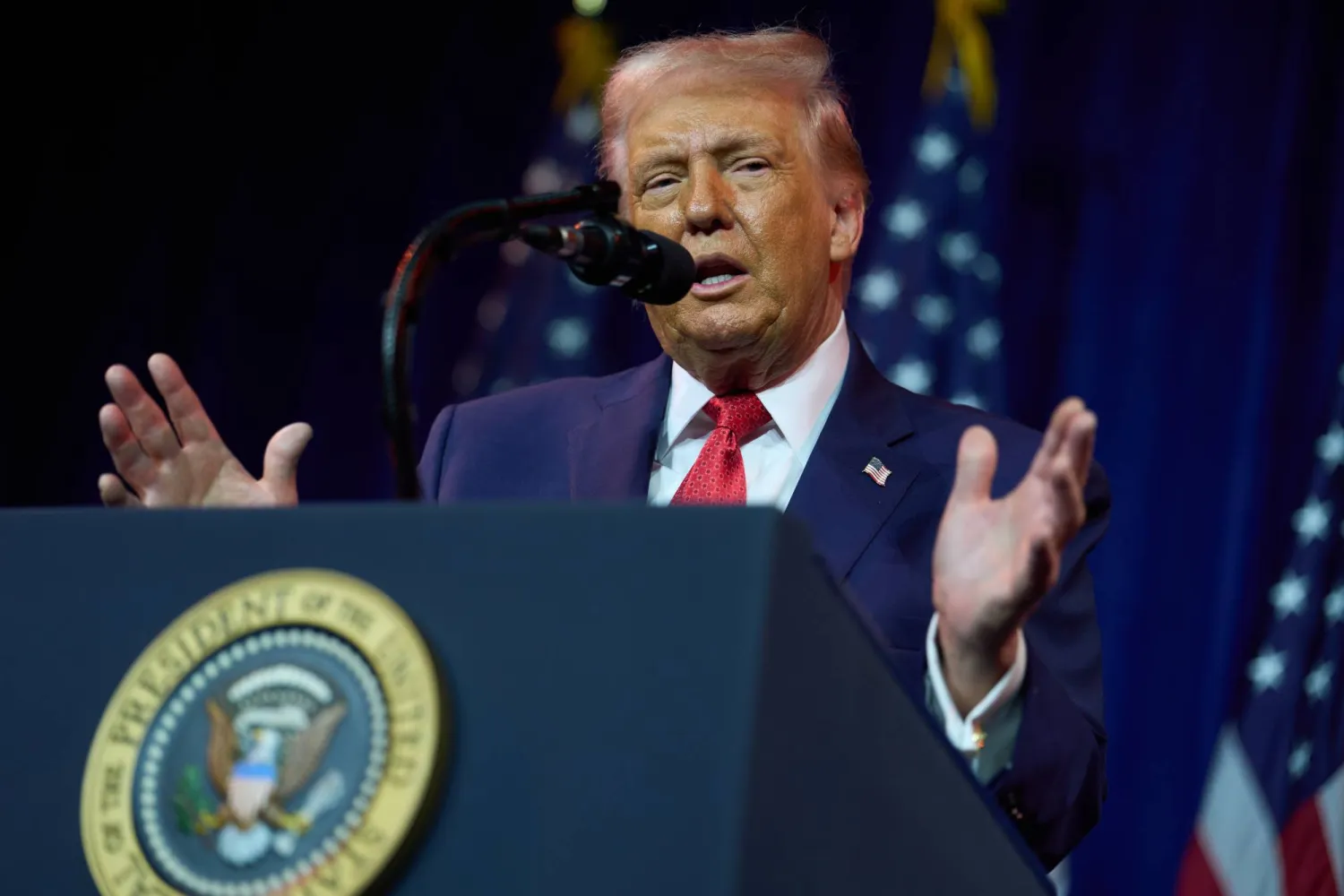
President Donald Trump speaks to House Republican lawmakers during their annual policy retreat, Tuesday, Jan. 6, 2026, in Washington. (AP)
TT

Trump Says ‘My Own Morality’ Is Only Restraint on Global Power

President Donald Trump speaks to House Republican lawmakers during their annual policy retreat, Tuesday, Jan. 6, 2026, in Washington. (AP)

US President Donald Trump said in an interview published Thursday that his "own morality" was the only constraint on his power to order military actions around the world.

Trump's comments to The New York Times came days after he launched a lightning operation to topple Venezuelan leader Nicolas Maduro, and threatened a host of other countries plus the autonomous territory Greenland.

"Yeah, there is one thing. My own morality. My own mind. It's the only thing that can stop me," Trump told the newspaper when asked if there were any limits on his global powers.

"I don't need international law," he added. "I'm not looking to hurt people."

The Republican president then added that "I do" need to abide by international law, but said "it depends what your definition of international law is."

The United States is not a member of the International Criminal Court (ICC), which tries war criminals, and it has repeatedly rejected decisions by the International Court of Justice (ICJ), the UN's top court.

Trump himself has had his own run-ins with domestic law, having been impeached twice, faced a slew of federal charges including conspiring to overturn the 2020 election -- which were eventually dropped after his re-election -- and convicted for covering up a hush money payment to a porn star.

While proclaiming himself as "peace president" and seeking the Nobel Prize, Trump has launched a series of military operations in his second presidential term.

Trump ordered attacks on Iran's nuclear program in June and in the past year has also overseen strikes on Iraq, Nigeria, Somalia, Syria, Yemen -- and most recently on Venezuela.

Since Maduro's capture, an emboldened Trump has threatened a string of other countries including Colombia, as well as Greenland, which is administered by fellow NATO member Denmark.

Asked whether his priority was preserving the NATO military alliance or acquiring Greenland, Trump told the Times: "It may be a choice."

Some members of Congress, including a handful of Republicans, are trying to check Trump's power.

On Thursday the Senate advanced a measure to rein in presidential military action in Venezuela. But even if it reaches his desk, Trump would likely veto it.

Billionaire Trump, who made his fortune as a property developer, added that US ownership of Greenland is "what I feel is psychologically needed for success."

Trump said separately that he had no problem with his family conducting foreign business deals since his return to office.

"I prohibited them from doing business in my first term, and I got absolutely no credit for it," Trump told the daily. "I found out that nobody cared, and I'm allowed to."


Trump Says Cutting US Troop Numbers in Germany 'Way Down'

US President Donald Trump (R) and German Chancellor Friedrich Merz hold a bilateral meeting in the Oval Office at the White House in Washington, DC, USA, 03 March 2026 (reissued 02 May 2026). EPA/Samuel Corum / POOL
TT

Trump Says Cutting US Troop Numbers in Germany 'Way Down'

US President Donald Trump (R) and German Chancellor Friedrich Merz hold a bilateral meeting in the Oval Office at the White House in Washington, DC, USA, 03 March 2026 (reissued 02 May 2026). EPA/Samuel Corum / POOL

President Donald Trump on Saturday doubled down on Washington's decision to withdraw 5,000 US troops from Germany, as a rift in transatlantic ties deepens over the Middle East war.

The Pentagon announced the 5,000-troop reduction on Friday, but Trump told reporters Saturday "we're going to cut way down, and we're cutting a lot further than 5,000." He did not elaborate, AFP said.

The move follows a spat between Trump and German Chancellor Friedrich Merz, who said on Monday that Iran was "humiliating" Washington at the negotiating table.

Pentagon spokesman Sean Parnell said Friday the withdrawal was expected "to be completed over the next six to twelve months."

NATO said it was "working with the US to understand the details of their decision on force posture in Germany."

"This adjustment underscores the need for Europe to continue to invest more in defense and take on a greater share of the responsibility for our shared security," NATO spokeswoman Allison Hart wrote on X.

There were 36,436 active-duty US troops in NATO ally Germany as of December 31, 2025, compared to 12,662 in Italy and 3,814 in Spain.

German Defense Minister Boris Pistorius said Saturday the US troop withdrawal "from Europe and also from Germany was to be expected."

It also came as Trump announced that tariffs on cars and trucks from the European Union would jump from 15 percent to 25 percent next week, accusing the bloc of failing to comply with a trade deal signed last summer.

The decision to reduce the number of troops in Germany is being met with skepticism by top Republican lawmakers who oversee US military policy.

In a joint statement Saturday, Senator Roger Wicker and Representative Mike Rogers, chairs of the Armed Services Committees in their respective chambers, warned that the move risks "sending the wrong signal to Vladimir Putin."

Even though European allies are boosting defense spending, "translating that investment into the military capability needed to assume primary responsibility for conventional deterrence will take time," they said.

The duo noted that Germany had heeded Trump's calls for greater spending on defense and that it had allowed American planes to use German bases and airspace during the ongoing conflict with Iran.


North Korea Calls US Cyber Crime Accusations 'Absurd Slander'

Pyongyang denied Washington's narrative of a cyber threat (Reuters)
TT

North Korea Calls US Cyber Crime Accusations 'Absurd Slander'

Pyongyang denied Washington's narrative of a cyber threat (Reuters)

North Korea dismissed on Sunday US accusations that it has engaged in cyber crimes to generate illicit revenues, calling the criticism "absurd slander".

Washington has accused Pyongyang of ramping up a cyber-warfare program responsible for the theft of billions of dollars in virtual assets in recent years, turning hacking into a key source of foreign currency in the face of biting sanctions over its nuclear and weapons programs.

In a statement carried by the official Korean Central News Agency, an unnamed foreign ministry spokesperson said the US government had been "trying to spread incorrect understanding" about North Korea, "talking about the non-existent 'cyber threat'".

"This is nothing but an absurd slander to tarnish the image of our country by spreading false information in pursuit of political purposes," AFP quoted it as saying.

The US Justice Department in April sentenced two Americans for helping North Koreans obtain remote IT work with US companies and raising more millions of dollars in illicit revenue for its weapons programs.

More than 100 US companies were targeted, including a number of Fortune 500 firms and a defense contractor in the multi-year scheme, the Justice Department said.

The ruse "placed North Korean IT workers on the payrolls of unwitting US companies and in US computer systems, thereby potentially harming our national security," said John Eisenberg, assistant attorney general for national security.

Google analysts and other cybersecurity experts said in April that hackers linked to North Korea were suspected of an ambitious attack on an inconspicuous but widely used software package.

A United Nations panel estimated in 2024 that North Korean cyberattacks since 2017 had stolen more than $3 billion in cryptocurrency.

The stolen money helps fund the development of weapons of mass destruction, the panel said.

Pyongyang's cyber-warfare program dates back to at least the mid-1990s, and the country has been dubbed "the world's most prolific cyber-thief" by a cybersecurity firm.


Trump Says US Not Likely to Accept New Iran Peace Proposal

PALM BEACH, FLORIDA - MAY 2: US President Donald Trump speaks to journalists before boarding Air Force One at Palm Beach International Airport on May 2, 2026 in Palm Beach, Florida. Trump is spending the weekend at his Mar-A-Lago resort. Roberto Schmidt/Getty Images/AFP
TT

Trump Says US Not Likely to Accept New Iran Peace Proposal

PALM BEACH, FLORIDA - MAY 2: US President Donald Trump speaks to journalists before boarding Air Force One at Palm Beach International Airport on May 2, 2026 in Palm Beach, Florida. Trump is spending the weekend at his Mar-A-Lago resort. Roberto Schmidt/Getty Images/AFP

US President Donald Trump said Saturday he was going to review a new Iranian peace proposal but cast doubt over its prospects, as a senior military officer in Tehran indicated renewed fighting was "likely."

The dour outlook came after Iran's Tasnim and Fars news agencies said Tehran had submitted a 14-point proposal to mediator Pakistan. Details included ending the conflict on all fronts and enacting a new framework for the crucial Strait of Hormuz, Tasnim said.

"I will soon be reviewing the plan that Iran has just sent to us, but can't imagine that it would be acceptable in that they have not yet paid a big enough price for what they have done to Humanity, and the World, over the last 47 years," Trump said on his Truth Social platform.

In a brief interview with reporters in West Palm Beach, Florida, he declined to specify what could trigger new military action against Iran.

"If they misbehave, if they do something bad, but right now, we'll see," he said. "But it's a possibility that could happen, certainly."

The war, launched by the United States and Israel in late February, has been on hold since April 8, with one failed round of peace talks having taken place in Pakistan.

On Saturday, Mohammad Jafar Asadi, a senior figure in the Iranian military's central command, said "a renewed conflict between Iran and the United States is likely."

"Evidence has shown that the United States is not committed to any promises or agreements," he added, according to Fars news agency.

Deputy foreign minister Kazem Gharibabadi told diplomats in Tehran "the ball is in the United States' court to choose the path of diplomacy or the continuation of a confrontational approach."

Iran, he said, was "prepared for both paths."

US news site Axios reported earlier in the week that Trump's envoy Steve Witkoff had asked for Tehran's nuclear program to be put back on the negotiating table.

Iran's mission to the UN pointed to the massive US nuclear arsenal, accusing Washington on Saturday of "hypocritical behavior" towards Iran's own atomic ambitions.

There was no legal "restriction on the level of uranium enrichment, so long as it is conducted under the IAEA's supervision, as was the case with Iran," it said, using the abbreviation for the UN nuclear watchdog.

Iran has maintained a stranglehold on the Strait of Hormuz since the war began, choking off major flows of oil, gas and fertilizer to the world economy, while the United States has imposed a counter-blockade on Iranian ports.

Oil prices are about 50 percent above pre-war levels.

The vice speaker of Iran's parliament, Ali Nikzad, said that under draft legislation being considered for managing the waterway, 30 percent of tolls collected would go towards military infrastructure, with the rest earmarked for "economic development."

"Managing the Strait of Hormuz is more important than acquiring nuclear weapons," he said.