

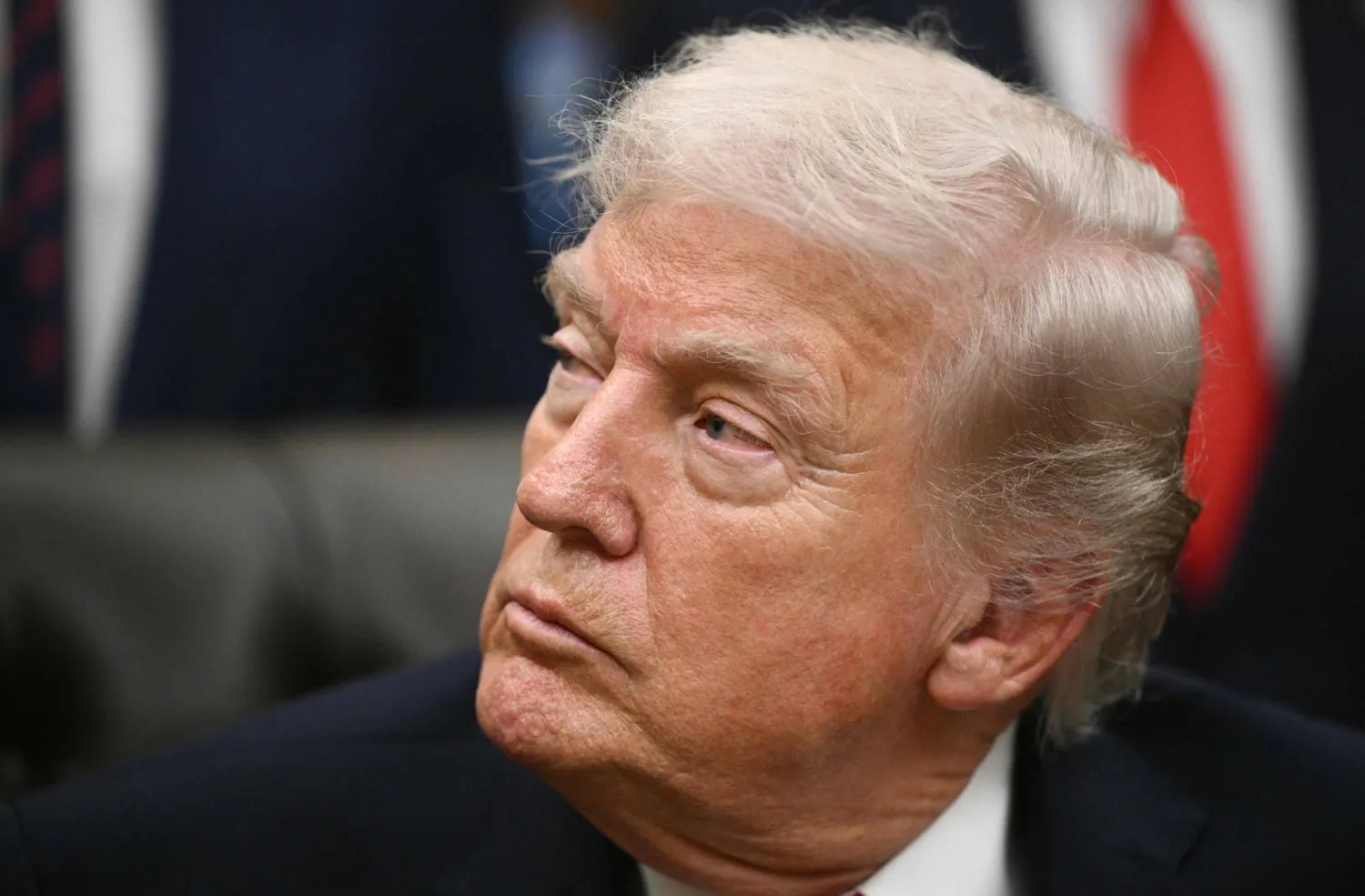

Trump Threatens Tariffs on Nations Selling Oil to Cuba

US President Donald Trump looks on after signing the "Great American Recovery Initiative" aimed at combating addiction and substance abuse in the Oval Office of the White House in Washington, DC, on January 29, 2026. (Photo by Brendan SMIALOWSKI / AFP)
TT

Trump Threatens Tariffs on Nations Selling Oil to Cuba

US President Donald Trump looks on after signing the "Great American Recovery Initiative" aimed at combating addiction and substance abuse in the Oval Office of the White House in Washington, DC, on January 29, 2026. (Photo by Brendan SMIALOWSKI / AFP)

US President Donald Trump signed an executive order Thursday threatening to impose additional tariffs on countries that sell oil to Cuba, further increasing pressure on the communist-led island.

The order did not specify the value of the tariffs or which countries would be targeted, leaving those determinations up to his secretary of commerce, said AFP.

Cuba, which has largely been under a US embargo since 1962, until recently received most of its oil from Venezuela.

But the United States has moved to block the flow after removing Havana's key ally Nicolas Maduro from power and effectively seizing control of Venezuelan oil exports.

Following the Venezuela operation, Trump vowed to completely cut off oil and money going to Cuba.

"I strongly suggest they make a deal, BEFORE IT IS TOO LATE," he threatened in a social media post.

The United States has been mum on what kind of deal it is seeking with the island's communist government.

Havana's foreign minister Bruno Rodriguez on Thursday called the latest move in a post on X a "brutal act of aggression against Cuba and its people, who for more than 65 years have been subjected to the longest and cruelest economic blockade ever imposed."

The order signed Thursday threatens added tariffs on any "country that directly or indirectly sells or otherwise provides any oil to Cuba."

The order invokes the International Emergency Economic Powers Act (IEEPA) and calls the Cuban government an "extraordinary threat" to US national security.

Other tariffs invoked under the IEEPA are currently being challenged at the Supreme Court.

Declaring a "national emergency" related to Cuba, Trump made similar claims to those made against Venezuela, such as providing support nations hostile to the United States.

"The regime aligns itself with -- and provides support for -- numerous hostile countries, transnational terrorist groups, and malign actors adverse to the United States," including Russia, China, and Iran, as well as the militant groups Hamas and Hezbollah, the order said.

The pressure comes as the communist island is in the throes of its worst economic crisis in decades, marked by recurring power outages of up to 20 hours a day and shortages of food and medicine that have created a mass exodus of Cubans.

US neighbor Mexico has become a significant provider oil to Cuba, though media reports have suggested that flows could be slowing under pressure from Trump.

Speaking at a press conference earlier this week, Mexican President Claudia Sheinbaum would neither confirm or deny the reports, but said Mexico would "continue to show solidarity" with Cuba.



Trump Says 'Hopefully' No Need for Military Action against Iran

President Donald Trump arrives for the premiere of first lady Melania Trump's movie "Melania" at The John F. Kennedy Memorial Center For The Performing Arts, Thursday, Jan. 29, 2026, in Washington. (AP Photo/Allison Robbert)
TT

Trump Says 'Hopefully' No Need for Military Action against Iran

President Donald Trump arrives for the premiere of first lady Melania Trump's movie "Melania" at The John F. Kennedy Memorial Center For The Performing Arts, Thursday, Jan. 29, 2026, in Washington. (AP Photo/Allison Robbert)

US President Donald Trump said on Thursday he hoped to avoid military action against Iran, which has threatened to strike American bases and aircraft carriers in response to any attack.

Trump said he is speaking with Iran and left open the possibility of avoiding a military operation after earlier warning time was "running out" for Tehran as the United States sends a large naval fleet to the region, reported AFP.

When asked if he would have talks with Iran, Trump told reporters: "I have had and I am planning on it."

"We have a group headed out to a place called Iran, and hopefully we won't have to use it," the US president added, while speaking to media at the premiere of a documentary about his wife Melania.

As Brussels and Washington dialled up their rhetoric and Iran issued stark threats this week, UN chief Antonio Guterres has called for nuclear negotiations to "avoid a crisis that could have devastating consequences in the region".

An Iranian military spokesman warned Tehran's response to any US action would not be limited -- as it was in June last year when American planes and missiles briefly joined Israel's short air war against Iran -- but would be a decisive response "delivered instantly".

Brigadier General Mohammad Akraminia told state television US aircraft carriers have "serious vulnerabilities" and that numerous American bases in the Gulf region are "within the range of our medium-range missiles".

"If such a miscalculation is made by the Americans, it will certainly not unfold the way Trump imagines -- carrying out a quick operation and then, two hours later, tweeting that the operation is over," he said.

- 'Protests crushed in blood' -

The European Union piled on the pressure by designating the Iranian Revolutionary Guard Corps (IRGC) a "terrorist organization" over a deadly crackdown on recent mass protests.

"'Terrorist' is indeed how you call a regime that crushes its own people's protests in blood," said EU chief Ursula von der Leyen, welcoming the "overdue" decision.

Though largely symbolic, the EU decision has already drawn a warning from Tehran.

Iran's military slammed "the illogical, irresponsible and spite-driven action of the European Union", alleging the bloc was acting out of "obedience" to Tehran's arch-foes the United States and Israel.

Iranian officials have blamed the recent protest wave on the two countries, claiming their agents spurred "riots" and a "terrorist operation" that hijacked peaceful rallies sparked over economic grievances.

Rights groups have said thousands of people were killed during the protests by security forces, including the IRGC -- the ideological arm of Tehran's military.

In Tehran on Thursday, citizens expressed grim resignation.

"I think the war is inevitable and a change must happen. It can be for worse, or better. I am not sure," said a 29-year-old waitress, speaking on condition of anonymity for fear of reprisals.

"I am not in favor of war. I just want something to happen that would result in something better."

Another 29-year-old woman, an unemployed resident of an upscale neighborhood in northern Tehran, told AFP: "I believe that life has highs and lows and we are now at the lowest point."

Trump had threatened military action if protesters were killed in the anti-government demonstrations that erupted in late December and peaked on January 8 and 9.

But his more recent statements have turned to Iran's nuclear program, which the West believes is aimed at making an atomic bomb.

On Wednesday, he said "time is running out" for Tehran to make a deal, warning the US naval strike group that arrived in Middle East waters on Monday was "ready, willing and able" to hit Iran.

- Conflicting tolls -

The US-based Human Rights Activists News Agency (HRANA) said it has confirmed 6,479 people were killed in the protests, as internet restrictions imposed on January 8 continue to slow verification.

But rights groups warn the toll is likely far higher, with estimates in the tens of thousands.

Iranian authorities acknowledge that thousands were killed during the protests, giving a toll of more than 3,000 deaths, but say the majority were members of the security forces or bystanders killed by "rioters".

Billboards and banners have gone up in the capital Tehran to bolster the authorities' messages. One massive poster appears to show an American aircraft carrier being destroyed.


Russia: There Is Still Room for Negotiations between US and Iran

 Russian President Vladimir Putin and Kremlin spokesman Dmitry Peskov in August 2025 (AFP) 
 Russian President Vladimir Putin and Kremlin spokesman Dmitry Peskov in August 2025 (AFP) 
TT

Russia: There Is Still Room for Negotiations between US and Iran

 Russian President Vladimir Putin and Kremlin spokesman Dmitry Peskov in August 2025 (AFP) 
 Russian President Vladimir Putin and Kremlin spokesman Dmitry Peskov in August 2025 (AFP) 

Russia said on Thursday that there was still room for negotiation between Iran and the United States and warned that any use of force against Tehran would have dangerous consequences and cause chaos throughout the Middle East.

Kremlin spokesman Dmitry Peskov was commenting a day after US President Donald Trump urged Iran to come to the table and make a deal on nuclear weapons or face a possible US attack.

“We continue to call on all parties to exercise restraint and to renounce any use of force to resolve issues. Clearly, the potential for negotiations is far from exhausted... We must focus primarily on negotiating mechanisms,” Peskov told reporters, according to Reuters.

He added, “Any forceful actions can only create chaos in the region and lead to very dangerous consequences in terms of destabilizing the security system throughout the region.”

Russia has forged closer ties with Iran since the start of its war in Ukraine and signed a 20-year strategic partnership treaty with Iran in January 2025.

Meanwhile, Russia is ready to evacuate its staff from Iran's Bushehr nuclear power plant if necessary, Alexei Likhachev, the head of Russia's state nuclear corporation, was cited as saying on Thursday by the state news agency TASS.

Russian President Vladimir Putin said last year that hundreds of Russians were working at the facility, Iran's only operating nuclear power plant, which Moscow built for Iran.

More nuclear facilities are currently being built at the Bushehr site by Russia.

Russia has enhanced its relation with Tehran since the war on Ukraine.

On 17 January 2025, Putin and his Iranian counterpart, Masoud Pezeshkian, signed the Iranian–Russian Treaty on Comprehensive Strategic Partnership, a 20-year strategic partnership agreement.

A US strike on Iran's nuclear facilities in June last year did not target Bushehr. Likhachev warned at the time that an attack on the site could trigger a catastrophe comparable to the 1986 Chernobyl nuclear disaster.

On Thursday, Likhachev was quoted by TASS as saying: “We sincerely hope that the parties to the conflict will uphold their commitments regarding the inviolability of this territory (Bushehr).”

He also said, “But, as they say, we are keeping our finger on the pulse and, in cooperation with the Ministry of Foreign Affairs and the Ministry of Defense, we will be ready to carry out evacuation measures if necessary.”

Iran denies seeking nuclear weapons, and Russia says it supports Tehran's right to use nuclear energy for peaceful purposes.


Türkiye Steps Up Mediation Efforts Between Iran, US

Iranian Foreign Minister Abbas Araghchi shakes hands with his Turkish counterpart Hakan Fidan during his visit to Tehran in November 2025 (Turkish Foreign Ministry)
TT

Türkiye Steps Up Mediation Efforts Between Iran, US

Iranian Foreign Minister Abbas Araghchi shakes hands with his Turkish counterpart Hakan Fidan during his visit to Tehran in November 2025 (Turkish Foreign Ministry)

Türkiye is intensifying efforts to mediate between Iran and the US, seeking to avert a new crisis on its eastern border that could also threaten regional stability, amid escalating threats of a US military strike aimed at toppling the Iranian government.

Türkiye’s Foreign Ministry said on Thursday that Iranian Foreign Minister Abbas Araghchi will visit Ankara on Friday, following Türkiye's offer to mediate between Tehran and Washington.

Araghchi’s visit follows a Wednesday phone call with his Turkish counterpart, Hakan Fidan, during which they discussed developments in Iran, US threats, and ways to end the crisis through diplomatic channels and to reduce regional tensions.

Sources at the Turkish Foreign Ministry said Fidan will reiterate Türkiye's opposition to any military intervention against Iran during his meeting with Araghchi in Ankara on Friday, warning of the risks such a step would pose to the region and the world.

The sources said Fidan will stress Türkiye’s readiness to help find a solution to the current tension between Tehran and Washington through dialogue.

He will also discuss bilateral relations between Türkiye and Iran, regional security, and steps to boost cooperation in trade, energy, and transport, as well as expanding cross-border exchanges through frontier trade centers.

They added that Fidan will also address developments in Syria and efforts to combat terrorist organizations, notably the Kurdistan Free Life Party, known as PJAK, and ISIS.

On the eve of the meeting with Araghchi, Fidan met on Thursday with the US ambassador to Ankara and special envoy for Syria, Tom Barrack, at the Turkish Foreign Ministry.

They discussed developments in Iran and ways to ease tensions, as well as the latest situation in Syria, according to Turkish sources.

US threats against Iran have intensified, with Washington signaling it could use force to change the government in Tehran.

In recent weeks, the US has deployed naval fleets and military reinforcements to the Middle East, while Iran has vowed to retaliate against any attack targeting it.

Fidan said on Wednesday that Türkiye rejects any foreign military intervention in Iran, calling on the United States to rely on diplomatic channels to resolve the crisis and warning that destabilizing the region would not serve Türkiye’s interests.

Turkish proposal

Hurriyet newspaper, which is close to the Turkish government, reported that President Recep Tayyip Erdogan has proposed to US President Donald Trump that they hold a three-way video conference with Iranian President Masoud Pezeshkian to mediate and de-escalate tensions.

The paper said the Iran file was the primary focus of a phone call between Erdogan and Trump on Tuesday, during which the Turkish leader reiterated Ankara’s position and proposed addressing the tensions through diplomacy.

It added that Trump responded positively to Erdogan’s proposal.

The call came after a series of Turkish diplomatic moves, including a phone call between Erdogan and Pezeshkian, two successive calls between Fidan and Araghchi, two meetings with US envoy Tom Barrack at the Turkish Foreign Ministry, and a phone conversation between Fidan and US Secretary of State Marco Rubio.

These contacts reflect ongoing Turkish mediation efforts aimed at easing tensions and preventing a strike on Iran that could threaten regional and global stability, the paper said, noting that the moves were carried out quietly as US statements about preparations to strike Iran intensified.

Preemptive measures

Türkiye’s National Security Council discussed developments in Iran and US threats of an attack on Tehran at a meeting chaired by Erdogan on Wednesday. In a statement after the meeting, the council stressed the importance of the stability and peace of “neighboring Iran” for Iran, Türkiye, and regional security.

Türkiye’s Defense Ministry said Ankara continues its efforts to end all conflicts and establish peace and stability in the region.

Defense Ministry spokesman Zeki Akturk said on Thursday that the ministry has taken all necessary precautions in coordination with relevant institutions, in anticipation of any potential adverse developments amid recent US moves and threats to strike Iran.

His remarks followed media reports about contingency plans to establish a “buffer zone” along the border with Iran, in the event of a US attack that could trigger a large-scale displacement from Iran into Türkiye.

According to the reports, the plan includes setting up a buffer zone on the Iranian side of the border if Iran comes under air strikes, to ensure that any displaced people remain within Iranian territory and to prevent their entry into Türkiye, regardless of whether the term “buffer zone” is formally used.

Türkiye’s Defense Ministry has previously said it has stepped up security measures along the roughly 560-kilometer border with Iran, using an integrated surveillance system that includes concrete walls, trenches, and electro-optical watchtowers, as well as round-the-clock monitoring by both crewless and manned aircraft.