


Russia Resumes Strikes on Freezing Ukrainian Capital

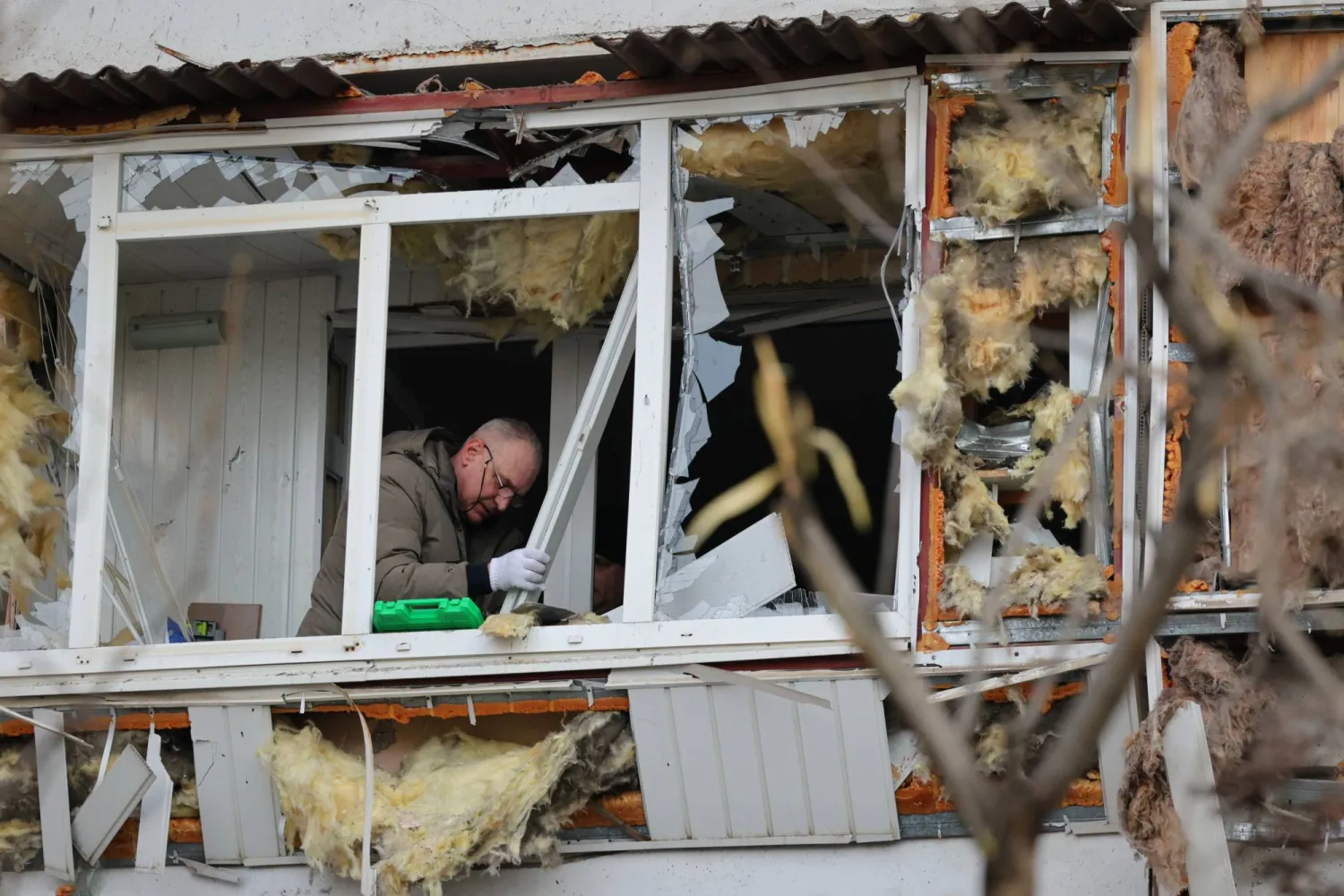
A local resident clears up debris from his broken balcony after a Russian attack in Zaporizhzhia, Ukraine, Wednesday, Jan. 28, 2026. (AP Photo/Kateryna Klochko)
TT

Russia Resumes Strikes on Freezing Ukrainian Capital

A local resident clears up debris from his broken balcony after a Russian attack in Zaporizhzhia, Ukraine, Wednesday, Jan. 28, 2026. (AP Photo/Kateryna Klochko)

Russia resumed strikes on Kyiv on Tuesday, Ukrainian officials said, as a brief truce announced by US President Donald Trump gave way to renewed attacks in freezing conditions.

Trump said on Thursday that Russian President Vladimir Putin had agreed to stop striking Kyiv and "various towns" during cold weather.

The Kremlin said the truce would last until Sunday but did not link it to the subzero temperatures. Ukraine said Moscow had kept up its strikes anyway.

Russia hit Kyiv "in the bitter cold with another massive strike" overnight, Tymur Tkachenko, the head of the city's military administration, said Tuesday on Telegram.

The emergency services said in a later post that three people in Kyiv had been wounded, reported AFP.

In the eastern city of Kharkiv, two people were wounded by Russian shelling, regional military chief Oleg Synegubov said.

The hours-long attack targeted energy infrastructure and aimed to "cause maximum destruction... and leave the city without heat during severe frost", Synegubov wrote on Telegram.

Authorities had to cut heating to more than 800 homes to prevent the wider network from freezing, he said, urging people to go to round-the-clock "invincibility points" around the city if they needed to warm up.

Overnight temperatures plunged to minus 17C in Kyiv and sank as low as minus 23C in Kharkiv.

- New talks planned -

Russia's invasion of Ukraine will hit the four-year mark on February 24.

Washington has sought to craft a peace settlement between both sides, but the first round of trilateral talks held in Abu Dhabi last weekend failed to yield a breakthrough.

A second round is due to begin on Wednesday in the Emirati capital.

Ukrainian President Volodymyr Zelensky said on Monday that recent "de-escalation" with Russia was helping build trust in negotiations, apparently referring to a break in attacks on energy facilities.

But territory remains a sticking point, and the warring sides have not yet shown willingness for compromise.

Russia wants full control of Ukraine's eastern Donetsk region, which Kyiv has ruled out, saying such a move would only embolden Moscow.

After failing in its aim of a lightning offensive to capture Kyiv and topple Ukraine's leadership in a matter of days in 2022, Russia has been bogged down in the face of Ukrainian defenses and is now mounting a grinding advance that has come at huge human cost.

Moscow's troops accelerated their advance in Ukraine throughout January, capturing almost twice as much land as in the previous month, according to an AFP analysis.

Russia seized 481 square kilometers (186 square miles) in January, analysis of data from the Institute for the Study of War, which works with the Critical Threats Project, showed.

The January gains were up from 244 square kilometers in December 2025 and one of the largest advances during a winter month since Russia invaded four years ago.



Cuba Confirms 'Communications' with US, But Says No Negotiations Yet

US President Donald Trump (EPA)
TT

Cuba Confirms 'Communications' with US, But Says No Negotiations Yet

US President Donald Trump (EPA)

Cuba's government on Monday told AFP that it was in "communication" with US President Donald Trump's administration but not yet in formal talks on a deal to end Washington's pressure campaign on the island.

"Today we cannot talk about having dialogue with the United States, but it is true that there have been communications between the two governments," deputy foreign minister Carlos Fernandez de Cossio said in an interview.

Trump on Sunday claimed the United States was in talks with "the highest people" in communist Cuba and that he expected to "make a deal" with its leadership, without saying what a deal might look like.

De Cossio repeated that Cuba was "open to dialogue" with the United States amid calls from Cubans for the government to negotiate to avert a humanitarian crisis.

Trump has been ratcheting up pressure on Havana since the January 3 capture by US special forces of Venezuelan leader Nicolas Maduro, a top Cuba ally and financial backer.

Pressured by Washington, Venezuela's new administration has cut crude shipments to Cuba.

Trump said Monday that Cuba's other main supplier, Mexico, would also "cease sending them oil" after he threatened tariff hikes on any country that allowed Cuba to circumvent the de-facto blockade.

There was no immediate response from Mexico.

The United States' largest trade partner had incurred Trump's ire by sending oil to Cuba to make up for a sharp decline in Venezuela's output under Maduro.

As recently as December, Mexico was still sending crude to Cuba.

President Claudia Sheinbaum had been loathe to cut the lifeline to Cuba, warning of a "far-reaching humanitarian crisis directly affecting hospitals, food supplies, and other basic services for the Cuban people."

But she also admitted last week: "We don't want to put our country at risk in terms of tariffs."

A decree signed by Trump last week effectively forced her and other Cuban partners to choose.

- 'The highest people' -

The pressure tactics threaten to plunge Cuba into complete darkness, with its power plants already struggling to keep the lights on due to fuel shortages.

Jorge Grosso, a 23-year-old student who spent nearly 24 hours last week queueing at a petrol station to fill up his Lada, told AFP he backed talks "to see what conditions are imposed (by Trump) because in the end they're strangling us."

For months Cubans have been forced to cope with power outages lasting up to 20 hours a day in rural areas.

On Monday, Trump repeated his claim that Cuba, which is limping through its worst economic crisis in decades, is a "failed nation."

He added he believed "we are pretty close (to a deal), but we are dealing with the Cuban leaders right now."

His pressure on Sheinbaum comes as the United States and its southern neighbor begin talks on a review of a tripartite free-trade deal with Canada which is crucial to Mexico's economy.

Over the past year, Sheinbaum has been scrambling to stave off the kind of tariffs pain Trump has imposed on other allies.

In a move widely seen as an attempt to appease him, Mexico in January imposed stiff tariffs on imports from China.


To Counter China, Trump to Create Strategic Reserve for Rare Earth Elements

President Donald Trump announces the creation of a critical minerals reserve during an event in the Oval Office at the White House in Washington, DC, 02 February 2026. EPA/BONNIE CASH / POOL
TT

To Counter China, Trump to Create Strategic Reserve for Rare Earth Elements

President Donald Trump announces the creation of a critical minerals reserve during an event in the Oval Office at the White House in Washington, DC, 02 February 2026. EPA/BONNIE CASH / POOL

The Trump administration plans to deploy nearly $12 billion to create a strategic reserve of rare earth elements, a stockpile that could counter China's ability to use its dominance of these hard to process metals as leverage in trade talks.

President Donald Trump on Monday announced the start of “Project Vault,” which would initially be funded by a $10 billion loan from the US Export-Import Bank and nearly $1.67 billion in private capital. The minerals kept in the reserve would help to shield the manufacturers of autos, electronics and other goods from any supply chain disruptions.

During trade talks last year spurred by Trump's tariffs, the Chinese government restricted the exporting of rare earths that are needed for jet engines, radar systems, electric vehicles, laptops and phones.

“We don’t want to ever go through what we went through a year ago,” Trump said in an apparent reference to the showdown with China, adding that, ultimately, “it did work out.” The president said he expects the government to make a profit from the loan being used to start the reserve.

China represents about 70% of the world’s rare earths mining and 90% of global rare earths processing. That gave it a chokehold on the sector that has caused the US to nurture alternative sources of the elements, creating a stockpile similar to the national reserve for petroleum.

The strategic reserve is expected to be the highlight of a ministerial meeting on critical minerals that Secretary of State Marco Rubio will host at the State Department on Wednesday.

Vice President JD Vance plans to deliver a keynote address at the meeting, which officials from several dozen European, African and Asian nations plan to attend. The meeting is also expected to include the signing of several bilateral agreements to improve and coordinate supply chain logistics.

The State Department said in its statement announcing the meeting that the gathering “will create momentum for collaboration” among the participants to secure access to rare earths.

The government-backed loan funding the reserve would be for a period of 15 years. The US government has previously taken stakes in the rare earths miner MP Materials, as well as providing financial backing to the companies Vulcan Elements and USA Rare Earth.

Bloomberg News was the first to report the creation of the rare earths strategic reserve.

Trump announced the reserve with General Motors CEO Mary Barra and mining industry billionaire Robert Friedland in the Oval Office, along with other members of his administration and congressional leaders.


Venezuela, US Talk ‘Transition’ Post-Maduro

This handout picture released by the Venezuelan Presidency shows Venezuela's interim President Delcy Rodriguez (R) talking with the new head of the United States diplomatic mission for Venezuela Laura Dogu during meeting at the Miraflores Presidential Palace in Caracas on February 2, 2026. (Daniela Millan / Venezuelan Presidency / AFP)
TT

Venezuela, US Talk ‘Transition’ Post-Maduro

This handout picture released by the Venezuelan Presidency shows Venezuela's interim President Delcy Rodriguez (R) talking with the new head of the United States diplomatic mission for Venezuela Laura Dogu during meeting at the Miraflores Presidential Palace in Caracas on February 2, 2026. (Daniela Millan / Venezuelan Presidency / AFP)

Venezuela's interim president Delcy Rodriguez solidified her new government Monday, appointing several cabinet members and meeting with Washington's new top diplomat in Caracas to address the country's "transition" after the ouster of Nicolas Maduro.

Laura Dogu, Washington's charge d'affaires in Venezuela, said on X she spoke with Rodriguez about US plans for "stabilization, economic recovery, reconciliation and transition."

It was not immediately clear what Dogu meant by a "transition." Maduro had been in power since 2013 until US forces raided the country and captured him, but much of his government remains in place.

Venezuela's Foreign Minister Yvan Gil said after the meeting the diplomatic focus going forward would involve "addressing the differences and historical controversies between the United States and Venezuela."

"We reviewed the common agenda, especially on energy, trade, and politics," he added.

- Staffing up cabinet -

In addition to meeting with Dogu, Rodriguez made several key appointments to her presidential cabinet, including tapping former foreign minister Felix Plasencia to lead Venezuela's diplomatic mission in the United States.

"Very soon we'll have our diplomatic representative, Felix Plasencia, in Washington to accelerate diplomatic work, political work, and the work of developing our common agenda," Gil said.

Plasencia's appointment marks a pivotal change in diplomatic relations between Caracas and Washington, which were severed in 2019 after the United States refused to recognize Maduro's reelection and instead supported a parallel government led by then-opposition leader Juan Guaido.

Rodriguez also appointed Daniella Cabello -- the daughter of Venezuela's powerful interior minister, Diosdado Cabello -- as her cabinet's tourism minister.

The elder Cabello was widely considered to be Venezuela's second-most powerful figure after Maduro, and his backing for Rodriguez's government is seen as critical.

Cabello pledged the police's support for Rodriguez when she became country's leader after Maduro was ousted in a deadly US military operation last month and whisked away to New York to stand trial on drug charges.

The appointments come weeks after Rodriguez, formerly the vice president, cleared ranks among the country's top military brass, appointing 12 senior officers to regional commands.

Among those she dismissed was businessman Alex Saab, the minister of industry under Maduro and a close ally of the former president.

Venezuelan opposition leader Maria Corina Machado meanwhile told reporters during a video call Monday that she would be willing to meet with Rodriguez "if it's necessary" in order to establish a "transition timeline."

"If it's necessary to exchange ideas in a meeting to define a transition timeline, it will happen," she said according to a transcript.

However, she added that Rodriguez's interim government "is still the mafia. They may have another name, but they are the mafia."