
Iran, US Start Crucial Talks in Oman as Confrontation Looms

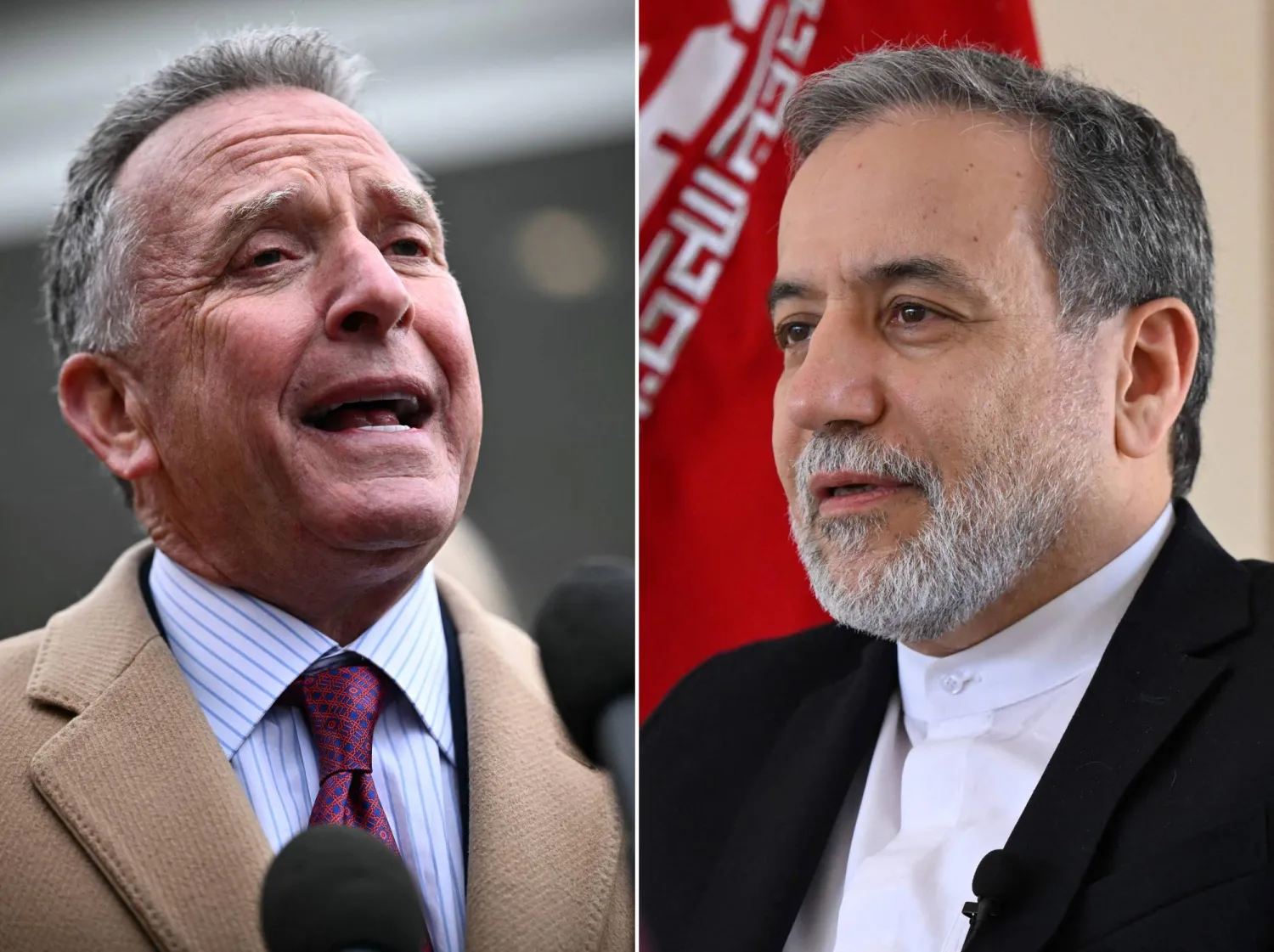
(COMBO) This combination of file photos created on April 9, 2025, shows US Middle East envoy Steve Witkoff speaking to reporters outside the West Wing of the White House in Washington, DC, on March 6, 2025 (L), and Iran's Foreign Minister Abbas Araghchi speaking to AFP during an interview at the Iranian consulate in Jeddah on March 7, 2025. (Photo by Mandel NGAN and Amer HILABI / AFP)
TT

Iran, US Start Crucial Talks in Oman as Confrontation Looms

(COMBO) This combination of file photos created on April 9, 2025, shows US Middle East envoy Steve Witkoff speaking to reporters outside the West Wing of the White House in Washington, DC, on March 6, 2025 (L), and Iran's Foreign Minister Abbas Araghchi speaking to AFP during an interview at the Iranian consulate in Jeddah on March 7, 2025. (Photo by Mandel NGAN and Amer HILABI / AFP)

Iran and the United States started high-stakes negotiations on Friday to try to overcome sharp differences over Tehran's nuclear program, with Oman shuttling between the sides, but a dispute over widening the agenda risks derailing diplomacy and triggering another Middle East conflict. 

While both sides have signaled readiness to revive diplomacy over Tehran's long-running nuclear row with the West, Washington wants to expand the talks to also cover Iran's ballistic missiles, support for armed groups around the region and "treatment of their own people", US Secretary of State Marco Rubio said on Wednesday. 

Iran has said it wants Foreign Minister Abbas Araghchi and US Middle East envoy Steve Witkoff to discuss only the nuclear issue in Muscat. US President Donald Trump's son-in-law Jared Kushner, who helped mediate in Gaza ceasefire talks, is also due to take part in the discussions. 

"Iran ‌enters diplomacy with ‌open eyes and a steady memory of the past year. We engage in good ‌faith ⁠and stand firm ‌on our rights. Commitments need to be honored," Araghchi said on X on Friday. 

An Iranian official told Reuters the talks have not officially started, although Iran’s demands have been conveyed to the United States via Oman. The official said indirect negotiations "possibly" would begin after a meeting between Witkoff and Oman’s foreign minister. Previous Iran-US talks adopted a shuttle diplomacy approach. 

Tehran's clerical leadership remains deeply worried that Trump may still carry out his threats to strike Iran after a military buildup by the US Navy near Iran. 

In June, the US struck Iranian nuclear targets, joining in the final stages of a 12-day Israeli bombing campaign. Tehran has since said its uranium enrichment work has stopped. The US naval buildup, which Trump ⁠has called a massive “armada”, has followed a bloody government crackdown on nationwide protests in Iran last month, heightening tensions between Washington and Tehran. 

Trump has warned that "bad things" would probably ‌happen if a deal could not be reached, ratcheting up pressure on the ‍Iranian Republic in a standoff that has led to mutual threats ‍of air strikes. 

"While these negotiations are taking place, I would remind the Iranian regime that the president has many options at ‍his disposal, aside from diplomacy, as the commander-in-chief of the most powerful military in the history of the world," White House Press Secretary Karoline Leavitt on Thursday told reporters. Iran has vowed a harsh response to any military strike and has cautioned countries hosting US bases that they could be in the firing line if they were involved in an attack. Iran has one of the Middle East's biggest stockpiles of ballistic missiles. 

MISSILE PROGRAM IS A RED LINE FOR TEHRAN 

Negotiators in Oman will have to navigate Iran's red line on discussing its missile program to reach a deal and avert future military action. Tehran ⁠has flatly ruled out talks on its "defense capabilities, including missiles and their range." 

In a show of defiance, Iran’s state TV said hours before the talks that “one of the country’s most advanced long-range ballistic missiles, the Khorramshahr-4,” had been deployed at one of the Revolutionary Guards’ vast underground “missile cities”. 

However, Tehran is willing to show "flexibility on uranium enrichment, including handing over 400 kg of highly enriched uranium (HEU) and accepting zero enrichment under a consortium arrangement as a solution," Iranian officials told Reuters last week. 

Iran also insists that its right to enrich uranium is not negotiable and demands the lifting of sanctions, reimposed since 2018 when Trump ditched Iran's 2015 nuclear deal with six powers. 

The United States, its European allies and Israel accuse Tehran of using its nuclear program as a veil for efforts to try to develop the capability to produce weapons. Iran says its nuclear program is for peaceful purposes only. 

Israel has likened the danger of Iran's missiles to its nuclear program. Prime Minister Benjamin Netanyahu said in January that Iran's "attempt to build atomic weapons" and "20,000 ballistic missiles" were like "two lumps of cancer". Tehran's influence throughout the region ‌has weakened severely with its regional allies - known as the "Axis of Resistance" - either dismantled or badly hurt since the start of the Hamas-Israel conflict in Gaza and the fall of Bashar al-Assad in Syria. 


World Economic Forum Head Steps Down Over Epstein Links

FILED - 21 January 2025, Switzerland, Davos: World Economic Forum president and CEO Borge Brende speaks during the Uncertain Times session at the World Economic Forum Annual Meeting. Photo: Faruk Pinjo/World Economic Forum/dpa
TT

World Economic Forum Head Steps Down Over Epstein Links

FILED - 21 January 2025, Switzerland, Davos: World Economic Forum president and CEO Borge Brende speaks during the Uncertain Times session at the World Economic Forum Annual Meeting. Photo: Faruk Pinjo/World Economic Forum/dpa

World Economic Forum head Børge Brende said Thursday that he is stepping down after facing pressure over his contacts with the late US sex offender Jeffrey Epstein.

Brende, a former Norwegian foreign minister, said in a statement that he had decided “after careful consideration” to step down as president and chief executive of the forum, known for its annual January summit in the Swiss Alpine resort of Davos.

“I am grateful for the incredible collaboration with my colleagues, partners, and constituents, and I believe now is the right moment for the Forum to continue its important work without distractions,” Brende said in a statement released by the WEF.

The US Justice Department has released more than 3 million pages of documents relating to Epstein, who died by suicide in jail in 2019 while awaiting trial on sex-trafficking charges.

Brende was Norway’s foreign minister from 2013-2017 and is one of several prominent Norwegians who have faced scrutiny following the latest release of Epstein files.

He didn't refer directly to that controversy in Thursday's statement, but the WEF announced earlier this month that it was opening an internal review into Brende to determine his relationship with Epstein after files indicated the two had dined together several times and exchanged messages.

Brende told Norwegian broadcaster NRK at the time that he was cooperating with the investigation, that he only met Epstein in business settings and that he had been unaware of Epstein’s criminal background.

WEF co-chairs André Hoffmann and Larry Fink said in a statement that “the independent review conducted by outside counsel has concluded. The findings stated that there were no additional concerns beyond what has been previously disclosed.”

They said that Alois Zwinggi will serve as the forum's interim president and CEO, and the forum's Board of Trustees would oversee the leadership transition, including a plan to identify a permanent successor.

Brende's resignation follows the departure last year of the WEF's founder and longstanding chair Klaus Schwab after he came under pressure from a whistleblower alleging misconduct.

The WEF subsequently said an internal investigation had found no evidence of material wrongdoing by Schwab.


US Moves to Cut Off Swiss Bank from Financial System over Alleged Iran, Russia Links

FILE PHOTO: A bronze seal for the Department of the Treasury is shown at the US Treasury building in Washington, US, January 20, 2023.  REUTERS/Kevin Lamarque/File Photo
FILE PHOTO: A bronze seal for the Department of the Treasury is shown at the US Treasury building in Washington, US, January 20, 2023. REUTERS/Kevin Lamarque/File Photo
TT

US Moves to Cut Off Swiss Bank from Financial System over Alleged Iran, Russia Links

FILE PHOTO: A bronze seal for the Department of the Treasury is shown at the US Treasury building in Washington, US, January 20, 2023.  REUTERS/Kevin Lamarque/File Photo
FILE PHOTO: A bronze seal for the Department of the Treasury is shown at the US Treasury building in Washington, US, January 20, 2023. REUTERS/Kevin Lamarque/File Photo

The US Treasury Department proposed a rule on Thursday that, if finalized, would sever MBaer Merchant Bank AG's access to the US financial system on the grounds the Swiss bank had supported illicit actors linked to Iran and Russia.

The Treasury alleged MBaer and its employees had facilitated corruption linked to Venezuelan and Russian money laundering as well as money laundering and terrorist ⁠financing on behalf ⁠of Iran's Revolutionary Guard Corps and its Quds Force, which are under sanctions from the US.

"MBaer has funneled over a hundred million dollars through the US financial system on behalf of illicit actors tied to Iran and ⁠Russia," Reuters quoted Treasury Secretary Scott Bessent as saying in a statement. "Banks should be on notice that the US Treasury will aggressively protect the integrity of the US financial system using the full force of our authorities."

The Treasury said that if finalized, the proposed rule would prohibit covered US financial institutions from opening or maintaining a correspondent account for, or on behalf of, MBaer. The Treasury's Financial ⁠Crimes ⁠Enforcement Network anti-money laundering bureau published a notice of proposed rulemaking that invites written comments for 30 days on the plan to cut off the small Swiss private bank from the US dollar-based financial system.

FinCEN said in the notice that for years, MBaer "has directly or indirectly facilitated money laundering for or on behalf of illicit actors, including through processing transactions related to Venezuelan corruption and Russian and Iranian illicit activities."


Cuba Vows to Defend Itself Against 'Terrorist and Mercenary Aggression'

(FILES) Cuban President Miguel Diaz-Canel delivers a speech during the closing of the IV Conference "Nation and Emigration" at the Convention Palace in Havana on November 19, 2023. (Photo by YAMIL LAGE / AFP)
TT

Cuba Vows to Defend Itself Against 'Terrorist and Mercenary Aggression'

(FILES) Cuban President Miguel Diaz-Canel delivers a speech during the closing of the IV Conference "Nation and Emigration" at the Convention Palace in Havana on November 19, 2023. (Photo by YAMIL LAGE / AFP)

President Miguel Diaz-Canel said on Thursday that Cuba will defend itself against "terrorist and mercenary aggression," a day after Havana said it had killed four exiles aboard a Florida-registered speedboat that entered Cuban waters and opened fire on a patrol.

The Cuban government said the people on the speedboat in Wednesday's incident were anti-government Cubans, some of whom were previously wanted for plotting attacks. Six people on the speedboat were wounded, Cuba says.

"Cuba ⁠does not attack ⁠nor threaten," Diaz-Canel wrote on X. "We have stated this on repeated occasions and reaffirm it today: Cuba will defend itself with determination and firmness."

The incident took place at a time of heightened tensions with the United States, which has ⁠blocked oil shipments to the island to pressure the Communist-run government, after capturing and jailing Venezuelan President Nicolas Maduro, an ally of Cuba.

A man fishes in Havana Bay across from the Nico Lopez oil refinery, in Havana, Cuba February 25, 2026. REUTERS/Norlys Perez

The fuel shortages have hit transport and worsened power cuts on the Caribbean's largest island, where the electricity grid relies on imported oil.

Venezuela had been Cuba's top oil supplier, but has not sent shipments since December, Reuters reported.

The UN has warned of a humanitarian crisis if Cuba's energy ⁠needs are ⁠not met.

On Thursday, Russia - one of Cuba's last oil suppliers, though it has not given a date for its next shipment - called for restraint and called the incident an "aggressive provocation by the United States".

US Secretary of State Marco Rubio said his government was going to independently investigate the incident.

"We're still gathering facts," he told reporters. "We don't generally make decisions in the United States on the basis of what Cuban authorities are saying."