


Trump Warns Iran of 'Very Traumatic' Outcome if No Nuclear Deal

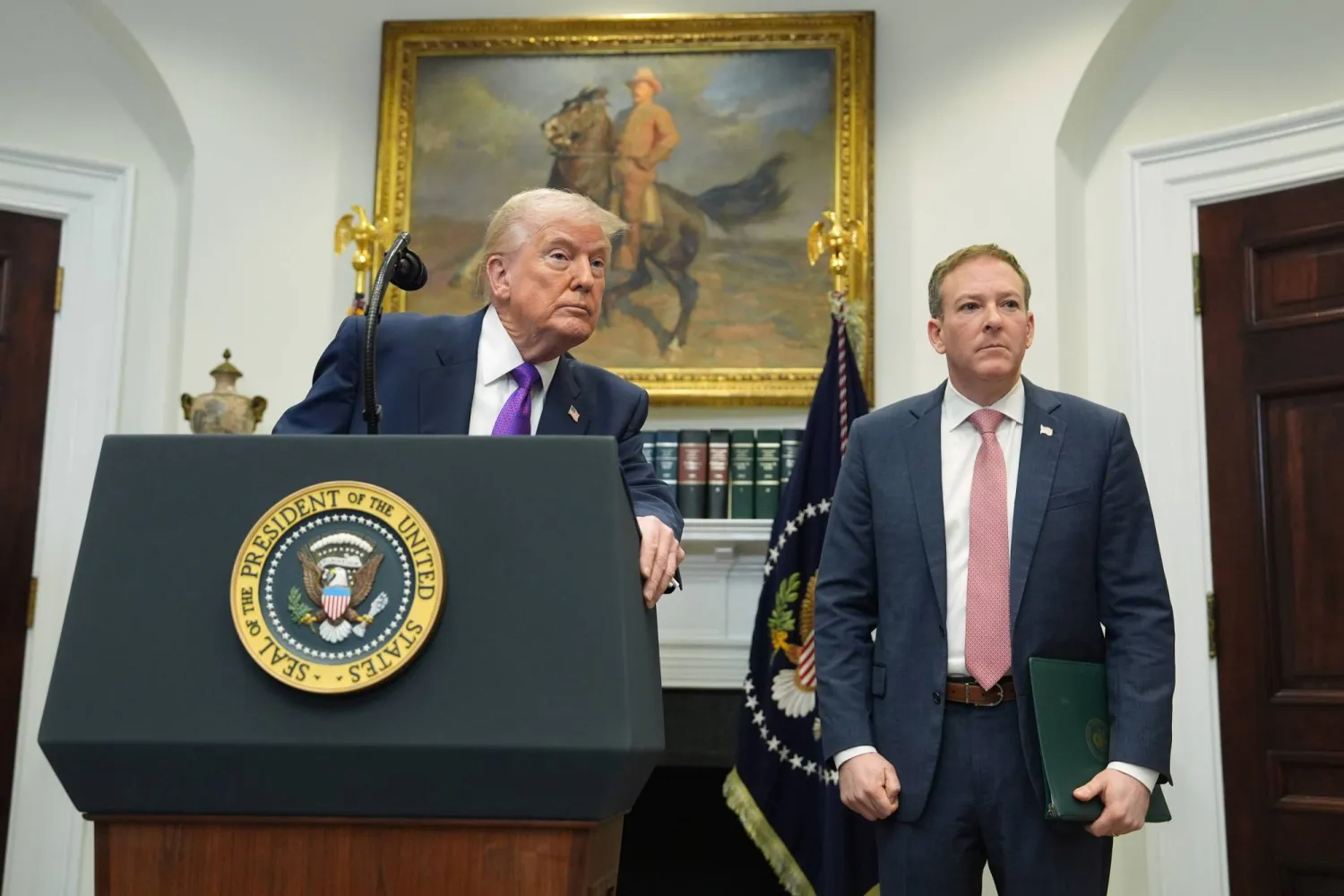
President Donald Trump listens to a question from a reporter during an event with Environmental Protection Agency director Lee Zeldin to announce the EPA will no longer regulate greenhouse gases, in the Roosevelt Room of the White House, Thursday, Feb. 12, 2026, in Washington. (AP Photo/Evan Vucci)
TT

Trump Warns Iran of 'Very Traumatic' Outcome if No Nuclear Deal

President Donald Trump listens to a question from a reporter during an event with Environmental Protection Agency director Lee Zeldin to announce the EPA will no longer regulate greenhouse gases, in the Roosevelt Room of the White House, Thursday, Feb. 12, 2026, in Washington. (AP Photo/Evan Vucci)

US President Donald Trump threatened Iran Thursday with "very traumatic" consequences if it fails to make a nuclear deal -- but Israeli Prime Minister Benjamin Netanyahu said he was skeptical about the quality of any such agreement.

Speaking a day after he hosted Netanyahu at the White House, Trump said he hoped for a result "over the next month" from Washington's negotiations with Tehran over its nuclear program.

"We have to make a deal, otherwise it's going to be very traumatic, very traumatic. I don't want that to happen, but we have to make a deal," Trump told reporters.

"This will be very traumatic for Iran if they don't make a deal."

Trump -- who is considering sending a second aircraft carrier to the Middle East to pressure Iran -- recalled the US military strikes he ordered on Tehran's nuclear facilities during Israel's 12-day war with Iran in July last year.

"We'll see if we can get a deal with them, and if we can't, we'll have to go to phase two. Phase two will be very tough for them," Trump said.

Netanyahu had traveled to Washington to push Trump to take a harder line in the Iran nuclear talks, particularly on including the Iranian Republic's arsenal of ballistic missiles.

But the Israeli and US leaders apparently remained at odds, with Trump saying after their meeting at the White House on Wednesday that he had insisted the negotiations should continue.

'General skepticism'

Netanyahu said in Washington on Thursday before departing for Israel that Trump believed he was laying the ground for a deal.

"He believes that the conditions he is creating, combined with the fact that they surely understand they made a mistake last time when they didn't reach an agreement, may create the conditions for achieving a good deal," Netanyahu said, according to a video statement from his office.

But the Israeli premier added: "I will not hide from you that I expressed general skepticism regarding the quality of any agreement with Iran."

Any deal "must include the elements that are very important from our perspective," Netanyahu continued, listing Iran's ballistic missile program and its support for armed groups such as the Palestinian movement Hamas, Yemen's Houthis and Hezbollah in Lebanon.

"It's not just the nuclear issue," he said.

Despite their differences on Iran, Trump signaled his strong personal support for Netanyahu as he criticized Israeli President Isaac Herzog for rejecting his request to pardon the prime minister on corruption charges.

"You have a president that refuses to give him a pardon. I think that man should be ashamed of himself," Trump said on Thursday.

Trump has repeatedly hinted at potential US military action against Iran following its deadly crackdown on protests last month, even as Washington and Tehran restarted talks last week with a meeting in Oman.

The last round of talks between the two foes was cut short by Israel's war with Iran and the US strikes.

So far, Iran has rejected expanding the new talks beyond the issue of its nuclear program. Tehran denies seeking a nuclear weapon, and has said it will not give in to "excessive demands" on the subject.



Russian Drone Strike in Ukraine’s Kharkiv Kills Two, Officials Say

A local man and a rescuer stand near the rubble at the site of a residential building destroyed by a Russian strike on 07 March, in Kharkiv, northeastern Ukraine, 09 March 2026. (EPA)
TT

Russian Drone Strike in Ukraine’s Kharkiv Kills Two, Officials Say

A local man and a rescuer stand near the rubble at the site of a residential building destroyed by a Russian strike on 07 March, in Kharkiv, northeastern Ukraine, 09 March 2026. (EPA)

A Russian drone hit a civilian business in Ukraine's second-largest city of Kharkiv, killing two people and injuring ‌five, local ‌officials said.

"Unfortunately, there ‌is ⁠preliminary information about ⁠two people killed," Mayor Ihor Terekhov said on the Telegram messaging app.

Kharkiv Regional Governor Oleh Syniehubov ⁠said that according to preliminary ‌information ‌all of the wounded ‌were in serious condition ‌and were receiving necessary assistance.

He added that the attack caused a ‌fire at the business.

Kharkiv, located 30 km (18 ⁠miles) ⁠from the Russian border, withstood early advances by Russian forces after their full-scale invasion in February 2022 and has since been a frequent target of Russian air attacks.


Iran Keeps up Pressure on Oil Infrastructure as Concerns of Global Energy Crisis Grow

Rocket trails are seen in the sky above the Israeli center coastal city of Netanya amid a fresh barrage of Iranian missile attacks on March 11, 2026. (AFP)
TT

Iran Keeps up Pressure on Oil Infrastructure as Concerns of Global Energy Crisis Grow

Rocket trails are seen in the sky above the Israeli center coastal city of Netanya amid a fresh barrage of Iranian missile attacks on March 11, 2026. (AFP)

Israel and Iran exchanged fire early Wednesday, with Tehran keeping up pressure on the region's oil industry and targeting infrastructure as global energy concerns mounted and the war in the Middle East showed no signs of abating.

Early Wednesday, a projectile hit a container ship off the coast of Oman in the Strait of Hormuz, setting it ablaze and forcing the crew to abandon the vessel, the British military said. Kuwait said its defenses downed eight Iranian drones and Saudi Arabia said it intercepted five drones heading toward the Kingdom’s Shaybah oil field.

Iran has effectively stopped cargo traffic in the narrow strait through which about a fifth of all oil is shipped from the Gulf toward the Indian Ocean. It has also targeted oil fields and refineries in Gulf Arab nations as part of a strategy apparently aimed at generating enough global economic pain to pressure the United States and Israel to end their strikes.

The UN Security Council was to vote later in the day on a resolution sponsored by the Gulf Cooperation Council demanding Iran stop attacking its Arab neighbors.

Israel said it had renewed attacks on Tehran, following multiple strikes the day before that residents described as some of the heaviest during the war.

Explosions were also heard in Beirut and in southern Lebanon after Israel said it had started a new assault on targets related to the Iran-linked militia Hezbollah.

Israel pounds Lebanon with new wave of attacks

The attacks set a building ablaze in central Beirut in the densely populated Aisha Bakkar area, engulfing the top two floors of the multistory structure. There were no immediate reports of casualties from the strike, which came without warning.

An earlier Israeli strike killed five people in the Nabatieh district in southern Lebanon, while two more were killed in strikes in the Tyre and Bint Jbeil districts, Lebanon's Health Ministry said. A Red Cross worker also died Wednesday of wounds sustained Monday, when his team was hit by an Israeli strike while they were rescuing people from an earlier attack.

Nearly 500 people have been killed so far in Lebanon since Hezbollah triggered the latest round of fighting with Israel when it fired rockets into the country’s north after the American and Israeli attacks on Iran started.

Iran launches multiple salvoes at Israel and Gulf nations

Israel warned of three Iranian attacks early Wednesday, with sirens heard in Tel Aviv and elsewhere but no immediate reports of casualties.

In addition to Iranian attacks targeting Saudi Arabia's oil fields, the Kingdom's defense ministry said it had destroyed six ballistic missiles launched toward Prince Sultan Air Base in eastern Saudi Arabia. The ministry also said it intercepted and destroyed two drones over the eastern city of Hafar al-Batin.

In the Strait of Hormuz north of Oman, a cargo ship was hit with a projectile and set on fire, according to the United Kingdom Maritime Trade Operations center, run by the British military.

Iran did not immediately claim the attack though it has been targeting ships in and around the strait.

The UKMTO earlier reported on another attack targeting a container ship off Ras al-Khaimah in the United Arab Emirates. In that case, it said the “extent of the damage is currently unknown but under investigation by the crew.”

The United Arab Emirates said early Wednesday that its air defenses were working to intercept incoming Iranian fire. The nation said Iranian attacks have killed six people and wounded 122 others there.

Bahrain sounded sirens early Wednesday, warning of an incoming Iranian attack. The warnings came a day after an Iranian attack hit a residential building in the capital, Manama, and killed a 29-year-old woman and wounding eight people.

At the United Nations, the Security Council was to vote Wednesday afternoon on the Gulf Cooperation Council resolution, according to three diplomats speaking on condition of anonymity ahead of an official announcement.

The council, a six-nation regional bloc, said its own facilities were targeted in an Iranian attack last week on Bahrain.

The draft resolution, obtained by The Associated Press, condemns Iran’s attacks on Saudi Arabia, Bahrain, Kuwait, Oman, Qatar, the United Arab Emirates and Jordan. The measure calls for an immediate end to all strikes and threats against neighboring states, including through proxies.

It would be the first Security Council resolution considered since the start of the war.

Oil prices stay high

Oil prices remained well below the peaks Monday but the price of Brent crude, the international standard, was still up some 20% Wednesday from when the war began, and consumers around the world are already feeling the pain at the pump.

The spike in oil prices has been rocking financial markets worldwide because of worries that the war could block the global flow of oil and natural gas for a long time.

The US military said Tuesday it had destroyed 16 Iranian minelayers near the Strait of Hormuz, though US President Donald Trump said in social media posts that there were no reports yet of Iran mining the passage, a prospect that experts warned of preceding the war.

If the strait is mined, it could take at least weeks to clean it up once the conflict is over.

Some tankers, believed linked to Iran, are continuing to get through the strait making so-called “dark” transits -- meaning they aren’t turning on their Automatic Identification System tracks, which show where vessels are. Vessels carrying sanctioned Iranian crude often turn off their AIS trackers.

The security firm Neptune P2P Group said Wednesday there had been seven ships pass through the strait since March 8. Of them, five were linked to Iranian-associated shipping, it said. In ordinary times the strait typically sees 100 ships or more transit daily from the Gulf into the Gulf of Oman.

Meanwhile, the commodity-tracking firm Kpler said Iran has restarted crude exports through its Jask oil terminal on the Gulf of Oman. A tanker loaded roughly 2 million barrels at Jask on March 7, it said.

Foreign nationals flee region as death tolls rise

In addition to the nearly 500 people killed in Lebanon, Iran has said more than 1,300 people have been killed there and Israel has reported 12 people dead.

The US has lost seven soldiers while another eight have suffered severe injuries.

Many foreign nationals have been getting out of the Gulf region since the war began, including over 45,000 UK citizens, the British Foreign Office said. Some 40,000 people returned to the United States, according to the State Department.


Iran’s New Supreme Leader ‘Safe and Sound’ Despite War Injury Reports, Says President’s Son

Iran’s new supreme leader, Mojtaba Khamenei, the second son of late Iran's Supreme Leader Ali Khamenei, attends a meeting in Tehran, Iran, March 2, 2016. Rouhollah Vahdati/ISNA/WANA (West Asia News Agency) via Reuters
TT

Iran’s New Supreme Leader ‘Safe and Sound’ Despite War Injury Reports, Says President’s Son

Iran’s new supreme leader, Mojtaba Khamenei, the second son of late Iran's Supreme Leader Ali Khamenei, attends a meeting in Tehran, Iran, March 2, 2016. Rouhollah Vahdati/ISNA/WANA (West Asia News Agency) via Reuters

Iran's new supreme leader Mojtaba Khamenei is "safe and sound" despite reports of an injury during the war with Israel and the United States, said the son of the Iranian president on Wednesday.

"I heard news that Mar Mojtaba Khamenei had been injured. I have asked some friends who had connections. They told me that, thank God, he is safe and sound," said Yousef Pezeshkian, who is also a government adviser, in a post on his Telegram channel.

State television had called Khamenei a "wounded veteran of the Ramadan war" but never specified his injury.

The new supreme leader is the son and successor of the country's longtime ruler Ali Khamenei, who was killed in US-Israeli strikes on Iran on February 28 which triggered a war across the Middle East.

The 56-year-old Mojtaba Khamenei, a discreet figure who has rarely appeared in public or spoken at official events, has yet to address the nation or issue a written statement since he was declared supreme leader on Sunday.

In a Wednesday report, the New York Times quoting three unnamed Iranian officials said that Khamenei "had suffered injuries, including to his legs, but that he was alert and sheltering at a highly secure location with limited communication".