


Iran Says US ‘More Realistic’ on Nuclear Issue, as Guards Begin Drills in Hormuz Strait

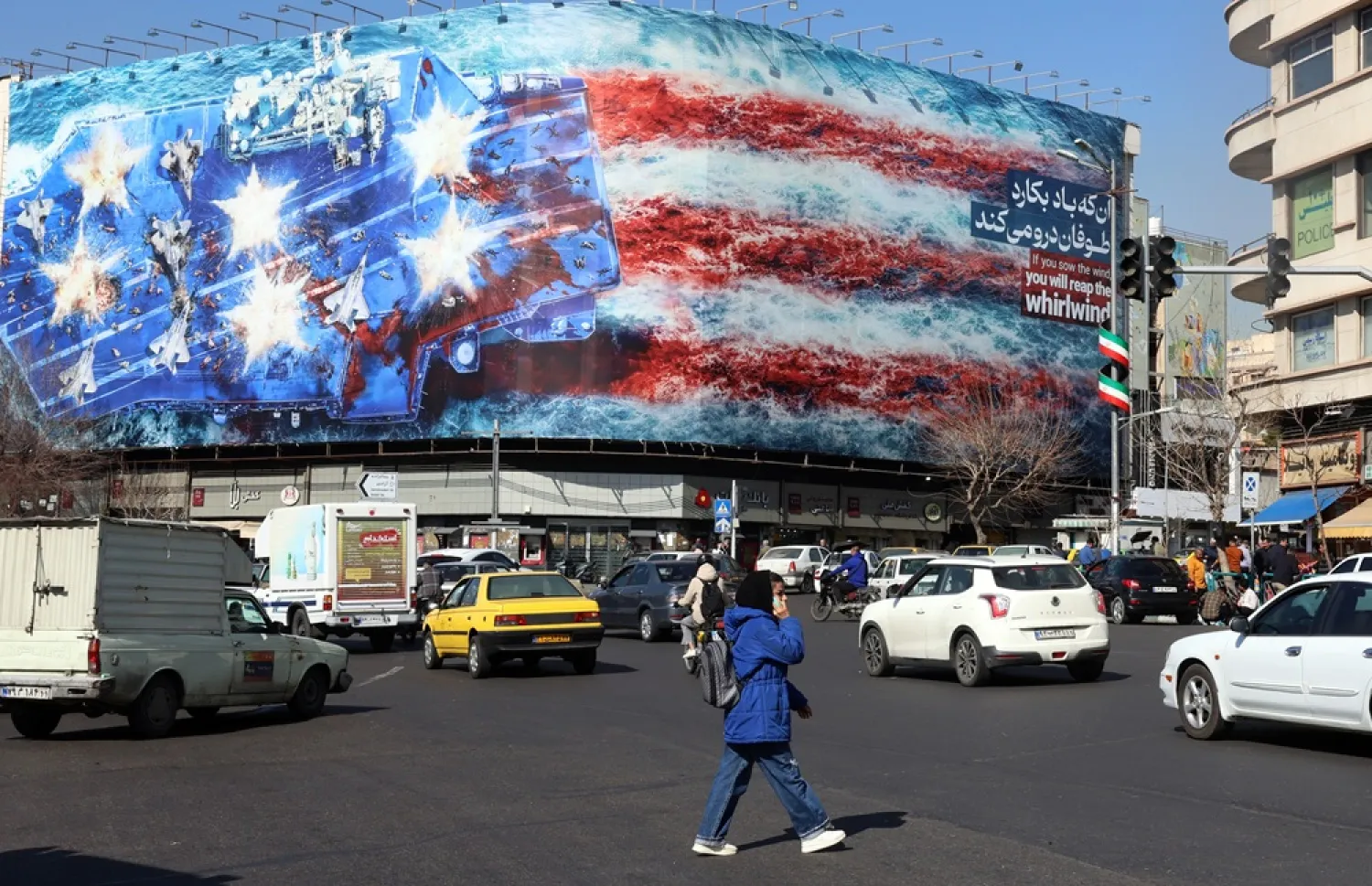
Iranians walk past an anti-US billboard at Enqelab Square in Tehran, Iran, 16 February 2026. (EPA)
TT

Iran Says US ‘More Realistic’ on Nuclear Issue, as Guards Begin Drills in Hormuz Strait

Iranians walk past an anti-US billboard at Enqelab Square in Tehran, Iran, 16 February 2026. (EPA)

Iran said on Monday that the United States' position on Iran's nuclear program "has moved towards a more realistic one", a day ahead of a second round of US-Iranian talks in Geneva. 

Tehran's foreign minister arrived in Geneva for the new round of indirect negotiations with the US, as the Revolutionary Guards began military drills in the Strait of Hormuz, a vital shipping lane for oil and gas. 

The two sides recently resumed indirect talks, mediated by Oman, after US President Donald Trump repeatedly threatened military action against Iran over a deadly crackdown on protesters last month. 

A previous attempt at negotiations collapsed when Israel launched surprise strikes on Iran, beginning a 12-day war that Washington briefly joined to bomb Iranian nuclear sites. 

"A cautious assessment is that, from the discussions that have taken place in Muscat to date, at least what we have been told is that the US position on the Iranian nuclear issue has moved towards a more realistic one," said foreign ministry spokesman Esmaeil Baqaei, the official IRNA news agency reported. 

According to Tehran, talks mediated by Oman will be held on Tuesday in Switzerland. 

Washington has previously pushed for other topics to be discussed including Iran's ballistic missiles and support for armed groups in the region. 

The war games being conducted by the Guards, the ideological arm of the military, aim to prepare it for "potential security and military threats" in the strait, Iranian state TV said. 

Iranian politicians have repeatedly threatened to block the strait, a strategic waterway through which about 20 percent of global oil passes, as both sides ramp up pressure with talks set to resume. 

US Secretary of State Marco Rubio told reporters on Monday "we're hopeful there's a deal". 

"The president always prefers peaceful outcomes and negotiated outcomes to things." 

Meanwhile, Iran's top diplomat, Abbas Araghchi, wrote on X that he was meeting in Geneva with the head of the International Atomic Energy Agency, Rafael Grossi, "for deep technical discussion". 

Grossi later confirmed the meeting on X, calling the conversation with Araghchi "in-depth" ahead of Tuesday's "important negotiations". 

- Protest crackdown - 

Araghchi is also set to hold talks with his Swiss and Omani counterparts as well as other international officials, Iran's foreign ministry said. 

"I am in Geneva with real ideas to achieve a fair and equitable deal. What is not on the table: submission before threats," Araghchi added on X. 

Washington has dispatched Middle East envoy Steve Witkoff and President Donald Trump's son-in-law Jared Kushner, the White House confirmed on Sunday. 

The latest talks follow repeated threats from Trump of military action against Tehran, first over Iran's deadly crackdown on anti-government protests, and then more recently over the country's nuclear program. 

The West fears the program is aimed at making a bomb, which Tehran denies. 

On Friday, Trump said a change of government in Iran would be the "best thing that could happen", as he sent a second aircraft carrier to the Middle East to ratchet up military pressure. 

His remarks came before demonstrations outside Iran against its clerical authorities swept a number of cities including in the US over the weekend. 

Iranians inside the country have also defied the deadly crackdown on protests last month and continued to shout slogans against the authorities from their windows. 

- 'Viable' deal - 

Iran's deputy foreign minister told the BBC that Tehran would consider compromises on its uranium stockpile if Washington lifts sanctions that have crippled the country's economy. 

"If we see the sincerity on their (American) part, I am sure we will be on a road to have an agreement," said Majid Takht-Ravanchi. 

Israeli Prime Minister Benjamin Netanyahu said on Sunday that any deal must involve the removal of all enriched uranium from Iran as well as Tehran's ability to enrich more. 

The whereabouts of Iran's stockpile of around 400 kilograms of uranium enriched to 60 percent remains unknown, with inspectors having last seen it in June. 


Iran Guards Vow ‘Stronger’ Response Than in January if New Protests Erupt

A security personnel stands guard as Iranians take part in a protest marking the annual al-Quds Day (Jerusalem Day) on the last Friday of the holy month of Ramadan, amid the US-Israeli conflict with Iran, in Tehran, Iran, March 13, 2026. Majid Asgaripour/WANA (West Asia News Agency) via Reuters
TT

Iran Guards Vow ‘Stronger’ Response Than in January if New Protests Erupt

A security personnel stands guard as Iranians take part in a protest marking the annual al-Quds Day (Jerusalem Day) on the last Friday of the holy month of Ramadan, amid the US-Israeli conflict with Iran, in Tehran, Iran, March 13, 2026. Majid Asgaripour/WANA (West Asia News Agency) via Reuters

Iran's Revolutionary Guards, the ideological arm of the country's military, warned on Friday that any new protests against the authorities would be met with a stronger response than in January, when several thousand people were killed.

"The evil enemy, failing to achieve its field battle goals, is once again pursuing the instillation of fear and street riots," the Guards said in a statement broadcast on TV, promising "a stronger blow than on January 8" in the event of new unrest.

The warning comes two weeks into Iran's war with the United States and Israel in which Israeli Prime Minister Benjamin Netanyahu says one of the aims is to "create, for the Iranian people, the conditions to bring down" the Iranian government.

US President Donald Trump has also called for Iranians to rise up and overthrow their government.

In December, protests against the high cost of living in Iran turned into a broad protest movement against the authorities.

It reached its peak on January 8 with what Iranian authorities called "riots" blamed on "terrorists" working on behalf of Israel and the United States.

The official death toll from Iranian authorities stands at more than 3,000, with the government saying the vast majority were members of security forces or passers-by.

NGOs based abroad have accused the security forces of deliberately firing on demonstrators.

The Human Rights Activists News Agency, based in the United States, says more than 7,000 people were killed.


Trump Threatens Iran Following New Wave of Attacks on Gulf States and Israel

File photo: President Donald Trump speaks as he meets with Congo's Foreign Minister Therese Kayikwamba Wagner, and Rwanda's Foreign Minister Olivier Nduhungirehe, Friday, June 27, 2025, in the Oval Office at the White House in Washington, as Vice President JD Vance and Secretary of State Marco Rubio listen. (AP Photo/Manuel Balce Ceneta)
TT

Trump Threatens Iran Following New Wave of Attacks on Gulf States and Israel

File photo: President Donald Trump speaks as he meets with Congo's Foreign Minister Therese Kayikwamba Wagner, and Rwanda's Foreign Minister Olivier Nduhungirehe, Friday, June 27, 2025, in the Oval Office at the White House in Washington, as Vice President JD Vance and Secretary of State Marco Rubio listen. (AP Photo/Manuel Balce Ceneta)

Iran launched multiple attacks early Friday on Gulf Arab states, including dozens of drones at Saudi Arabia, following warnings from its new supreme leader about hosting American bases, and US President Donald Trump threatened major new retaliation.

“Watch what happens to these deranged scumbags today," Trump wrote in a social media post. “Iran’s Navy is gone, their Air Force is no longer, missiles, drones and everything else are being decimated, and their leaders have been wiped from the face of the earth.”

The comments came the day after Iran's Supreme Leader Mojtaba Khamenei vowed to “not refrain from avenging the blood” of Iranians killed, and warned Gulf Arab nations to shut US bases, saying the notion of American protection was “nothing more than a lie.”

Intense airstrikes landed around Iran’s capital, Tehran early Friday, just before rallies were to begin for the annual Quds Day event in support of the Palestinians. Israel said its air force had hit more than 200 targets in Iran over the past 24 hours, including missile launchers, defense systems and weapons production sites.

With growing global concerns about a possible energy crisis and no end to the war in sight, the price of Brent crude oil, the international standard, remained stubbornly over $100 per barrel as Iran kept its stranglehold on shipping through the Strait of Hormuz, the strategic waterway through which a fifth of the world's oil transits on its way from the Arabian Gulf to the open seas.

Brent prices have spiked as high as about $120 per barrel and are currently some 40% higher than when Israel and the United States attacked Iran on Feb. 28 to start the war.

Iran has been attacking ships that try to transit the strait, and Khamenei's comments — his first to the public since being named to replace his father, who was killed during the first day of the conflict — said Iran would continue to block the waterway.

In Iraq, recovery efforts were underway after an American KC-135 refueling plane went down, according to US Central Command. And a French soldier who was stationed in the north of the country was killed in an attack, the French president said Friday.

Iran launches new attacks on Gulf Arab countries

Iran has been attacking oil and other infrastructure around the Gulf region, and on Friday Saudi Arabia that it had downed nearly 50 drones sent in multiple waves throughout the early morning hours.

In Oman, two people were killed when two drones crashed in an industrial area in the region of Sohar, the Oman News Agency reported.

Sirens also sounded in Bahrain warning of incoming fire, and in Dubai black smoke billowed from an industrial area after a blaze authorities said was sparked by debris from an interception.

A building at the Dubai International Financial Center also sustained damage when hit with debris from what authorities described as a “successful interception.”

The DIFC is an economic free zone for banks, capital traders and wealth managers, home to exclusive restaurants and nightclubs for the city-state’s elite. Iran said earlier this week that it would target banks and financial institutions after an airstrike hit a bank in Tehran.

Nearly 60 people were wounded in northern Israel after Hezbollah said it had fired several rocket salvoes toward the area and at Israeli troops in southern Lebanon. Almost all the injuries were described as very minor.

One person was killed in southwestern Beirut in an Israeli strike, according to the Lebanese Health Ministry, and another attack hit an apartment in the capital, leaving it engulfed in flames. Following the attacks, the Israeli army said it had been targeting a member of Iran-linked Hezbollah.

In eastern Lebanon, a strike on an apartment wounded a local official with the Lebanese branch of the Muslim Brotherhood and killed his two sons, the state-run National News Agency reported. Israel for the past two years has targeted officials with the group, known as al-Jamaa al-Islamiya or the Islamic Group.

More than 600 people have been killed in Lebanon since the fighting began, the Health Ministry has reported and nearly 800,000 have been internally displaced, according to the UN refugee agency.

Iranian authorities say more than 1,300 people have been killed there, and Israel has reported 12 deaths. The US has lost at least seven soldiers while another eight have suffered severe injuries.

In his Friday morning post, Trump said that "we are totally destroying the terrorist regime of Iran, militarily, economically, and otherwise."

“They’ve been killing innocent people all over the world for 47 years, and now I, as the 47th President of the United States of America, am killing them,” Trump said. “What a great honor it is to do so!”

The US military said American forces have now struck more than 6,000 targets since the operation against Iran began, including more than 30 minelaying vessels.


Earthquake Hits Northeast Türkiye, Says Disaster Agency

 A working seismograph is shown in a display about earthquakes. (Reuters)
A working seismograph is shown in a display about earthquakes. (Reuters)
TT

Earthquake Hits Northeast Türkiye, Says Disaster Agency

 A working seismograph is shown in a display about earthquakes. (Reuters)
A working seismograph is shown in a display about earthquakes. (Reuters)

A magnitude 5.5 earthquake rattled northeast Türkiye on Friday, the country's disaster management agency said.

The tremor hit around 3:35 am (0035 GMT) in Tokat province, with no reports of damage, the Turkish disaster and emergency management authority said.

The agency added it was continuing to assess the situation.

The governor of Tokat announced that schools would be closed on Friday.

Türkiye is crisscrossed by several geological fault lines which have previously caused catastrophes in the country.

A quake in February 2023 in the southwest killed at least 53,000 people and devastated Antakya, site of the ancient city of Antioch.
