

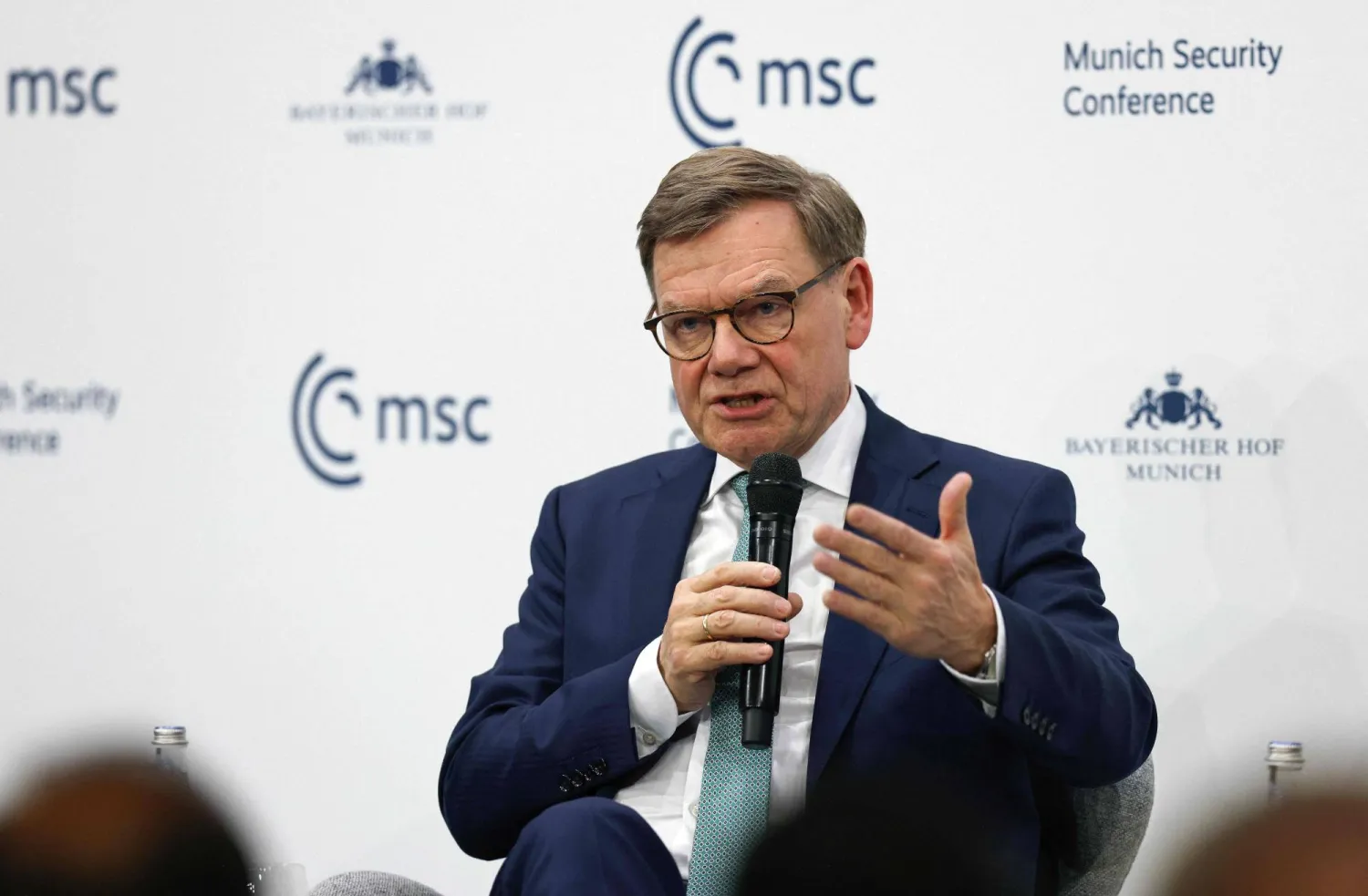

German Foreign Minister Slams France Over Defense Spending 

German Foreign Minister Johann Wadephul speaks during the 62nd Munich Security Conference (MSC) on February 14, 2026 in Munich, southern Germany. Heads of state and government as well as foreign and defense ministers from all over the world are expected to attend the security policy talks from February 13 to 15, 2026. (AFP)
TT

German Foreign Minister Slams France Over Defense Spending 

German Foreign Minister Johann Wadephul speaks during the 62nd Munich Security Conference (MSC) on February 14, 2026 in Munich, southern Germany. Heads of state and government as well as foreign and defense ministers from all over the world are expected to attend the security policy talks from February 13 to 15, 2026. (AFP)

German Foreign Minister Johann Wadephul criticized French defense spending on Monday, calling for Paris to do more to turn calls for European security sovereignty into concrete capabilities.

The comments marked the latest crack in relations between the two European giants.

French President Emmanuel Macron "repeatedly and correctly refers to our pursuit of European sovereignty," Wadephul told public broadcaster Deutschlandfunk.

"Anyone who talks about it needs to act accordingly in their own country."

European NATO members are under pressure from the United States to build up their defence spending.

Though they pledged last June to raise their defense and security-related outlays to five percent of GDP by 2035, Wadephul said progress in Europe so far had been lacking.

"Unfortunately, efforts in the French Republic have also been insufficient to achieve this so far," Wadephul said. "France, too, needs to do what we are doing here with difficult discussions."

Germany last year exempted most defense spending from constitutionally enshrined debt limits and current budgets foresee Berlin spending more than 500 billion euros ($593 billion) on defense between 2025 and 2029.

Under financial pressure, France has less room for maneuver.

The country has the European Union's third-highest debt burden as a proportion of GDP after Greece and Italy, almost twice the 60-percent ceiling set in EU treaties.

France and Macron needed to be ready to take difficult decisions, Wadephul said, including possible welfare cuts, to build the "breathing space needed".

"That is a call that goes out to all European countries," he added. "We will have to hold very open, very honest discussions about this here in our European family."

- Discord over fighter jet -

Wadephul's call comes amid strains in the Franco-German alliance, traditionally the motor of European cooperation.

Germany has slapped down Macron's repeated calls for so-called eurobonds to boost investment, fearing common EU debt would lead to open-ended subsidies of EU member states with weak finances.

Wadephul reiterated that Germany was also opposed to the proposal when it comes to defense spending, adding that NATO member states had last year agreed to reach the five-percent spending goal by their own efforts.

"We must also say to all our European partners -- in a spirit of friendship but with clarity -- that what was promised, the five per cent, were commitments to national contributions," he said.

"We are looking forward to and eagerly await another speech by the French president, I believe on the 27th of this month, where he will comment on strategic issues," Wadephul added.

Nerves are also fraying over plans by Paris and Berlin for a next-generation European fighter jet, where German industry and unions have accused French aerospace firm Dassault of seeking to dictate the terms of the project.

In other recent disagreements, France wanted to block an EU trade deal with a group of South American countries, backed by Germany. Paris also opposed a push by Berlin and Rome to water down a planned EU ban on new petrol and diesel cars by 2035.

A European diplomat last week told AFP that right now "the Franco-German axis isn't working".


Türkiye Condemns Closing of 8 Turkish Schools in Greece

View of the island of Halki from a ferry sailing to the island of Rhodes, off the island of Halki, Greece, April 13, 2021. (Reuters)
TT

Türkiye Condemns Closing of 8 Turkish Schools in Greece

View of the island of Halki from a ferry sailing to the island of Rhodes, off the island of Halki, Greece, April 13, 2021. (Reuters)

Türkiye's foreign ministry on Sunday condemned a decision by Greece to close eight schools catering to the country's Turkish-speaking minority, accusing its neighbor of discrimination.

In a communique, the ministry condemned "systematic practices aimed at undermining the right to education of the Turkish minority in Western Thrace".

"We once again call on Greece to act in accordance with its contractual obligations regarding minority rights and fundamental rights," it added.

The number of Turkish-language schools left in the north-east region of Thrace -- near the border between the two countries -- is now 76.

Greek authorities have said they were closing schools, and not solely in Turkish-speaking areas, because of declining numbers of pupils.

According to 2021 statistics, some 120,000 Muslims of Turkish origin live in Thrace, where they enjoy specific rights in regards to religion and education under the Treaty of Lausanne, signed after the First World War.


5.5 Magnitude Earthquake Hits Peru’s Andes Region, Killing at Least 5 People

This handout picture released by Peru's Defense Ministry shows a collapsed house on the outskirts of Huancayo, about 300 km east of Lima, on July 19, 2026, following a 5.5 magnitude quake. (Handout / Peruvian Ministry of Defense / AFP)
TT

5.5 Magnitude Earthquake Hits Peru’s Andes Region, Killing at Least 5 People

This handout picture released by Peru's Defense Ministry shows a collapsed house on the outskirts of Huancayo, about 300 km east of Lima, on July 19, 2026, following a 5.5 magnitude quake. (Handout / Peruvian Ministry of Defense / AFP)

A 5.5 magnitude earthquake shook the Andes region of Peru, killing at least five people, local authorities said on Sunday.

More than 20 people were injured, and 300 have been displaced so far.

The US Geological Survey (USGS) reported the quake struck on Saturday at 9:24 p.m. local time, with its epicenter located 2 kilometers (1.24 miles) west-southwest of the city of Sicaya, in Huancayo province. The incident took place at a depth of 10 kilometers (6.21 miles).

Peru’s National Civil Defense Institute said in a statement the total number of people missing is still unknown.

Several buildings collapsed or suffered structural damage, including the local church and convent.

Images broadcast by local media captured the anguish of victims’ relatives in one of the hardest-hit areas, the agricultural region of Chongo Bajo, where residents huddled under blankets outside severely damaged homes. Animals were also seen under the rubble.

In 2007, a magnitude 7.9 earthquake struck the province of Pisco in the Ica region, leaving nearly 600 people dead.

Earthquakes are frequent in Peru, as the country is located in the so-called Pacific “Ring of Fire.”


UN Watchdog Calls for Restraint as Iran Says US Attacked Unfinished

Iranians walk past an anti-US banner in Tehran on July 19, 2026. (AFP)
TT

UN Watchdog Calls for Restraint as Iran Says US Attacked Unfinished

Iranians walk past an anti-US banner in Tehran on July 19, 2026. (AFP)

The UN's nuclear watchdog called for restraint on Sunday after Iran's Atomic Energy Organization said the United States had attacked an under-construction nuclear power plant in the country's southwest.

The US and Iran have been trading escalating attacks for days, and Washington carried out fresh airstrikes on Sunday to "punish" Iran for the deaths of two US service members in Jordan on Friday -- its first reported losses since the return to open hostilities in the Middle East war.

Tehran's Atomic Energy Organization said US forces "in an aggressive and brutal act contrary to international law, attacked the under-construction Darkhovin nuclear power plant... with a number of projectiles on Sunday", according to a statement carried by state TV.

The UN's International Atomic Energy Agency said it was looking into the reports, noting the plant "is in the very early stages of construction and contained no nuclear material when last visited by the IAEA".

While the incident "is not believed to pose any radiological risk", IAEA director Rafael Grossi reiterated his "call for military restraint in the vicinity of all nuclear-related sites", the agency said, in a post on X.

Iran's nuclear program has long been a major point of contention between it and the West, including in negotiations aimed at ending the current war.

While foreign powers including the US and Israel suspect it of seeking a bomb, Tehran has always maintained its program is peaceful, though it insists on its right to enrich uranium for civilian purposes.
