


IAEA Says Unable to Verify Whether Iran Has Suspended All Uranium Enrichment

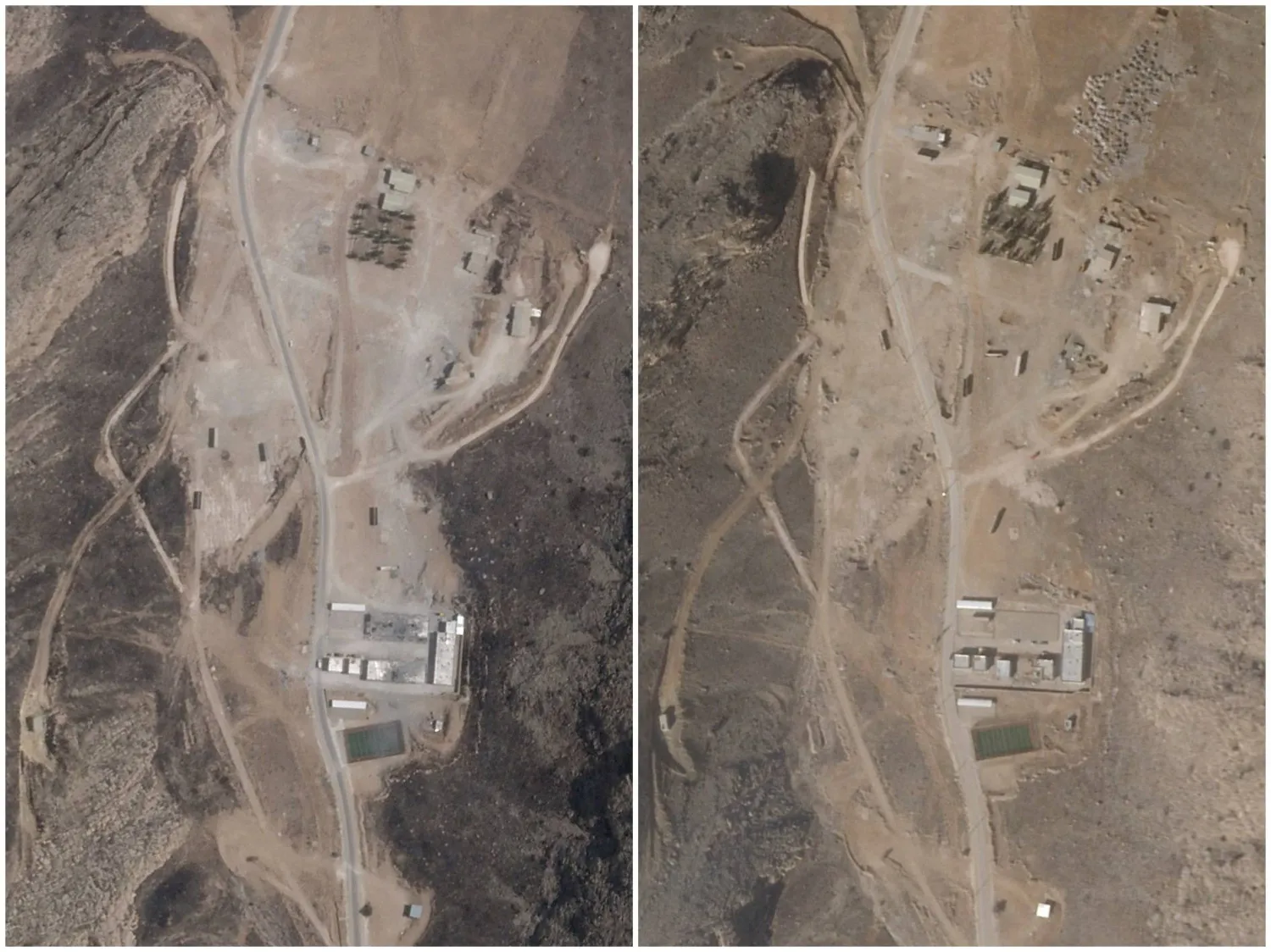
A combination picture of satellite images shows Shiraz South Missile Base in Shiraz South, Iran, before reconstruction, July 3, 2025 (LEFT), and after reconstruction and clearance efforts, January 30, 2026. Planet Labs PBC/Handout via REUTERS
TT

IAEA Says Unable to Verify Whether Iran Has Suspended All Uranium Enrichment

A combination picture of satellite images shows Shiraz South Missile Base in Shiraz South, Iran, before reconstruction, July 3, 2025 (LEFT), and after reconstruction and clearance efforts, January 30, 2026. Planet Labs PBC/Handout via REUTERS

Iran has not allowed the United Nations nuclear agency access to its nuclear facilities bombed by Iran and the United States during a 12-day war in June, according to a confidential report by the watchdog circulated to member states and seen Friday by The Associated Press.

The report from the International Atomic Energy Agency stressed that it “cannot verify whether Iran has suspended all enrichment-related activities,” or the “size of Iran’s uranium stockpile at the affected nuclear facilities.”

The IAEA report on Friday warned that due to the continued lack of access to any of Iran’s four declared enrichment facilities, the agency “cannot provide any information on the current size, composition or whereabouts of the stockpile of enriched uranium in Iran.”

The agency also said that Iran has not provided access to IAEA inspectors to the Isfahan Fuel Enrichment Plant since Iran first made available information about the new facility over eight months ago. The confidential report warned that therefore the agency does not know whether this facility “contains nuclear material or is operational.”

The report stressed that the “loss of continuity of knowledge over all previously declared nuclear material at affected facilities in Iran needs to be addressed with the utmost urgency.”

Iran has long insisted its program is peaceful, but the IAEA and Western nations say Tehran had an organized nuclear weapons program up until 2003.

The IAEA reported that Iran had informed the agency in a letter dated Feb. 2 that “the conditions resulting from acts of aggression and the continuation of threats have created a situation in which the normal implementation of safeguards is legally untenable and materially impracticable,” adding that it would be “inconsistent with Iran’s essential security considerations."

The confidential IAEA report also said Friday that Iran did provide access to its inspectors “to each of the unaffected nuclear facilities at least once since the military attacks of June 2025, with the exception of Karun Nuclear Power Plant, which is in the early stages of construction and does not contain nuclear material.”

Iran suspended all cooperation with the IAEA after the war with Israel. Iran is legally obliged to cooperate with the IAEA under the Treaty on the Non-Proliferation of Nuclear Weapons.

Highly enriched material should be verified regularly According to the IAEA, Iran maintains a stockpile of 440.9 kilograms (972 pounds) of uranium enriched up to 60% purity — a short, technical step away from weapons-grade levels of 90%.

That stockpile could allow Iran to build as many as 10 nuclear bombs, should it decide to weaponize its program, IAEA director general Rafael Grossi warned in a recent interview with the AP. He added that it doesn’t mean that Iran has such a weapon.

Such highly enriched nuclear material should normally be verified every month, according to the IAEA’s guidelines.

The IAEA also reported that it had observed, through the analysis of commercially available satellite imagery, “regular vehicular activity around the entrance to the tunnel complex at Isfahan.”

The facility in Isfahan, some 350 kilometers (215 miles) southeast of Tehran, was mainly known for producing the uranium gas that is fed into centrifuges to be spun and purified.

Both Israel and Iran struck the Isfahan site in June.

The IAEA also reported that through the analysis of commercially available satellite imagery, it has observed “activities being conducted at some of the affected nuclear facilities, including the enrichment facilities at Natanz and Fordow,” but it added that “without access to these facilities it is not possible for the Agency to confirm the nature and the purpose of the activities.”

The IAEA reported on Friday that Grossi attended negotiations between the US and Iran on Feb. 17 and Feb. 26 in Geneva at which he “provided advice on issues relevant to the verification of Iran’s nuclear program.” The report said that those negotiations are “ongoing."

The Trump administration has held three rounds of nuclear talks this year with Iran under Omani mediation. Thursday's talks in Geneva ended without a deal, leaving the danger of another Mideast war on the table as the US has gathered a massive fleet of aircraft and warships in the region.

Oman’s Foreign Minister Badr al-Busaidi, who mediated in the Geneva talks, said technical discussions involving lower-level representatives would continue next week in Vienna, the home of the IAEA. The agency is likely to be critical in any deal.

The US is seeking a deal to limit Iran’s nuclear program and ensure it does not develop nuclear weapons.

If the talks fail, uncertainty hangs over the timing of any possible attack, as well as its mission and goals.

Iran says it is not pursuing weapons and has so far resisted demands that it halt uranium enrichment on its soil or hand over its stockpile of highly enriched uranium.

Similar talks last year between the US and Iran about Iran’s nuclear program broke down after the start of the war in June. Before then, Iran had been enriching uranium up to 60% purity.


Trump Announces Major Combat, Tells Iran Officials to Lay Down Arms or ‘Face Death’

US President Donald Trump speaks at the Port of Corpus Christi in Corpus Christi, Texas, Friday, Feb. 27, 2026. (AP Photo/Michael Gonzalez)
TT

Trump Announces Major Combat, Tells Iran Officials to Lay Down Arms or ‘Face Death’

US President Donald Trump speaks at the Port of Corpus Christi in Corpus Christi, Texas, Friday, Feb. 27, 2026. (AP Photo/Michael Gonzalez)

US President Donald Trump on Saturday called attacks on Iran “a noble mission,” saying they were necessary because of Tehran’s pursuit of nuclear weapons and missile systems that could reach the US.

The US and Israel launched the coordinated attacks on Iran to destroy the country's missile forces and "annihilate" the country's navy.

Trump encouraged the Iranian people to “take over your government — it will be yours to take.”

Despite claims that last year’s strike against Iran’s nuclear facilities destroyed the country’s nuclear program, Trump said that Iran “attempted to rebuild their nuclear program and to continue developing the long-range missiles that can now threaten our very good friends and allies in Europe, our troops stationed overseas, and could soon reach the American homeland.”

Trump said that Saturday’s strikes would be part of “a massive and ongoing operation” that will aim to “destroy their missiles and raze their missile industry to the ground” as well as “annihilate their navy,” and “ensure that the region’s terrorist proxies can no longer destabilize the region or the world and attack our forces.”

Trump urged Iranian forces to surrender, including the Revolutionary Guards.

"To the members of the Islamic Revolutionary Guard, the armed forces, and all of the police, I say tonight that you must lay down your weapons and have complete immunity or in the alternative, face certain death," Trump said.

The attack was widely expected after Trump ordered the biggest military deployment to the Middle East in years.


Israel Says it Launched Pre-emptive Attack Against Iran

A plume of smoke rises following a reported explosion in Tehran on February 28, 2026. (Photo by ATTA KENARE / AFP)
TT

Israel Says it Launched Pre-emptive Attack Against Iran

A plume of smoke rises following a reported explosion in Tehran on February 28, 2026. (Photo by ATTA KENARE / AFP)

Israel said it launched a pre-emptive attack against Iran on Saturday, pushing the Middle East into a renewed military confrontation and further dimming hopes for a diplomatic solution to Tehran's long-running nuclear dispute with the West.

The New York Times, citing a US official, reported that US strikes on Iran were underway. A source told Reuters that Iran's supreme leader, Ayatollah Ali Khamenei, was not in Tehran and had been transferred to a secure location.

The attack, coming after Israel and Iran engaged in a 12-day air war in June, follows repeated US-Israeli warnings that they would strike again if Iran pressed ahead with its nuclear and ballistic missile programs.

"The State of Israel ⁠launched a pre-emptive ⁠attack against Iran to remove threats to the State of Israel," Defense Minister Israel Katz said.

An Israeli defense official said the operation had been planned for months in coordination with Washington, and that the launch date was decided weeks ago.

Explosions were heard in Tehran on Saturday, Iranian media reported, and sirens sounded across Israel around 08:15 local time in what the military said was a proactive ⁠alert to prepare the public for the possibility of an incoming missile strike.

The Israeli military announced the closure of schools and workplaces, with exceptions for essential sectors, and a ban on public airspace. Israel closed its airspace to civilian flights, and the airports authority asked the public not to go to any of the country's airports.

The US and Iran renewed negotiations in February in a bid to resolve the decades-long dispute through diplomacy and avert the threat of a military confrontation that could destabilize the region.

Israel, however, insisted that any US deal with Iran must include the dismantling of Tehran's nuclear infrastructure, not just stopping the ⁠enrichment process, and ⁠lobbied Washington to include restrictions on Iran's missile program in the talks.

Iran said it was prepared to discuss curbs on its nuclear program in exchange for lifting sanctions but ruled out linking the issue to missiles.

Tehran also said it would defend itself against any attack.

It warned neighboring countries hosting US troops that it would retaliate against American bases if Washington struck Iran.


20 Dead as Cash-packed Military Plane Crashes in Bolivia

A military police stands next to a plane that crashed in El Alto, Bolivia, Friday, Feb. 27, 2026. (AP Photo/Juan Karita)
TT

20 Dead as Cash-packed Military Plane Crashes in Bolivia

A military police stands next to a plane that crashed in El Alto, Bolivia, Friday, Feb. 27, 2026. (AP Photo/Juan Karita)

At least 20 people were killed Friday when a Bolivian military cargo plane carrying banknotes crashed while landing near the capital city La Paz, authorities said, prompting police to repel bystanders who were grabbing cash.

The aircraft, a C-130 Hercules transport plane, veered off the runway at El Alto International Airport and crashed into an avenue, destroying multiple cars and damaging trucks, local media footage showed.

Mangled parts of the aircraft were seen on the road where the plane came down, as bystanders rushed to try and grab the scattered cash and police tried to repel the crowds with tear gas.

Authorities later set the money alight in a bonfire at the scene of the crash.

It was not immediately known what caused the crash but witnesses said the weather at the time was treacherous.

"A heavy hailstorm" was falling and "there was lightning" when the plane went down, Cristina Choque, a 60-year-old vendor whose car was struck by the aircraft wreckage, told AFP.

"The tire is what fell on top of us... my daughter is injured, she has a head wound," she added.

The Ministry of Defense said it would launch an investigation into the crash.

"There are about 20, maybe a few more," Colonel Rene Tambo, head of the police homicide division in El Alto, told reporters late Friday. 

Bolivia's health ministry reported at least 28 people were injured.

Fatalities were recorded both at the airport and on the busy avenue where the plane crashed and struck several vehicles.

The Bolivian Air Navigation and Airports authority NAABOL said in a statement that the C-130 departed from the eastern city of Santa Cruz and crashed while landing at the international airport, which suspended its operations.

The C-130 Hercules -- manufactured by Lockheed Martin -- was carrying Bolivian banknotes, which scattered upon impact.

Footage from local media showed police using tear gas to disperse people who approached the crash site to gather the money.

The defense ministry in a statement said that "the money transported in the crashed aircraft has no official serial number... therefore it has no legal or purchasing power."

It said that "its collection, possession, or use constitutes a crime."

Choque and her family remained inside the wrecked vehicle for fear of being looted by the crowd.

The La Paz Prosecutor's Office received reports of looting of businesses by criminals who took advantage of the chaos in the streets.

"Twelve people have been arrested" for questioning, prosecutor Luis Carlos Torres told reporters.

Operations at El Alto International Airport, the second most important in Bolivia, were suspended.

Hospitals in El Alto also launched a blood donation campaign to treat the injured.

La Paz, at an altitude of 3,650 meters (11,975 feet) and surrounded by Andean peaks, is the highest administrative capital in the world.
