


More Strikes Aimed at Iran After US, Israeli Assault Kills Khamenei

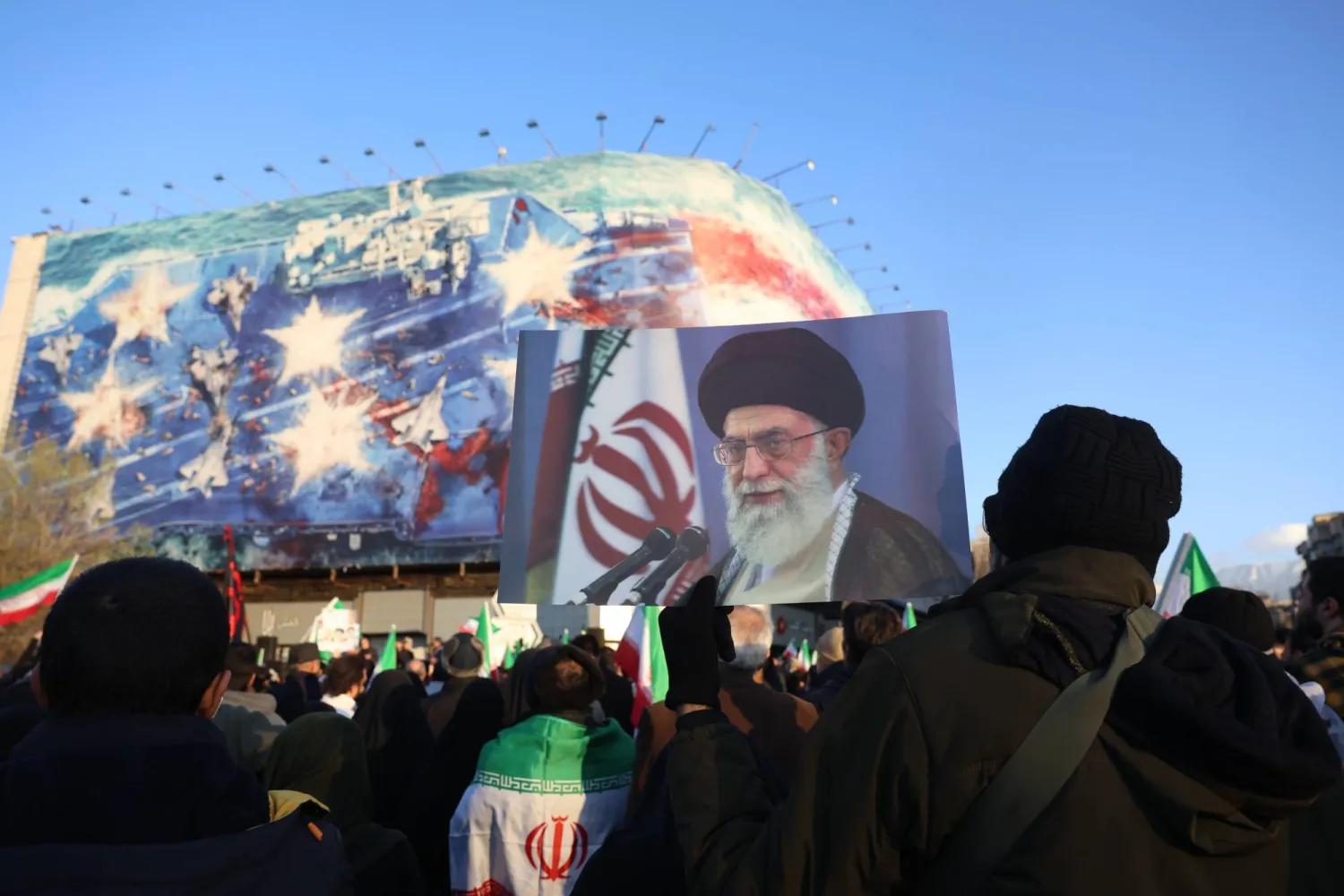
Mourners react following the death of Iranian Supreme Leader Ali Khamenei, at Enqelab Square in Tehran, Iran, 01 March 2026. (EPA)
TT

More Strikes Aimed at Iran After US, Israeli Assault Kills Khamenei

Mourners react following the death of Iranian Supreme Leader Ali Khamenei, at Enqelab Square in Tehran, Iran, 01 March 2026. (EPA)

Israel said it launched another wave of strikes on Iran on Sunday, as Iranians grappled with uncertainty after the killing of their supreme leader in US and Israeli attacks that threaten to destabilize the wider Middle East.

Hours after both nations said an air strike killed Ali Khamenei in the most ambitious series of attacks on Iran in decades, the country's state media confirmed the 86-year-old leader's death on Saturday.

US President Donald Trump said the air strikes aimed to end a decades-long threat from Iran and ensure it could not develop a nuclear weapon, as he sought to justify a risky gambit that seemed to contradict his professed opposition to American involvement in complex overseas conflicts.

"This is not only Justice for the people of Iran, but for all Great Americans, and those people from many Countries throughout the World, that have been killed or mutilated by Khamenei and his gang of bloodthirsty THUGS," Trump wrote on Truth Social after Khamenei's body was found.

Experts said that while the deaths of Khamenei and other Iranian leaders would deal the country a major blow, it would not necessarily spell the end of Iran's entrenched clerical rule or the Revolutionary Guards' sway over the population.

Israel's military said it targeted Iran’s ballistic missile and ‌air defense systems with ‌strikes on Sunday morning.

Iran's armed forces would soon retaliate again with their biggest offensive against US bases and ‌Israel, ⁠Revolutionary Guard Corps ⁠vowed in a statement on Sunday.

Shortly after 6 a.m., air raid sirens repeatedly sounded across Israel, warning residents of an incoming attack. In Tel Aviv, a series of explosions were heard as Israel’s sophisticated air defense system sought to intercept the latest Iranian offensive. There was no immediate report of any damage or injuries.

Witnesses in the Gulf cities of Dubai and Doha heard several loud blasts.

Iran had responded to Saturday's initial attacks by launching hundreds of missiles and drones targeting US troops and cities in Israel and Arab countries, prompting widespread cancellations of Middle East flights.

The Pentagon said there were no US deaths or injuries, but the strikes raised concerns of new risks for Americans.

A senior US intelligence official told Reuters that while the largest threat stemming from the attack was against US military personnel in the region, cyber attacks could ⁠also target critical US infrastructure.

IRAN POUNDS KEY REGIONAL FACILITIES IN RESPONSE

Major Middle Eastern airports, including Dubai, the world’s busiest international ‌travel hub, were shut on Saturday after the strikes on Iran's missile retaliation unleashed one of global ‌aviation's most severe disruptions in years.

Dubai's landmark Burj Al Arab hotel and the airport, which handles more than 1,000 flights a day, were damaged in an overnight attack on ‌sites across the Arab Gulf states that also hit airports in Abu Dhabi and Kuwait.

On Saturday, Tehran warned that it had closed the Strait of Hormuz, ‌the narrow conduit for about a fifth of global oil consumption, raising expectations of a sharp jump in oil prices.

Hundreds of civilians were killed and injured in the US and Israeli strikes, Iran's ambassador to the United Nations, Amir Saeid Iravani, told an emergency meeting of the UN Security Council on Saturday.

Iravani called Iran's retaliatory attacks a matter of self-defense, describing the bases of hostile forces as legitimate military targets.

In his remarks, UN Secretary-General Antonio Guterres, who urged an immediate cessation of hostilities, said he deeply regretted that an opportunity for ‌diplomacy had been "squandered."

SUPREME LEADER KILLED

Witnesses said some Iranians took to the streets in Tehran, the nearby city of Karaj and the central city of Isfahan to celebrate after reports of Khamenei's death emerged.

Videos posted on social ⁠media, which Reuters was unable to immediately ⁠verify, also showed celebrations elsewhere.

Israel and the United States timed the attacks to coincide with a meeting of Khamenei and his top aides, said two US sources and a US official familiar with the matter.

Khamenei was working in his office at the time of Saturday's attack, state media said, which also killed his daughter, grandchild, daughter-in-law and son-in-law.

In a statement, the Revolutionary Guards mourned the loss of "a great leader."

Trump and Israeli Prime Minister Benjamin Netanyahu called on Iranians to rise up and overthrow their government after the attacks, which took out at least seven senior military commanders, Israel's military said.

FAILED NEGOTIATIONS

Israeli military operations over the past two years had already killed some of Iran's senior military officials and severely weakened several of Tehran's once-feared proxy forces across the Middle East.

After Israel pounded Iran in a 12-day air war in June, joined by the United States, both warned they would strike again if Iran persisted with nuclear and ballistic missile programs.

During the UN meeting, envoys from Russia and China criticized both countries for launching the strikes while Tehran was negotiating with Washington.

Iran had been "stabbed in the back," said Russian UN envoy Vasily Nebenzya, disputing the US justification of the attacks as preventing Iran from acquiring a nuclear weapon.

China called for an immediate ceasefire, urging all sides to avoid escalation and resume talks, while the official Xinhua news agency criticized the attacks on Sunday as "brazen aggression against a sovereign nation".

Senior US officials said the latest talks showed Iran was unwilling to give up its ability to enrich uranium, saying it was wanted for nuclear energy, although US officials said it would enable the country to build a nuclear bomb.



Israel Military Says It Has Destroyed Half of Iran's Missile Stockpiles

 A video grab image taken from footage released by the Israeli military on March 1, 2026, shows what it says are large-scale strikes on "the headquarters of the Iranian terror regime" in Tehran on March 1. (Photo by Handout / Israeli Army / AFP)
A video grab image taken from footage released by the Israeli military on March 1, 2026, shows what it says are large-scale strikes on "the headquarters of the Iranian terror regime" in Tehran on March 1. (Photo by Handout / Israeli Army / AFP)
TT

Israel Military Says It Has Destroyed Half of Iran's Missile Stockpiles

 A video grab image taken from footage released by the Israeli military on March 1, 2026, shows what it says are large-scale strikes on "the headquarters of the Iranian terror regime" in Tehran on March 1. (Photo by Handout / Israeli Army / AFP)
A video grab image taken from footage released by the Israeli military on March 1, 2026, shows what it says are large-scale strikes on "the headquarters of the Iranian terror regime" in Tehran on March 1. (Photo by Handout / Israeli Army / AFP)

The Israeli military on Sunday said it had destroyed roughly half of Iran's missile stockpiles in the previous war in June 2025, adding the Iranian republic had been producing dozens of surface-to-surface missiles each month.

"During the operation (in June 2025), we destroyed approximately half of the Iranian regime's missile stockpiles and prevented the production of at least 1,500 additional missiles," military spokesman Brigadier General Effie Defrin said in a televised statement.

"The regime had recently been producing dozens of surface-to-surface missiles per month and intended to increase production to hundreds per month."


North Korea Condemns US-Israel Attacks on Iran as ‘Illegal’

Smoke rises in central Tehran after an Israeli attack in Iran, 01 March 2026. (EPA)
TT

North Korea Condemns US-Israel Attacks on Iran as ‘Illegal’

Smoke rises in central Tehran after an Israeli attack in Iran, 01 March 2026. (EPA)

North Korea condemned on Sunday the ongoing United States and Israeli attack on Iran as an "illegal act of aggression", claiming it had shown Washington's "gangster-like" nature.

The military campaigns against Iran by the two states "constitute a thoroughly illegal act of aggression and the most vile form of violation of sovereignty in their nature", a spokesperson for the North's foreign ministry said in a statement carried by the official Korean Central News Agency.

Pyongyang said the military actions showed the "shameless and gangster-like conduct" of the two allies, who it said had chosen to "abuse military force to fulfil their selfish and hegemonic ambitions".

North Korea and the United States are longtime adversaries but Washington has mounted a push to revive high-level talks with Pyongyang in recent months, eyeing a potential summit between US President Donald Trump and the North's Kim Jong Un this year.

After largely ignoring those overtures for months, Kim said this week that the two nations could "get along" if Washington accepted Pyongyang's nuclear status.


EU Says Khamenei’s Killing Brings Both Hope and Peril

 EU High Representative and Vice-President for Foreign Affairs and Security Policy Kaja Kallas speaks to the press as she arrives for the EU Foreign Affairs Council in Brussels on February 23, 2026. (AFP)
EU High Representative and Vice-President for Foreign Affairs and Security Policy Kaja Kallas speaks to the press as she arrives for the EU Foreign Affairs Council in Brussels on February 23, 2026. (AFP)
TT

EU Says Khamenei’s Killing Brings Both Hope and Peril

 EU High Representative and Vice-President for Foreign Affairs and Security Policy Kaja Kallas speaks to the press as she arrives for the EU Foreign Affairs Council in Brussels on February 23, 2026. (AFP)
EU High Representative and Vice-President for Foreign Affairs and Security Policy Kaja Kallas speaks to the press as she arrives for the EU Foreign Affairs Council in Brussels on February 23, 2026. (AFP)

Top EU officials said Sunday the killing of Iran's supreme leader Ali Khamenei in US-Israeli strikes could spell "hope" for the country -- but carried a serious risk of regional instability. 

European Union's top diplomat Kaja Kallas described Khamenei's death as "a defining moment in Iran's history", while European Commission President Ursula von der Leyen said it spurred "renewed hope for the people of Iran". 

"At the same time, this moment carries a real risk of instability that could push the region into a spiral of violence," von der Leyen added. 

Von der Leyen said Brussels was engaging closely "with all key actors" to safeguard stability and security and to protect civilian lives. 

"With Khamenei gone, there is renewed hope for the people of Iran. We must ensure that the future is theirs to claim and shape," she wrote on social media, after a call with Jordan's King Abdullah II. 

Likewise, Kallas said she was in contact with regional partners "that bear the brunt of Iran's military actions" to find practical steps for de-escalation. 

"The death of Ali Khamenei is a defining moment in Iran's history. What comes next is uncertain. But there is now an open path to a different Iran, one that its people may have greater freedom to shape," Kallas wrote on X.