


Iran President, 2 Officials to Lead Transition after Khamenei's Death

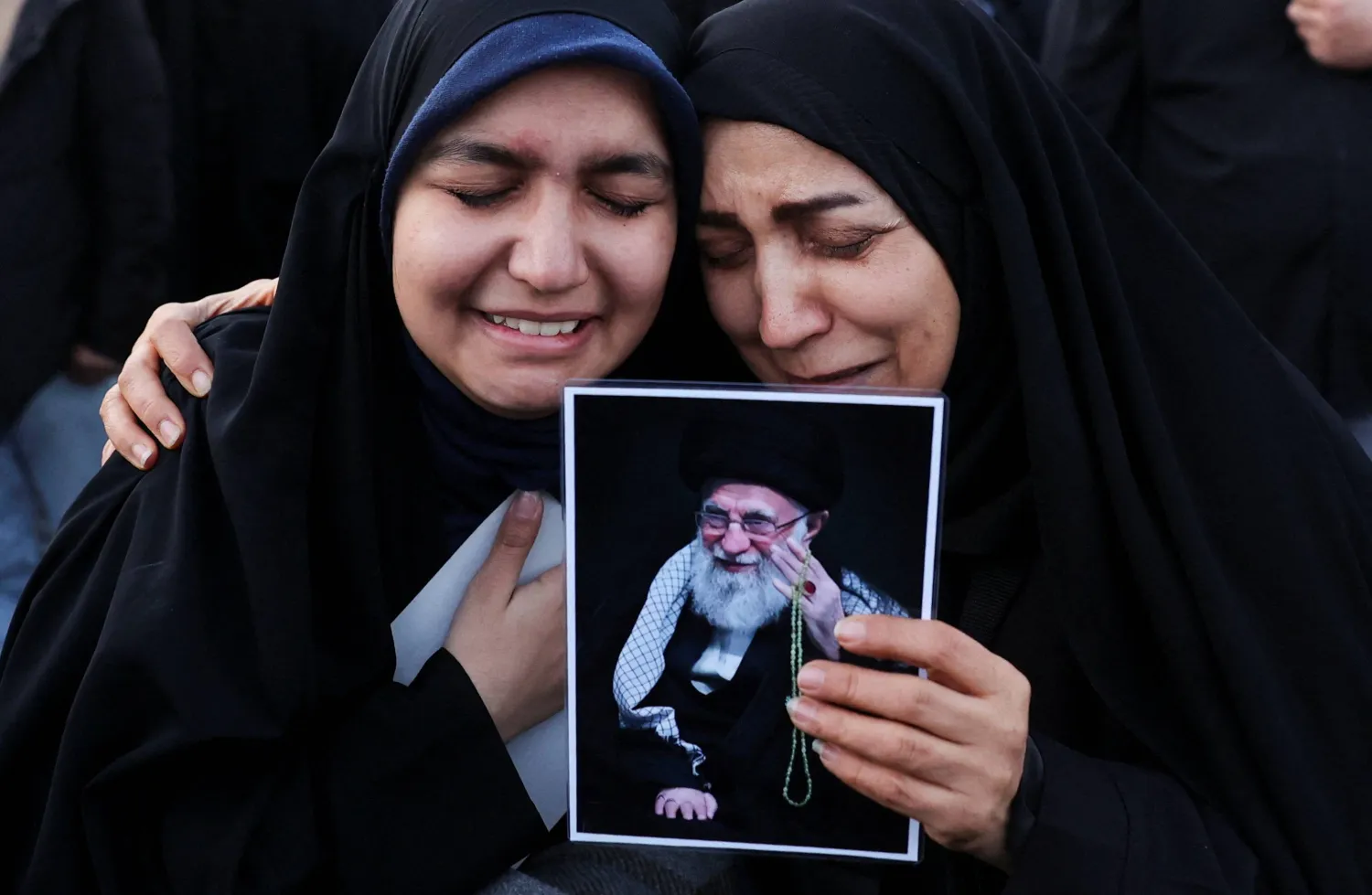
People react as they gather at the Enghelab Square, after Iran's Supreme Leader Ali Khamenei was killed in Israeli and US strikes on Saturday, in Tehran, Iran, March 1, 2026. Majid Asgaripour/WANA (West Asia News Agency) via REUTERS
TT

Iran President, 2 Officials to Lead Transition after Khamenei's Death

People react as they gather at the Enghelab Square, after Iran's Supreme Leader Ali Khamenei was killed in Israeli and US strikes on Saturday, in Tehran, Iran, March 1, 2026. Majid Asgaripour/WANA (West Asia News Agency) via REUTERS

Iranian President Masoud Pezeshkian and two top other officials will lead Iran in the transitional period following the death of supreme leader Ali Khamenei, state television reported on Sunday.

Judiciary chief Gholamhossein Mohseni Ejei and another official from the country's legal council will be part of the trio overseeing the transition, according to state television which cited Mohammad Mokhber, one of Khamenei's advisors.

The United States and Israel launched waves of strikes Saturday against targets in Iran, sparking swift retaliation by the Iranian republic.

US President Donald Trump said that Iran's supreme leader Ali Khamenei was dead. Iranian state television confirmed the news early Sunday.

The death of Khamenei raises paramount questions about the country's future. And while a clerical panel is tasked with replacing him, succession is a complex matter in Iran's theocracy: 

Here is what to know: 

A clerical council selects a new supreme leader  

An 88-member panel called the Assembly of Experts appoints the supreme leader. The panel can remove one as well, although that has never happened. 

The panel consists entirely of Shiite clerics who are popularly elected every eight years and whose candidacies are approved by the Guardian Council, Iran's constitutional watchdog. That body is known for disqualifying candidates in various elections in Iran and the Assembly of Experts is no different. The Guardian Council barred former Iranian President Hassan Rouhani, a relative moderate whose administration struck the 2015 nuclear deal with world powers, from election for the Assembly of Experts in March 2024. 

A temporary leadership council may assume duties in case of delay Iranian law says the Assembly of Experts “must, as soon as possible” pick a new supreme leader. But until then, a leadership council can step in and “temporarily assume all the duties of leadership.” 

The assembly is made up of Iran's sitting president, the head of the country's judiciary and a member of the Guardian Council chosen by Iran's Expediency Council, which advises the supreme leader and settles disputes with parliament. If that were to happen now, Iran's reformist President Masoud Pezeshkian and hard-line judiciary chief Gholamhossein Mohseni Ejei would be on that leadership council. 

Khamenei's son could be a possible contender  

Clerical deliberations about succession and machinations over it take place far from the public eye, making it hard to gauge who may be a top contender. 

Previously, it was thought Khamenei's protégé, hard-line President Ebrahim Raisi, may try to take the mantle. However, he was killed in a May 2024 helicopter crash. That has left one of Khamenei's sons, Mojtaba, a 56-year-old Shiite cleric, as a potential candidate, though he has never held government office. But a father-to-son transfer in the case of a supreme leader could spark anger, not only among Iranians already critical of clerical rule, but also among supporters of the system. Some may see it as un-Islamic and in line with creating a new, religious dynasty after the 1979 collapse of the US-backed Shah Mohammad Reza Pahlavi's government. 

A transition like this has happened only once before  

There has been only one other transfer of power in the office of supreme leader of Iran, the paramount decision-maker since the country's 1979 Iranian Revolution. 

In 1989, Grand Khomeini died at age 86 after being the figurehead of the revolution and leading Iran through its bloody eight-year war with Iraq. This transition now comes after Israel launched a 12-day war against Iran in June 2025 as well. 

The vast powers of a supreme leader  

The supreme leader is at the heart of Iran’s complex power-sharing Shiite theocracy and has final say over all matters of state. 

He also serves as the commander-in-chief of the country's military and the powerful Revolutionary Guard, a paramilitary force that the United States designated a terrorist organization in 2019 and which Khamenei empowered during his rule. The Guard, which has led the self-described “Axis of Resistance,” a series of militant groups and allies across the Middle East meant to counter the US and Israel, also has extensive wealth and holdings in Iran. 


Israel Military Says It Has Destroyed Half of Iran's Missile Stockpiles

 A video grab image taken from footage released by the Israeli military on March 1, 2026, shows what it says are large-scale strikes on "the headquarters of the Iranian terror regime" in Tehran on March 1. (Photo by Handout / Israeli Army / AFP)
A video grab image taken from footage released by the Israeli military on March 1, 2026, shows what it says are large-scale strikes on "the headquarters of the Iranian terror regime" in Tehran on March 1. (Photo by Handout / Israeli Army / AFP)
TT

Israel Military Says It Has Destroyed Half of Iran's Missile Stockpiles

 A video grab image taken from footage released by the Israeli military on March 1, 2026, shows what it says are large-scale strikes on "the headquarters of the Iranian terror regime" in Tehran on March 1. (Photo by Handout / Israeli Army / AFP)
A video grab image taken from footage released by the Israeli military on March 1, 2026, shows what it says are large-scale strikes on "the headquarters of the Iranian terror regime" in Tehran on March 1. (Photo by Handout / Israeli Army / AFP)

The Israeli military on Sunday said it had destroyed roughly half of Iran's missile stockpiles in the previous war in June 2025, adding the Iranian republic had been producing dozens of surface-to-surface missiles each month.

"During the operation (in June 2025), we destroyed approximately half of the Iranian regime's missile stockpiles and prevented the production of at least 1,500 additional missiles," military spokesman Brigadier General Effie Defrin said in a televised statement.

"The regime had recently been producing dozens of surface-to-surface missiles per month and intended to increase production to hundreds per month."


North Korea Condemns US-Israel Attacks on Iran as ‘Illegal’

Smoke rises in central Tehran after an Israeli attack in Iran, 01 March 2026. (EPA)
TT

North Korea Condemns US-Israel Attacks on Iran as ‘Illegal’

Smoke rises in central Tehran after an Israeli attack in Iran, 01 March 2026. (EPA)

North Korea condemned on Sunday the ongoing United States and Israeli attack on Iran as an "illegal act of aggression", claiming it had shown Washington's "gangster-like" nature.

The military campaigns against Iran by the two states "constitute a thoroughly illegal act of aggression and the most vile form of violation of sovereignty in their nature", a spokesperson for the North's foreign ministry said in a statement carried by the official Korean Central News Agency.

Pyongyang said the military actions showed the "shameless and gangster-like conduct" of the two allies, who it said had chosen to "abuse military force to fulfil their selfish and hegemonic ambitions".

North Korea and the United States are longtime adversaries but Washington has mounted a push to revive high-level talks with Pyongyang in recent months, eyeing a potential summit between US President Donald Trump and the North's Kim Jong Un this year.

After largely ignoring those overtures for months, Kim said this week that the two nations could "get along" if Washington accepted Pyongyang's nuclear status.


Khamenei’s Killing ‘Defining Moment’ in Iran’s History, Says EU’s Kallas

 EU High Representative and Vice-President for Foreign Affairs and Security Policy Kaja Kallas speaks to the press as she arrives for the EU Foreign Affairs Council in Brussels on February 23, 2026. (AFP)
EU High Representative and Vice-President for Foreign Affairs and Security Policy Kaja Kallas speaks to the press as she arrives for the EU Foreign Affairs Council in Brussels on February 23, 2026. (AFP)
TT

Khamenei’s Killing ‘Defining Moment’ in Iran’s History, Says EU’s Kallas

 EU High Representative and Vice-President for Foreign Affairs and Security Policy Kaja Kallas speaks to the press as she arrives for the EU Foreign Affairs Council in Brussels on February 23, 2026. (AFP)
EU High Representative and Vice-President for Foreign Affairs and Security Policy Kaja Kallas speaks to the press as she arrives for the EU Foreign Affairs Council in Brussels on February 23, 2026. (AFP)

EU foreign policy chief Kaja Kallas said Sunday that the killing of Iran's supreme leader Ali Khamenei in US-Israeli strikes was a defining moment in the country's history.

"The death of Ali Khamenei is a defining moment in Iran's history. What comes next is uncertain. But there is now an open path to a different Iran, one that its people may have greater freedom to shape," Kallas wrote on X.

"I'm in contact with partners, including those in the region that bear the brunt of Iran's military actions, to find practical steps for de-escalation."
