
Airspace Closed, Flights Cancelled as US-Iran Conflict Flares

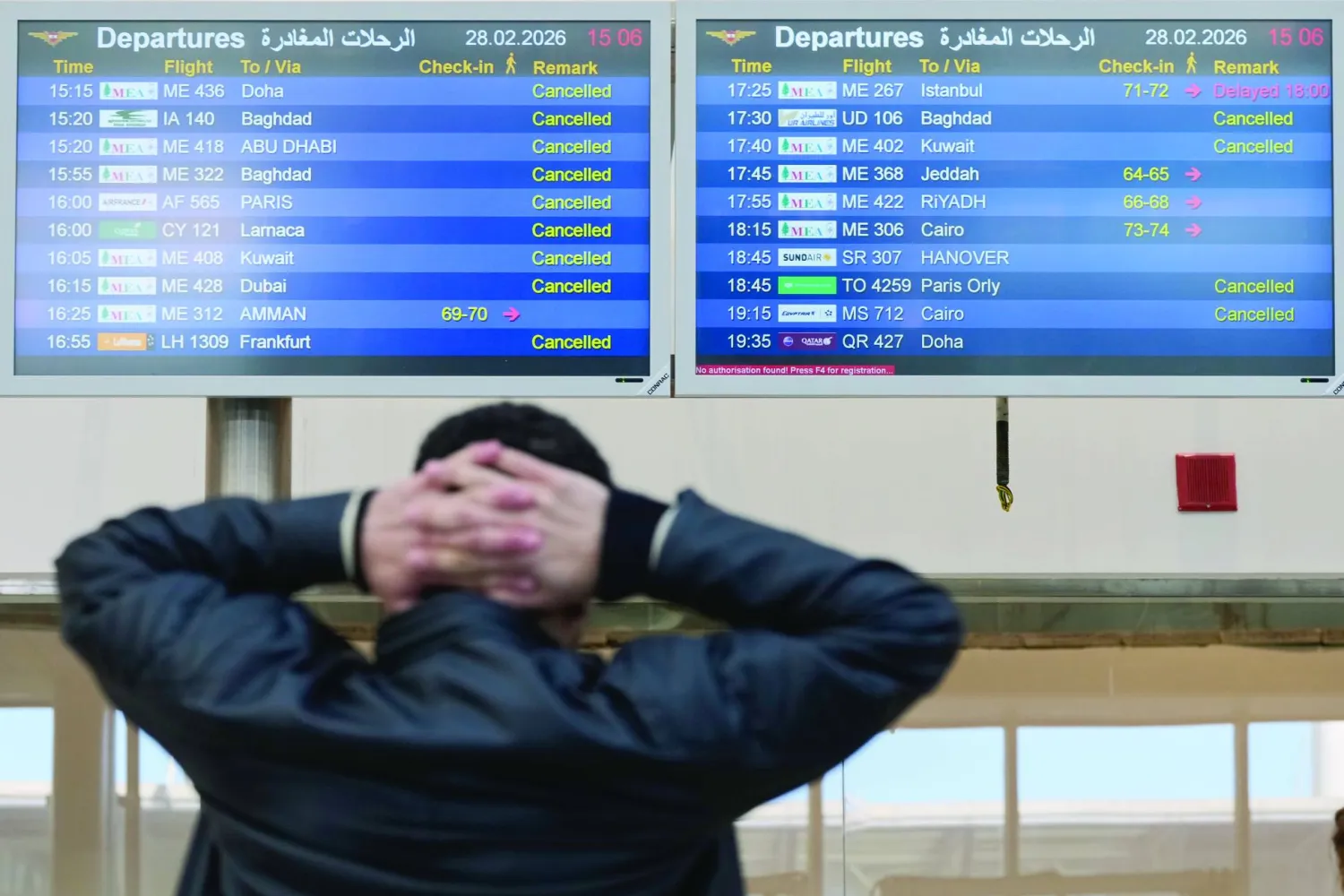
A traveler checks departure times as many flights are cancelled at Beirut Rafik Hariri International Airport in Beirut, Lebanon, Saturday, Feb. 28, 2026, as many airlines canceled flights due to the conflict involving the United States, Israel and Iran. (AP Photo/Hassan Ammar)
TT

Airspace Closed, Flights Cancelled as US-Iran Conflict Flares

A traveler checks departure times as many flights are cancelled at Beirut Rafik Hariri International Airport in Beirut, Lebanon, Saturday, Feb. 28, 2026, as many airlines canceled flights due to the conflict involving the United States, Israel and Iran. (AP Photo/Hassan Ammar)

Thousands of flights have been delayed or cancelled in the biggest disruption to global air transport since the Covid pandemic as airlines suspend services to the Middle East following the US and Israeli attacks on Iran.

Iran, Iraq, Israel, Syria, Kuwait and the United Arab Emirates all announced at least partial closures of their skies after Saturday's strikes and Iran launching missiles at capital cities around the Gulf region, said AFP.

Major carriers from the Middle East, Europe, Asia-Pacific and the United States announced widespread cancellations, leaving thousands of passengers stranded.

Notable airlines that cancelled services included Emirates, Etihad, Air France, British Airways, Air India, Turkish Airlines, and Lufthansa.

According to aviation analytics company Cirium, of around 4,218 flights scheduled to land in Middle Eastern countries on Saturday, 966 (22.9 percent) were cancelled, with the figure rising above 1,800 if also including outbound flights.

For Sunday, 716 flights out of 4,329 scheduled to the Middle East have been cancelled, Cirium said.

Flight tracking website FlightAware meanwhile said more than 19,000 flights had been delayed globally and more than 2,600 were cancelled as of 0230 GMT Sunday.

- Airspace closures -

Iran swiftly closed its airspace as the strikes began "until further notice", said the spokesman of Iran's Civil Aviation Organization, quoted by the Tasnim news agency.

Israel also closed its airspace to civilian flights, Transport Minister Miri Regev announced.

Qatar's civil aviation authority said it had temporarily closed the Gulf state's airspace.

Iraq shut down airspace, state media said.

The United Arab Emirates said it was closing its skies "partially and temporarily".

Syria closed part of its airspace in the south along the border with Israel for 12 hours, the Civil Aviation Authority said.

Jordan's air force was conducting drills to "defend the kingdom's skies", its military said.

Kuwait closed its airspace.

- Middle East and North Africa airlines -

Gulf carriers Emirates and Etihad cancelled 38 percent and 30 percent of their flights respectively, Cirium said.

Qatar Airways suspended all flights from Doha. It cancelled 41 percent of total flights, according to Cirium.

Syria Air, the country's national carrier, cancelled all flights until further notice.

Egypt's national airline, EgyptAir, announced the suspension of its flights to cities across the Middle East, including Dubai, Doha, Manama, Abu Dhabi, Beirut and Baghdad among others.

- European airlines -

Russia's air transport authority Rosaviatsia said all commercial flights to Israel and Iran were cancelled "until further notice".

Turkish Airlines cancelled flights to Lebanon, Syria, Iraq, Iran, and Jordan until March 2.

Air France cancelled its Dubai, Riyadh and Beirut flights for Saturday, and flights to Tel Aviv until Sunday.

British Airways said it was not flying to Tel Aviv and Bahrain until March 4, and cancelled flights to the Jordanian capital Amman on Saturday.

Swiss International Air Lines suspended flights to and from Tel Aviv until March 7, and cancelled flights from Zurich to Dubai scheduled for Saturday and Sunday.

Germany's Lufthansa, which comprises Swiss and ITA Airways, cancelled its flights to and from Tel Aviv, Beirut, Amman, Erbil and Tehran until March 7.

The airline group and its subsidiaries suspended flights to and from Dubai and Abu Dhabi until Sunday.

- North America airlines -

Delta Air Lines suspended New York-Tel Aviv flights until Sunday.

American Airlines "temporarily suspended" Doha-Philadelphia flights.

United flights to Tel Aviv are cancelled until Monday, and flights to Dubai until Sunday.

Air Canada said it cancelled flights from Canada to Israel until March 8 and to Dubai until March 3.

- Asia-Pacific airlines -

India's two largest private carriers IndiGo and Air India suspended flights to all destinations in the Middle East.

Pakistan International Airlines, the flag carrier of the country that borders Iran, said it had suspended flights to the UAE, Bahrain, Doha and Kuwait.

Hong Kong's Cathay Pacific suspended flights to Dubai and Riyadh.

Garuda Indonesia, Indonesia's flag carrier, temporarily suspended flights to and from Doha "until further notice", the company said in a statement Sunday.

Singapore Airlines and Singapore's Scoot cancelled six flight routes in the region until the end of Sunday, local media reported.

Philippine Airlines flights from Manila to Doha, Riyadh to Manila, and Dubai to Manila were cancelled on Saturday, as well as one Doha-Manila flight on Sunday.

Other major airlines including Australia's Qantas and Japan's All Nippon Airways did not announce any flight cancellations.

- Africa airlines -

Ethiopian Airlines cancelled its flights to Amman, Tel Aviv, Dammam, and Beirut.

Kenya Airways has suspended its flights to Dubai and Sharjah until further notice.


Israel Military Says It Has Destroyed Half of Iran's Missile Stockpiles

 A video grab image taken from footage released by the Israeli military on March 1, 2026, shows what it says are large-scale strikes on "the headquarters of the Iranian terror regime" in Tehran on March 1. (Photo by Handout / Israeli Army / AFP)
A video grab image taken from footage released by the Israeli military on March 1, 2026, shows what it says are large-scale strikes on "the headquarters of the Iranian terror regime" in Tehran on March 1. (Photo by Handout / Israeli Army / AFP)
TT

Israel Military Says It Has Destroyed Half of Iran's Missile Stockpiles

 A video grab image taken from footage released by the Israeli military on March 1, 2026, shows what it says are large-scale strikes on "the headquarters of the Iranian terror regime" in Tehran on March 1. (Photo by Handout / Israeli Army / AFP)
A video grab image taken from footage released by the Israeli military on March 1, 2026, shows what it says are large-scale strikes on "the headquarters of the Iranian terror regime" in Tehran on March 1. (Photo by Handout / Israeli Army / AFP)

The Israeli military on Sunday said it had destroyed roughly half of Iran's missile stockpiles in the previous war in June 2025, adding the Iranian republic had been producing dozens of surface-to-surface missiles each month.

"During the operation (in June 2025), we destroyed approximately half of the Iranian regime's missile stockpiles and prevented the production of at least 1,500 additional missiles," military spokesman Brigadier General Effie Defrin said in a televised statement.

"The regime had recently been producing dozens of surface-to-surface missiles per month and intended to increase production to hundreds per month."


North Korea Condemns US-Israel Attacks on Iran as ‘Illegal’

Smoke rises in central Tehran after an Israeli attack in Iran, 01 March 2026. (EPA)
TT

North Korea Condemns US-Israel Attacks on Iran as ‘Illegal’

Smoke rises in central Tehran after an Israeli attack in Iran, 01 March 2026. (EPA)

North Korea condemned on Sunday the ongoing United States and Israeli attack on Iran as an "illegal act of aggression", claiming it had shown Washington's "gangster-like" nature.

The military campaigns against Iran by the two states "constitute a thoroughly illegal act of aggression and the most vile form of violation of sovereignty in their nature", a spokesperson for the North's foreign ministry said in a statement carried by the official Korean Central News Agency.

Pyongyang said the military actions showed the "shameless and gangster-like conduct" of the two allies, who it said had chosen to "abuse military force to fulfil their selfish and hegemonic ambitions".

North Korea and the United States are longtime adversaries but Washington has mounted a push to revive high-level talks with Pyongyang in recent months, eyeing a potential summit between US President Donald Trump and the North's Kim Jong Un this year.

After largely ignoring those overtures for months, Kim said this week that the two nations could "get along" if Washington accepted Pyongyang's nuclear status.


Khamenei’s Killing ‘Defining Moment’ in Iran’s History, Says EU’s Kallas

 EU High Representative and Vice-President for Foreign Affairs and Security Policy Kaja Kallas speaks to the press as she arrives for the EU Foreign Affairs Council in Brussels on February 23, 2026. (AFP)
EU High Representative and Vice-President for Foreign Affairs and Security Policy Kaja Kallas speaks to the press as she arrives for the EU Foreign Affairs Council in Brussels on February 23, 2026. (AFP)
TT

Khamenei’s Killing ‘Defining Moment’ in Iran’s History, Says EU’s Kallas

 EU High Representative and Vice-President for Foreign Affairs and Security Policy Kaja Kallas speaks to the press as she arrives for the EU Foreign Affairs Council in Brussels on February 23, 2026. (AFP)
EU High Representative and Vice-President for Foreign Affairs and Security Policy Kaja Kallas speaks to the press as she arrives for the EU Foreign Affairs Council in Brussels on February 23, 2026. (AFP)

EU foreign policy chief Kaja Kallas said Sunday that the killing of Iran's supreme leader Ali Khamenei in US-Israeli strikes was a defining moment in the country's history.

"The death of Ali Khamenei is a defining moment in Iran's history. What comes next is uncertain. But there is now an open path to a different Iran, one that its people may have greater freedom to shape," Kallas wrote on X.

"I'm in contact with partners, including those in the region that bear the brunt of Iran's military actions, to find practical steps for de-escalation."