


Cheers, Mourning as Iran’s Khamenei Is Killed

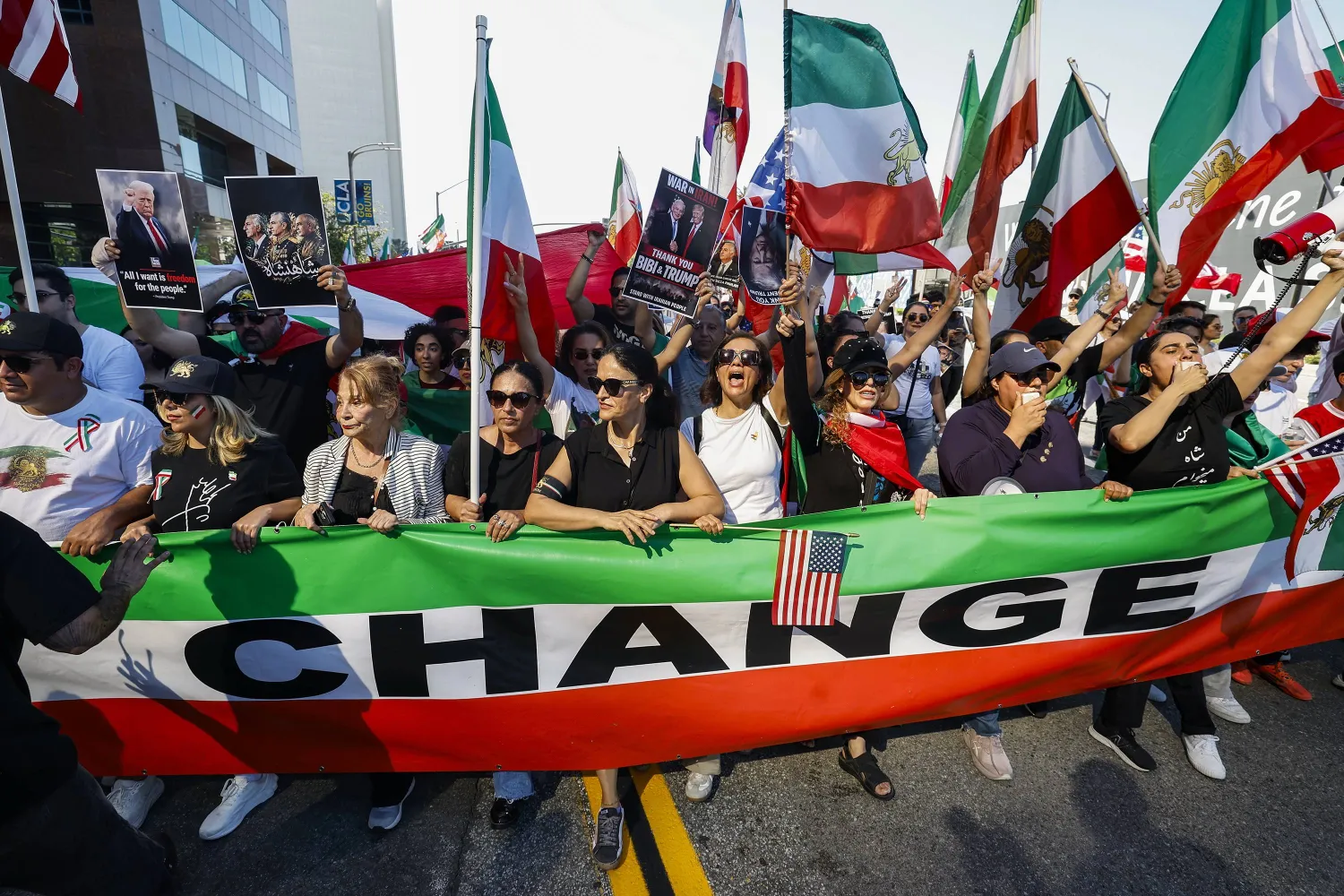
Demonstrators wave flags and march in celebration following the US and Israeli strikes in Iran; in Los Angeles, California, USA, 28 February 2026. (EPA)
TT

Cheers, Mourning as Iran’s Khamenei Is Killed

Demonstrators wave flags and march in celebration following the US and Israeli strikes in Iran; in Los Angeles, California, USA, 28 February 2026. (EPA)

Cheers in Tehran. Retaliation and mourning announced by Iran. Protests erupting in some parts of the world, celebrations in others.

The world greeted with trepidation the news Sunday that Iran's supreme leader Ali Khamenei had been killed in the US-Israeli strikes on the Islamic republic one day earlier.

- Music in Tehran -

Iranians took to the streets cheering with joy and playing celebratory music after reports of Khamenei's death, according to witnesses and video footage verified by AFP.

The celebrations in Tehran began shortly after 11 pm (1930 GMT), even before Iranian state television had confirmed US President Donald Trump's statement that Khamenei was dead, according to multiple witnesses and audio recordings.

Loud and sustained whistles, cheers were heard and fireworks could be seen being launched on videos shared on social media that were verified by AFP.

People were not, however, coming out en masse to celebrate, according to social media.

Many Iranians were fearful after the deadly crackdown on mass anti-government protests in January.

- Mourning in Tehran -

The thousands who did gather in the center of Iran's capital were instead mourning Khamenei's death, according to AFP journalists.

The mourners, dressed mostly in black and some crying, chanted "death to America" and "death to Israel" in Enghelab (Revolution) Square, with many waving Iran's flags and holding photos of Khamenei.

Iranian state television announced a 40-day mourning period and seven public holidays.

"With the martyrdom of the supreme leader, his path and mission neither will be lost nor will be forgotten, on the other hand, they will be pursued with greater vigor and zeal," a presenter said.

- 'Hand of revenge' -

Iran's Revolutionary Guards vowed on Sunday to punish Khamenei's "murderers".

"The hand of revenge of the Iranian nation for a severe, decisive and regrettable punishment for the murderers of the Imam of the Ummah will not let go of them," the Guards said in a statement.

- 'Most evil' -

"Khamenei, one of the most evil people in History, is dead," Trump said, announcing the killing on his Truth Social network late Saturday.

The killing "is the single greatest chance for the Iranian people to take back their country," Trump said.

- 'Cruel tyrant' -

Israeli Prime Minister Benjamin Netanyahu also called for Iranians to "overthrow the regime" after Khamenei's killing.

"For more than three and a half decades, this cruel tyrant has spread terror across the world while oppressing his own people, while working tirelessly and without pause on a plan to destroy Israel," he said in a televised statement.

- 'Dustbin of history' -

The son of Iran's late shah on Saturday hailed the killing, saying the Islamic republic that replaced his pro-Western father was finished.

"With his death, the Islamic Republic has effectively come to an end and will soon be consigned to the dustbin of history," Reza Pahlavi wrote on X.

- 'Guiding light' -

Iraqi leaders, including influential cleric Moqtada al-Sadr, on Sunday mourned Khamenei.

"We extend our condolences to the Islamic world," Al-Sadr said in a statement, declaring a three-day period of mourning.

Government spokesman Bassem al-Awadi said in a statement that Khamenei was killed in "a blatant act of aggression".

- Protests in Baghdad -

Hundreds of Iraqis attempted Sunday to storm Baghdad's fortified Green Zone, where the US embassy is located, after the death of Khamenei, an AFP journalist reported.

"Their attempts had been thwarted so far, but they keep trying," a security source told AFP.

- 'Will not be mourned' -

Australian Prime Minister Anthony Albanese said on Sunday that Khamenei "will not be mourned".

"Ali Khamenei was responsible for the regime's ballistic missile and nuclear program, support for armed proxies and its brutal acts of violence and intimidation against its own people," Albanese told reporters.

"His passing will not be mourned."

- 'Free Iran' -

Jubilant Iranian-Americans on Saturday took to the streets from Boston to Los Angeles to cheer Khamenei's death and voice hope for a brighter future for their homeland.

In Los Angeles, home to a massive Iranian diaspora, singing and ululating marchers carried flags of shah-era Iran and posters bearing Trump's image, with some wearing "Free Iran" shirts.

- 'All scenarios' -

Iran's security chief Ali Larijani said the transition process following the killing will begin from Sunday.

Iran has prepared for "all scenarios", including the way forward, its parliament's speaker said Sunday.

Trump and Netanyahu have "crossed our red lines" and "will suffer the consequences", Mohammad Bagher Ghalibaf added in a video carried on state TV.



France Criticizes ‘Demagogic’ Move by Israel to Ban Hard-Left Leader Melenchon

 09 November 2026, France, Paris: France's Foreign Minister Jean-Noel Barrot, speaks during a G7 foreign ministers' meeting in Paris. (dpa)
09 November 2026, France, Paris: France's Foreign Minister Jean-Noel Barrot, speaks during a G7 foreign ministers' meeting in Paris. (dpa)
TT

France Criticizes ‘Demagogic’ Move by Israel to Ban Hard-Left Leader Melenchon

 09 November 2026, France, Paris: France's Foreign Minister Jean-Noel Barrot, speaks during a G7 foreign ministers' meeting in Paris. (dpa)
09 November 2026, France, Paris: France's Foreign Minister Jean-Noel Barrot, speaks during a G7 foreign ministers' meeting in Paris. (dpa)

France has ‌criticized as "demagogic" a decision by Israel to ban French hard-left presidential candidate Jean-Luc Melenchonand another leading figure in his France Unbowed (La France Insoumise) party from entering the country.

Israel's Foreign Ministry said on Thursday it would bar Melenchon and Mathilde Panot, the party’s parliamentary group chair, over "the extreme anti-Israel stance of La France Insoumise party and the outrageous statements made by ‌its leaders."

"This demagogic ‌decision, coming from a ‌government ⁠that has repeatedly violated international ⁠law, plays into the hands of those who, like La France Insoumise, thrive on exploiting the Israeli-Palestinian conflict," Foreign Minister Jean-Noel Barrot said on X.

"France will continue to work tirelessly toward a two-state solution and the ⁠peaceful coexistence of the Israeli and ‌Palestinian peoples,” he ‌said.

The Israeli Foreign Ministry said in a ‌statement on Thursday that both Melenchon and ‌Panot had made statements spreading "blood libels" against Israel, and that Melenchon had called for French ships to escort illegal flotillas to Gaza.

"Israel will respond ‌firmly to those who seek to harm it and will not allow ⁠individuals ⁠who act against Israel and incite against its citizens to enter the country," it said.

Melenchon told Franceinfo radio: "I am banned from entering a territory I did not ask to enter...I regret that the Israeli government is pursuing me like this."

In a campaign speech last Saturday, Melenchon made clear that, if he were elected president, French vessels would accompany activists hoping to force aid into the Gaza Strip.


UN Hails Progress in Ebola Response, Cites Insecurity as Biggest Challenge

Congolese workers wearing personal protective equipment (PPE) walk outside the Ebola Treatment Center at the Bunia General Referral Hospital following a resurgence of Ebola involving the Bundibugyo strain, in Bunia, Ituri province, the Democratic Republic of Congo, November 2, 2026. (Reuters)
TT

UN Hails Progress in Ebola Response, Cites Insecurity as Biggest Challenge

Congolese workers wearing personal protective equipment (PPE) walk outside the Ebola Treatment Center at the Bunia General Referral Hospital following a resurgence of Ebola involving the Bundibugyo strain, in Bunia, Ituri province, the Democratic Republic of Congo, November 2, 2026. (Reuters)

UN health officials on Friday hailed progress in the Ebola response six months after the outbreak first prompted global concerns, but cautioned that the disease continues to spread to more remote and dangerous parts of Congo.

With the number of confirmed cases now surpassing 11,000, the outbreak is the second-worst for Ebola on record and ‌has spread to parts ‌of east, central and ‌west ⁠Africa.

Flagged by health ⁠authorities in mid-May, the outbreak is driven by the rare Bundibugyo species of the virus, for which there are no approved treatments or vaccines.

"We do see encouraging signs," said Chikwe Ihekweazu, head of ⁠the World Health Organization's Health Emergencies Program, ‌citing falling ‌cases in former hotspots like Bunia in eastern Democratic ‌Republic of Congo.

“But what we have ‌seen now is the emergence of cases in more rural and more difficult-to-reach areas ... The biggest challenge the response faces right now ‌is the rising insecurity," he said, citing WHO data showing 80 attacks ⁠on health ⁠sites and workers so far.

French medical charity Médecins Sans Frontières has been more downbeat on the Ebola response, saying that supplies are missing and the virus is still spreading out of control.

Julien Harneis, the UN's special Ebola coordinator, said in response to the criticism: "The area of operation is vast, just unimaginable vast...But 80% of the time, and across this vast area, we're able to operate."


Five Facts About APEC with Trump, Putin and Xi Set to Attend

Workers install signage for the upcoming Asia-Pacific Economic Cooperation (APEC) China 2026 summit on the wall of a building in Shenzhen, China's Guangdong province on November 12, 2026. (AFP)
TT

Five Facts About APEC with Trump, Putin and Xi Set to Attend

Workers install signage for the upcoming Asia-Pacific Economic Cooperation (APEC) China 2026 summit on the wall of a building in Shenzhen, China's Guangdong province on November 12, 2026. (AFP)

Attention will focus next week ‌on a summit of US, Chinese and Russian leaders set for the 21-member gathering of the Asia-Pacific Economic Cooperation (APEC) forum in China's southern technology hub of Shenzhen.

WHAT IS APEC?

Founded as an informal 12-member dialogue effort in 1989 in the Australian capital of Canberra, it has become the region's premier economic forum to foster ties on advancing growth, trade and investment.

Accounting for about 62% of global GDP and roughly half of global trade, the grouping of "member economies" rather than nations allows participation by Chinese-ruled Hong Kong and democratically governed Taiwan, which Beijing claims as its own territory.

It does not include India, the world's most populous nation, however.

APEC operates on non-binding commitments reached strictly by consensus, with commitments undertaken on a voluntary basis.

The APEC Economic Leaders' Meeting is set for November 18 and 19, preceded by an annual summit of CEOs on November 17-18.

WHY SHENZHEN?

China is ‌hosting the summit ‌for the third time, after events in the commercial hub of Shanghai ‌in ⁠2001 and the ⁠capital, Beijing, in 2014.

Both domestic and international reasons govern the choice of Shenzhen, adjacent to the financial center of Hong Kong, said Chim Lee, senior analyst at the Economist Intelligence Unit.

As part of China's Greater Bay Area home to Hong Kong and Macau, which Beijing seeks to establish as a global hub for technology and innovation, the city offers a platform to showcase China's vision for development and trade.

It also highlights Shenzhen's resilience to geopolitical turbulence, Lee added.

The city is the base of several leading Chinese auto and tech giants, such as BYD, ⁠Huawei and Tencent .

WHO WILL BE THERE?

China has said President Xi Jinping ‌will chair the leaders' meeting and deliver remarks. US President Donald ‌Trump, Russian President Vladimir Putin and Philippine President Ferdinand Marcos Jr. are among those expected.

The leaders of Canada, Australia, Mexico ‌and Indonesia are also due to attend, along with those of Malaysia, South Korea and Vietnam among ‌Asia-Pacific nations.

Taiwan has designated Stan Shih, founder of Acer, as its envoy.

WHAT TO WATCH AND KEY STICKING POINTS

Middle East Instability: The economic ripple effects of conflict, such as risks to energy security, trade flows, supply chains and inflation are ‌major concerns expected to figure in talks.

Tripartite Dynamics: All eyes are on the possible meeting of Chinese, Russian and US leaders. China is hesitant to ⁠engage in talks on nuclear ⁠disarmament, as it has fewer such weapons than the other two, analysts said.

The US and Russia will also be keen to discuss the Ukraine war, but not necessarily China, they said.

China-US Relations: A key focus to see if ties can stay stable. Both sides are falling short on commitments to an extended trade truce, analysts said. Rare earth supplies, artificial intelligence and tariffs are also likely to figure on the agenda, with US arms sales to Taiwan closely watched.

China's ties with Japan and the Philippines: Strains in Japan and China ties have persisted since Prime Minister Sanae Takaichi angered Beijing in November 2025 by suggesting that Japan could deploy its military if a Chinese move against neighboring Taiwan also threatened its territory.

China-Philippines relations will likewise be closely watched amid continuing tension in the disputed waterway of the South China Sea.

WHO ARE APEC'S MEMBERS?

These are Australia, Brunei, Canada, Chile, China, Hong Kong, Indonesia, Japan, South Korea, Malaysia, Mexico, New Zealand, Papua New Guinea, Peru, the Philippines, Russia, Singapore, Taiwan, Thailand, the United States and Vietnam.