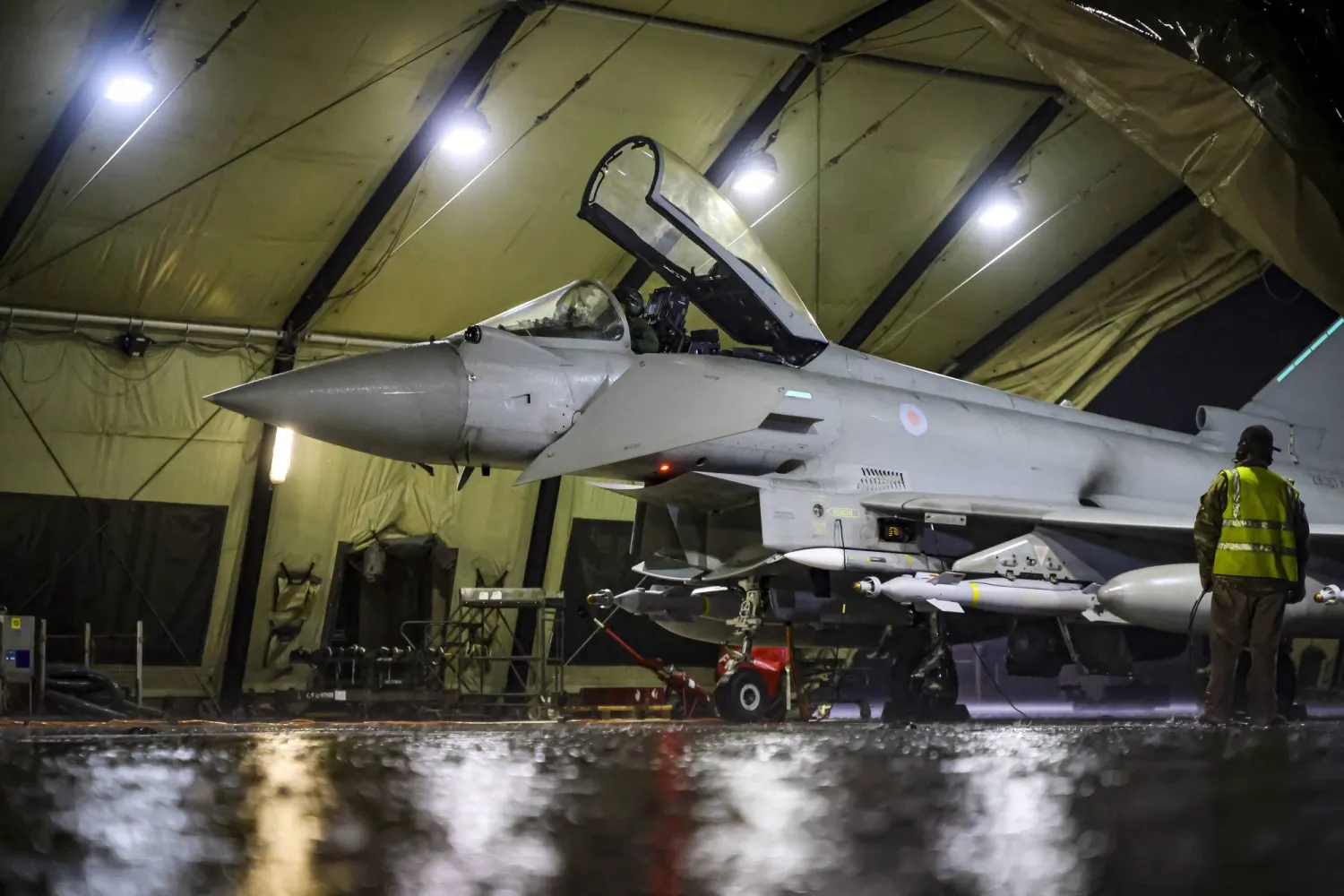
British Air Base in Cyprus Hit by Suspected Drone Strike

In this image provided by the UK Ministry of Defense, a Royal Air Force Typhoon FGR4 is prepared to take off to carry out airstrikes against Houthi targets in Yemen, from RAF Akrotiri, Cyprus, Monday, Jan. 22, 2024. (AS1 Leah Jones/Ministry of Defence via AP)
TT

British Air Base in Cyprus Hit by Suspected Drone Strike

In this image provided by the UK Ministry of Defense, a Royal Air Force Typhoon FGR4 is prepared to take off to carry out airstrikes against Houthi targets in Yemen, from RAF Akrotiri, Cyprus, Monday, Jan. 22, 2024. (AS1 Leah Jones/Ministry of Defence via AP)

Britain's Royal Air Force base Akrotiri in Cyprus was hit by a suspected drone strike overnight, causing limited damage and no casualties, Cypriot authorities and the UK's Ministry of Defense said.

A Cyprus government spokesperson ⁠said that "information received through ⁠various channels indicates that it involved an unmanned drone, which caused limited damage.”

A security alert put out to residents in ⁠the vicinity of Akrotiri by the British bases administration advised residents to shelter in place until further notice 'following a suspected drone impact.’

Britain retains sovereignty over the territory of two bases on the eastern Mediterranean island, which is a member ⁠of ⁠the European Union.

RAF Akrotiri covers a sprawling, square-shaped peninsula on the southern tip of Cyprus. The last time it was directly attacked was by Libyan militants in the mid-1980s.

The incident came as Britain agreed on Sunday to allow the United States to use British military bases to fire "defensive" strikes at Iranian missile systems.


US Warned Iran About Israel’s Aims to Assassinate Leaders

Iran's Speaker of Parliament, Mohammed Bagher Ghalibaf (L), and the Minister of Foreign Affairs of Iran, Abbas Araghchi (C), attend a meeting at the Bürgenstock resort in Obbürgen, near Lucerne, Switzerland, Sunday, 21 June 2026. EPA/URS FLUEELER
TT

US Warned Iran About Israel’s Aims to Assassinate Leaders

Iran's Speaker of Parliament, Mohammed Bagher Ghalibaf (L), and the Minister of Foreign Affairs of Iran, Abbas Araghchi (C), attend a meeting at the Bürgenstock resort in Obbürgen, near Lucerne, Switzerland, Sunday, 21 June 2026. EPA/URS FLUEELER

Senior US officials feared that Israel intended to assassinate Iran’s top negotiators as the Trump administration pursued a high-stakes deal to end the war there and reopen the Strait of Hormuz, current and former officials familiar with the matter told The Washington Post.

The officials said the US worried that Israel might assassinate Mohammad Bagher Ghalibaf, the Iranian parliamentary speaker who is leading negotiations with the US, or Foreign Minister Abbas Araghchi, who has also been a public face of the talks.

They said the concern was so serious that this spring the United States took the unusual step of asking intermediaries to warn Tehran that Israel might attempt to assassinate the two leaders. “If these two men are killed, the pragmatists would be gone,” a US official told the newspaper.

US Vice President JD Vance looks on next to US President Donald Trump's son-in-law Jared Kushner, as Iran's Foreign Minister Abbas Araqchi shakes hands with Pakistan's Prime Minister Shehbaz Sharif, prior to a quadrilateral meeting between the United States, Iran, Pakistan and Qatar at the Burgenstock luxury hotel complex overlooking Lake Lucerne, Switzerland, on June 21, 2026, as part of high-level talks aimed at advancing a deal to end the Middle East conflict. (Photo by Nathan Howard / POOL / AFP)

“This illustrates the divergence in war aims between the United States and Israel, as well as the Israeli prime minister's fundamental willingness to torpedo any negotiation the United States might conclude,” Aaron David Miller, a former State Department official who advised both Republican and Democratic administrations, told the newspaper.

The newspaper noted that Israel's embassy in Washington declined to comment.

US officials had also urged Israeli counterparts as early as March not to target Iran's political leadership while diplomatic efforts were underway, according to a diplomat cited by the newspaper.

A White House official told The Washington Post, “The president wants the peace process to play out.”

Trump and Netanyahu during a press conference at the White House on September 29, 2025 (AFP)

According to the newspaper, while both countries initially backed regime change in Iran after the conflict began on Feb. 28, US officials later concluded that Iran’s political and military establishment would likely remain in power and shifted focus toward securing a negotiated settlement.

It said tensions deepened after Israel allegedly assassinated senior Iranian national security official Ali Larijani in March.

“The turning point wasn’t the assassination of the supreme leader, it was the assassination of Larijani,” a Western official was quoted as saying. “The US was looking for an Iranian official to deal with an all of a sudden he was gone.”

According to the Washington Post, Araghchi and Ghalibaf later became Washington’s principal interlocutors in securing an initial ceasefire in April and negotiating a broader framework agreement in June to end the conflict.


US Offers Tehran a Trade-Off: Frozen Funds in Exchange for Abandoning Hormuz Toll Payments

A group of people stands in shallow water as a cargo ship appears anchored in the Strait of Hormuz off Bandar Abbas, Iran, Tuesday, June 30, 2026. (Amirhosein Khorgooi/ISNA via AP)
TT

US Offers Tehran a Trade-Off: Frozen Funds in Exchange for Abandoning Hormuz Toll Payments

A group of people stands in shallow water as a cargo ship appears anchored in the Strait of Hormuz off Bandar Abbas, Iran, Tuesday, June 30, 2026. (Amirhosein Khorgooi/ISNA via AP)

Iran has insisted on managing the Strait of Hormuz in coordination with Oman, with a plan to impose a service fee on ships passing through the Strait, despite US opposition.

According to The Wall Street Journal, the US and Oman are looking for ways to break Iran’s insistence on charging tolls for ships to pass through the Strait. Their chief lever in indirect talks was a promise to unfreeze some of the $100 billion in Iranian funds held overseas.

On Friday, Axios said US President Donald Trump's envoys Steve Witkoff and Jared Kushner, who visited Doha last Tuesday, have been trying to convey to the Iranians that their demand for tolls could blow up a US-Iran deal that would ultimately be far more lucrative for Iran.
“The US message to Iran was 'Think bigger,’” a US official told Axios.

The official claimed the sums Iran could generate from developing and selling oil and other resources freely — if the US lifted all sanctions under a deal — “would be 100 times more valuable to them than using a gangster tactic to try and charge a toll.”

Also citing people familiar with the talks, WSJ said the US and Doha are looking for ways to break Iran’s insistence on charging tolls for ships to pass through the Strait of Hormuz, with Washington offering to unfreeze some of the $100 billion in Iranian funds held overseas.

The US diplomats offered Iran a trade-off: relinquish its claim to control the strait and renounce toll payments in exchange for billions of dollars of unfrozen funds, the newspaper wrote.

Talks had initially been progressing toward the release of $6 billion held in Qatar, but Iran’s decision to block the strait set back the release, it added.

In return, Tehran estimates that charging for security, safety and environmental services in the strait would bring in $40 billion a year in revenue for states involved. The idea was rejected by Washington.

The Iranians are insisting they have joint sovereignty over the strait, along with Oman, and that both countries will administer it and request passage fees after the 60-day term of the MOU ends.

Iranian Deputy Foreign Minister Kazem Gharibabadi stressed that the Strait of Hormuz is defined under Iran’s command.

“Hormuz is defined under Iran’s command, not CENTCOM,” Gharibabadi wrote in a post on his X account early Thursday, following his return from Doha.

Iran's military command has also threatened ships that attempt to cross the Strait of Hormuz using unapproved routes with a “forceful response.”

Omani Proposal

Meanwhile, negotiators from the US and Iran are actively discussing a recent Omani proposal regarding the management and transit of the Strait of Hormuz after Muscat proposed a voluntary maritime fund as a compromise.

The proposal, under which shipping companies would pay service fees to use the strait, mentions voluntary fees rather than a mandatory toll.

Sources said Oman has already made contacts with oil and shipping companies to explore their willingness to contribute to the maritime fund, but Tehran insists on controlling traffic and collecting transit fees.

An informed source said the plan was recently handed over to US negotiators, who had some reservations about the proposal but intend to discuss it with the Omani side.

Another source added that the proposal would eventually be an indirect form of the toll system that Iran benefits from.

Maritime traffic in the Strait of Hormuz, through which a fifth of the world's oil and liquefied natural gas supplies travel, have been largely blocked since the war broke out with US-Israeli strikes on Iran on February 28.

Galibaf: We Will Not Allow US Interference

Iranian Parliament Speaker Mohammad Bagher Ghalibaf said his country is resolved that the United States would not be allowed to interfere in the management of the Strait of Hormuz.

During a meeting with He WeiHe, Vice Chairman of the Standing Committee of China's National People's Congress, Ghalibaf said Iran and Oman have come to an agreement regarding the regulation of traffic in the Strait of Hormuz, based on Article V of the Memorandum of Understanding with the United States.

Article V of the memorandum commits Iran to work with Oman and the other Gulf littoral states to determine the future administration of navigation and maritime services in the Strait of Hormuz in accordance with international law and the sovereign rights of the states bordering the waterway.

The Speaker said Iran is actively moving forward with the implementation of this new maritime framework and intends to hold further consultations with other countries bordering the Gulf.


Netanyahu, Trump Agree to Meet Soon after Phone Call

Trump and Netanyahu at Mar-a-Lago on December 29, 2025. (AFP via Getty Images)
TT

Netanyahu, Trump Agree to Meet Soon after Phone Call

Trump and Netanyahu at Mar-a-Lago on December 29, 2025. (AFP via Getty Images)

Israeli Prime Minister Benjamin Netanyahu spoke with ‌US ‌President Donald ‌Trump ⁠on Friday and the ⁠two leaders agreed ⁠to ‌meet soon ‌in the ‌United States, ‌Netanyahu's office said.

The ‌statement did not specify ⁠when ⁠the meeting would take place.