
Trump Says Iran War Could Be Over Soon, but Oil Disruption Would Trigger Harsher US Strikes

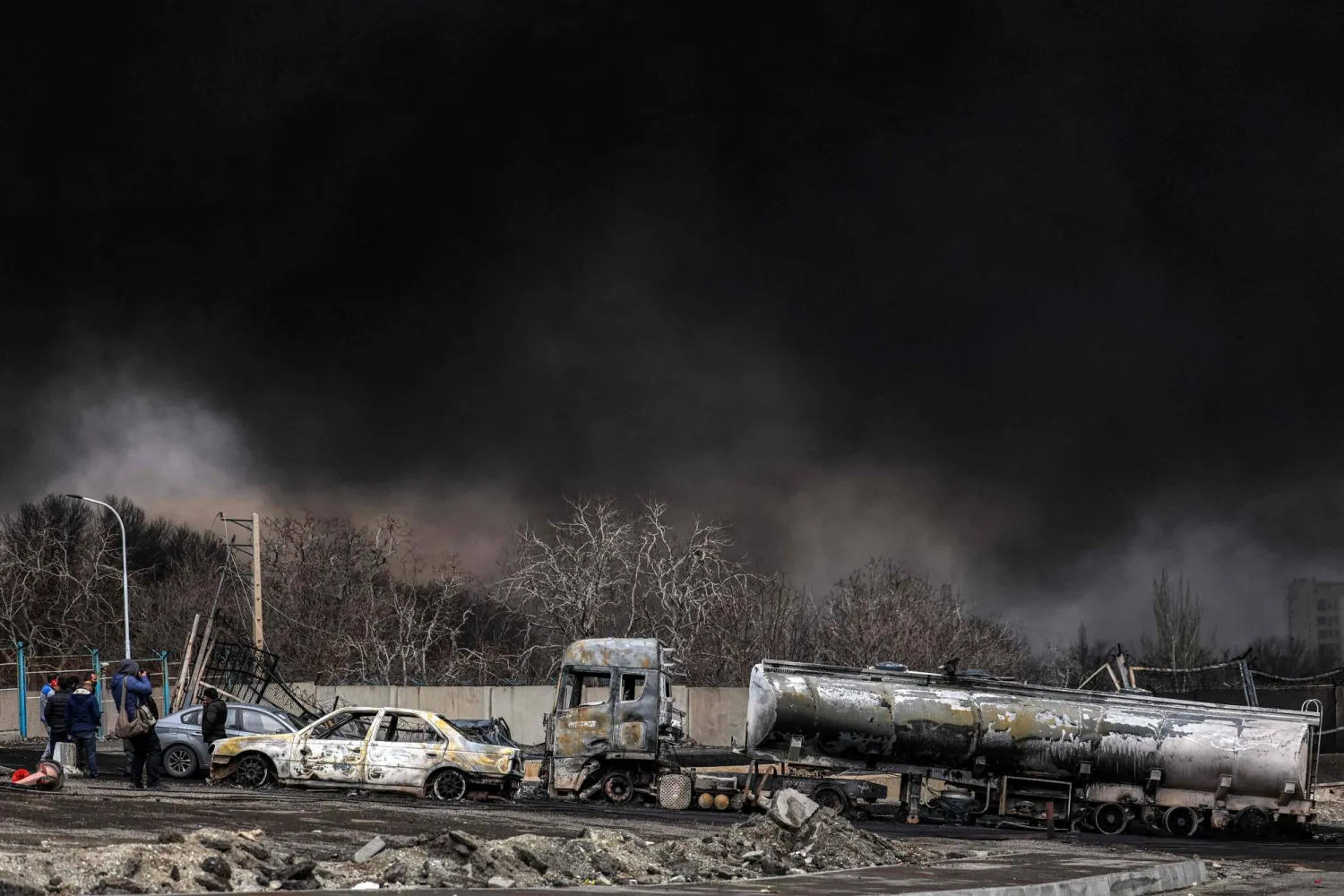
A dark smoke cloud engulfs destroyed vehicles near an ongoing fire following an overnight airstrike on the Shahran oil refinery in northwestern Tehran on March 8, 2026. (AFP)
TT

Trump Says Iran War Could Be Over Soon, but Oil Disruption Would Trigger Harsher US Strikes

A dark smoke cloud engulfs destroyed vehicles near an ongoing fire following an overnight airstrike on the Shahran oil refinery in northwestern Tehran on March 8, 2026. (AFP)

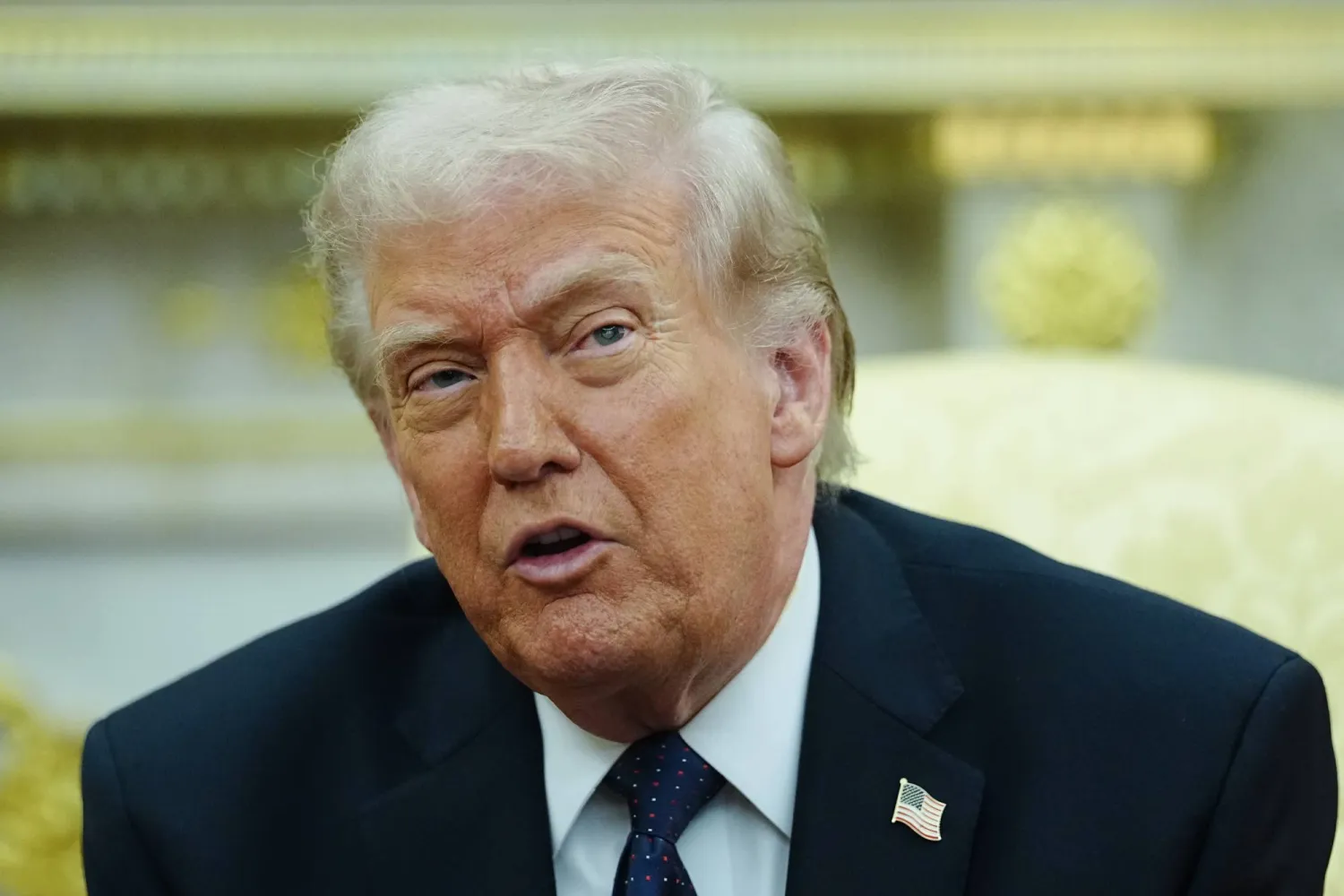
US President Donald Trump said Monday that the war against Iran could be short-lived, but he left open the possibility of an escalation in fighting if global oil supplies are disrupted by Tehran, which chose a new hard-line supreme leader. 

Oil prices briefly shot to their highest level since 2022 a day after Iran selected Mojtaba Khamenei to succeed his late father as Iran’s supreme leader. Investors saw it as a signal that Iran was digging in 10 days into the war launched by the United States and Israel. 

But prices later fell and US stocks rose on hopes that the war with Iran may not last much longer. 

“We took a little excursion” to the Middle East “to get rid of some evil. And, I think you’ll see it’s going to be a short-term excursion,” Trump told Republican lawmakers at his golf club near Miami. 

Hours later, Trump posted on social media: “If Iran does anything that stops the flow of Oil within the Strait of Hormuz, they will be hit by the United States of America TWENTY TIMES HARDER than they have been hit thus far." 

In an apparent response to Trump’s remarks published in Iranian state media, a spokesperson for the paramilitary Revolutionary Guard, Ali Mohammad Naini, said “Iran will determine when the war ends.” 

The war has choked off major supplies of oil and gas to world markets and sent fuel prices rising across the US. The fighting has also led foreigners to flee from business hubs and prompted millions to seek shelter as bombs hit military bases, government buildings, oil and water installations, hotels and at least one school. 

Trump also had a call Monday with Russian President Vladimir Putin to discuss the war and other issues. Putin’s foreign affairs adviser, Yuri Ushakov, said Putin “voiced a few ideas regarding a quick political and diplomatic settlement” of the conflict following his conversations with Gulf leaders and Iranian President Masoud Pezeshkian. 

Khamenei, a secretive 56-year-old cleric, is only the third supreme leader in the history of the republic. He has close ties to the paramilitary Revolutionary Guard, which has been firing missiles and drones at Israel and Gulf Arab states since his father, Ali Khamenei, who had ruled since 1989, was killed during the war’s opening salvo. 

Multiple strikes shake Tehran 

Dozens of explosions were heard in Tehran in what was considered the heaviest air raid on the capital since the war started Feb. 28. Iranian media did not report on damages and casualties. 

Israel said Monday that it was carrying out “a wide-scale wave of strikes” on the Iranian city of Isfahan, as well as Tehran and in southern Iran. The Israeli military said it hit dozens of infrastructure sites, including the drone headquarters of the Revolutionary Guard. 

Meanwhile, Israel’s military alerted the population throughout the day about incoming missiles from Iran. From Lebanon, Iran-backed Hezbollah also fired rockets into Israel on Monday. 

Trump said the United States was nearing its goal to eliminate Iran’s ballistic missile stockpile and its ability to produce and launch them. The administration has offered shifting rationales and timelines since the start of the conflict. 

He also talked about "building a new country,” a comment that seemed to suggest the US might be engaged in the building of a new Iran. 

Trump likes idea of another ‘internal’ candidate to lead Iran  

Thousands poured into a central square in the capital, Tehran, and other locations in a show of allegiance to the new supreme leader, waving flags and shouting phrases like “Death to America” and “Death to Israel.” 

The younger Khamenei, who has not been seen in public since the war started, was long considered a potential successor — even before the killing of his 86-year-old father. 

Trump told reporters that he was “disappointed” that Mojtaba Khamenei was picked and that he liked “the idea” of a leader drawn from an “internal” group of candidates, saying that worked well with Venezuela. 

The younger Khamenei is seen as even less compromising than his late father. As supreme leader, he has the final say on all major policies, including Tehran’s disputed nuclear program. 

Though Iran’s key nuclear sites are in tatters after the US bombed them during the 12-day Israel-Iran war in June, it still has highly enriched uranium that’s a technical step away from weapons-grade levels. Khamenei could choose to do what his father never did — build a nuclear bomb. 

Trump told reporters the war with Iran started because that country was working on a new site for developing material for nuclear weapons to replace one bombed last year by the US. 

Israel has already described Khamenei as a potential target. Trump said Monday it “would be inappropriate” to say whether he would be targeted. 

US market seesaws over uncertainty of war  

The US stock market careened through a manic Monday, going from a steep early loss to a solid gain as worries turned into hope that the war with Iran may not last that long. Oil prices whipped from nearly $120 per barrel, the highest since 2022, back toward $90. 

Iran’s attacks in the Strait of Hormuz have all but stopped tankers from using the shipping lane through which a fifth of the world’s oil is carried, and Iranian drones and missiles have targeted oil and gas infrastructure in major producers. Attacks on merchant ships near the strait have killed at least seven mariners, according to the International Maritime Organization. 

Kamal Kharazi, foreign policy adviser to the office of the supreme leader, told CNN on Monday that Iran is prepared for a long war. He said he sees no “room for diplomacy anymore” unless economic pressure prompts other countries to intervene and stop the “aggression of Americans and Israelis against Iran.” 

Türkiye, meanwhile, said NATO defenses had intercepted a ballistic missile that entered the country’s airspace for the second time since the war started. 


Germany's Merz Says Iran is Humiliating US as Talks Stall

 Germany's Chancellor Friedrich Merz speaks during a press conference after taking part in an informal meeting of the European Council in Nicosia on April 24, 2026. (AFP)
Germany's Chancellor Friedrich Merz speaks during a press conference after taking part in an informal meeting of the European Council in Nicosia on April 24, 2026. (AFP)
TT

Germany's Merz Says Iran is Humiliating US as Talks Stall

 Germany's Chancellor Friedrich Merz speaks during a press conference after taking part in an informal meeting of the European Council in Nicosia on April 24, 2026. (AFP)
Germany's Chancellor Friedrich Merz speaks during a press conference after taking part in an informal meeting of the European Council in Nicosia on April 24, 2026. (AFP)

German Chancellor Friedrich Merz said on Monday Iran's leadership was humiliating the United States and getting US officials to travel to Pakistan and then leave without results, in an unusually abrupt rebuke over the conflict.

Merz also said he not see what exit strategy the US was pursuing in the Iran war- comments that underlined deep divisions between Washington and its European NATO allies, which had already been festering over Ukraine and other issues.

"The Iranians are obviously very skilled at negotiating, or rather, very skilful at not negotiating, letting the Americans travel to Islamabad and then leave again without any result," he said during a talk to students in the town of Marsberg, Reuters reported.

"An entire nation is being humiliated by the Iranian leadership, especially by these so-called Revolutionary Guards. And so I hope that this ends as quickly as possible," he added at the venue in the state of North Rhine-Westphalia.

US President Donald Trump has harshly criticized NATO allies for not sending their navies to help open the Strait of Hormuz during the conflict. The waterway has remained virtually shut, causing market turmoil and unprecedented disruption in energy supplies.

Merz reiterated that Germans and Europeans were not consulted before the US and Israel started attacking Iran on February 28, and that he had conveyed his scepticism directly to Trump afterwards.

"If I had known that it would continue like this for five or six weeks and get progressively worse, I would have told him even more emphatically," Merz said, comparing it to previous US wars in Iraq and Afghanistan.

Hopes of reviving peace efforts have receded since Trump scrapped a visit on Saturday by his envoys Steve Witkoff and Jared Kushner to Islamabad, the Pakistani capital.

Iranian Foreign Minister Abbas Araqchi travelled to Russia on Monday after failed talks in Pakistan and Oman.

Merz said it was evident the Strait of Hormuz had been at least partially mined. "We have offered, also as Europeans, to send German minesweepers to clear the strait, which has obviously been mined in part," he said.

He said the conflict was costing Germany "a lot of money, a lot of taxpayers' money and a lot of economic strength."


German Foreign Minister: We Need Deterrence in Face of Nuclear Threats

 27 April 2026, Berlin: Johann Wadephul, German Foreign Minister, gives a statement on the military section of Berlin Brandenburg Airport on an aircraft of the air force before his departure to the United Nations in New York. (dpa)
27 April 2026, Berlin: Johann Wadephul, German Foreign Minister, gives a statement on the military section of Berlin Brandenburg Airport on an aircraft of the air force before his departure to the United Nations in New York. (dpa)
TT

German Foreign Minister: We Need Deterrence in Face of Nuclear Threats

 27 April 2026, Berlin: Johann Wadephul, German Foreign Minister, gives a statement on the military section of Berlin Brandenburg Airport on an aircraft of the air force before his departure to the United Nations in New York. (dpa)
27 April 2026, Berlin: Johann Wadephul, German Foreign Minister, gives a statement on the military section of Berlin Brandenburg Airport on an aircraft of the air force before his departure to the United Nations in New York. (dpa)

German Foreign Minister Johann Wadephul said on Monday that deterrence is needed amid nuclear threats, even as he underscored support for nuclear non-proliferation.

"As long as nuclear threats against ‌us and ‌our partners continue, we ‌will ⁠need a credible ⁠deterrent," he said in a statement ahead of meetings on the Nuclear Non-Proliferation Treaty that he ⁠is due to attend ‌this ‌week at the United ‌Nations in New York.

He ‌added the conference would seek new ways of safeguarding the treaty's achievements ‌and focus on nuclear disarmament.

France and Germany ⁠last ⁠month announced plans to deepen cooperation on nuclear deterrence, marking a significant shift in defence policy as Europe faces rising threats from Russia and instability linked to the Iran conflict.


Too Early to Drop Sanctions Against Iran, Says EU’s von der Leyen

 President of the European Commission Ursula von der Leyen speaks the opening press conference of the CDU/CSU parliamentary group’s executive committee meeting in Berlin, Germany April 27, 2026. (Reuters)
President of the European Commission Ursula von der Leyen speaks the opening press conference of the CDU/CSU parliamentary group’s executive committee meeting in Berlin, Germany April 27, 2026. (Reuters)
TT

Too Early to Drop Sanctions Against Iran, Says EU’s von der Leyen

 President of the European Commission Ursula von der Leyen speaks the opening press conference of the CDU/CSU parliamentary group’s executive committee meeting in Berlin, Germany April 27, 2026. (Reuters)
President of the European Commission Ursula von der Leyen speaks the opening press conference of the CDU/CSU parliamentary group’s executive committee meeting in Berlin, Germany April 27, 2026. (Reuters)

European Commission President Ursula von der Leyen said on Monday that it was too early to drop sanctions imposed on ‌Iran.

"We think ‌the dropping ‌of ⁠sanctions would be ⁠too early," she said in Berlin at a meeting of the ⁠conservative CDU and ‌its ‌CSU Bavarian sister party, ‌adding that ‌the sanctions were in place due to Iran's suppression of ‌its own population.

"We first have to ⁠see ⁠a change, a fundamental change in Iran for the dropping of sanctions," von der Leyen added.