


North Korea’s Kim Yo Jong Says US-South Korea Drills to Harm Regional Stability

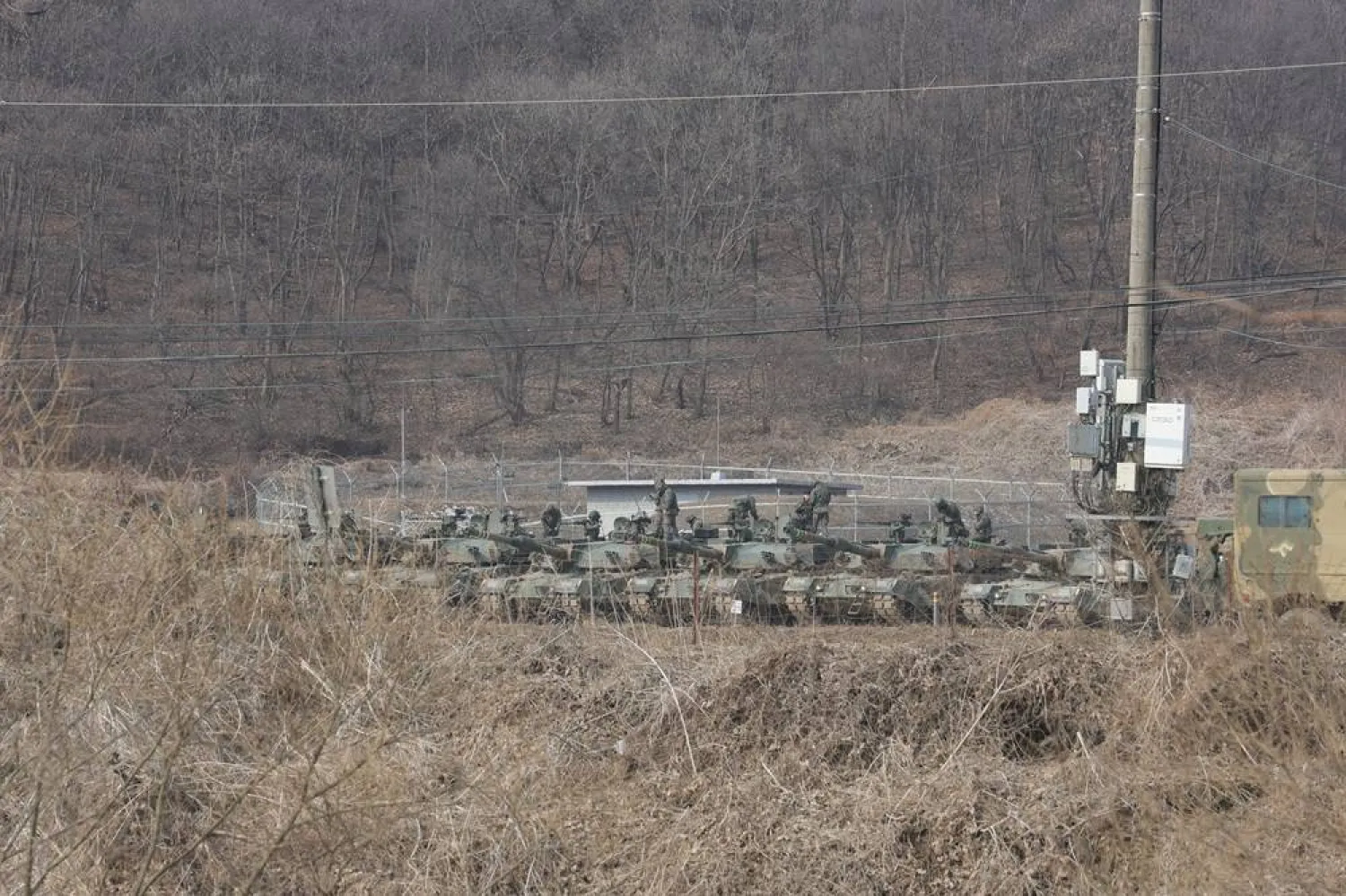
 09 March 2026, South Korea, Paju: South Korean tanks stand on standby at a training ground in Paju as South Korea and the United States begin their annual joint springtime military exercise to strengthen their combined defense posture. (YNA/dpa)
09 March 2026, South Korea, Paju: South Korean tanks stand on standby at a training ground in Paju as South Korea and the United States begin their annual joint springtime military exercise to strengthen their combined defense posture. (YNA/dpa)
TT

North Korea’s Kim Yo Jong Says US-South Korea Drills to Harm Regional Stability

 09 March 2026, South Korea, Paju: South Korean tanks stand on standby at a training ground in Paju as South Korea and the United States begin their annual joint springtime military exercise to strengthen their combined defense posture. (YNA/dpa)
09 March 2026, South Korea, Paju: South Korean tanks stand on standby at a training ground in Paju as South Korea and the United States begin their annual joint springtime military exercise to strengthen their combined defense posture. (YNA/dpa)

North Korea's Kim Yo Jong, the sister of leader Kim Jong Un, said US-South Korea military drills that began this week were a "provocative and aggressive war rehearsal" that would harm regional stability, state media KCNA reported on Tuesday.

The annual Freedom Shield military exercises revealed the allies' "habitual hostile policy" toward North Korea and "will further destroy regional ‌stability," Kim said ‌in a statement.

Kim described the drills in ‌South ⁠Korea as involving ⁠more than 18,000 South Korean and US forces and being staged "day and night across the territorial ground, sea, air, outer space and cyberspace" of North Korea.

She said the display of military force could "lead to terrible consequences that are unimaginable."

Recent global geopolitical crises and various international events demonstrate that in all military maneuvers carried out by hostile forces, there ⁠is no distinction between defense and offense, nor between ‌drills and actual combat, Kim ‌said.

South Korea and the United States have said the drills, which run from ‌March 9 to 19, were "defensive in nature" and would incorporate ‌deterrence scenarios related to North Korea's nuclear weapons.

The exercise will also serve as an opportunity to support ongoing preparations for the transfer of US wartime operational control to South Korea, officials from both countries have said. South Korea aims to ‌complete the handover of military command from the US before President Lee Jae Myung's term ends ⁠in 2030.

Analysts say ⁠the drills come at a sensitive time for North Korea, as it witnesses the US and Israel carry out leadership-targeting operations against Iran that may reinforce Pyongyang's reliance on its nuclear capacity.

Kim's remarks that offensive power is the most reliable deterrent "reflects a determination not to suffer the same fate as Iran, serving as both a justification for self-defense and a renewed message at home and abroad that giving up nuclear weapons would mean doom," said Lim Eul-chul, a North Korea expert at South Korea's Kyungnam University.

The US-South Korea drills follow North Korea'sruling Party Congress in February, where leader Kim Jong Un said he would focus on expanding his country's nuclear arsenal.



US Warships Transit Strait of Hormuz in Mine Clearance Op

A boat is off the coast of Musandam governorate, overlooking the strait of Hormuz, in Musandam governance, in Oman, April 8, 2026. (Reuters)
TT

US Warships Transit Strait of Hormuz in Mine Clearance Op

A boat is off the coast of Musandam governorate, overlooking the strait of Hormuz, in Musandam governance, in Oman, April 8, 2026. (Reuters)

Two US Navy warships have transited the Strait of Hormuz at the start of an operation to clear the strategic waterway of mines laid by Iran, US Central Command said Saturday.

The announcement -- which marks the first such transit since the US-Israeli war with Iran began -- came shortly after President Donald Trump said Washington had started "clearing out" the strait, through which a fifth of the world's crude oil passes.

"Today, we began the process of establishing a new passage and we will share this safe pathway with the maritime industry soon to encourage the free flow of commerce," said CENTCOM commander Admiral Brad Cooper.

The USS Frank E. Peterson and the USS Michael Murphy are the guided-missile destroyers involved in the operation, but CENTCOM said that "additional US forces including underwater drones" could join the effort in coming days.

Earlier, US media outlet Axios reported that the operation was not coordinated with authorities in Tehran.

"We're now starting the process of clearing out the Strait of Hormuz," Trump said on his Truth Social platform, calling it "a favor" to countries such as China, Japan and France that "don't have the Courage or Will to do this work themselves."

He insisted that Iran is "LOSING BIG!" in the conflict, while acknowledging that Iranian mines in the strategic strait still pose a threat.

"The only thing they have going is the threat that a ship may 'bunk' into one of their sea mines," Trump wrote.

The key shipping lane off the coast of Iran has been virtually blocked by Tehran since the United States and Israel started bombing Iran on February 28, though reopening the strait was ostensibly a condition of the shaky ceasefire put in place earlier this week.

Senior Iranian and American officials held face-to-face negotiations in Pakistan on Saturday in a bid to bring an end to a conflict that has plunged the Middle East into violence and sent shockwaves through the world economy.

In an earlier post, Trump said that empty tankers were headed to the United States from around the world to purchase oil, without providing details.


In Fiery Speech, Pope Leo Says ‘Enough to War!’

 Pope Leo XIV presides over a Prayer Vigil and Rosary for Peace, in Saint Peter's Basilica at the Vatican, April 11, 2026. (Reuters)
Pope Leo XIV presides over a Prayer Vigil and Rosary for Peace, in Saint Peter's Basilica at the Vatican, April 11, 2026. (Reuters)
TT

In Fiery Speech, Pope Leo Says ‘Enough to War!’

 Pope Leo XIV presides over a Prayer Vigil and Rosary for Peace, in Saint Peter's Basilica at the Vatican, April 11, 2026. (Reuters)
Pope Leo XIV presides over a Prayer Vigil and Rosary for Peace, in Saint Peter's Basilica at the Vatican, April 11, 2026. (Reuters)

Pope Leo lashed out against warmongers on Saturday while calling on billions of people around the globe to embrace peace and "believe once again in love, moderation and good politics".

In one of his most passionate entreaties yet to end the raging conflict in the Middle East, the American pope said faith was needed "in order to face this dramatic hour in history together".

"Enough of the idolatry of self and money! Enough of the display of power! Enough of war! True strength is shown in serving life," Pope Leo implored in an address during a prayer vigil for peace at St Peter's Basilica.

Uttered in measured tones, as is customary for the soft-spoken head of the world's 1.4 billion Catholics, the comments by the 70-year-old Leo nevertheless marked some of the most pointed criticism yet of the wave of conflicts inflaming the globe.

"Dear brothers and sisters, there are certainly binding responsibilities that fall to the leaders of nations. To them we cry out: Stop! It is time for peace! Sit at the table of dialogue and mediation, not at the table where rearmament is planned and deadly actions are decided!"

As he has done in the past, the Chicago native did not cite politicians by name, and did not call out specific countries.


UN Demands Accountability for Violations of Rules of War in Middle East

Smoke rises from the sites of Israeli airstrikes in Beirut and its southern suburbs on April 8, 2026. (AFP)
TT

UN Demands Accountability for Violations of Rules of War in Middle East

Smoke rises from the sites of Israeli airstrikes in Beirut and its southern suburbs on April 8, 2026. (AFP)

UN agency chiefs on Saturday demanded an end to impunity for widespread international law violations in the Middle East, as casualties pile up six weeks into the war unleashed by US-Israeli strikes on Iran.

In a joint statement, the heads of multiple United Nations agencies said they were "alarmed by the sustained violations of the rules of war and international humanitarian law" in the region.

"Even wars have rules, and these rules must be respected," the statement from the UN Inter-Agency Standing Committee said.

The joint statement -- penned by UN humanitarian chief Tom Fletcher along with the heads of the UN agencies for human rights, health, food, refugees and children among others -- decried the soaring toll since the Middle East war erupted on February 28.

"In just the last month across the Middle East, thousands of civilians have been killed and injured. Hundreds of thousands have been displaced, many multiple times," it said.

"The numbers continue to rise and essential services are increasingly difficult to access.

"Health workers, hospitals and ambulances have been targeted. Schools have been struck. Civilian infrastructure - including bridges, residential buildings, houses, water facilities and power plants - has been destroyed," it said.

The agency chiefs voiced particular concern about the impact on "women and children and others with specific needs", as well as on global supply chains, "with food and fuel prices on the rise."

At the same time, they highlighted that "our humanitarian colleagues have been caught up in hostilities."

Just since the beginning of this year, they said, "14 aid workers have been killed or injured in the Occupied Palestinian Territory, eight in Iran and five in Lebanon."

"This is an alarming toll."

The agency chiefs said they "strongly condemn all attacks on civilians, including humanitarian and health workers, as well as civilian objects."

"We demand that all parties - whether Member States of the United Nations or armed groups - respect their legal obligation to protect civilians, including humanitarian personnel, and civilian infrastructure," they said.

"All violations must be met with accountability."