


Iran-US-Israel Conflict Enters Phase of Prolonged Attrition

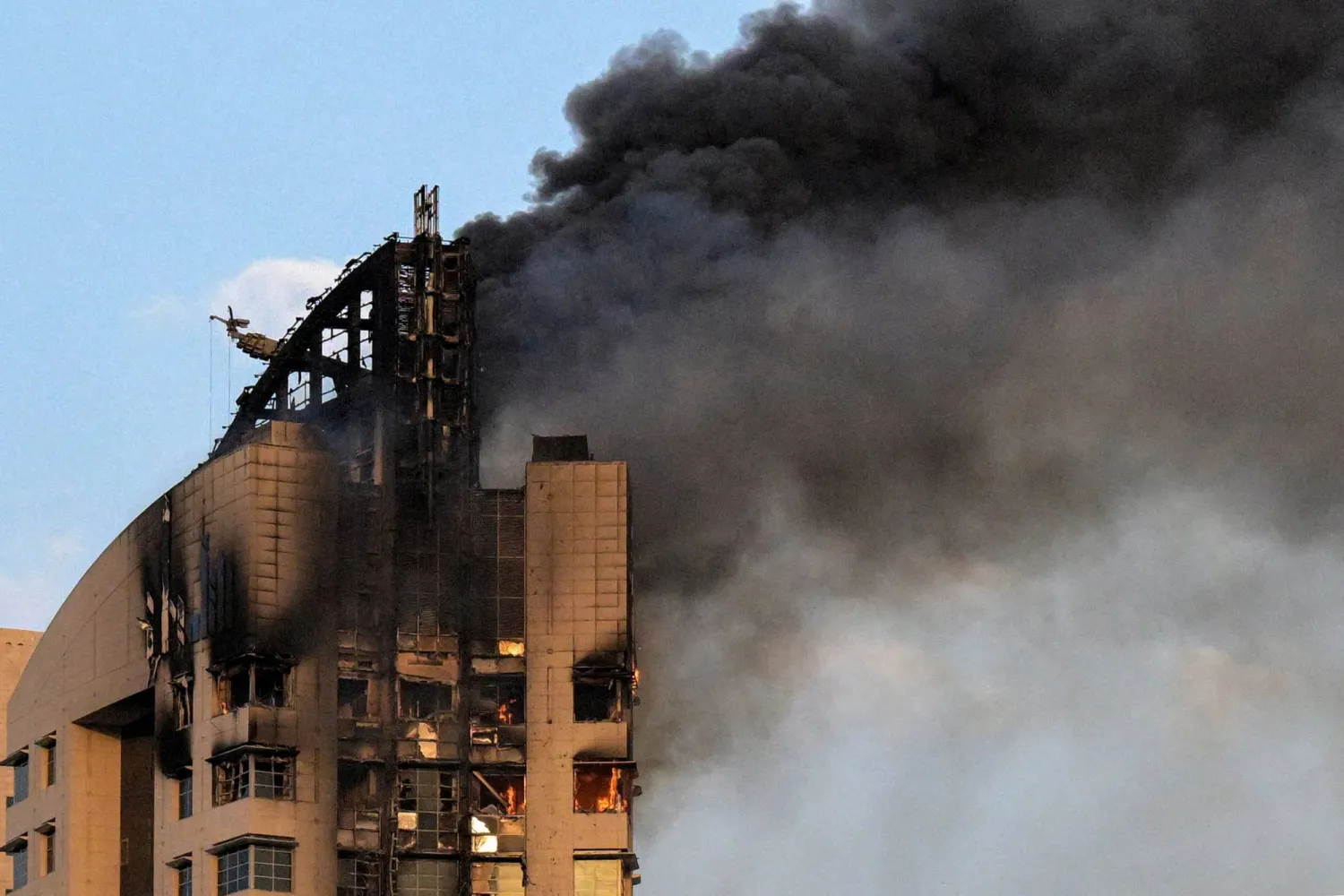
Smoke rises from a building in Kuwait following Iranian attacks (AFP). 
TT

Iran-US-Israel Conflict Enters Phase of Prolonged Attrition

Smoke rises from a building in Kuwait following Iranian attacks (AFP). 

The confrontation between Iran on one side and the United States and Israel on the other has entered a phase of mutual attrition, shifting from temporary military escalation to a sustained pattern of operations, deterrence and endurance.

According to a report released Wednesday by the Gulf Research Center, based in Jeddah, the United States is building a long-term campaign aimed at degrading Iran’s missile capabilities and restoring confidence in maritime shipping routes.

Iran, meanwhile, is relying on its geography, security infrastructure and the strategic leverage of the Strait of Hormuz to prevent its adversaries from turning operational superiority into lasting strategic stability.

Rear Admiral Abdullah Al-Zaidi, senior adviser for security and defense studies at the center and author of the report, said the crisis has entered a stage of extended confrontation.

In this phase, the US effort has shifted from merely containing the Iranian threat to reducing Tehran’s capacity to regenerate and sustain its military capabilities by targeting missiles, drones and the military-industrial infrastructure that supports them.

A War of Attrition

The report said one of the most notable developments is the expansion of the US campaign from exhausting Iranian operational capabilities to striking the broader military-industrial base.

The chairman of the US Joint Chiefs of Staff has indicated that the campaign now focuses on destroying Iran’s missile and drone capabilities and degrading its naval forces in order to safeguard freedom of navigation through the Strait of Hormuz.

The report also noted that after national energy authorities in Qatar, Kuwait and Bahrain declared force majeure, the conflict could no longer be viewed as purely military. Its repercussions have now extended into the global energy sector.

Strait of Hormuz Pressure

Developments in the Strait of Hormuz, the report argued, show that Iran remains capable of generating significant strategic impact without formally closing the waterway. By reducing shipping traffic, raising operational risks and undermining confidence in maritime routes, Tehran can disrupt the flow of commerce without declaring a blockade.

The report added that from a Gulf perspective, the crisis is no longer simply an external escalation affecting global markets, but rather a direct challenge to national and energy securities and freedom of navigation.

Military Campaign Expands

Militarily, the report stated that the US campaign has shifted from reducing the tempo of Iranian attacks to systematically targeting the sources of Iranian military power. This includes destroying missile stockpiles and launch platforms, weakening Iran’s naval capabilities and expanding strikes to facilities involved in drone production.

Iran’s Strategic Depth

According to the report, Iran’s geography provides Tehran with natural strategic depth and a layered defensive capability. The country relies on rugged terrain, underground fortifications, tunnel networks and buried facilities to protect critical military assets.

Israeli estimates cited in the report suggest that more than 60 percent of Iran’s ballistic missile launchers have been disabled, with operational launch platforms declining from roughly 400 to about 150.

Nevertheless, current indicators suggest Tehran is pursuing a strategy of prolonged attrition based on absorbing strikes while extending the duration of the confrontation.

Disruption Without Closure

More than 20 million barrels of oil per day pass through the Strait of Hormuz, along with roughly one-fifth of global liquefied natural gas trade. Yet the report stressed that disrupting shipping does not require a full closure of the waterway.

Recent developments have shown that traffic can be significantly impeded without a formal blockade, it says.

The report also warned of rising risks in the strait, including the possibility that naval mines could be deployed as a direct tool of pressure.

Restoring Shipping Confidence

The contest over Hormuz is no longer solely military but also economic. The report said the central challenge now lies in persuading shipping companies and insurers to resume normal operations in the corridor.

Key Risks

Among the main risks identified are the possibility that the Strait of Hormuz crisis could evolve from a price shock into a supply crisis.

Other risks include potential direct confrontations during naval escort operations, the normalization of shipping disruption without a declared blockade, and the introduction of naval mines into the strategic equation.

The report also highlighted the continued external supply of Iranian missile capabilities, along with expanding international intelligence activity and growing cyber threats.

Outlook

The Gulf Research Center report concluded that the most likely short-term scenario is the continued disruption of traffic in the Strait of Hormuz without a full closure, a strategy that raises operational costs while avoiding the political consequences of an openly declared blockade.

It also expected Iran’s missile-based attrition strategy to continue without a rapid collapse, given the country’s geographic advantages and defensive infrastructure, which could prolong the confrontation.



Islamic Nations D-8 Summit Postponed Due to Middle East War

People gather at the site of an airstrike, amid the US-Israeli conflict with Iran, in Tehran, Iran, March 12, 2026. (Reuters)
TT

Islamic Nations D-8 Summit Postponed Due to Middle East War

People gather at the site of an airstrike, amid the US-Israeli conflict with Iran, in Tehran, Iran, March 12, 2026. (Reuters)

An April summit of the D-8 bloc of Muslim-majority developed countries that includes Iran has been postponed due to the war in the Middle East, host Indonesia said Friday.

No new date was announced for the meeting that was to have stretched over four days, culminating in a leaders' summit on April 15.

Fresh strikes rocked Iran and several Gulf countries Friday as Israel and Iran unleashed a new wave of attacks in a war that has ignited the Middle East and threatens to torpedo the world economy.

Apart from Iran and Indonesia, the D-8 Organization for Economic Cooperation also includes Azerbaijan, Bangladesh, Egypt, Malaysia, Nigeria, Pakistan and Türkiye.

Referring to "developments since February 28" when the US-Israeli attacks on Iran started, Indonesian foreign ministry official Tri Tharyat said it was decided to hold the D-8 meeting at a later date.

"It is regrettable that there are still no visible signs of de-escalation," he told reporters in Jakarta.

"Last night, the foreign minister signed a letter addressed to his counterparts announcing the postponement of the D-8 summit," added Tri.


US Braces for Potential Iranian Retaliatory Operations within its Borders

US President Donald Trump speaks with the media as Defense Secretary Pete Hegseth (R) and special envoy Steve Witkoff (C) look on aboard Air Force One during a flight from Dover, Delaware, to Miami, Florida, on March 7, 2026. (AFP)
TT

US Braces for Potential Iranian Retaliatory Operations within its Borders

US President Donald Trump speaks with the media as Defense Secretary Pete Hegseth (R) and special envoy Steve Witkoff (C) look on aboard Air Force One during a flight from Dover, Delaware, to Miami, Florida, on March 7, 2026. (AFP)

Fears have grown in the US that Tehran could activate “sleeper cells” or carry out unconventional retaliatory attacks on American soil as Washington and Tel Aviv continue their war against Iran.

President Donald Trump warned on Wednesday that his administration knows where the Iranian sleeper cells are and is monitoring all of their members. The statement appeared aimed both at reassuring the public and sending a warning to Iran.

Still, the tone contrasts with more cautious assessments from US security agencies, which say the threat remains potential rather than imminent or specific.

Security agencies on alert

Trump’s remarks followed earlier comments in which he said the situation was “under control” and that authorities were “watching everyone” of the suspected sleeper cells.

While the president sought to link the issue to immigration, security agencies have adopted a more measured approach. A US intelligence assessment issued after the killing of Iran’s Supreme Leader Ali Khamenei warned that Iran and its proxies could resort to selective attacks inside the United States, though large-scale assaults are considered less likely.

Officials see a higher probability of cyberattacks or smaller operations carried out by limited networks or sympathetic individuals.

The Department of Homeland Security has similarly assessed that Iran and its proxies could pose a threat through targeted attacks inside the United States.

Against that backdrop, Kash Patel, director of the Federal Bureau of Investigation, announced on Feb. 28 that the bureau had placed its counterterrorism and intelligence teams on “maximum alert.”

The move included mobilizing additional security resources and emphasizing that the FBI’s Joint Terrorism Task Forces nationwide are working around the clock to detect and disrupt potential threats. Such measures typically involve heightened surveillance of high-priority suspects, expanded use of confidential sources, reviews of technical intelligence tools and closer coordination between federal and local authorities.

Drone concerns in California

One development that drew attention in recent days was the disclosure of a confidential FBI bulletin circulated through the Los Angeles Joint Regional Intelligence Center before the outbreak of the war.

The notice warned that Iran might attempt to retaliate for US attacks by launching drones from ships at sea targeting California.

According to a security bulletin reviewed by Reuters, the FBI distributed the warning last month to law enforcement agencies, citing information collected in late February suggesting Iran could plan a surprise drone attack launched from a vessel offshore if Washington carried out strikes against it.

The bulletin, however, contained no specific information on timing or targets and described the scenario more as a potential ambition than a confirmed operational plan. It also said no further details were available regarding how such an attack might be carried out or who might be involved.

Details of the bulletin emerged publicly as the war, which began with US and Israeli strikes on Iran on Feb. 28, entered its twelfth day.

Vigilance but no imminent threat

California authorities sought to balance caution with reassurance. Governor Gavin Newsom said the state was aware of the warning and was coordinating closely with federal and local agencies while preparing for worst-case scenarios. He stressed that no credible or imminent threats had been identified.

Los Angeles Mayor Karen Bass and San Francisco Mayor Daniel Lurie delivered similar messages, saying no specific threat had been detected but that coordination with federal authorities was ongoing.

Local police departments across the state said they had been informed of a higher risk environment and urged residents to report suspicious activity.

Past incidents

Previous cases have heightened US concerns. In July 2021, the Justice Department revealed a plot linked to an Iranian intelligence network to kidnap journalist and activist Masih Alinejad from New York and forcibly take her to Iran.

In March 2025, a federal court convicted two leaders of an Eastern European organized crime network in a murder-for-hire scheme targeting Alinejad on behalf of actors linked to Iran’s Revolutionary Guard Corps.

They were sentenced in October that year to 25 years in prison each. Another defendant involved in surveilling Alinejad and planning her killing in New York was sentenced in January 2026 to 15 years in prison.


Turkish-Owned Ship Allowed to Pass Through Strait of Hormuz, Minister Says

A man walks along the shore as oil tankers and cargo ships line up in the Strait of Hormuz, seen from Khor Fakkan, United Arab Emirates, Wednesday, March 11, 2026. (AP)
TT

Turkish-Owned Ship Allowed to Pass Through Strait of Hormuz, Minister Says

A man walks along the shore as oil tankers and cargo ships line up in the Strait of Hormuz, seen from Khor Fakkan, United Arab Emirates, Wednesday, March 11, 2026. (AP)

A Turkish-owned ship that had been waiting near Iran was allowed to pass through the Strait of Hormuz after authorities received permission from Tehran, Turkish Transport and Infrastructure Minister Abdulkadir Uraloglu said. 

In comments to Turkish media on Thursday that were released on Friday, Uraloglu said Ankara had declared the highest-level security warning ‌for the strait ‌and continued contacts with Iranian ‌officials ⁠regarding the situation ⁠of the remaining 14 Turkish-owned vessels there. 

"Fifteen ships (with Turkish owners) were there; we obtained permission from the Iranian authorities for one of them, which had used an Iranian port, and it passed," Uraloglu said. 

The ministry said the ⁠ship that passed the strait was ‌the Rozana. It added ‌that Turkish-owned vessels had a total of 171 personnel ‌in the area. 

The US-Israeli war on Iran ‌has effectively shut the Strait of Hormuz, leaving tankers and other ships stranded, which has stoked concerns about global energy supply. 

Separately, the ministry said Turkish ‌Airlines and Ajet had cancelled flights to Iraq, Syria, Lebanon, Jordan, Doha, Dubai, ⁠Abu ⁠Dhabi, Kuwait, Bahrain and Dammam until March 19, while flights to Iran were cancelled until March 20. 

Pegasus Airlines cancelled flights to Kuwait, Bahrain, Doha, Amman, Beirut, Iraq, Dubai, Abu Dhabi, and Sharjah until March 23, while cancelling Iran flights until March 28, it added. 

Turkish Airlines has added flights to Oman, it said, adding that 76 flights had been diverted to Türkiye since the start of the war on February 28.