


Iran Rejects De-Escalation Offers; Israel Says It Kills Iranian Security Chief

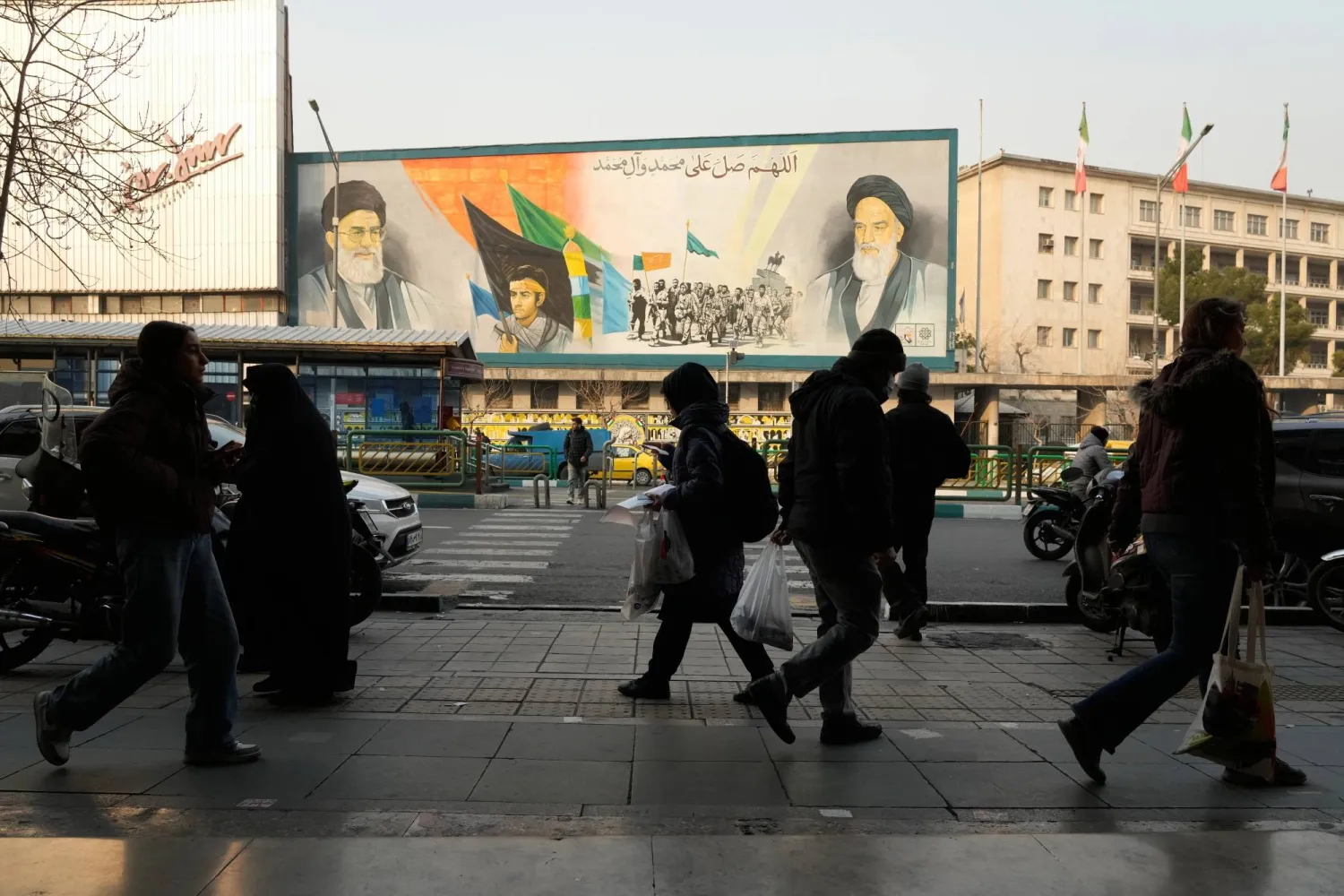
People walk in front of a mural depicting the late Iranian revolutionary founder Khomeini, right, members of the Basij paramilitary force and Supreme Leader Ali Khamenei along Enqelab-e-Eslami Street in Tehran, Iran, Sunday, Jan. 25, 2026. (AP Photo/Vahid Salemi)
TT

Iran Rejects De-Escalation Offers; Israel Says It Kills Iranian Security Chief

People walk in front of a mural depicting the late Iranian revolutionary founder Khomeini, right, members of the Basij paramilitary force and Supreme Leader Ali Khamenei along Enqelab-e-Eslami Street in Tehran, Iran, Sunday, Jan. 25, 2026. (AP Photo/Vahid Salemi)

Israel said on Tuesday it had killed Iran's security chief, the most senior figure targeted since the war's first day, while a senior Iranian official said the new supreme leader had rejected de-escalation offers conveyed by intermediary countries. 

Iran did not immediately comment on Israel's announcement it had killed Ali Larijani, widely viewed as one of Iran's most powerful figures and a confidant of slain Supreme Leader Ali Khamenei and his son and successor, Mojtaba. 

In a sign of Iran's continued defiance after more than two weeks of war, the senior Iranian official who asked not to be identified said the younger Khamenei had rejected proposals that were conveyed to Iran's Foreign Ministry for "reducing tensions or ceasefire with the United States". The official did not give further details. 

The official said Mojtaba Khamenei had held his first foreign policy session since being named supreme leader, and had declared that it was not "the right time for peace until the United States and Israel are brought to their knees, accept defeat, and pay compensation". 

He did not clarify whether the younger Khamenei, who has not yet been pictured since being named last week to replace his slain father, had attended the meeting in person or remotely. 

The US-Israeli war on Iran is ‌now in its ‌third week, with at least 2,000 people killed and no end in sight. 

The Strait of Hormuz remains largely closed ‌off and ⁠US allies have rebuffed ⁠US President Donald Trump's calls for them to help to reopen the vital waterway, through which about 20% of global oil and liquefied natural gas flows. 

Trump has called on allies to provide military assistance to ease the global economic impact by reopening the strait. Most NATO allies have informed the US they don't want to get involved in the conflict, Trump said on Tuesday, describing their position as "a very foolish mistake." 

"Because of the fact that we have had such Military Success, we no longer 'need,' or desire, the NATO Countries’ assistance — WE NEVER DID!" Trump wrote in a post on Truth Social, also singling out Japan, Australia and South Korea. 

European Union foreign policy chief Kaja Kallas said in an interview with Reuters on Tuesday that nobody was ready to risk the lives of their people in protecting the strait. 

"We have to find diplomatic ways to keep this open so that we don't have ⁠a food crisis, fertilizers crisis, energy crisis as well," Kallas said. 

Oil prices rose about 2% on Tuesday as Iran renewed ‌its strikes on oil facilities in the United Arab Emirates, and are up around 45% since the start of ‌the war, raising concerns of a renewed spike in global inflation. 

ISRAEL TARGETS IRAN'S SECURITY OFFICIALS 

The killing of Larijani, if confirmed, would make him the most senior figure killed by Israel ‌and the United States since the war's first day when they killed the supreme leader, other members of his family and other senior officials. 

Israel's Defense Minister Israel ‌Katz said Israeli forces had killed Larijani, as well as Gholamreza Soleimani who led the volunteer Basij militia, which plays a major role in domestic security. 

Prime Minister Benjamin Netanyahu said Israel was weakening Iran's leadership to give its people the opportunity to rise up and topple the government. 

"It won't happen in one go, it won't happen easily. But if we persist - we will provide them with the opportunity to take their destiny into their own hands," he added. 

Iranian state media published a handwritten note by Larijani commemorating Iranian sailors killed in a US attack. 

Larijani, secretary of ‌the Supreme National Security Council, had held a series of senior jobs and was close to the slain leader, although he had a reputation for pragmatic relations with other factions in the ruling system. 

AIR RAID SIRENS SOUND IN ISRAEL 

There ⁠was no let-up in attacks by both ⁠sides on Tuesday. 

In Israel, where Iranian missile attacks have killed 12 people, air raid sirens sounded throughout the day in the commercial hub Tel Aviv and surrounding cities as loud blasts of interceptions were heard as far away as Jerusalem. 

The barrage underscores Tehran's capacity to carry out long-range strikes despite more than two weeks of pounding by US and Israeli weapons. 

The Israeli military said it was targeting "Iranian regime infrastructure" with a new wave of strikes across Tehran, as well as Hezbollah sites in Beirut. 

Foreign Minister Gideon Saar said Israel "had, in effect already won the war", but gave no timeline for when the war might end. 

More than 900 people have died since Israel began attacks on Lebanon on March 2, the Lebanese Health Ministry said on Tuesday. More than 1,300 people have been killed and 7,000 injured in Iran, Iran's ambassador to the UN said on Monday. 

FUJAIRAH PORT DISRUPTED IN THIRD ATTACK 

Iran has responded by wide-ranging attacks on its Gulf neighbors. 

Gulf Arab states, including the UAE, have faced more than 2,000 missile and drone attacks on US diplomatic missions and military bases as well as oil infrastructure, ports, airports, ships and residential and commercial buildings. 

Oil loading at the UAE port of Fujairah was at least partly halted on Tuesday after a third attack in four days caused a fire at the export terminal. Fujairah lies on the far side of the Strait of Hormuz from the Gulf, making it one of the few ports from which the region's oil can be shipped without passing through the blockaded waterway. 

UAE authorities said debris from an intercepted ballistic missile also fell in Abu Dhabi's Bani Yas area, killing one Pakistani national, while a fire caused by a drone attack was being fought at Abu Dhabi's Shah gas field. 


Britain Warns Iran It Will Not Tolerate Hostile Activity on UK Soil

Britain's Foreign Minister Ed Miliband arrives to attend an informal meeting of EU foreign affairs ministers at Druids Glen in Wicklow, south of Dublin, Ireland, on September 2, 2026.  (Photo by Paul Faith / AFP)
Britain's Foreign Minister Ed Miliband arrives to attend an informal meeting of EU foreign affairs ministers at Druids Glen in Wicklow, south of Dublin, Ireland, on September 2, 2026. (Photo by Paul Faith / AFP)
TT

Britain Warns Iran It Will Not Tolerate Hostile Activity on UK Soil

Britain's Foreign Minister Ed Miliband arrives to attend an informal meeting of EU foreign affairs ministers at Druids Glen in Wicklow, south of Dublin, Ireland, on September 2, 2026.  (Photo by Paul Faith / AFP)
Britain's Foreign Minister Ed Miliband arrives to attend an informal meeting of EU foreign affairs ministers at Druids Glen in Wicklow, south of Dublin, Ireland, on September 2, 2026. (Photo by Paul Faith / AFP)

Britain's foreign minister met his Iranian counterpart on the sidelines of the UN General Assembly in New York and told him his country would "not tolerate intimidation, threats or hostile activity on UK soil" from groups linked to Iran.

British Foreign Secretary Ed Miliband and Iranian Foreign Minister Abbas Araghchi also discussed the war in the Middle East, the importance of reopening the Strait of Hormuz and Britain's "unwavering resolve ‌to combat ‌threats from Iranian-linked groups on UK soil," ‌a ⁠Foreign Office statement said.

"The ⁠Foreign Secretary reiterated the UK's unwavering resolve to combat threats from Iranian-linked groups on UK soil, including attacks on the British Jewish community," it said.

In July, Britain banned support for Iran's Revolutionary Guard Corps and a linked group following a series of ⁠antisemitic attacks, using new legal powers designed ‌to stop the use ‌of state-sponsored proxies, said
Reuters.

Iran has previously denied using proxies. The British statement ‌did not say how Araghshi responded to ‌Miliband.

A statement on Araghchi’s Telegram account said he had used the meeting to call for a correction to "the destructive and irresponsible approaches of some European governments towards Iran and regional ‌developments."

He also said an "insistence on interfering in countries’ internal affairs and the instrumental ⁠use of ⁠human rights concepts is in no way acceptable."

Britain's National Cyber Security Center said last week Iranian state-linked cyber actors had used a spyware family known as "CHOSEN BRICK" to steal emails, messages and other sensitive information through "spear-phishing" campaigns on messaging platforms including WhatsApp and Telegram.

"The Foreign Secretary made clear that Britain will not tolerate intimidation, threats or hostile activity on UK soil and set out the measures the Government has taken in response," the Foreign Office statement added.


Zelensky Says Trump Made 'Final Decision' to Give Ukraine Patriot License

NEW YORK, NEW YORK - SEPTEMBER 23: President of Ukraine Volodymyr Zelensky addresses the 81st session of the United Nations (UN) General Assembly at UN Headquarters on September 23, 2026 in New York City. Alexi J. Rosenfeld/Getty Images/AFP
TT

Zelensky Says Trump Made 'Final Decision' to Give Ukraine Patriot License

NEW YORK, NEW YORK - SEPTEMBER 23: President of Ukraine Volodymyr Zelensky addresses the 81st session of the United Nations (UN) General Assembly at UN Headquarters on September 23, 2026 in New York City. Alexi J. Rosenfeld/Getty Images/AFP

Ukrainian President Volodymyr Zelensky on Friday said US President Donald Trump told him he would allow Ukraine to produce advanced Patriot air defense missiles, after a series of reversals on the issue.

Kyiv is facing a shortage of the missiles, which remain the only ones reliably able to counter the ballistic missiles that Russia launches at Ukraine.

"At our last meeting, President Trump emphasized to me that yes, I have made a final decision. Ukraine will receive licenses for the production of Patriot missiles," Zelensky said in a voice note to journalists.

In July, Trump said it would be "pretty cool" to grant Ukraine the licenses, before backtracking, saying the United States should be "very careful" before granting Ukraine authorization.

Ukraine has reported an acute shortage of Patriot interceptors since the United States and Israel went to war with Iran in February, diverting supplies of the advanced systems.

Even if the licenses are granted, establishing industrial capacity would require more than a year and would not meet Kyiv's immediate needs.

And Kyiv has renewed calls for urgent support ahead of winter, and the threat of a repeated campaign of Russian strikes against Ukraine's power and heating infrastructure.

Kyiv needs five percent of the United States' Patriot interceptor missiles to get through the winter and 10 percent to destroy all of Russia's ballistic projectiles, Zelensky said last month.

In parallel, he said Kyiv is working on its own anti-ballistic systems, Freya.


Iran Proposes Reopening Hormuz Within 7 Days

FILE PHOTO: Vessels at the Strait of Hormuz, as seen from Musandam, Oman, September 23, 2026. Picture taken through a window. REUTERS/Stringer/File Photo
TT

Iran Proposes Reopening Hormuz Within 7 Days

FILE PHOTO: Vessels at the Strait of Hormuz, as seen from Musandam, Oman, September 23, 2026. Picture taken through a window. REUTERS/Stringer/File Photo

Iran has submitted a proposal to the United States to end their war and reopen the Strait of Hormuz within seven days, its foreign minister told media outlets in New York.

"If certain conditions are met, the strait will be open within seven days and talks will start," Abbas Araghchi, who is in the US for the UN General Assembly, told media outlets including the New York Times and The Guardian.

Japanese news agency Kyodo was the first to report the proposal, citing a senior Iranian official on Tuesday.

Iranian media, however, denied the Kyodo report, while authorities in Tehran have not clarified their position.

Araghchi also met for talks on Tuesday with US President Donald Trump's envoy Steve Witkoff.

Iran has previously set out seven conditions for ending the war and reopening the strait.

According to Araghchi, as quoted by the New York Times, the latest plan calls for a cessation of all hostilities in the Middle East for seven days, including in Lebanon.

It also calls for the release of frozen Iranian assets estimated to be worth at least $12 billion, as well as the lifting of sanctions on Iranian oil and an end to the US naval blockade of Iran.

On the seventh day of the truce, Iran would reopen Hormuz.

Araghchi said he was waiting for a US response to the plan and maintained that China supported the proposal.

Chinese President Xi Jinping is visiting the United States this week where he is meeting with Trump for talks.

Hossein Mohebi, a spokesman for the Revolutionary Guards, the ideological arm of Iran's military, told AFP in an exclusive interview on Tuesday that ending hostilities in Yemen was also among Tehran's demands.

The US and Iran signed a memorandum of understanding in June that aimed to end the war, reopen the strait and launch talks on Iran's nuclear program.

But the deal broke down shortly afterwards when Iran fired on commercial ships in Hormuz that it accused of deviating from its approved route through the waterway.

Iran requires ships to obtain authorization before passage, citing security and sovereignty reasons.

Ships that refuse to comply are regularly targeted, while the United States sporadically bombs Iranian coastal areas in retaliation.
