

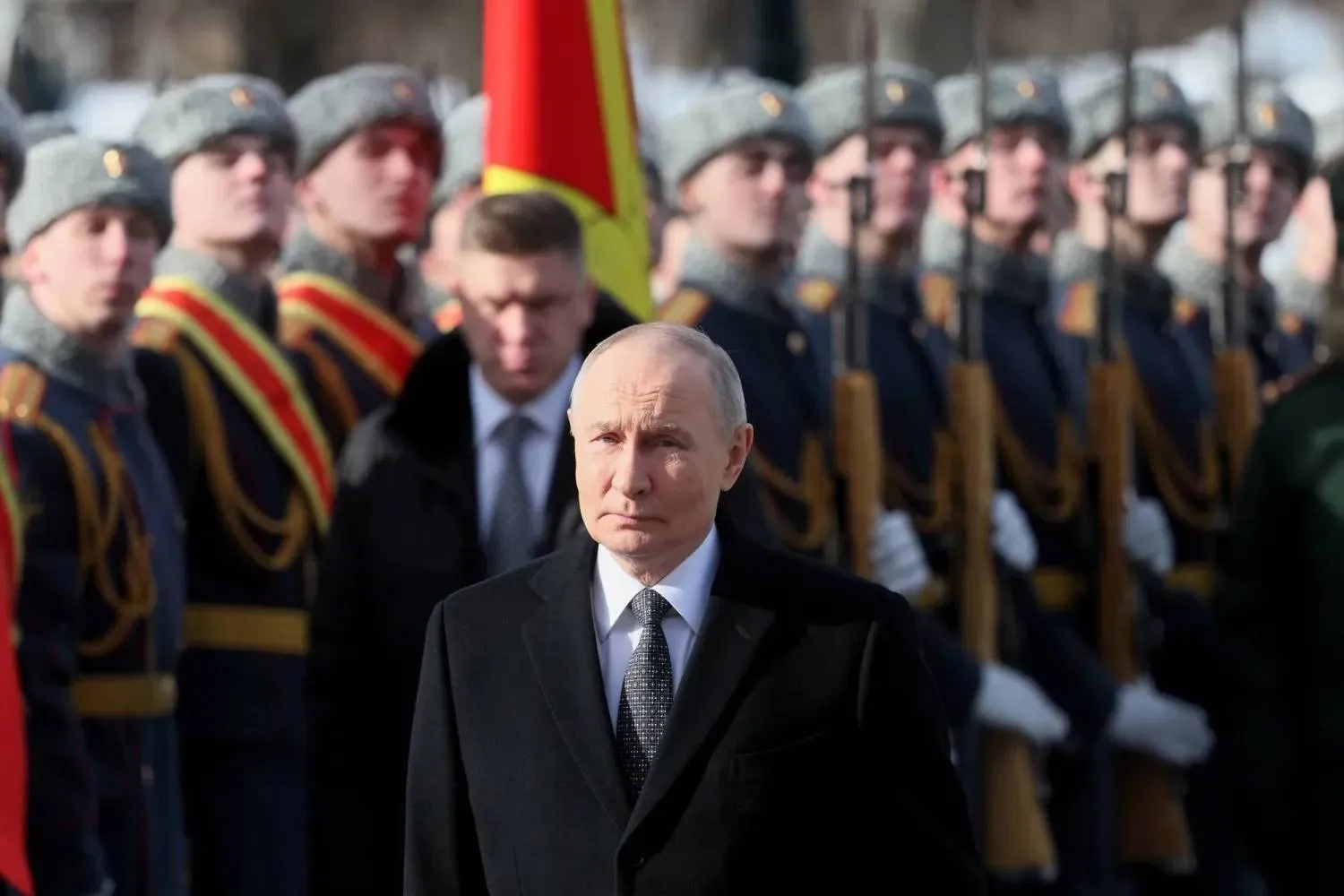

Moscow Bets on Tehran’s Resilience, Western Rift

The Russian President attends events marking “Defender of the Fatherland Day” in Moscow on February 23 (AP)
TT

Moscow Bets on Tehran’s Resilience, Western Rift

The Russian President attends events marking “Defender of the Fatherland Day” in Moscow on February 23 (AP)

The Kremlin’s expectations appeared markedly pessimistic in the fourth week of the Iran war, as confidence grew that Russia’s ability to influence the conflict was waning and that the repercussions for one of its key partners could be severe.

With limited leverage, the Kremlin’s main options now seem to be avoiding direct involvement while closely monitoring the fallout, particularly signs of widening divisions between Washington and European capitals — and what one veteran Russian diplomat described as “driving the final wedge” into transatlantic relations.

Kremlin spokesman Dmitry Peskov summed up the mood: “No reasonable person would dare predict how the situation in the Middle East will evolve, but it is clear that things are moving toward the worse.”

From the outset, Russian assessments have focused on two key assumptions: that air strikes alone cannot topple Iran’s political system, regardless of their scale, and that ending the war without a costly ground intervention would be difficult for the attacking parties.

A second assumption is that any cessation of hostilities would resemble the outcome of the brief 12-day war of 2025, with each side claiming success without achieving its ultimate objectives, particularly Israel’s stated goal of dismantling Iran’s ruling system.

Such a scenario would suit Moscow, even if Iran were to emerge weakened but still cohesive under its leadership.

Despite increasingly pessimistic forecasts about a potential geographic expansion of the conflict, Moscow believes Tehran has so far absorbed the initial blow and shifted the confrontation into a war of attrition. Russian officials are also banking on possible internal developments within Washington and Tel Aviv, as well as growing divergences with European allies.

Peskov has repeatedly stressed that military operations against Iran have led to greater cohesion among the Iranian people around their leadership, adding that attempts at regime change tend to produce the opposite effect.

He also condemned ongoing assassination campaigns targeting Iranian leaders, calling the situation “abnormal” and warning of “serious consequences.” In a pointed remark, he added that Iran is “actively defending itself against attacks on its territory.”

These statements underline Russia’s primary bet: that Iran’s internal stability will hold, while divisions deepen among its adversaries.

Putin’s mediation effort

President Vladimir Putin initially sought to use the crisis to bolster Russia’s diplomatic standing by proposing rapid mediation to halt the war.

During the first week, he held a series of calls with regional leaders, criticizing Iranian strikes on Gulf countries while emphasizing Moscow’s ability to send “direct messages” to Tehran.

Russia also revived earlier proposals discussed in Oman concerning Iran’s nuclear capabilities and missile program. Moscow offered to take control of enriched uranium and transfer it to Russian territory, while guaranteeing that Iran’s missile capabilities would not be used against Israel or neighboring states.

The proposal was also raised during Putin’s only call with US President Donald Trump in the second week of the war. However, it failed to gain traction in either Tel Aviv — which insists on a military solution — or Washington, where Trump signaled that Putin should first resolve the Ukraine conflict before seeking a role elsewhere.

Limited support for Iran

Against this backdrop, the Kremlin’s options for meaningful intervention appear extremely limited. Complicating matters are accusations that Moscow has provided valuable intelligence support to Iran.

These claims gained weight when US presidential envoy Steve Witkoff reportedly issued a strong warning to Moscow, and the issue was raised directly during the Trump-Putin call.

Nevertheless, Russian circles argue that Moscow has little choice but to continue offering indirect assistance to Tehran while avoiding provoking Washington.

According to Russian media sources, this support takes two main forms: sharing limited intelligence on Israeli movements — carefully calibrated to avoid harming US interests — and providing indirect backing through private companies specializing in cyber technologies, an area where Russia and China have made significant advances.

European repercussions

Another key aspect of Russia’s strategy is its close monitoring of how the war is affecting Ukraine and European positions, which Moscow still sees as the main obstacle to ending the conflict on its terms.

There is little concealment of Russian satisfaction at Europe’s difficulties amid the war, particularly fears over rising oil and gas prices and the prospect of easing sanctions on Moscow to offset supply shortages.

Kremlin commentary suggests that European priorities are shifting, with energy costs replacing Ukraine at the top of government agendas.

Veteran Russian diplomat Alexander Yakovenko argued that the Middle East crisis, combined with the fallout from Ukraine, is intensifying tensions within the transatlantic alliance.

He pointed to German Chancellor Friedrich Merz rejecting a US request to help secure the Strait of Hormuz as evidence of deepening strains. Trump, he noted, responded by describing NATO as a “paper tiger.”

According to Yakovenko, the coming weeks will be decisive for the Iran conflict and its broader consequences. He added that transatlantic relations are facing a severe crisis, with disagreements over Ukraine fueling European opposition to Trump, a factor that could influence the US midterm elections in November.

More broadly, he warned that a US setback in Iran would weaken Washington’s position vis-à-vis Beijing, noting that China has already used export controls on rare earth minerals to counter US trade pressure.

In this context, Yakovenko sees the emergence of three dominant global powers — the United States, China and Russia — with Europe increasingly sidelined.

Such a shift, he suggested, would echo the post-World War II Yalta-Potsdam order, albeit with China replacing Britain, marking the end of two centuries of Western containment of Russia.



London Summons Envoy Over Iran’s ‘Reckless’ Actions

Ambassador from Iran, Seyed Ali Mousavi (2nd L), meets Britain's King Charles III during an audience at Buckingham Palace in London on June 12, 2025. (AFP)
TT

London Summons Envoy Over Iran’s ‘Reckless’ Actions

Ambassador from Iran, Seyed Ali Mousavi (2nd L), meets Britain's King Charles III during an audience at Buckingham Palace in London on June 12, 2025. (AFP)

Britain's foreign ministry on Monday summoned Iran's ambassador to London, Seyed Ali Mousavi, criticizing what it called Tehran's "reckless and destabilizing actions" in the UK and overseas.

"The summons follows the recent charging of two individuals, one Iranian national and one British-Iranian dual national, under the National Security Act, on suspicion of providing assistance to a foreign intelligence service," a Foreign Office spokesperson said.

"This government will take all measures necessary to protect the British people, including exposing Iran's reckless and destabilizing actions at home and abroad," the spokesperson added.

Two Iranians appeared in court in London on Thursday accused of spying on the Jewish community in London on behalf of Tehran, including by allegedly carrying out reconnaissance of potential targets such as a synagogue.

UK police, the domestic MI5 intelligence service and members of parliament have long warned about a growing threat from Iran, which is currently locked in a war with the United States and Israel.

Nematollah Shahsavani, 40, a dual Iranian-British national, and Alireza Farasati, 22, an Iranian citizen, are charged with engaging in contact likely to assist a foreign intelligence service between July 9 and August 15 last year.

Prosecutor Louise Attrill told the court last week the pair were "suspected of assisting the Iranian intelligence service by conducting hostile surveillance of locations and individuals linked to the Israeli and Jewish community".

Police on Saturday also said an Iranian man, along with a Romanian woman, had been charged over attempting to enter a Royal Navy base where Britain's nuclear submarines are based.

The pair were arrested for trying to breach the Faslane base in Scotland on Thursday, which houses the UK's Trident nuclear deterrent, made up of four submarines armed with Trident ballistic missiles.

The Iranian man has since been released from custody pending further inquiries, Scotland's public prosecution service said in a statement on Monday.

The service added there would be "no proceedings" against the Romanian woman, 31, although it reserved "the right to proceed in the future should further evidence become available".

There are fears in Britain the country could become a target over its role in the US-Israeli war on Iran.

Britain has authorized American forces to use two of its bases for some US operations against Iran, which the British government insists are purely "defensive".


‘Point of No Return’ Looming in Middle East War, Warns Red Cross

 A drone view shows a damage in a residential neighborhood, following a night of Iranian missile strikes which injured dozens of Israelis, amid the US-Israel conflict with Iran, in Dimona, southern Israel March 22, 2026. (Reuters)
A drone view shows a damage in a residential neighborhood, following a night of Iranian missile strikes which injured dozens of Israelis, amid the US-Israel conflict with Iran, in Dimona, southern Israel March 22, 2026. (Reuters)
TT

‘Point of No Return’ Looming in Middle East War, Warns Red Cross

 A drone view shows a damage in a residential neighborhood, following a night of Iranian missile strikes which injured dozens of Israelis, amid the US-Israel conflict with Iran, in Dimona, southern Israel March 22, 2026. (Reuters)
A drone view shows a damage in a residential neighborhood, following a night of Iranian missile strikes which injured dozens of Israelis, amid the US-Israel conflict with Iran, in Dimona, southern Israel March 22, 2026. (Reuters)

The International Committee of the Red Cross demanded Monday a halt to the "war on essential infrastructure" in the Middle East, warning of potential "irreversible consequences" including harm to nuclear facilities.

"What we have seen in recent days in the Middle East risks reaching a point of no return," ICRC president Mirjana Spoljaric warned in a statement.

"Most alarming is the potential harm to nuclear facilities, whether deliberate or incidental," she said.

Energy infrastructure has been repeatedly hit since the start of the war on February 28, when the United States and Israel began their attacks on Iran. Tehran has responded by striking targets in Israel and Gulf states.

Over the weekend, an Iranian strike hit the southern Israeli town of Dimona, home to a nuclear facility, in what Tehran said was in response to an earlier attack on its nuclear site at Natanz.

"Damage to these sites could trigger irreversible consequences, which is why they are afforded heightened protections under the rules of war," Spoljaric said.

She cautioned that "war on essential infrastructure is war on civilians".

"Deliberate attacks on essential services and civilian infrastructure can amount to war crimes."

Her comments came as US President Donald Trump suddenly backtracked on a threat to "obliterate" Iran's power infrastructure if it did not reopen the strategic Strait of Hormuz.

In response to Trump's initial threat, Iran had threatened to deploy naval mines in the Gulf and target power plants across the region.

On Monday, Trump said he was putting his ultimatum on hold after "very good" talks with unidentified Iranian officials, while Iranian media outlets quoted the foreign ministry in Tehran denying any negotiations and suggesting Trump was angling to bring down energy prices.

"Attacks on essential infrastructure have already punished millions of civilians both near and far from the front lines," Spoljaric said in her statement.

"This pattern, combined with an escalatory rhetoric that disregards the limits imposed by international humanitarian law, normalizes a style of warfare that strips away our shared humanity."


Iran’s True Casualty Figures Unknown as Internet Blackout Hampers Monitors

Emergency personnel work at the site of a strike on a residential building, amid the US-Israeli conflict with Iran, in Tehran, Iran, March 23, 2026. Majid Asgaripour/WANA (West Asia News Agency) via Reuters
TT

Iran’s True Casualty Figures Unknown as Internet Blackout Hampers Monitors

Emergency personnel work at the site of a strike on a residential building, amid the US-Israeli conflict with Iran, in Tehran, Iran, March 23, 2026. Majid Asgaripour/WANA (West Asia News Agency) via Reuters

Iran has not updated its official death toll figures for weeks, while human rights groups outside the country are struggling with chronic communication problems, meaning the number of people killed during the war remains largely unknown.

The last time Iran's health ministry gave a full update about casualties was on March 8, the ninth day of the conflict, when it said around 1,200 civilians had been killed in US and Israeli airstrikes across the country.

Overseas human rights groups have long been considered one of the most reliable sources of information about life inside the heavily censored country.

But with Iran's connections to the global internet cut off and phone lines down, they are struggling to reach their networks of contacts who are their eyes and ears on the ground.

The US-based Human Rights Activists News Agency (HRANA), which played an important role corroborating deaths during anti-government protests in January, estimates the civilian death toll at 1,407 people, including 214 children.

"I would say it's an absolute, absolute minimum, and that's simply because we don't have the capacity to be everywhere at one time, understanding the full extent of what's happening," HRANA deputy director Skylar Thompson told AFP.

"With the scale and the speed at which places are being targeted across the country, it's impossible to document it at the same pace," she added.

The Iranian Red Crescent is not providing casualty estimates, but its latest figures indicate 61,555 homes, 19,000 businesses, 275 medical centers, and nearly 500 schools have been damaged.

AFP journalists have been able to confirm that many civilian buildings in Tehran have been damaged, including apartment blocks caught in the blast wave of nearby missile or bomb strikes, but not beyond the city.

Reporters are unable to travel around the country without official authorization.

- Connection problems -

Distrust of Iran's official figures is high among human rights groups, particularly after the bloody crackdown on anti-government protests in January.

Although Iran acknowledged around 3,000 deaths, mostly among security forces, researchers and campaigners outside Iran estimated that anywhere from 7,000 to 35,000 people were killed in the indiscriminate shooting.

"The Islamic republic has a history of not publishing or not collecting data," Awyar Shekhi from the Norway-based human rights group Hengaw told AFP.

The problem for Hengaw and others seeking to provide a credible alternative to the incomplete official data has been the almost-total shutdown of Iran's internet connections to the outside world since the start of the war on February 28.

"The connection is worse than it ever was before, so it's really difficult to get accurate data of how many people have been killed, and the information we get is so little," Shekhi added.

Both she and Thompson stressed that Iranian authorities have been threatening and arresting people who have illegally accessed the global internet to send information abroad, sometimes accusing them of spying.

Making telephone calls to Iran from abroad is also largely impossible.

- 'Focus on the civilian harm' -

The biggest loss of life for civilians in the war so far was the airstrike on an elementary school in Minab on the first day of the war that killed at least 165 people, according to an official toll.

A US Tomahawk cruise missile hit the school because of a targeting mistake, according to the preliminary findings of a US military investigation reported by The New York Times.

Hengaw also documented an airstrike on a flour factory in the city of western Naqadeh on March 7 that killed 11 workers and injured another 21.

"I believe that the US and Israel are using a quite aggressive interpretation of what is a military target," Thompson from HRANA added.

Unlike in January, during the anti-government protests, she said there had so far been relatively little attention in the Western media on the toll of ordinary Iranians.

"There's such a focus on the geopolitics of it all, I think it's really important to have a focus on the civilian harm," she added.

Elsewhere in the region, Lebanon's health ministry said Israeli strikes had killed 1,029 people in the country.