


4 Dead, 38 Rescued during Attempted Channel Crossing from France to UK

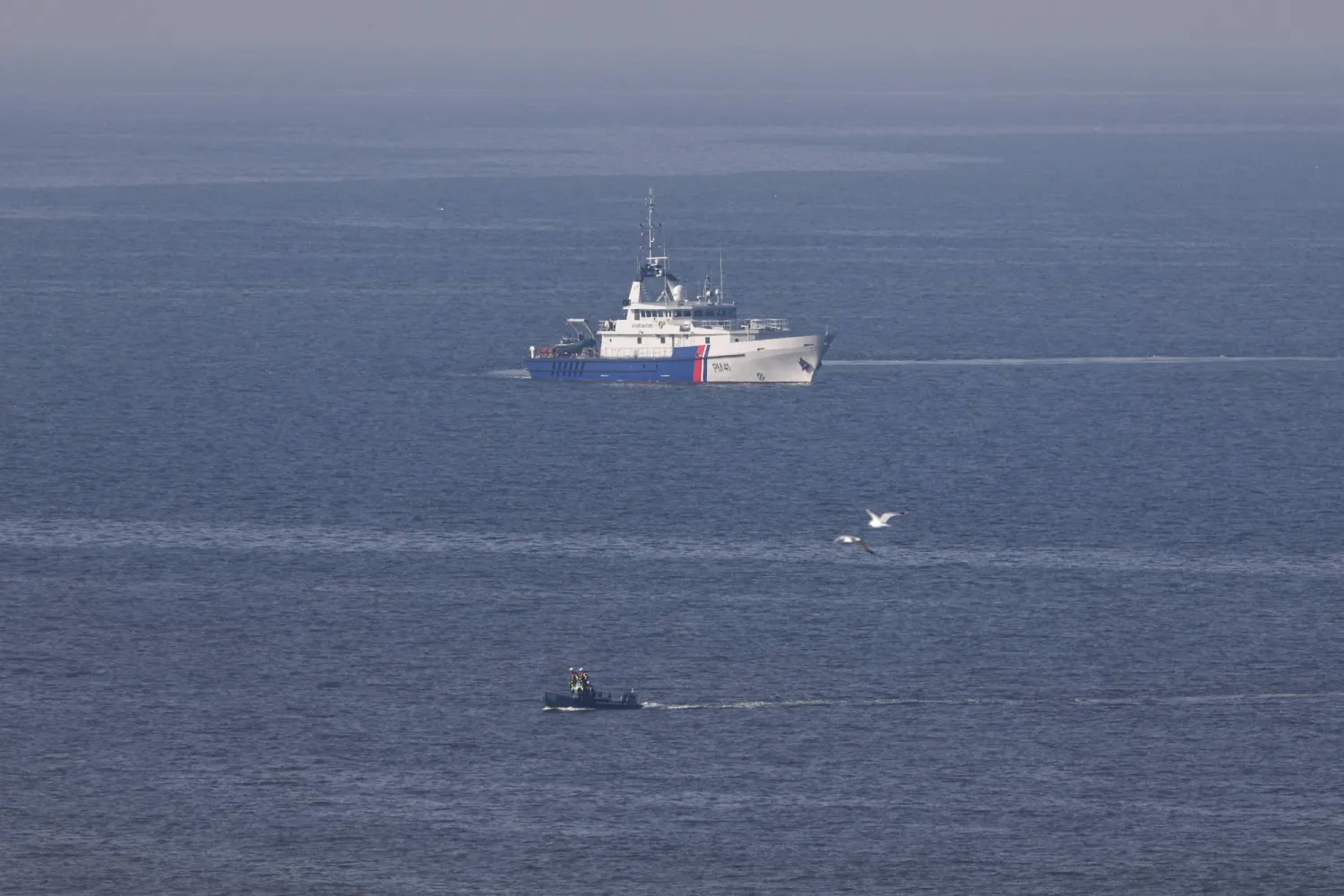
A vessel from the Maritime Affairs Department is sailing off France's Pas-de-Calais northern coastal city of Equihen-Plage after an attempt to cross the English Channel illegally turned tragic with several migrants found in cardiac arrest, on April 9, 2026. (Photo by Sameer AL-DOUMY / AFP)
TT

4 Dead, 38 Rescued during Attempted Channel Crossing from France to UK

A vessel from the Maritime Affairs Department is sailing off France's Pas-de-Calais northern coastal city of Equihen-Plage after an attempt to cross the English Channel illegally turned tragic with several migrants found in cardiac arrest, on April 9, 2026. (Photo by Sameer AL-DOUMY / AFP)

French authorities said that at least four people, two men and two women, died on Thursday as they were trying to get onboard an inflatable boat to attempt the perilous sea crossing from northern France to the UK. 

The prefect of the Pas-de-Calais region in northern France, François-Xavier Lauch, said 38 others were rescued, including one whose condition involved medical emergency. He spoke while rescue operations were still ongoing on Equihen Beach on Thursday morning. 

Lauch said migrants were carried away by dangerous currents as they were trying to embark on a “taxi-boat,” the name authorities use for small motorized boats, usually inflatable, used by traffickers to pick up people along large stretches of the northern French coast, The Associated Press said. 

Thursday's incident happened along a broad expanse of sand, backed by dunes and a forest where people attempting the perilous crossing hide out, sometimes for days at a time, as they wait for boats and suitable weather and sea conditions. Police patrol on buggies and keep watch from the remains of World War II-era bunkers but cannot prevent all departures on a beach so long. 

Attempted crossings and deaths have surged in recent days. French maritime authorities said Wednesday 102 people have been rescued in two separate operations while trying to cross the channel. Last week, two people died in a similar incident off the coast north of Calais. 

Unlike inflatable boats that migrants carry themselves into the water, so-called “taxi boats” set off largely empty from secluded spots along the coast and pick up migrants from prearranged rendezvous areas on beaches. 

An Associated Press reporter attended such scenes on Wednesday in Malo-les-Bains, near Dunkirk. 

Migrants wade into the sea, with adults carrying children in their arms or on their shoulders, then clamber aboard the inflatables that wait offshore. Once loaded up, they set off on the cross-channel journey, sometimes picking up more people along the way. 

Depending on tides, weather and police patrols, migrants sometimes have to wade far from the water’s edge, up to their torsos, to reach the boats, increasing the risk of losing their footing, being caught by currents, or wading too deep. 

Campaign groups for migrant rights have long warned that increasingly vigorous efforts by French police to prevent boat departures from beaches, including using knives to hack and puncture inflatable boats to render them unusable, are encouraging the use of “taxi boats,” which increases the risks of drownings, injuries and the need for rescues. 


Iran Rejects Curbs on Its Uranium Enrichment Program

FILE - This satellite image provided by Vantor shows the Natanz nuclear complex in Iran on March 7, 2026, with no new damage seen at the facility or the tunnels. (Satellite image ©2026 Vantor via AP, file)
TT

Iran Rejects Curbs on Its Uranium Enrichment Program

FILE - This satellite image provided by Vantor shows the Natanz nuclear complex in Iran on March 7, 2026, with no new damage seen at the facility or the tunnels. (Satellite image ©2026 Vantor via AP, file)

The head of Iran’s Atomic Energy Organization, Mohammad Eslami, on Thursday ruled out accepting any restrictions on the country’s uranium enrichment program, as demanded by the United States and Israel.

In an interview with the ISNA news agency, Eslami said: “The demands and conditions set by our enemies to restrict Iran’s enrichment program are nothing but daydreams that will be buried,” AFP reported.

The remarks come as talks between Washington and Tehran are expected to be held at the end of the week under Islamabad’s auspices, as part of a ceasefire agreement brokered by Pakistan. The discussions are expected to address Tehran’s nuclear program.

Western powers accuse Iran of seeking to acquire a nuclear weapon and have worked to prevent it from doing so, while Tehran has consistently denied the allegations.

During his first term, US President Donald Trump withdrew from the landmark 2015 agreement that had placed limits on Iran’s nuclear enrichment activities in exchange for sanctions relief, a deal opposed by Israel.


Germany's Merz: We Do Not Want NATO to Split over US-Iran War

Commemorative photo of NATO leaders in The Hague in 2025 (Turkish Presidency).
TT

Germany's Merz: We Do Not Want NATO to Split over US-Iran War

Commemorative photo of NATO leaders in The Hague in 2025 (Turkish Presidency).

German Chancellor Friedrich Merz said on Thursday he did not want US-Iran war to place any further strain on relations between the United States and its European NATO partners.

"We do not want – I do not want – NATO to split. NATO is a guarantor of our security, including and above all in Europe," he said, speaking to journalists.

He added he had encouraged US President Donald Trump in a call to pursue negotiations with Iran with urgency.

Germany was resuming direct talks with Iranian leadership in Tehran, Merz said in Berlin.


Pentagon Leaders Assert Destruction of Iran’s Military Capabilities, Threaten to Resume Operations

Defense Secretary Pete Hegseth speaks to members of the media during a press briefing at the Pentagon in Washington, Wednesday, April 8, 2026. (AP Photo/Manuel Balce Ceneta)
TT

Pentagon Leaders Assert Destruction of Iran’s Military Capabilities, Threaten to Resume Operations

Defense Secretary Pete Hegseth speaks to members of the media during a press briefing at the Pentagon in Washington, Wednesday, April 8, 2026. (AP Photo/Manuel Balce Ceneta)

The US war against Iran has "completely" destroyed the country's ability to build missiles or other sophisticated weaponry, Defense Secretary Pete Hegseth said Wednesday

"We finished completely destroying Iran's defense-industrial base, a core pillar of our mission," Hegseth told reporters.

"They can no longer build missiles."

For his part, Chairman of the Joint Chiefs of Staff Dan Caine said: “We attacked, along with our partners, approximately 90 percent of their weapons factories,” including facilities producing Shahed-type drones, as well as facilities manufacturing guidance systems used by these drones.

Regarding the naval fleet, Caine said that it will take years before Iran can rebuild its surface combatant capabilities.

The general added that approximately 80 percent of Iran’s nuclear industrial base was targeted, significantly undermining its nuclear weapons development efforts.

He warned that US forces remain ready to resume fighting with Iran if the ceasefire ends, stating: “Let’s be clear: the ceasefire is just a temporary pause. The armed forces remain ready, if ordered, to resume combat operations with the same speed and precision demonstrated over the past 38 days.”

Statements by Dan Caine, and his warning about a possible resumption of fighting, suggest that the announcement of a suspension of the war came under US pressure, according to Michael Rubin, a researcher at the American Enterprise Institute.

As for the restoration of freedom of navigation, military officials’ statements did not indicate that it has been fully secured, instead emphasizing the need to “ensure Iran’s compliance” and the safe passage of vessels.

At the same time, there were continued indications that ships received messages from Iranian forces stating that they require permission to transit the strait, suggesting that Tehran is seeking to establish a new equation: keeping Hormuz open on the condition of recognizing a supervisory or sovereign role for itself.

If that is the case, the region and the global economy would be entering a phase that goes beyond a mere ceasefire, as the risk shifts from missiles to the rules governing transit, insurance, pricing, and maritime fees.

Statements by Pentagon leaders, followed by remarks from Donald Trump, reveal that the real dispute is not over the ceasefire itself, but over what comes after it. Washington rejects the continuation of Iranian uranium enrichment and is demanding that the stockpile of highly enriched uranium be handed over, or “taken” by force if necessary.

By contrast, narratives circulating in Iranian media about the “ten points” of the ceasefire agreement point in a completely different direction: recognition of Iran’s right to enrich, the lifting of sanctions, and no clear position on the fate of the enriched stockpile.

This is precisely where the structural contradiction lies, one that could undermine the negotiating round from its very first day, according to Michael Rubin.

The second aspect of the dispute concerns the scope of de-escalation. The United States and Israel have made clear that a ceasefire with Iran does not mean a halt to Israeli operations in Lebanon against Hezbollah, while reports continued of missile and drone attacks on Gulf states in the hours following the truce. This suggests that the region is facing a form of “selective de-escalation,” according to observers: a direct easing between Washington and Tehran, while proxy arenas and exchanges of messages remain active.

Remarks by Hegseth that Washington had been prepared, just hours earlier, to strike power stations, bridges, and oil and energy infrastructure “that Iran cannot rebuild” indicate that the decision to halt hostilities did not stem from a fully realized settlement, but rather from the suspension of a massive escalatory strike against Tehran.

Accordingly, the ceasefire appears more like a testing window: if Tehran complies with conditions related to navigation and the transfer of uranium, the truce could hold and pave the way toward a definitive end to the war. If not, the United States may return to the option of large-scale destruction of infrastructure.
