


Iranians Look at Pakistan Talks with Mixture of Skepticism, Outright Fear

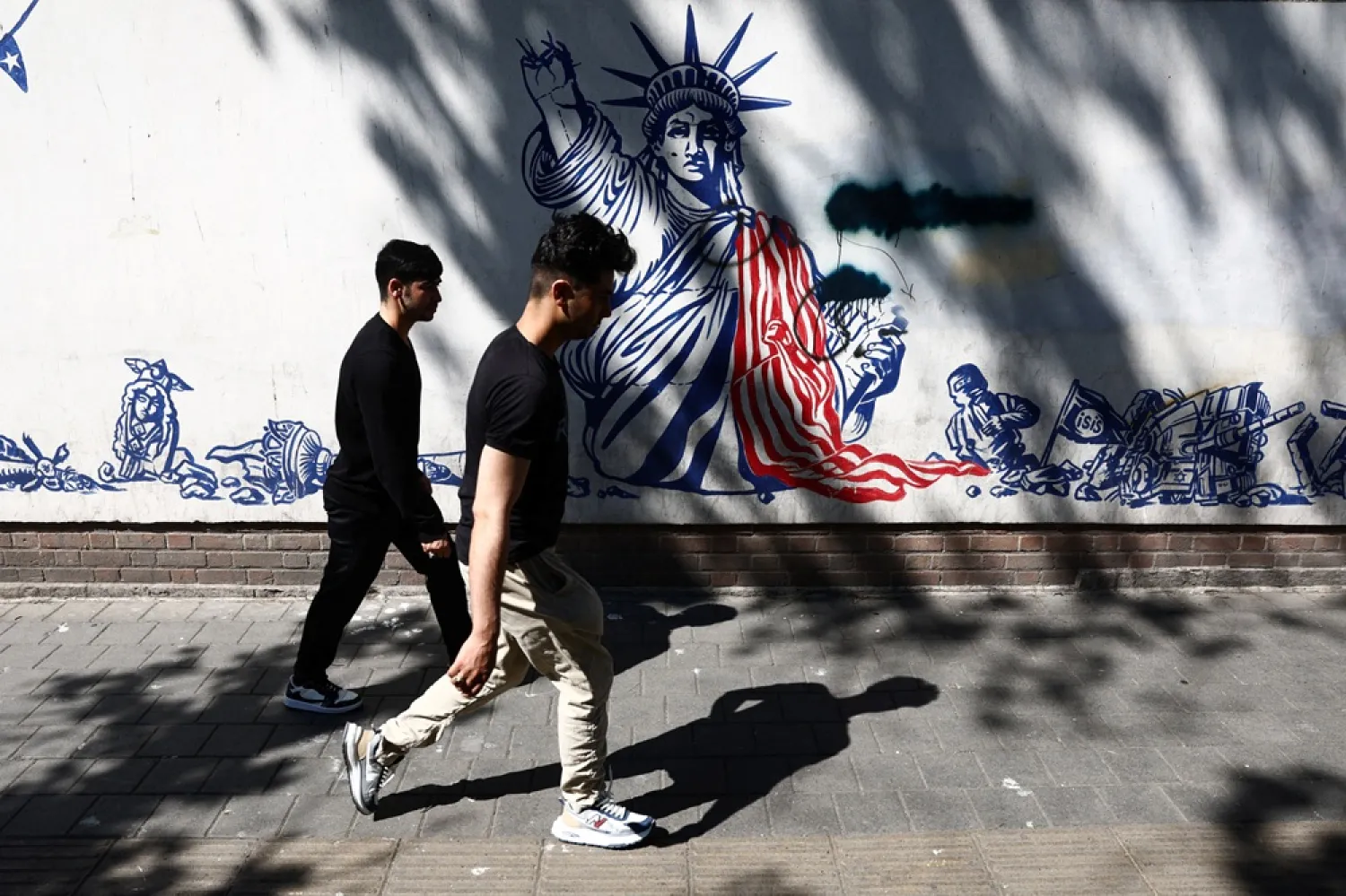
People walk past an anti-US mural on a street in Tehran, Iran, April 10, 2026. Majid Asgaripour/WANA (West Asia News Agency) via Reuters
TT

Iranians Look at Pakistan Talks with Mixture of Skepticism, Outright Fear

People walk past an anti-US mural on a street in Tehran, Iran, April 10, 2026. Majid Asgaripour/WANA (West Asia News Agency) via Reuters

Everyday Iranians are awaiting planned negotiations between Washington and Tehran with a mixture of skepticism and outright fear, caught between a government they say does not understand peace and an American president who has threatened to destroy a “whole civilization.”

Talks between the US and Iran and hosted by Pakistan were hanging in the balance on Friday, but if they go ahead they could transform a temporary ceasefire in the US-Israeli campaign against the Iranian republic into a lasting peace.

Residents of Tehran contacted by AFP from Paris – who withheld their surnames out of concern for their safety – have mixed views on that prospect and are far from optimistic, with feelings ranging from anger, to anxiety, to deep disillusionment.

Amir, a 40-year-old artist, said he did not “think this temporary agreement and negotiation will last even a week.”

Iran’s repressive apparatus is seen as having been strengthened by the war that broke out on Feb 28, making a deal all the more unlikely, according to Amir.

“The propaganda machine has delivered them such lies that they really believe they have won the war,” he said. “They cannot last in peace because they don’t understand peace.”

For Sheida, 38, the uncertainty around the talks has generated a sense of anxiety.

“We’ve got so much hardship dumped on us that we don’t even know what to worry about first,” she said. “Now that the ceasefire has started, everyone’s scrambling to settle debts and sort out financial stuff.”

A choice between the return of terrifying US-Israeli airstrikes and the preservation of the Iranian republic’s long-standing system is no choice at all, according to Sheida.

“I am scared of the war starting again, and at the same time I’m scared of the regime staying,” she said, adding that “the people in power have become even more aggressive.”

Amir said if the talks do result in an agreement, he continued, it would likely do little to serve the Iranian people.

He pointed to anti-government protests just before the war that were met with a deadly crackdown, saying he and other like-minded Iranians would keep up their opposition, adding: “We will not forgive our murderers.”

Trump’s Shifting Goals

Tehran resident Amin, 30, said it was difficult to determine what US President Donald Trump hoped to accomplish in the talks.

“I guess you shouldn’t take Trump so serious,” Amin said. “He wants to erase a civilization and he makes a ceasefire built on nothing 12 hours later.”

“Most of what he says is just pure noise,” he continued.

Sheida, meanwhile, questioned Trump’s sense of strategy, saying he must be “either crazy or inexperienced.”

“Did the US president really not realize they could get stuck if the Strait of Hormuz was closed?” she said.

Homemaker Shahrzad, 39, said she had been both terrified and disillusioned by Trump’s threat – issued before the ceasefire – that “a whole civilization will die” if Iran did not reopen the strategic Strait of Hormuz.

“I had hoped for the fall of the Islamic regime and accepted the hardships of war, but now I realize this man is playing the whole world and has no sense of humanity.”

Sara, a 44-year-old graphic designer, said Iran’s “government is an ideological one, and it’s not going to collapse easily”.

“Its mindset exists all the way down to the lowest levels, so it’s really not simple to change,” she added.

Amir said he believed the country’s surviving leaders would continue fighting. “They are prepared to destroy everything just to prevail,” he added.



Report: Iran’s New Supreme Leader Has Severe and Disfiguring Wounds

 A demonstrator holds a picture of Iran's Supreme Leader Mojtaba Khamenei during a gathering after announcement of a two-week ceasefire with the United States and Israel, in Tehran, Iran, Wednesday, April 8, 2026. (AP)
A demonstrator holds a picture of Iran's Supreme Leader Mojtaba Khamenei during a gathering after announcement of a two-week ceasefire with the United States and Israel, in Tehran, Iran, Wednesday, April 8, 2026. (AP)
TT

Report: Iran’s New Supreme Leader Has Severe and Disfiguring Wounds

 A demonstrator holds a picture of Iran's Supreme Leader Mojtaba Khamenei during a gathering after announcement of a two-week ceasefire with the United States and Israel, in Tehran, Iran, Wednesday, April 8, 2026. (AP)
A demonstrator holds a picture of Iran's Supreme Leader Mojtaba Khamenei during a gathering after announcement of a two-week ceasefire with the United States and Israel, in Tehran, Iran, Wednesday, April 8, 2026. (AP)

Iran's new Supreme Leader Mojtaba Khamenei is still recovering from severe facial and leg injuries ‌suffered in the airstrike that killed his father at the beginning of the war, three people close to his inner circle told Reuters.

Khamenei's face was disfigured in the attack on the supreme leader's compound in central Tehran and he suffered a significant injury to one or both legs, all three sources said.

The 56-year-old is nonetheless recovering from his wounds and remains mentally sharp, according to the people, who requested anonymity to discuss sensitive matters. He is taking part in meetings with senior officials via audio conferencing and is engaged in decision-making on major issues including the war and negotiations with Washington, two of them said.

The question of whether Khamenei's health allows him to run state affairs comes during Iran's moment of gravest peril for decades, with high-stakes peace talks with the United States opening in the Pakistani capital Islamabad on Saturday.

The accounts of the people close to Khamenei's inner circle provide the most detailed description of the leader's condition for weeks. Reuters couldn't independently verify their descriptions.

Khamenei's whereabouts, condition and ability to rule still largely remain a mystery to the public, with no photo, video or audio recording of him published since the air attack and his subsequent appointment as his father's replacement on March 8.

Iran's United Nations mission did not respond to Reuters questions about the extent of Khamenei's injuries or the reason he has not yet appeared in any images or recordings.

Khamenei was wounded on February 28, the first day of the war launched by the US and Israel, in the attack that ‌killed his father and predecessor ‌Ali Khamenei, who had ruled since 1989. Mojtaba Khamenei's wife, brother-in-law and sister-in-law were among other members of his family ‌killed in the ⁠strike.

There has been ⁠no official Iranian statement on the extent of Khamenei's injuries. However, a newsreader on state television described him as a "janbaz", a term used for those badly wounded in war, after he was named supreme leader.

The accounts of Khamenei's injuries tally with a statement made by US Secretary of Defense Pete Hegseth on March 13 when he said that Khamenei was "wounded and likely disfigured".

A source familiar with US intelligence assessments told Reuters that Khamenei was believed to have lost a leg.

The CIA declined to comment on Khamenei's condition. The Israeli prime minister's office didn't respond to questions.

Alex Vatanka, senior fellow at the Middle East Institute, said that, regardless of the severity of his injuries, it was unlikely the new and inexperienced leader would be able to command the overarching power wielded by his father. While he is seen to represent continuity, it could take years for him to build up the same level of automatic authority, Vatanka added.

"Mojtaba will be one voice but ⁠it will not be the decisive one," he said. "He needs to prove himself as the credible, powerful, overriding voice. The regime ‌as a whole has to make a decision in terms of where they are going to go."

One of the ‌people close to Khamenei's circle said images of the supreme leader could be expected to be released within one or two months and that he might even appear in public then, although all ‌three sources stressed he would only emerge when his health and the security situation allowed.

'WE DON'T KNOW MUCH ABOUT HIS WORLD VIEW'

In Iran's theocratic system of rule, ultimate ‌power is meant to be wielded by the supreme leader, a venerable Shiite cleric appointed by an assembly of 88 clerics. The leader oversees the elected president while directly commanding parallel institutions including the Revolutionary Guards, a powerful political and military force.

Iran's first supreme leader, Khomeini, enjoyed unquestioned authority as the charismatic leader of the revolution and the most learned cleric of his day.

His successor, Ali Khamenei, was a less revered cleric but had served as Iran's president. He spent decades cementing his authority after his appointment in 1989, partly through promoting the power of the Revolutionary Guards.

His son Mojtaba does ‌not command absolute power in the same way, senior Iranian sources have previously told Reuters.

The Revolutionary Guards, who helped steer him into the top job after his father's assassination, have emerged as the dominant voice on strategic decisions during the war. ⁠Iran's UN mission didn't respond to questions about ⁠the power wielded by the Guards and the new supreme leader.

As an influential figure in his father's office, Khamenei had previously spent years involved in exercising power at the top levels of the regime, officials and insiders have said, building ties with senior Guards figures.

While he is widely seen as likely to continue his father's hardline approach due to his links to the Guards, we don't know much about his world view, said Vatanka at the Middle East Institute.

Khamenei's first communication with Iranians as supreme leader came on March 12, saying in a written statement read out by a television news presenter that the Strait of Hormuz should stay closed and warning regional countries to shut US bases.

His office has since issued a few other brief written statements from him, including on March 20 when he welcomed in the Persian new year, which he named the "year of resistance".

Public statements of policy on Iran's war stance, its approach towards diplomacy, neighbors, ceasefire negotiations and domestic unrest, have been made by other senior officials.

'WHERE IS MOJTABA?' MEMES CIRCULATE ONLINE

Khamenei's absence is widely discussed on Iranian social media and in messaging app groups, when the country's patchy internet allows, with conspiracy theories widespread about his condition and who is running the country.

One popular meme circulating online is a picture of an empty chair under a spotlight with the slogan "Where is Mojtaba?"

However, some government supporters, including a senior member of the Basij militia, a volunteer paramilitary group run by the Revolutionary Guards, said that it was important for Khamenei to keep a low profile, given the threat posed by waves of US and Israeli airstrikes that have already wiped out much of the country's leadership.

A lower-ranking Basij member agreed.

"Why should he appear in public? To become a target for these criminals?" Mohammad Hosseini, from the city of Qom, said in a text message.


Russia and Ukraine Set to Begin Easter Truce

In this image made from video provided by Russian Defense Ministry Press Service on Tuesday, March 31, 2026, Russian soldiers prepare to fire a grenade launcher towards Ukrainian positions on an undisclosed location in Ukraine. (Russian Defense Ministry Press Service via AP)
TT

Russia and Ukraine Set to Begin Easter Truce

In this image made from video provided by Russian Defense Ministry Press Service on Tuesday, March 31, 2026, Russian soldiers prepare to fire a grenade launcher towards Ukrainian positions on an undisclosed location in Ukraine. (Russian Defense Ministry Press Service via AP)

A temporary ceasefire between Russia and Ukraine for Orthodox Easter is set to begin on Saturday afternoon, as US-led diplomatic efforts to end the war falter.

The Kremlin said it had ordered a temporary truce from Saturday at 4:00 pm (1300 GMT) until the end of Sunday, a 32-hour period, AFP said.

Russia's Defense Minister Andrei Belousov and army chief Valery Gerasimov have been instructed to "cease hostilities in all directions during this period", the Kremlin said.

Ukrainian President Volodymyr Zelensky said Kyiv had "repeatedly stated" it was ready for a ceasefire over Easter, and was willing to reciprocate.

The temporary ceasefire came as US-led talks on ending the four-year-old conflict have been derailed by the Middle East war.

The two sides also held a ceasefire for the Orthodox Easter last year.

Authorities in Ukraine's southern Odessa said on Saturday that two people had been killed in Russian strikes, and two others wounded, just hours before the ceasefire was set to begin.

Two people were killed and around 15 others wounded overnight Friday in two separate attacks in Ukraine's central region of Poltava, and Sumy, a region in the northeast, regional authorities said.

According to the Ukrainian Air Force, Russia launched 128 drones against the country overnight Thursday.

- Slowdown in Russian military operations -

Several rounds of US-led talks have failed to bring the warring sides closer to an agreement and Washington's attention is now focused on Iran.

The negotiations have become deadlocked, with Moscow demanding territorial and political concessions that Zelensky has ruled out as tantamount to capitulation.

Kremlin spokesman Dmitry Peskov denied Russia had discussed the ceasefire with Ukraine or the United States in advance and said it was not linked to negotiations to end the war.

The war has cost hundreds of thousands of lives and forced millions to flee their homes, making it Europe's deadliest conflict since World War II.

Over the past few years, fighting on the front has come to a near standstill. Russia has made small territorial gains at a high cost.

But Kyiv recently managed to push back in the southeast and Russian advances have been slowing since late 2025, according to the US-based Institute for the Study of War (ISW).

Apart from Ukrainian counter-attacks, analysts attributed the slowdown to Russia being banned from using SpaceX's Starlink satellites and Moscow's own efforts to block the Telegram messaging app.

The situation is, however, unfavorable for Ukraine in the Donetsk region, towards the cities of Kramatorsk and Sloviansk, according to the ISW.

Moscow occupies just over 19 percent of Ukraine, most of which was seized during the first weeks of the conflict.


Polls: Israelis Favor Resuming War with Iran, Netanyahu Likely to Lose Election

Israeli soldiers on the border with the southern Lebanon village of Bint Jbeil, seen from the Israeli side of the border on 10 April 2026, as the Israeli military continues its targeting operations in southern Lebanon. (EPA)
TT

Polls: Israelis Favor Resuming War with Iran, Netanyahu Likely to Lose Election

Israeli soldiers on the border with the southern Lebanon village of Bint Jbeil, seen from the Israeli side of the border on 10 April 2026, as the Israeli military continues its targeting operations in southern Lebanon. (EPA)

Three opinion polls conducted in Tel Aviv on Friday showed that an overwhelming majority of Israelis view the war against Iran and Lebanon’s Hezbollah as a failure for US President Donald Trump and Israeli Prime Minister Benjamin Netanyahu, while supporting a resumption of the fighting to achieve the objectives announced at the outset.

Most respondents gave low ratings to the political leadership, in contrast to their assessment of the military leadership. On potential Knesset election results, the polls suggested the war would not save Netanyahu from losing power.

The surveys were published by Israel’s public broadcaster Kan 11 and Channel 12, while the third was jointly conducted by Maariv and the Walla news website.

In the Maariv and Walla poll, 46% said the United States and Israel had not won the war, compared with 22% who said they had, while 32% said it was too early to judge.

In the Kan 11 poll, 58% of Israelis said the United States and Israel had not won, while only 25% said they had.

Some 56% of respondents said Tel Aviv should have continued the war, while only about a quarter said the ceasefire had been the right step for Israel.

In the Channel 12 poll, only 30% said Israel and the United States had won, while 19% said Iran had won. About 40% said neither side had prevailed, and 11% said they did not know.

Asked whether they supported a ceasefire with Iran, 53% said they opposed it, compared with 30% who supported it.

Among those intending to vote for the governing coalition, 57% opposed the ceasefire and 25% supported it. Among opposition voters, 62% opposed it and 26% supported it.

Resumption of the war

Asked whether the conflict with Iran would resume, most Israelis said they believed it would, according to the Channel 12 poll.

Some 45% said the war would resume within two weeks after the ceasefire ends, while 26% said it would resume within a few months to a year.

Seven percent said it would resume after more than a year, while only 6% said it would not resume, and 16% said they did not know.

In the same poll, respondents were asked whether Israel should continue the war in Lebanon. An overwhelming majority, about 79%, said it should, while 13% said it should not.

Performance assessment

In the Maariv and Walla poll, respondents were asked about the US president’s performance in the war. Some 52% said they were satisfied, while 43% said they were not.

According to the Kan 11 poll, Israeli military chief Eyal Zamir was seen as having managed the war well, while the prime minister and his defense minister, Israel Katz, were not.

Half of the respondents said Netanyahu had not managed the war well, compared with 45% who said he had. Katz also received a low rating: 52% said his performance was poor, and 37% said it was good.

By contrast, 69% said Zamir had managed the war against Iran well, while 23% disagreed.

David Barnea, head of the Mossad, was rated positively by 57%, while 18% said he had not managed the war well.

In the Maariv poll, 46% said they were satisfied with Netanyahu, while 49% said they were not. Some 71% said they were satisfied with Zamir, 40% with Katz, and 29% with Finance Minister Bezalel Smotrich.

Israeli Air Force commander Tomer Bar received the highest rating, with 77% expressing support, while only 14% said they were dissatisfied.

Election outlook

In the Channel 12 poll, respondents were asked who was best suited to serve as prime minister. The results showed Netanyahu still ahead of all rivals, though former military chief Gadi Eisenkot was narrowing the gap. In a direct contest, Netanyahu led 39% to 35%.

However, if elections were held today, all three polls indicated Netanyahu would lose power. The ruling coalition would fall from its current 68 seats to 49-51, while the opposition would win 59-61 seats, including Arab parties projected to secure 10.
