


Cuba's President Warns US Against Attacking Island or Trying to Depose Him

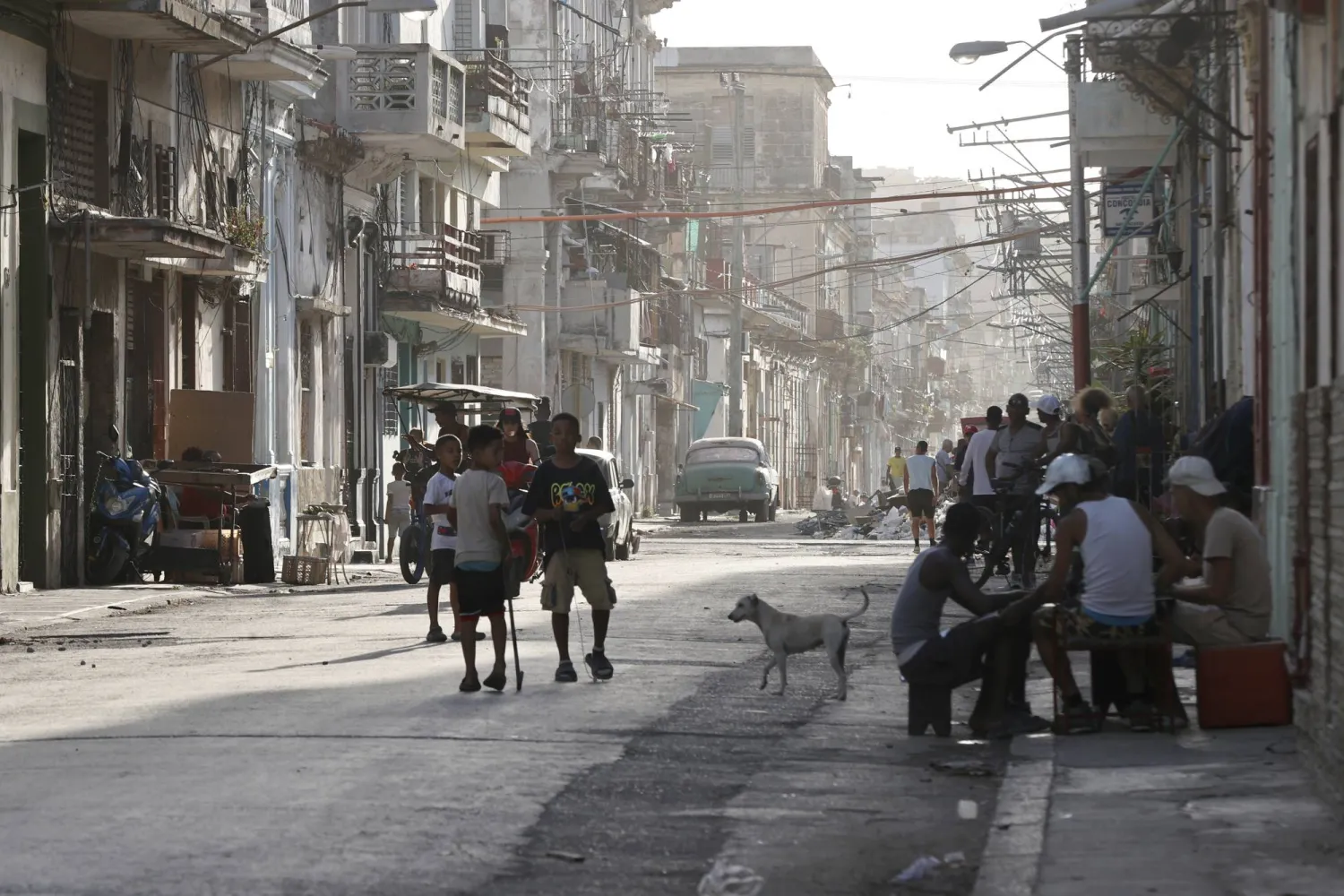
Children walk down a street in Havana, Cuba, 09 April 2026 (issued 10 April 2026). EPA/ERNESTO MASTRASCUSA
TT

Cuba's President Warns US Against Attacking Island or Trying to Depose Him

Children walk down a street in Havana, Cuba, 09 April 2026 (issued 10 April 2026). EPA/ERNESTO MASTRASCUSA

Cuban President Miguel Díaz-Canel said the US has no valid reason to carry out a military attack against the island or to attempt to depose him.

Speaking in an interview on NBC News’ Meet the Press program, the president said an invasion of Cuba would be costly and affect regional security. But should it happen, Díaz-Canel said, Cubans would defend themselves.

“If the time comes, I don’t think there would be any justification for the United States to launch a military aggression against Cuba, or for the US to undertake a surgical operation or the kidnapping of a president,” Díaz-Canel said, speaking through a translator.

He added: “If that happens, there will be fighting, and there will be a struggle, and we will defend ourselves, and if we need to die, we’ll die, because as our national anthem says, ‘Dying for the homeland is to live'.”

His comments come as tensions between Cuba and the US remain high despite both sides acknowledging talks, although no details have been shared.

Díaz-Canel has accused the US government of implementing a “hostile policy” against Cuba and said it has “no moral to demand anything from Cuba.” He noted that Cuba is interested in engaging in dialogue and discussing any topic without conditions, “not demanding changes from our political system as we are not demanding change from the American system, about which we have a number of doubts.”

Cuba blames a US energy blockade for its deepening woes, with a lack of petroleum affecting the island’s health system, public transportation and the production of goods and services.

Cuba produces only 40% of the fuel it consumes, and it stopped receiving key oil shipments from Venezuela after the US military attacked the South American country in early January, seized President Nicolás Maduro and took him to New York to face drug trafficking charges. Then, with cooperation from ruling party leaders, the Trump administration began implementing a phased plan to end Venezuela’s entrenched crisis.

The arrival of a Russian tanker carrying 730,000 barrels of crude oil in Cuba in March marked the island’s first oil shipment in three months. Russia has promised to send a second tanker.

Despite threatening tariffs in January on countries that sell or provide oil to Cuba, the Trump administration allowed the tanker to proceed.

“Cuba’s finished,” President Donald Trump said at the time. “They have a bad regime. They have very bad and corrupt leadership and whether or not they get a boat of oil, it’s not going to matter.”

According to The Associated Press, Díaz-Canel said his government takes Trump’s words as a warning.

“You hear that Cuba is next, that Cuba is going to be next, that there are, there’s a way out, that they’re going to take over Cuba,” he said. “So, from the position of responsibility within the leadership of the country, that is a warning. And we need to responsibly protect our people, protect our project and protect our country.”



Man Charged over Death of Australian Indigenous Girl that Sparked Riots

A police vehicle burns outside the Alice Springs Hospital in Alice Springs, Australia, Thursday, April 30, 2026. (Rhett Hammerton/AAP Image via AP)
TT

Man Charged over Death of Australian Indigenous Girl that Sparked Riots

A police vehicle burns outside the Alice Springs Hospital in Alice Springs, Australia, Thursday, April 30, 2026. (Rhett Hammerton/AAP Image via AP)

Police in Australia's Northern Territory said on Sunday they had charged a man with murdering an Indigenous girl, days after the 5-year-old's death sparked violent clashes in an outback town.

Jefferson Lewis, 47, was also charged with two other offences, which cannot be publicly disclosed for legal reasons, over the death of Kumanjayi Little Baby, the name by which the victim is known in line with Indigenous custom, Reuters quoted police as saying in a statement.

"This is an horrific event and an horrific set of circumstances, and our thoughts remain strongly with the family," Northern Territory Police Commissioner ⁠Martin Dole said in ⁠televised remarks from Alice Springs.

Lewis, who had presented himself to one of the camps on the outskirts of the outback town, was charged on Saturday evening and will appear in court in the territory's capital, Darwin, on Tuesday, police said.

The girl's killing and subsequent capture of the suspect, after he was found and beaten ⁠unconscious by locals, sparked protests by roughly 400 Indigenous people near Alice Springs late on Thursday. Lewis has past convictions for physical assault and had recently been released from prison.

Some demonstrators threw projectiles and lit fires, injuring a number of police officers and medical workers and damaging police vehicles, ambulances and fire trucks. Members of the crowd were seen in televised footage calling for payback - traditional, mostly physical, punishment in Aboriginal societies.

Police used tear gas to disperse the protesters, while Prime Minister Anthony Albanese, local officials and a spokesperson for the ⁠victim's family ⁠appealed for calm.

Australia has struggled for decades to reconcile with its Indigenous people, who have inhabited the land for some 50,000 years but were marginalized by British colonial rule.

Indigenous Australians account for 3.8% of the population and face disadvantages including discrimination, poor health and education outcomes and high incarceration rates.

Thousands, including the victim and her family, live in camp communities where housing and services are often inadequate. A fifth of Alice Springs citizens are Indigenous.

The victim's body was located on Thursday by one of hundreds of people searching the dense bushland around the town, a popular tourist destination that has previously had problems with alcohol-fueled violence.


Trump Says Cutting US Troop Numbers in Germany 'Way Down'

US President Donald Trump (R) and German Chancellor Friedrich Merz hold a bilateral meeting in the Oval Office at the White House in Washington, DC, USA, 03 March 2026 (reissued 02 May 2026). EPA/Samuel Corum / POOL
TT

Trump Says Cutting US Troop Numbers in Germany 'Way Down'

US President Donald Trump (R) and German Chancellor Friedrich Merz hold a bilateral meeting in the Oval Office at the White House in Washington, DC, USA, 03 March 2026 (reissued 02 May 2026). EPA/Samuel Corum / POOL

President Donald Trump on Saturday doubled down on Washington's decision to withdraw 5,000 US troops from Germany, as a rift in transatlantic ties deepens over the Middle East war.

The Pentagon announced the 5,000-troop reduction on Friday, but Trump told reporters Saturday "we're going to cut way down, and we're cutting a lot further than 5,000." He did not elaborate, AFP said.

The move follows a spat between Trump and German Chancellor Friedrich Merz, who said on Monday that Iran was "humiliating" Washington at the negotiating table.

Pentagon spokesman Sean Parnell said Friday the withdrawal was expected "to be completed over the next six to twelve months."

NATO said it was "working with the US to understand the details of their decision on force posture in Germany."

"This adjustment underscores the need for Europe to continue to invest more in defense and take on a greater share of the responsibility for our shared security," NATO spokeswoman Allison Hart wrote on X.

There were 36,436 active-duty US troops in NATO ally Germany as of December 31, 2025, compared to 12,662 in Italy and 3,814 in Spain.

German Defense Minister Boris Pistorius said Saturday the US troop withdrawal "from Europe and also from Germany was to be expected."

It also came as Trump announced that tariffs on cars and trucks from the European Union would jump from 15 percent to 25 percent next week, accusing the bloc of failing to comply with a trade deal signed last summer.

The decision to reduce the number of troops in Germany is being met with skepticism by top Republican lawmakers who oversee US military policy.

In a joint statement Saturday, Senator Roger Wicker and Representative Mike Rogers, chairs of the Armed Services Committees in their respective chambers, warned that the move risks "sending the wrong signal to Vladimir Putin."

Even though European allies are boosting defense spending, "translating that investment into the military capability needed to assume primary responsibility for conventional deterrence will take time," they said.

The duo noted that Germany had heeded Trump's calls for greater spending on defense and that it had allowed American planes to use German bases and airspace during the ongoing conflict with Iran.


North Korea Calls US Cyber Crime Accusations 'Absurd Slander'

Pyongyang denied Washington's narrative of a cyber threat (Reuters)
TT

North Korea Calls US Cyber Crime Accusations 'Absurd Slander'

Pyongyang denied Washington's narrative of a cyber threat (Reuters)

North Korea dismissed on Sunday US accusations that it has engaged in cyber crimes to generate illicit revenues, calling the criticism "absurd slander".

Washington has accused Pyongyang of ramping up a cyber-warfare program responsible for the theft of billions of dollars in virtual assets in recent years, turning hacking into a key source of foreign currency in the face of biting sanctions over its nuclear and weapons programs.

In a statement carried by the official Korean Central News Agency, an unnamed foreign ministry spokesperson said the US government had been "trying to spread incorrect understanding" about North Korea, "talking about the non-existent 'cyber threat'".

"This is nothing but an absurd slander to tarnish the image of our country by spreading false information in pursuit of political purposes," AFP quoted it as saying.

The US Justice Department in April sentenced two Americans for helping North Koreans obtain remote IT work with US companies and raising more millions of dollars in illicit revenue for its weapons programs.

More than 100 US companies were targeted, including a number of Fortune 500 firms and a defense contractor in the multi-year scheme, the Justice Department said.

The ruse "placed North Korean IT workers on the payrolls of unwitting US companies and in US computer systems, thereby potentially harming our national security," said John Eisenberg, assistant attorney general for national security.

Google analysts and other cybersecurity experts said in April that hackers linked to North Korea were suspected of an ambitious attack on an inconspicuous but widely used software package.

A United Nations panel estimated in 2024 that North Korean cyberattacks since 2017 had stolen more than $3 billion in cryptocurrency.

The stolen money helps fund the development of weapons of mass destruction, the panel said.

Pyongyang's cyber-warfare program dates back to at least the mid-1990s, and the country has been dubbed "the world's most prolific cyber-thief" by a cybersecurity firm.