


US Military to Begin Blockade of Iranian Ports on Monday

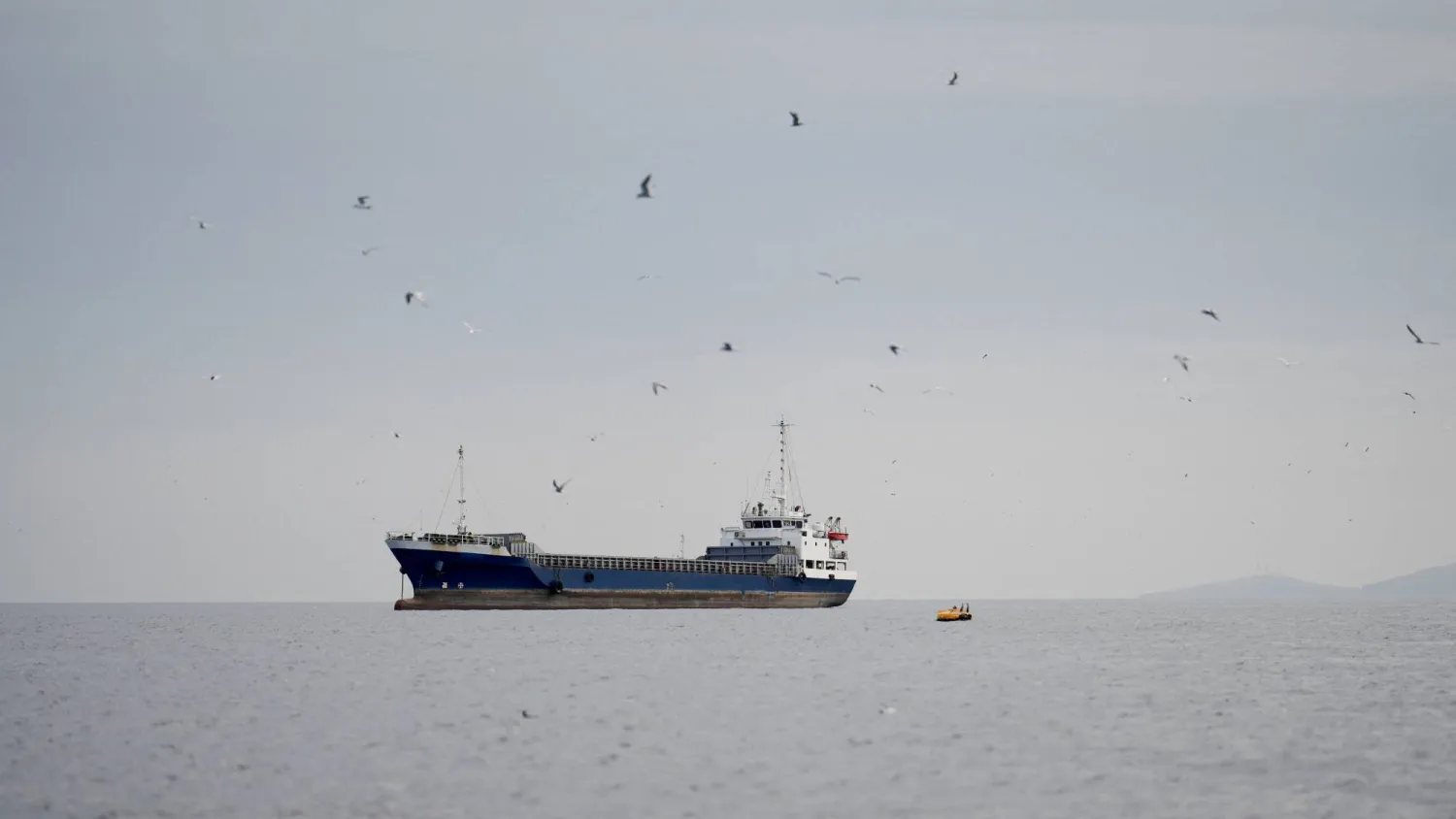
A vessel at the Strait of Hormuz, off the coast of Oman’s Musandam province, April 12, 2026. (Reuters)
TT

US Military to Begin Blockade of Iranian Ports on Monday

A vessel at the Strait of Hormuz, off the coast of Oman’s Musandam province, April 12, 2026. (Reuters)

The US military said it would begin a blockade of all Iranian ports on Monday, after talks between the warring sides in Pakistan collapsed with President Donald Trump blaming Tehran's refusal to abandon its nuclear ambitions.

Trump had announced on social media he would blockade the strategic Strait of Hormuz trading route that he has been demanding Tehran fully re-open, after his vice president, JD Vance left negotiations with an Iranian delegation in Islamabad on Sunday.

The stall in talks dashed global hopes of a deal to permanently end the war that has killed thousands and thrown the global economy into turmoil since it began in late February.

As negotiating teams flew out, mediator Pakistan said it would keep facilitating their dialogue and has called on both sides to honor the fragile two-week ceasefire struck last week that experts said could be put at risk by any maritime military blockade.

"The blockade will be enforced impartially against vessels of all nations entering or departing Iranian ports and coastal areas, including all Iranian ports on the Arabian Gulf and Gulf of Oman," US Central Command said in a statement, adding it would begin at 1400 GMT on Monday.

US forces would not impede vessels transiting the Strait of Hormuz to and from non-Iranian ports, it added.

Trump on his Truth Social platform confirmed the US military's statement, a more limited operation than envisaged in his earlier post that asserted all ships trying to enter or exit the strait would be blocked.

Iran's Revolutionary Guards had warned before the US military announcement that they had full control of traffic through Hormuz and would trap any challenger "in a deadly vortex".

In his lengthy social media post, Trump said on Sunday his goal was to clear the strait of mines and reopen it to all shipping, but that Iran must not be allowed to profit from controlling the waterway.

"Effective immediately, the United States Navy, the Finest in the World, will begin the process of BLOCKADING any and all Ships trying to enter, or leave, the Strait of Hormuz," Trump said. "Any Iranian who fires at us, or at peaceful vessels, will be BLOWN TO HELL!"

Oil prices -- which tumbled last week after the temporary ceasefire -- jumped around eight percent Monday, with both key WTI and Brent contracts topping $100 a barrel.

Iran's parliament speaker Mohammad Bagher Ghalibaf, who led Tehran's delegation in Pakistan, said Tehran would "not bow to any threats" from Washington, while navy chief Shahram Irani called Trump's blockade threat "ridiculous".

After the highest-level US-Iran talks since the 1979 revolution failed to deliver a deal, Iranian foreign ministry Abbas Araghchi blamed "maximalism, shifting goalposts, and (a) blockade" that prevented an agreement he said they were "just inches away from".

Trump told reporters on Sunday he was ambivalent on the prospect of talks continuing with Iran.

"I don't care if they come back or not. If they don't come back, I'm fine," he said.

- 'Final and best offer' -

Tehran has already been restricting traffic through the strait -- a key route for global oil and gas shipments -- while allowing some vessels serving friendly countries such as China to pass.

Nicole Grajewski, an assistant professor at Sciences Po's Center for International Research, said a US blockade was "not a minor coercive signal" but could rather be considered an effective resumption of the war.

The US military said Saturday that two US Navy warships had transited the strait to begin clearing it of mines, a claim Tehran denied.

Iran's Fars news agency reported Sunday that two Pakistan-flagged oil tankers bound for the strait had turned back.

But the strait was far from the only friction point jettisoning global efforts led by Pakistan to end the war, which began on when Israel and the US launched strikes on Iran, which retaliated by attacking Gulf and Israeli cities.

The US delegation in Islamabad -- led by Vance, special envoy Steve Witkoff and Trump's son-in-law Jared Kushner -- was frustrated by Iran's refusal to give up what it called its right to a nuclear program.

"I have always said, right from the beginning, and many years ago, IRAN WILL NEVER HAVE A NUCLEAR WEAPON!" Trump later posted.

Vance told reporters in Islamabad that Washington had made Tehran its "final and best offer," adding: "We'll see if the Iranians accept it."

- Violence in Lebanon -

Even before the historic talks, concern had been high over whether the ceasefire could collapse due to continued Israeli strikes it says are targeting Iran-backed Hezbollah in Lebanon, where Iran and Pakistan insist the truce also applies.

Lebanese Prime Minister Nawaf Salam said Sunday he was working to stop the war and ensure Israeli troops withdrew, even as Israeli premier Benjamin Netanyahu told troops in south Lebanon that the fight there was far from over.

Lebanese and Israeli officials are due to hold talks in Washington on Tuesday.

Hezbollah said overnight it had launched rocket towards towns in northern Israel, continuing attacks that it began in early March to avenge the death of Iran's supreme leader in the opening salvo of Israeli-US strikes that began the regional war.

Israeli strikes on Beirut and other parts of Lebanon last week after the temporary ceasefire announcement had killed hundreds, according to Lebanon's health authorities.



Italian PM Condemns ‘Unacceptable’ Trump Criticism of Pope

Italian Prime Minister Giorgia Meloni gestures in the Senate chamber during the briefing to Parliament on the government's activities in Rome, Italy, 09 April 2026. (EPA)
TT

Italian PM Condemns ‘Unacceptable’ Trump Criticism of Pope

Italian Prime Minister Giorgia Meloni gestures in the Senate chamber during the briefing to Parliament on the government's activities in Rome, Italy, 09 April 2026. (EPA)

Italian Prime Minister Giorgia Meloni on Monday condemned US President Donald Trump's criticism of Pope Leo XIV as "unacceptable", after the US pontiff spoke out against the Middle East war.

"The Pope is the head of the Catholic Church, and it is right and normal for him to call for peace and to condemn all forms of war," she said in a statement.

It represents a rare rebuke of Trump by Meloni, a far-right leader who has sought to be a bridge between the conservative US president and European leaders.

Meloni earlier put out a statement supporting Pope Leo's efforts at peace and reconciliation in a trip to Africa, which began Monday, just hours after Trump launched a scathing criticism of the first US pontiff.

"I thought the meaning of my statement this morning was clear, but I will restate it more explicitly. I find President Trump's words about the Holy Father unacceptable," she said.

Speaking to reporters late Sunday, Trump said he was "not a big fan of Pope Leo", accusing the pontiff of "toying with a country (Iran) that wants a nuclear weapon".

The president later doubled down on his comments with a post on Truth Social, saying: "I don't want a Pope who thinks it's OK for Iran to have a Nuclear Weapon."

"Pope Leo is WEAK on Crime, and terrible for Foreign Policy," he said.

His comments drew outrage from many Italian politicians, while Catholic bishops from the United States and Italy were quick to defend the pontiff.

Leo himself told reporters on the plane to Algeria -- the first stop on a four-nation tour that also takes in Cameroon, Angola and Equatorial Guinea -- that he had a "moral duty" to speak out against war.

"I have no fear, neither of the Trump administration, nor speaking out loudly about the message of the Gospel," he said.


Middle East Ceasefire a ‘Priority’, China’s FM Tells Pakistan

Chinese Foreign Minister Wang Yi waves after a press conference on the sidelines of the National People's Congress (NPC), in Beijing, China, March 8, 2026. (Reuters)
TT

Middle East Ceasefire a ‘Priority’, China’s FM Tells Pakistan

Chinese Foreign Minister Wang Yi waves after a press conference on the sidelines of the National People's Congress (NPC), in Beijing, China, March 8, 2026. (Reuters)

Maintaining a ceasefire in the Middle East war is an "immediate priority" for resolving the conflict, China's top diplomat told his Pakistan counterpart in a phone call on Monday.

Pakistan's Prime Minister Shehbaz Sharif also said on Monday that the ceasefire between the United States and Iran was "holding" and that efforts were underway to reach an agreement after talks in Islamabad at the weekend failed to do so.

"The immediate priority is to make every effort toward preventing the resumption of hostilities and to maintain the hard-won ceasefire momentum," Wang Yi told Pakistan's Ishaq Dar, according to a Chinese foreign ministry statement.

Wang said a joint peace plan by China and Pakistan announced last month as the two officials met in Beijing "still can serve as a direction for efforts toward a resolution".


UN Maritime Chief Says No Country Has Right to Close Hormuz

FILE PHOTO: Cargo ships in the Gulf, near the Strait of Hormuz, as seen from northern Ras al-Khaimah, near the border with Oman’s Musandam governance, March 11, 2026. REUTERS/Stringer/File Photo
TT

UN Maritime Chief Says No Country Has Right to Close Hormuz

FILE PHOTO: Cargo ships in the Gulf, near the Strait of Hormuz, as seen from northern Ras al-Khaimah, near the border with Oman’s Musandam governance, March 11, 2026. REUTERS/Stringer/File Photo

The head of the UN maritime agency said Monday no country had a legal right to block shipping in the Strait of Hormuz, a trade passage paralysed by the US-Iran war.

The International Maritime Organization's Secretary General Arsenio Dominguez addressed a news conference as access to the strait remained blocked six weeks after the war erupted with US and Israeli strikes against Iran.

The United States had threatened to begin a blockade on Monday of Iranian ports in and around the strait, which Tehran's forces have been controlling access to since after the war broke out on February 28.

"In accordance to international law, no countries have the right to prohibit the right of innocent passage or the freedom of navigation through international straits that are used for international transit," Dominguez said.

Iranian authorities have been allowing a trickle of vetted vessels to pass the strait through a route close to their coast and in some cases have reportedly levied a payment to let vessels through.

"This principle of introducing a toll on an international strait for international navigation is against the international law of the sea and the customary law," Dominguez said.

"It will create a very dangerous precedent."

The US vow to blockade Iranian ports meanwhile "doesn't make it any easier", he added.

"De-escalation is what is going to start helping us to address the crisis and to bring shipping back to the way that we used to operate."

He predicted that the extra impact of a US blockade on shipping would be negligible, however.

"With the very few number of ships that have managed to transit, an additional blockade is not going to exacerbate the situation in a level that it could be perceived."