


North Korea Uses Cluster Bombs in Latest Missile Test

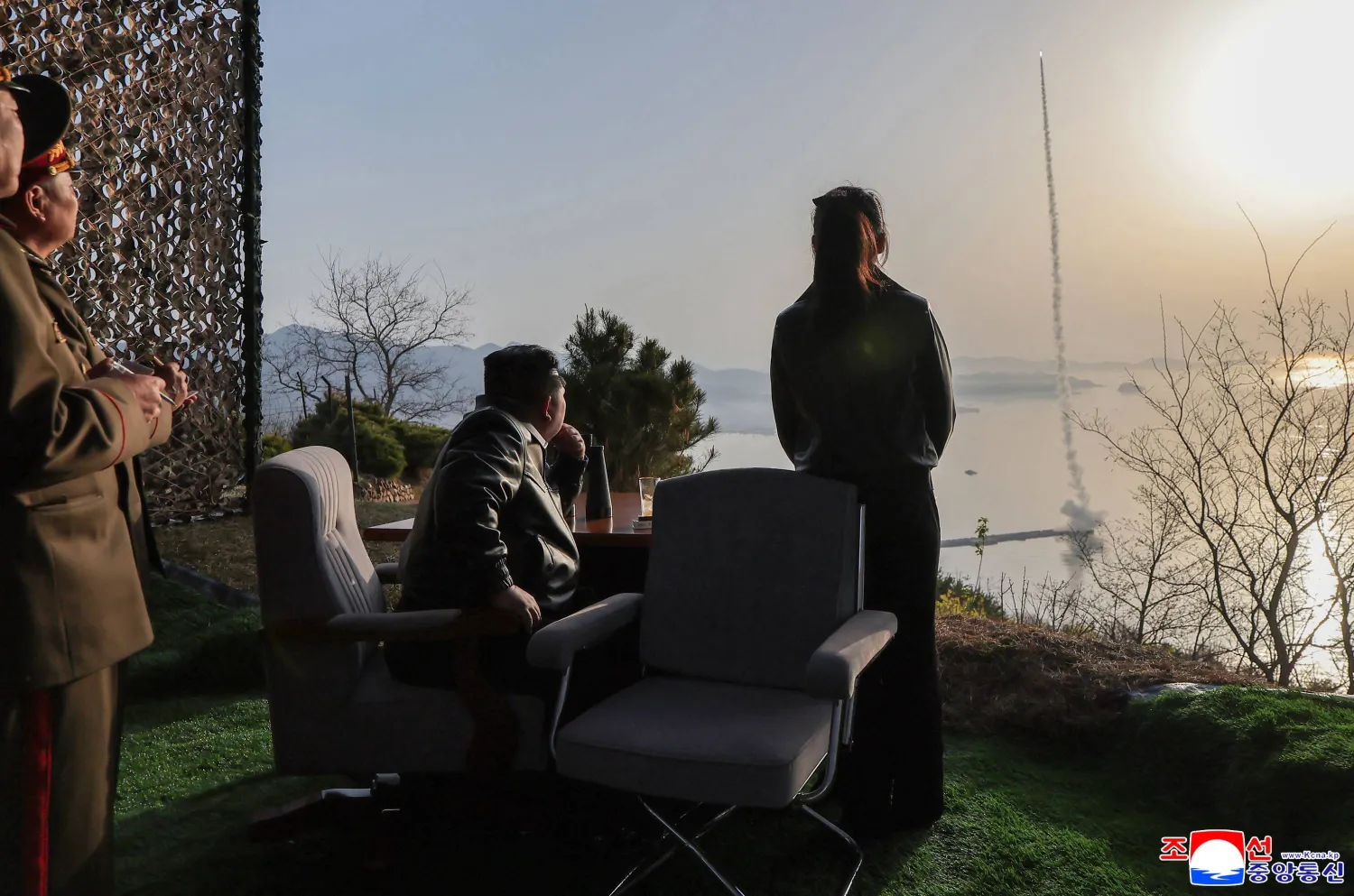
This picture taken on April 19, 2026 and released by North Korea's official Korean Central News Agency (KCNA) on April 20, 2026 shows North Korean leader Kim Jong Un (L) and his daughter Kim Ju Ae (R) inspecting the test-fire of a ballistic missile at an undisclosed location in North Korea. (KCNA via KNS / AFP)
TT

North Korea Uses Cluster Bombs in Latest Missile Test

This picture taken on April 19, 2026 and released by North Korea's official Korean Central News Agency (KCNA) on April 20, 2026 shows North Korean leader Kim Jong Un (L) and his daughter Kim Ju Ae (R) inspecting the test-fire of a ballistic missile at an undisclosed location in North Korea. (KCNA via KNS / AFP)

North Korea fired multiple short-range ballistic missiles that tested the power of its cluster munitions, its government news agency said on Monday, confirming the latest in a flurry of launches by the nuclear-armed state.

The Sunday launches, which were supervised by leader Kim Jong Un, aimed to "verify the characteristics and power of cluster bomb warhead and fragmentation mine warhead applied to the tactical ballistic missile", the Korean Central News Agency (KCNA) reported.

They followed other tests in recent weeks of weaponry, including ballistic missiles, anti-warship cruise missiles and cluster munitions.

Neither Korea has signed the 2008 Oslo convention against cluster bombs.

South Korea condemned the launches and called on the North to cease "provocations".

KCNA said the maneuver tested the warhead of the Hwasongpho-11 Ra surface-to-surface tactical ballistic missile.

Five projectiles were fired towards a target area around an island about 136 kilometers (85 miles) from the launch site, it said.

They struck an area of 12.5 to 13 hectares with "very high density, fully displaying their combat might".

Kim "expressed great satisfaction over the test results" and noted that the development of cluster bomb warheads "can... boost the high-density striking capability to quell a specific target area as well as the high-precision striking capability", KCNA said.

Hong Min, a senior research fellow at the Korea Institute for National Unification, said the reported range would put Seoul and key US military installations within Pyongyang's reach.

"This system appears designed to fill the gap between multiple rocket launchers and short-range ballistic missiles," he said.

Yang Moo-jin, a professor at Seoul's University of North Korean Studies, noted that frontline corps commanders observed the test, in contrast to the weapons researchers who watched previous ones.

"This suggests the system is nearing operational deployment, with the capability to be launched directly from forward positions against South Korea and US bases," he said.

The United States stations about 28,000 troops in the South to help it defend against military threats from the North.

- 'Firm' defense posture -

South Korea reported the test on Sunday, saying its military had "detected several short-range ballistic missiles" fired from the Sinpo area in eastern North Korea.

Seoul said it was maintaining a "firm combined defense posture" with the United States and would "respond overwhelmingly to any provocation".

"Pyongyang must immediately halt its successive missile provocations that are heightening tensions", and "actively engage in the South Korean government's efforts to establish peace", the defense ministry said.

But analysts said the tests signaled that Pyongyang had rejected Seoul's attempts to repair strained ties.

Among them was an expression of regret from Seoul over civilian drone incursions into the North in January, a gesture that Pyongyang initially seemed to welcome before reverting to describing the South as its "most hostile" enemy state.

- Two more destroyers -

North Korea is subject to multiple United Nations sanctions banning its nuclear weapons development and use of ballistic missile technology, restrictions it has repeatedly flouted.

Earlier in April, Kim Jong Un oversaw tests of strategic cruise missiles launched from a naval warship, with official photos showing him watching the firings flanked by military officials.

Those tests were carried out from the Choe Hyon, one of two 5,000-ton destroyers in the North's arsenal, both launched last year.

The North is also building two more 5,000-ton class destroyers to add to its fleet.

Citing satellite imagery from a US-based intelligence firm, a South Korean lawmaker said this month that the North was "accelerating the naval forces' modernization on the back of military assistance from Russia".

North Korea has sent ground troops and artillery shells to support Russia's invasion of Ukraine, and observers say Pyongyang is receiving military technology assistance from Moscow in return.



Russia Arrests German Woman in Alleged Bomb Plot

People visit the observation deck at Vorobyovy gory (Sparrow Hills) with the main building of the Ministry of Foreign Affairs of Russia in the background during a spring day in Moscow, Russia, 17 April 2026. (EPA)
TT

Russia Arrests German Woman in Alleged Bomb Plot

People visit the observation deck at Vorobyovy gory (Sparrow Hills) with the main building of the Ministry of Foreign Affairs of Russia in the background during a spring day in Moscow, Russia, 17 April 2026. (EPA)

Russia said Monday it had arrested a German woman found with a homemade bomb in her backpack in what it alleged was a Ukrainian-hatched plot to blow up a security services facility in the south.

Russia has arrested dozens of people throughout the four-year war, mostly its own citizens, on allegations of working for Ukraine to carry out sabotage attacks.

There has been a string of high-profile arrests of Western citizens since Moscow ordered its troops into Ukraine -- typically on espionage charges that are widely seen as baseless, with those detained later swapped in exchange for Russians jailed abroad.

Detentions of Western citizens for carrying out or preparing actual attacks are much rarer.

The FSB security agency said the woman, born in 1969, had been dragged into the alleged plot by a citizen from a Central Asian country, who was working on orders from Ukraine.

She was detained and found with an improvised explosive device in her bag in the Caucasus city of Pyatigorsk, the FSB said.

The FSB said it had "prevented a terrorist attack planned by the Kyiv regime against a law enforcement facility in the Stavropol region, involving a German citizen born in 1969," the agency said in a statement.

The FSB said the device -- which contained an explosive charge equivalent to 1.5 kilograms (three pounds) of TNT -- was supposed to be detonated remotely, killing the German woman.

The blast was prevented by electronic jamming, the FSB added.

- 'Radical ideology' -

A man from an unidentified Central Asian state, born in 1997 and "a supporter of radical ideology", was found and arrested near the targeted site, it added.

The pair face life in prison on terrorist charges.

There was no immediate reaction to the allegations in Kyiv or Berlin.

Video footage of the purported arrest published on state media showed armed Russian security agents approach the woman, who was lying face down dressed in all black in a car park.

Another video showed masked plainclothes agents pulling a man into a station, followed by a controlled explosion of the backpack.

Russia has previously accused Ukraine of working with fundamentalists to carry out terror attacks inside Russia, without providing evidence.

Officials initially alleged that the perpetrators of a 2024 massacre at a concert hall on the outskirts of Moscow that killed 150 people were ISIS members in coordination with Ukraine.

ISIS claimed responsibility for that attack, making no reference of any Ukrainian involvement, for which no evidence was presented by Moscow and which Kyiv denies.


Iran Foreign Ministry Says US Not Serious About Pursuing Diplomacy

An Iranian woman walks next to a wall painting of Iran’s national flag on a street in Tehran, Iran, 20 April 2026. (EPA)
TT

Iran Foreign Ministry Says US Not Serious About Pursuing Diplomacy

An Iranian woman walks next to a wall painting of Iran’s national flag on a street in Tehran, Iran, 20 April 2026. (EPA)

Iran's foreign ministry said Monday that the United States was not serious about pursuing diplomacy, citing what it called "violations" of their two-week ceasefire.

"While claiming diplomacy and readiness for negotiations, the US is carrying out behaviors that do not in any way indicate seriousness in pursuing a diplomatic process," said ministry spokesman Esmaeil Baqaei in a weekly press briefing.

He said a US attack on an Iranian cargo ship early Monday, the US naval blockade on Iranian ports, and delays in implementing a ceasefire in Lebanon were all "clear violations of the ceasefire".

Iran has been at war with Israel and the United States since February 28 when strikes killed supreme leader Ali Khamenei, triggering a conflict that has engulfed the region.

Tehran and Washington have since held a round of negotiations which failed to culminate in a deal to end the war. It took place against the backdrop of a fragile two-week ceasefire which began on April 8.

US President Donald Trump said Sunday he had ordered US negotiators to travel to Pakistan on Monday to hold another round of talks, but Iran has yet to confirm its attendance.

"As of now, while I am at your service, we have no plans for the next round of negotiation, and no decision has been made in this regard," said Baqaei.

Key sticking points include Iran's stockpile of highly enriched uranium and the status of the strategic Strait of Hormuz, which has been largely closed since the outbreak of the war.

"Regarding the issue of transferring enriched uranium, neither during this period of negotiations nor before has transferring it to the United States been discussed," Baqaei said.

"It was never raised as an option for us," he added.


Tsunami Warning as 7.4-Magnitude Quake Hits Northern Japan

A television screen shows a news report on Japan Meteorological Agency's tsunami warning, saying it expected tsunami waves of up to 3 meters (9.84 feet) to reach large coastal areas in northern Japan after an earthquake with a preliminary magnitude of 7.4 struck off the northeastern coast of Japan, in Tokyo, Japan April 20, 2026.(Reuters)
TT

Tsunami Warning as 7.4-Magnitude Quake Hits Northern Japan

A television screen shows a news report on Japan Meteorological Agency's tsunami warning, saying it expected tsunami waves of up to 3 meters (9.84 feet) to reach large coastal areas in northern Japan after an earthquake with a preliminary magnitude of 7.4 struck off the northeastern coast of Japan, in Tokyo, Japan April 20, 2026.(Reuters)

A 7.4-magnitude earthquake struck northern Japan Monday, Japan's Meteorological Agency (JMA) said, issuing a tsunami warning for waves up to three meters (10 feet).

The quake, which hit at 4:53 pm (0753 GMT) in Pacific waters off northern Iwate prefecture, was strong enough to shake large buildings as far as Tokyo, hundreds of kilometers away.

Around 40 minutes later, an 80-centimeter (31-inch) tsunami wave hit a port in Kuji in Iwate, according to the JMA.

"Evacuate immediately from coastal regions and riverside areas to a safer place such as high ground or an evacuation building," it said, warning that damage due to tsunami waves was expected.

"Tsunami waves are expected to hit repeatedly. Do not leave safe ground until the warning is lifted," it said.

Footage from national broadcaster NHK did not show any immediate visible damage around several ports in Iwate.

A JMA official warned in a televised press briefing that more quakes could strike the area.

The prime minister's office said it had set up a crisis management team.

"For those of you who live in areas for which the warnings have been issued, please evacuate to higher, safer places such as higher ground," Prime Minister Sanae Takaichi told reporters, adding that the government was trying to confirm whether there were any casualties or property damage.

Japan is one of the world's most seismically active countries, sitting on top of four major tectonic plates along the western edge of the Pacific "Ring of Fire".

The archipelago, home to around 125 million people, typically experiences around 1,500 jolts every year and accounts for about 18 percent of the world's earthquakes.

The vast majority are mild, although the damage they cause varies according to their location and the depth below the Earth's surface at which they strike.

Japan is haunted by the memory of a massive 9.0-magnitude undersea quake in 2011, which triggered a tsunami that killed around 18,500 people and caused a devastating meltdown at the Fukushima nuclear plant.

In 2024, the JMA issued its first special advisory of a possible "megaquake" along the Nankai Trough.

This 800-kilometer undersea trench is where the Philippine Sea oceanic tectonic plate is "subducting" -- or slowly slipping -- underneath the continental plate that Japan sits atop.

The government has said a quake in the Nankai Trough and subsequent tsunami could kill as many as 298,000 people and cause up to $2 trillion in damage.

The JMA lifted the 2024 advisory after a week but it led to panic-buying of staples like rice and prompted holidaymakers to cancel hotel reservations.

It issued a week-long second "megaquake" advisory in December 2025 after a magnitude-7.5 tremor struck off the northern coast.

The December 8 quake triggered tsunami waves of up to 70 centimeters (28 inches) and injured more than 40 people, but no major damage was reported.