


Iran FM Blames US for Failure of Talks as He Meets with Putin

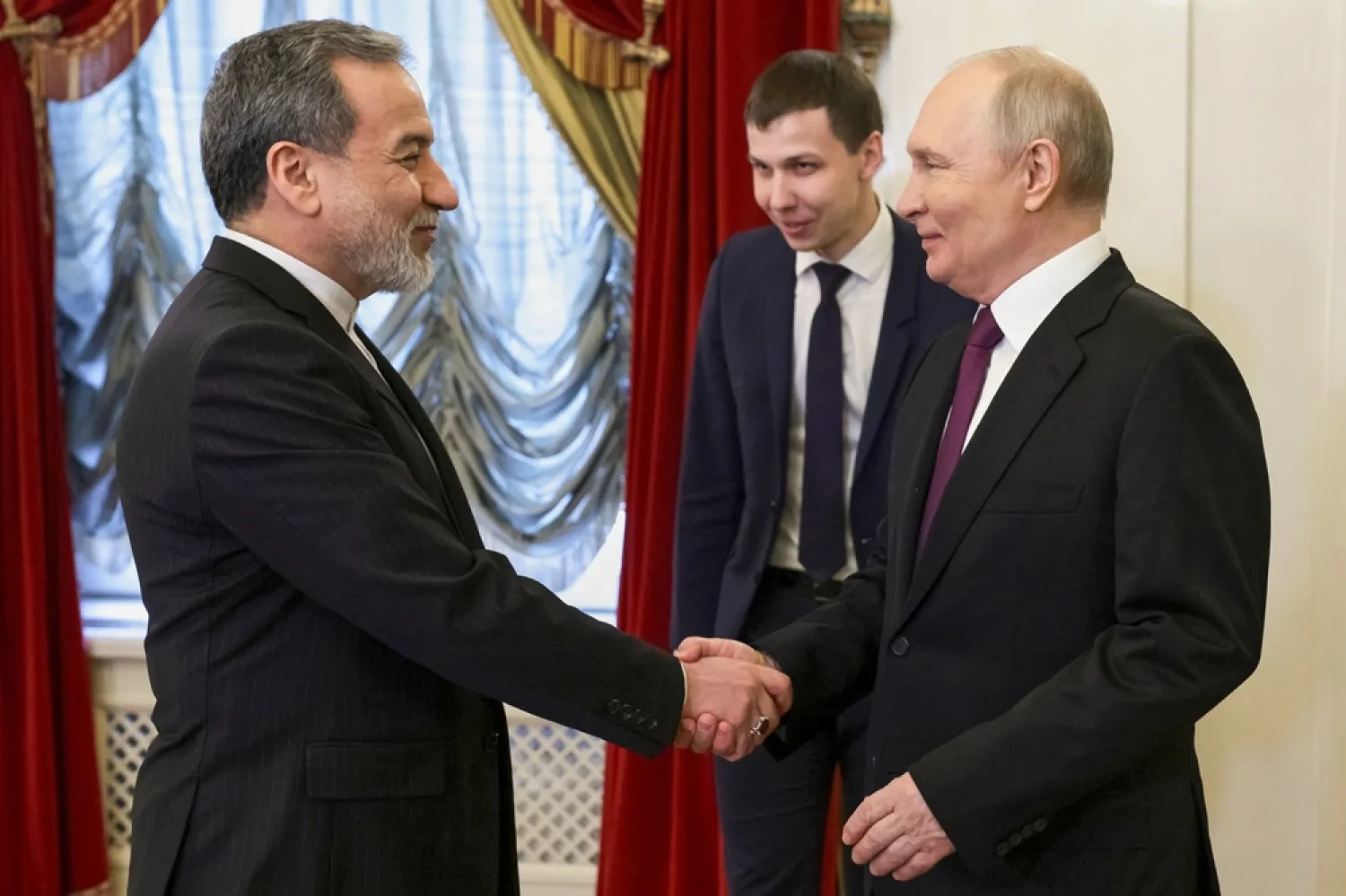
 Russian President Vladimir Putin, right, shakes hands with Iranian Foreign Minister Abbas Araghchi during their meeting at the Boris Yeltsin Presidential Library, in St. Petersburg, Russia, Monday, April 27, 2026. (Gavriil Grigorov, Sputnik, Kremlin Pool Photo via AP)
Russian President Vladimir Putin, right, shakes hands with Iranian Foreign Minister Abbas Araghchi during their meeting at the Boris Yeltsin Presidential Library, in St. Petersburg, Russia, Monday, April 27, 2026. (Gavriil Grigorov, Sputnik, Kremlin Pool Photo via AP)
TT

Iran FM Blames US for Failure of Talks as He Meets with Putin

 Russian President Vladimir Putin, right, shakes hands with Iranian Foreign Minister Abbas Araghchi during their meeting at the Boris Yeltsin Presidential Library, in St. Petersburg, Russia, Monday, April 27, 2026. (Gavriil Grigorov, Sputnik, Kremlin Pool Photo via AP)
Russian President Vladimir Putin, right, shakes hands with Iranian Foreign Minister Abbas Araghchi during their meeting at the Boris Yeltsin Presidential Library, in St. Petersburg, Russia, Monday, April 27, 2026. (Gavriil Grigorov, Sputnik, Kremlin Pool Photo via AP)

Iran's top diplomat blamed Washington on Monday for the failure of Middle East peace talks during a visit to Russia, where President Vladimir Putin promised him Moscow's support in bringing the war to a close. 

Foreign Minister Abbas Araghchi was in Saint Petersburg on the fourth leg of a whirlwind diplomatic tour, having sandwiched a trip to Oman in between two visits to main mediator Pakistan over the past few days. 

Islamabad hosted the first and only round of unsuccessful US-Iran talks, and Araghchi's visit had fanned hopes for fresh negotiations over the weekend, until US President Donald Trump scrapped a planned trip by his envoys Steve Witkoff and Jared Kushner. 

"The US approaches caused the previous round of negotiations, despite progress, to fail to reach its goals because of the excessive demands," Araghchi said Monday. 

After nixing his emissaries' trip, Trump told Fox News that if Iran wanted talks, "they can call us" -- though he has said the cancellation does not signal a return to hostilities. 

Following their meeting, Putin and Araghchi both voiced their commitment to the two countries' "strategic relationship". 

Putin promised that Russia would "do everything that serves your interests... so that peace can be achieved", state media reported. 

Araghchi said the war with the US and Israel had shown the world "Iran's true power" and the stability of its governing system. 

But back home in Tehran, the outlook was more sober. 

"Everything in the country is up in the air right now. I have not worked for a long time... Other people I am in contact with are not working either," said one small business owner named Farshad who spoke to Paris-based AFP journalists. 

"The country is in complete economic collapse... The situation has gotten really scary." 

- Economic pain - 

In a sign that back-channel diplomatic efforts were ongoing, the Fars news agency said Iran had passed "written messages" to the Americans via Pakistan spelling out red lines, including nuclear issues and the Strait of Hormuz. 

US media outlet Axios -- citing a US official and two other sources -- reported on Sunday that Iran had sent a new proposal to end the war centered on reopening the Strait of Hormuz and ending a US naval blockade there, with nuclear negotiations postponed. 

Iranian state news agency IRNA cited the report without denying it. 

Trump, meanwhile, was expected to hold a meeting with his top national security advisers on Monday to discuss the stalled talks and how to proceed, Axios and ABC News reported. 

Though the ceasefire has so far held, the war's economic shock waves have continued to reverberate. 

Tehran resident Shervin said he was trying to keep his head up despite a lack of work, "but at the same time it is the first time that I have reached a point where I was late on my rent". 

Iran has blockaded Hormuz, cutting off flows of oil, gas and fertilizer and sending prices soaring. 

In response, the US has imposed a blockade of Iranian ports in the waterway and beyond. 

Trump is facing domestic pressure to find an off-ramp as fuel prices rise, with midterm elections due in November and polls showing the war is unpopular among Americans. 

Iran's Revolutionary Guards, however, have said they have no intention of easing their market-rattling chokehold. 

Ebrahim Azizi, head of the national security commission in Iran's parliament, told state television Monday that a proposed law for managing the strait would make Iran's armed forces the overseeing authority, with financial gains from the waterway to be paid in Iranian rial. 

- Violence in Lebanon - 

Violence, meanwhile, has continued on the war's Lebanese front, despite a recently extended ceasefire between Israel and Iran-backed Hezbollah. 

Hezbollah drew Lebanon into the Middle East war by firing rockets at Israel to avenge the death of Iran's supreme leader, with Israel responding with strikes and a ground invasion. 

The group's leader Naim Qassem on Monday rejected planned direct negotiations between Lebanon and Israel as a "grave sin" that would destabilize the country, vowing Hezbollah "will not back down". 

Shortly afterwards, the Israeli military said it had begun hitting Hezbollah targets in Lebanon. Israel maintains that under the terms of the truce, it can act against imminent threats. 

Lebanese President Joseph Aoun, responding to Qassem, said his "goal is to reach an end to the state of war with Israel". 

"What we are doing is not treason," he said of the negotiations. "Rather, treason is committed by those who take their country to war to achieve foreign interests." 


Peru Cuts Ties with Iran, Accusing Tehran of Escalating Middle East War

Peruvian Foreign Minister Carlos Espa gestures during his presentation ceremony at the Foreign Ministry building in Lima on July 31, 2026. (AFP)
TT

Peru Cuts Ties with Iran, Accusing Tehran of Escalating Middle East War

Peruvian Foreign Minister Carlos Espa gestures during his presentation ceremony at the Foreign Ministry building in Lima on July 31, 2026. (AFP)

Peru's Foreign Ministry said Tuesday it has severed diplomatic relations with Iran, accusing Tehran of inciting "an escalation of conflicts" in the Middle East and hindering maritime transit in the Strait of Hormuz.

Citing a historic pacifist stance, the Peruvian government "has made the decision to sever diplomatic relations with Iran," the ministry said in a statement.

The war in the Middle East has restarted in recent days, with new US attacks on Iran on Sunday, and retaliatory tit-for-tat strikes since then.

"Peru views with deep concern the severe restrictions imposed by the Iranian regime, as well as the disruption of international trade through the Strait of Hormuz," the ministry said in a statement.

Peru also accused Iran of obstructing the work of the International Atomic Energy Agency, saying Tehran had denied inspectors access to nuclear facilities on different occasions and hindered verification needed to prevent the production of nuclear weapons.

Despite severing diplomatic ties, Peru said consular relations would remain in place to protect the interests and nationals of both countries, in accordance with the relevant Vienna conventions.

Peru's conservative President Keiko Fujimori campaigned on iron-fist security policies and took steps to join US President Donald Trump's Shield of Americas initiative days after taking office July 28, signaling a willingness to work with Washington.

A few days ago, Peru's neighbor Chile announced the closure of its embassy in Tehran, but did not decide to sever ties for economic and security reasons.

Peru's statement came as the US launched a barrage of airstrikes against Iran on Tuesday, prompting Iranian retaliation, in the most serious escalation in weeks in a conflict that has driven up global energy prices.


Hopes of Finding Survivors Dim a Week After Catastrophic Nepal Flood

People work during a search and rescue operation near the Hydropower Project sites, following deadly flash floods and mudslides hit parts of Nepal, in this handout obtained by Reuters on September 1, 2026. (Nepal Army/Handout via Reuters)
TT

Hopes of Finding Survivors Dim a Week After Catastrophic Nepal Flood

People work during a search and rescue operation near the Hydropower Project sites, following deadly flash floods and mudslides hit parts of Nepal, in this handout obtained by Reuters on September 1, 2026. (Nepal Army/Handout via Reuters)

Hopes of finding more survivors among the thousands still missing in Nepal were fading, authorities said on Wednesday, a week after a glacier collapse in the Himalayas unleashed flash floods that devastated the mountainous nation.

At least 1,050 people have been killed and nearly 4,000 remain unaccounted for, with officials fearing many are buried under debris left by the floods that tore through towns and valleys near the Chinese border.

Across the border in Tibet, China's official toll has held steady since Sunday at 16 dead and 546 missing.

"The hope of finding survivors is decreasing," Phanindra Paudel, a senior official at the government’s National Emergency Operation Center (NEOC), said. "We pray ‌and are hopeful. ‌Hope is hope!"

Rescuers are trying to find survivors believed to be ‌trapped inside ⁠the tunnels of ⁠several hydroelectric plants, whose powerhouses have spaces and rooms for people to stay, army spokesperson Raja Ram Basnet said.

Authorities said 279 people had been rescued from the ruins of hydropower projects, but at least 639 more were still missing, some of whom are believed to be trapped in tunnels.

FOCUS SHIFTING TO REHABILITATION

"Looking at the nature of the disaster and the area which has been hit by the flood, as days go by there are less chances of human survivors," Binoj Basnet, a ⁠retired senior army general who oversaw the search and rescue operation ‌during the 2015 earthquake in which about 9,000 people were ‌killed, said.

Prime Minister Balendra Shah said the focus would shift from search, rescue and relief operations towards ‌rehabilitation and reconstruction.

"The government is now focusing on rehabilitation while working to protect the lives of ‌people in the affected areas and providing necessary medical treatment and psychological counselling," Shah said in a late-night post on social media on Tuesday.

The disaster left at least 2.2 million tons of debris, according to a preliminary estimate by the United Nations Development Program (UNDP), including parts of buildings, rocks, and sediment, the equivalent of ‌six Empire State buildings.

"The amount of debris shows the scale of the destruction and the challenge communities face as they clear homes, roads ⁠and public spaces and begin ⁠to rebuild," it said.

PUBLIC HEALTH RISK

UN spokesperson Stephane Dujarric said aid agencies were "very concerned" about the growing public health risk from overcrowded shelters, contaminated water and damaged health facilities, particularly for women and children during the monsoon season.

About 3,900 people remain unaccounted for and nearly 3,500 people are living in 27 displacement sites across the hardest-hit districts of Nuwakot and Rasuwa, Dujarric told a regular UN press briefing on Tuesday.

Shah said his government had stepped up surveillance and response measures to prevent possible outbreaks of disease in flood-affected areas.

The Himalayan region faces severe risks from future glacial floods, a senior UN official said on Tuesday, a sentiment that Shah echoed in his post.

"Questions about why the ice and rock collapsed and how such a large volume of water was generated must be answered by the global community," Shah said.

China has linked the flood to climate change as well.


G20 Finance Leaders Close Talks Marked by US Welcoming Russia

A plenary session meeting on financial literacy takes place as world leaders in finance join with US Treasury Secretary Scott Bessent for the 2026 G20 Financial meetings on September 1, 2026 in Asheville, North Carolina. (Getty Images/AFP)
TT

G20 Finance Leaders Close Talks Marked by US Welcoming Russia

A plenary session meeting on financial literacy takes place as world leaders in finance join with US Treasury Secretary Scott Bessent for the 2026 G20 Financial meetings on September 1, 2026 in Asheville, North Carolina. (Getty Images/AFP)

G20 finance leaders closed their two-day gathering on Tuesday with a statement that all but China backed in full, as Washington insisted that the presence of a Russian minister had no effect on talks.

US Treasury Secretary Scott Bessent said the fact that nearly all participants agreed to the chair's statement suggested "there has been no impact" from Russia's attendance.

Ukraine's European allies had expressed frustration after Russian Finance Minister Anton Siluanov was welcomed at the US-hosted meetings in Asheville, North Carolina.

The broiling Middle East war and President Donald Trump's tariffs also loomed over the gathering.

The chair's statement called for "free, safe, and predictable navigation through the Strait of Hormuz," though China dissented from that section.

The key waterway has been largely blocked by Tehran since the war began in late February with US-Israeli strikes on Iran.

A traditional "family photo" of G20 participants was taken Monday without Siluanov, following European officials' protests.

At a separate G20 innovation gathering in Chapel Hill, North Carolina, participants took two group photos, allowing European leaders to be separated from Russia's delegation.

An EU spokesperson said representatives were only given short notice of Siluanov's attendance.

"It created discomfort, no doubt about that," Canadian Finance Minister Francois-Philippe Champagne told AFP on Tuesday when asked if Siluanov's appearance had a bearing on discussions.

EU economy chief Valdis Dombrovskis told reporters that it was not the time to "normalize" Russia's presence at such events.

He said Moscow's inclusion entails discussing sensitive economic matters with representatives of a government that is "waging an aggressive war" and "killing civilians on a daily basis" in its conflict in Ukraine.

But Bessent countered at a press conference: "I know that some Europeans had a sour taste, but I think it's very important to engage."

"And I will point out that the finance minister who I met with is unsanctioned," he added of Siluanov.

The tension also comes as Germany blamed Russia on Tuesday for an attempted "hybrid attack" involving a drone at a strategic German airport last month, and unveiled diplomatic counter-measures.

The United States holds the rotating G20 presidency, and Washington was also pushing this week to rally support from partners on Iran sanctions and reducing trade imbalances.

Asked if he also pressured Russia to cut its support for Iran, Bessent earlier told reporters that "many conversations are best done privately."

- 'Persistent imbalances' -

Another topic China took issue with was a declaration that "excessive and persistent imbalances pose risks and can generate economic distortions."

The section called for countries to "take steps to eliminate non-market policies." This echoed criticism of excess industrial capacity in the world's second biggest economy, which critics say creates unfair competition and drives prices lower.

"We need to discuss and look at collective action, because global imbalances as they are today are not sustainable," Champagne said. "Everyone has to be at that table."

The G20 comprises 19 nations plus the EU and the African Union, and was established in the wake of the 1997-1998 Asian financial crisis to boost global economic and financial stability.

The Asheville finance talks also set the stage for a G20 leaders' summit that Trump will convene in December in Miami.

Another issue that came up was support for Ukraine, which was discussed on the sidelines at a meeting by the narrower Group of Seven advanced economies.

Moscow has intensified its strikes on Kyiv this summer. US-brokered talks remain frozen while the Kremlin has maintained its maximalist demands to end the war.

German Finance Minister Lars Klingbeil said Tuesday there has been an "increase in brutal rocket attacks on the civilian population."

"This all has to come to an end," he added.

Klingbeil said he and other European ministers "made our position on Ukraine absolutely clear." As G7 leaders met late Monday, he said Ukraine's finance minister joined remotely for talks on support for Kyiv.
