


Washington Zigzags Between Rolling Out More Sanctions, Extending Waiver in Iran’s War

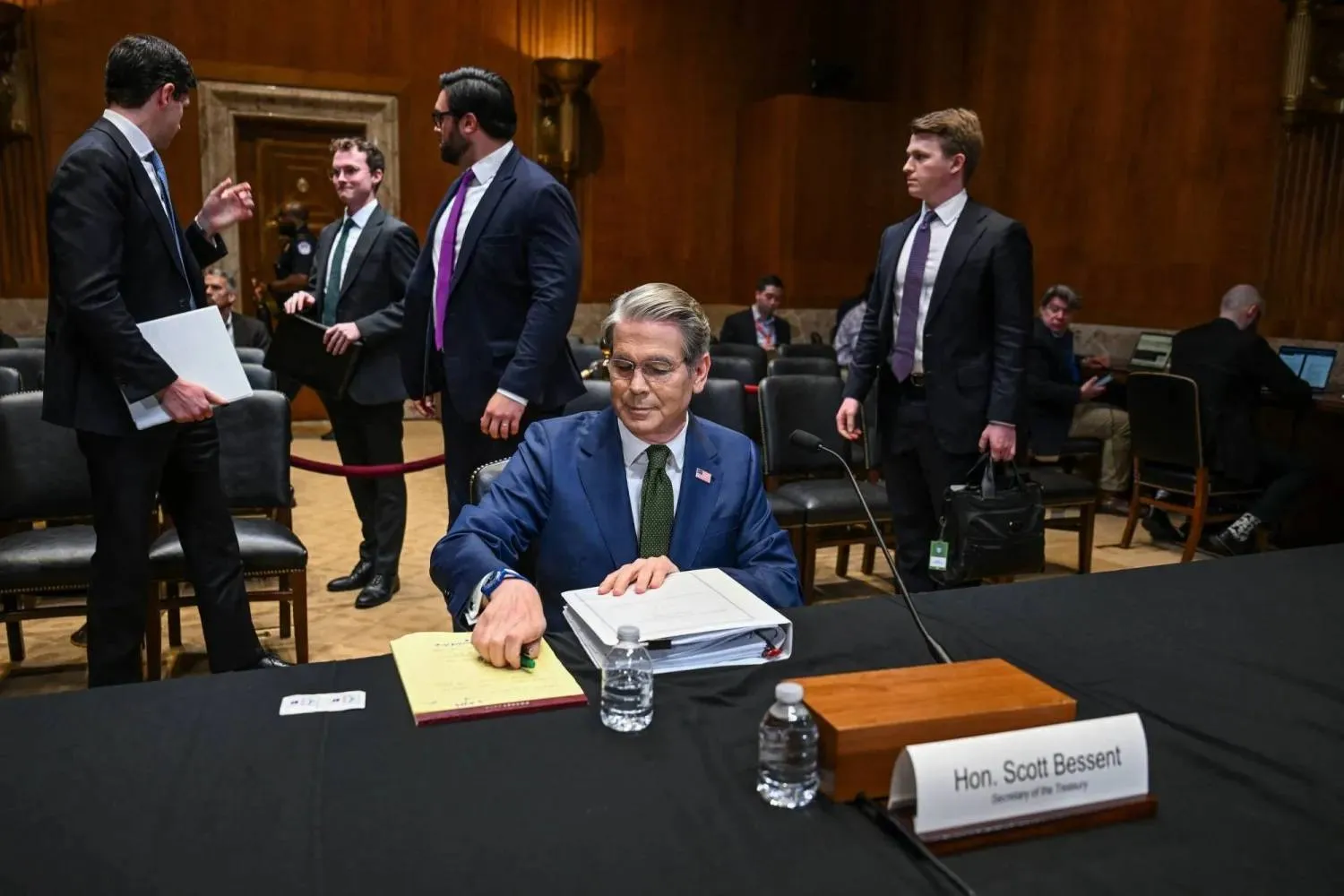
US Treasury Secretary Scott Bessent at the end of a Senate Appropriations Financial Services and General Government Subcommittee hearing on President Trump's fiscal year 2027 budget request for the Department of the Treasury, on Capitol Hill in Washington, DC, US, April 22, 2026. (Reuters)
TT

Washington Zigzags Between Rolling Out More Sanctions, Extending Waiver in Iran’s War

US Treasury Secretary Scott Bessent at the end of a Senate Appropriations Financial Services and General Government Subcommittee hearing on President Trump's fiscal year 2027 budget request for the Department of the Treasury, on Capitol Hill in Washington, DC, US, April 22, 2026. (Reuters)

Alan Rappeport and Ephrat Livni*

With oil prices in mind, the administration of US President Donald Trump has deployed a haphazard approach to sanctions on Russia and Iran.

Treasury Secretary Scott Bessent declared in mid-April that the United States would not extend a waiver allowing the sale of Russian oil. Two days later, on a Friday evening, the Treasury Department quietly issued another 30-day reprieve.

Ukraine’s President Volodymyr Zelensky condemned the waiver, saying that “every dollar paid for Russian oil is money for the war.” Senate Democrats called the 180-degree reversal a “shameful” decision.

Then, on Friday, Bessent told The Associated Press that the United States did not plan to renew the waiver for sales of Russian oil another time. The current waiver ends on May 16.

The about-face on Russian oil sanctions underscored the haphazard state of US statecraft as the Trump administration confronts the fallout from the war it and Israel started with Iran.

While the United States could once use its financial might to cripple the economies of adversaries, countries such as Russia and Iran have been using their leverage in energy markets to fight back. That has forced the Treasury Department, which oversees the US sanctions program, to improvise.

The Trump administration rolled out a blitz of sanctions on Friday, targeting 40 shipping firms and vessels that it identified as part of Iran’s so-called shadow fleet of oil tankers as it broadened its efforts to cripple the Iranian economy.

The administration also imposed sanctions on an independent Chinese refinery, Hengli Petrochemical Refinery, which is one of Iran’s largest customers for crude oil and other petroleum products.

At a Senate hearing last week, Bessent said that the decision to extend the Russia license came after developing countries lobbied him to keep more Russian oil on the market while they were in Washington for the spring meetings of the International Monetary Fund and World Bank.

“It was my belief we would not do it,” Bessent said, but added that poor countries have been struggling with the global shortfall of oil.

The White House and Treasury Department had no comment on whether the decision to continue easing the Russia sanctions came directly from Trump.

The sanctions relief has been filling Russia’s coffers with, by some estimates, as much as $200 million per day, undermining years of work by the US and Western allies that aimed to make it harder for Moscow to pay for its war in Ukraine.

“You don’t have to read ‘The Art of War’ to know that helping your adversaries gain money while you’re at war is a terrible idea,” Senator Chris Coons, Democrat of Delaware, said while questioning Bessent at the hearing on Wednesday. “No country has profited more from this war than Russia,” Coons added, noting that the country’s revenues also help support Iran militarily.

The strategy toward Iran has been equally muddled. The United States last month granted a 30-day exemption allowing the sale of Iranian oil, arguing that it would help curb global oil prices while preventing the Iranians from profiting by blocking the Strait of Hormuz.

But this month, the Trump administration changed course, letting the sanctions exemption expire and embarking on Operation Economic Fury, with new sanctions on Iran. The US military also extended its blockade on vessels coming in and out of Iranian ports to the waters of the wider world.

Bessent has likened the initiative to a financial bombing campaign.

Last week, he and Trump emphasized the economic pressures they are putting on Iran. They have argued that Iran will be unable to store any more oil in a matter of days and will be forced to shut its wells, leading to the wells’ possible eventual failure and driving economic collapse.

“It is a kind of whiplash in terms of policy,” said Jennifer Kavanagh, a senior fellow and director of military analysis at Defense Priorities, a foreign policy think tank in Washington. “This whole back and forth is evidence the Trump administration did not expect this to last this long.”

Previously, “the primary vector of pressure” was military action, and the expectation seemed to be that bombing would force Iran to capitulate, she said.

But as fighting has dragged on, raising the stakes of the war, the notion of military escalation became less palatable and Trump had already “escalated rhetorically to the maximum,” with his threat to wipe out Iranian civilization before a ceasefire, she said, leading to the focus on economics.

Iran complicated the US sanctions strategy by blocking the Strait of Hormuz, engaging in economic warfare by military means.

An analysis from Lloyd’s List, the shipping intelligence firm, noted that there are “signs of disruption to Iran’s shadow fleet operations” amid the global US blockade, with some tankers turning, diverting or pausing since its imposition. But vessel-tracking information also showed other Iran-linked tankers were actively sailing.

On Thursday, the Pentagon said US military forces stopped and boarded a second sanctioned tanker carrying oil from Iran in the Indian Ocean, following a similar interdiction on Tuesday.

“But blockades are not quick fixes,” Kavanagh said. She has argued that Iran can probably withstand the pressure because they work slowly.

The global blockade raises legal and operational questions because it has no geographical boundaries. And the United States can only seize so many ships, suggesting the practical impact could be “marginal,” she argued, while at the same time degrading the US reputation as an upholder of the international order, since many countries view such seizures as piracy.

Edward Fishman, a fellow at the Council on Foreign Relations, said that the haphazard use of sanctions by the United States reflects how economic and military warfare are merging. “We don't have a playbook for this kind of economic warfare, which may help explain some of the fumbling by the United States,” Fishman said.

*The New York Times


Israel’s Purchase of ‘Stolen’ Ukrainian Grain Is Not ‘Legitimate’, Zelenskiy Says

Ukraine's President Volodymyr Zelenskiy arrives to attend an informal European leaders' summit in Ayia Napa, Cyprus April 23, 2026. (Reuters)
TT

Israel’s Purchase of ‘Stolen’ Ukrainian Grain Is Not ‘Legitimate’, Zelenskiy Says

Ukraine's President Volodymyr Zelenskiy arrives to attend an informal European leaders' summit in Ayia Napa, Cyprus April 23, 2026. (Reuters)

Ukrainian President Volodymyr Zelenskiy said on Tuesday that Israel's purchase of grain from occupied Ukrainian territory "stolen" by Russia "cannot be legitimate business" and that Kyiv was readying sanctions against those attempting to profit from it.

"Another vessel carrying such grain has arrived at a port in Israel and is preparing to unload," Zelenskiy said on X. "This is ‌not – and cannot ‌be – legitimate business."

"The Israeli ‌authorities ⁠cannot be unaware ⁠of which ships are arriving at the country's ports and what cargo they are carrying," he added.

Ukrainian Foreign Minister Andrii Sybiha said on Monday that Israel's ambassador had been summoned to his ministry over what he ⁠described as Israeli inaction in allowing ‌shipments of grain to ‌enter the country from Russian-occupied Ukraine.

Israeli Foreign ‌Minister Gideon Saar told Sybiha that Ukraine had ‌provided no evidence to support allegations that the grain was "stolen".

Kyiv considers all grain produced in the four regions Russia claimed as its own since ‌invading Ukraine in 2022, and Crimea, annexed by Russia in 2014, ⁠to ⁠have been stolen by Moscow.

Russia refers to the four regions as its "new territories", but they are still internationally recognized as Ukrainian.

"Russia is systematically seizing grain on temporarily occupied Ukrainian land and organizing its export through individuals linked to the occupiers," Zelenskiy said.

"Such schemes violate the laws of the State of Israel itself."

He added that Ukraine expected Israel to respect Ukraine and refrain from actions that undermine bilateral relations.


Iran Says US No Longer in Position to ‘Dictate’ Policy to Other Nations

 Women carry Iranian flags as they cross an intersection to attend a pro-government gathering in Tehran, Iran, Monday, April 27, 2026. (AP)
Women carry Iranian flags as they cross an intersection to attend a pro-government gathering in Tehran, Iran, Monday, April 27, 2026. (AP)
TT

Iran Says US No Longer in Position to ‘Dictate’ Policy to Other Nations

 Women carry Iranian flags as they cross an intersection to attend a pro-government gathering in Tehran, Iran, Monday, April 27, 2026. (AP)
Women carry Iranian flags as they cross an intersection to attend a pro-government gathering in Tehran, Iran, Monday, April 27, 2026. (AP)

Iran said on Tuesday that the United States was no longer able to "dictate" what other countries do, as Washington weighed a new proposal from Tehran on unblocking the Strait of Hormuz.

Iran has effectively sealed off the strategic waterway since early in the war with the United States and Israel, sending shockwaves through global energy markets and putting the strait at the center of negotiations to end the conflict.

"The United States is no longer in a position to dictate its policy to independent nations," defense ministry spokesman Reza Talaei-Nik said, according to state TV, adding Washington would "accept that it must abandon its illegal and irrational demands".

While a ceasefire has halted the fighting between Iran, the US and Israel, talks on bringing a permanent conclusion to the conflict have been inconclusive.

The proposal being considered in Washington would reportedly reopen the Strait of Hormuz -- a vital conduit for global oil and gas shipments -- as broader negotiations on the war continue.

Talaei-Nik, speaking ahead of a Shanghai Cooperation Organization defense ministers' meeting, said Iran was also "ready to share its defensive military capabilities with independent countries, especially the member states" of the SCO.


Philippines Is Not Concerned Iran War Will Distract US from Region, Defense Secretary Says

Troops from New Zealand, the Philippines, US, and Australia pose for a photo with their national flags after participating in counter-landing live fire exercises during Balikatan, the annual joint military exercises between the US and the Philippines, at Long Point Beach, Brgy. Aporawan, Aborlan, Palawan, Philippines, April 27, 2026. (Reuters)
TT

Philippines Is Not Concerned Iran War Will Distract US from Region, Defense Secretary Says

Troops from New Zealand, the Philippines, US, and Australia pose for a photo with their national flags after participating in counter-landing live fire exercises during Balikatan, the annual joint military exercises between the US and the Philippines, at Long Point Beach, Brgy. Aporawan, Aborlan, Palawan, Philippines, April 27, 2026. (Reuters)

The Philippines is not worried about any reduction in US deterrence capabilities in the Indo-Pacific due to the Middle East war, though China would likely try to seize on any perceived opening, the Defense Secretary said ‌on Tuesday.

China's recent ‌actions in the ‌South ⁠China Sea and ⁠the Taiwan Strait were "not surprising", Gilberto Teodoro told Reuters in an interview, saying Beijing looked to take advantage when it thought rival powers were preoccupied ⁠elsewhere.

"It is not surprising ‌that ‌any opportunity they see, perceived opportunity, or ‌with a perceived weakness ‌or a perceived opening, they will take advantage," Teodoro said.

Teodoro said he had full confidence in the ‌Mutual Defense Treaty, the long-standing security pact between Manila ⁠and Washington, ⁠and was not worried by concerns that the Iran war could weaken US strategic bandwidth in Asia.

"I'm not concerned at all about reduced deterrence," he said, pointing to joint military exercises currently underway with the US as a sign of Washington's commitment.
