
Former IRGC Chief Says No Direct Talks Before US Confidence-Building Steps

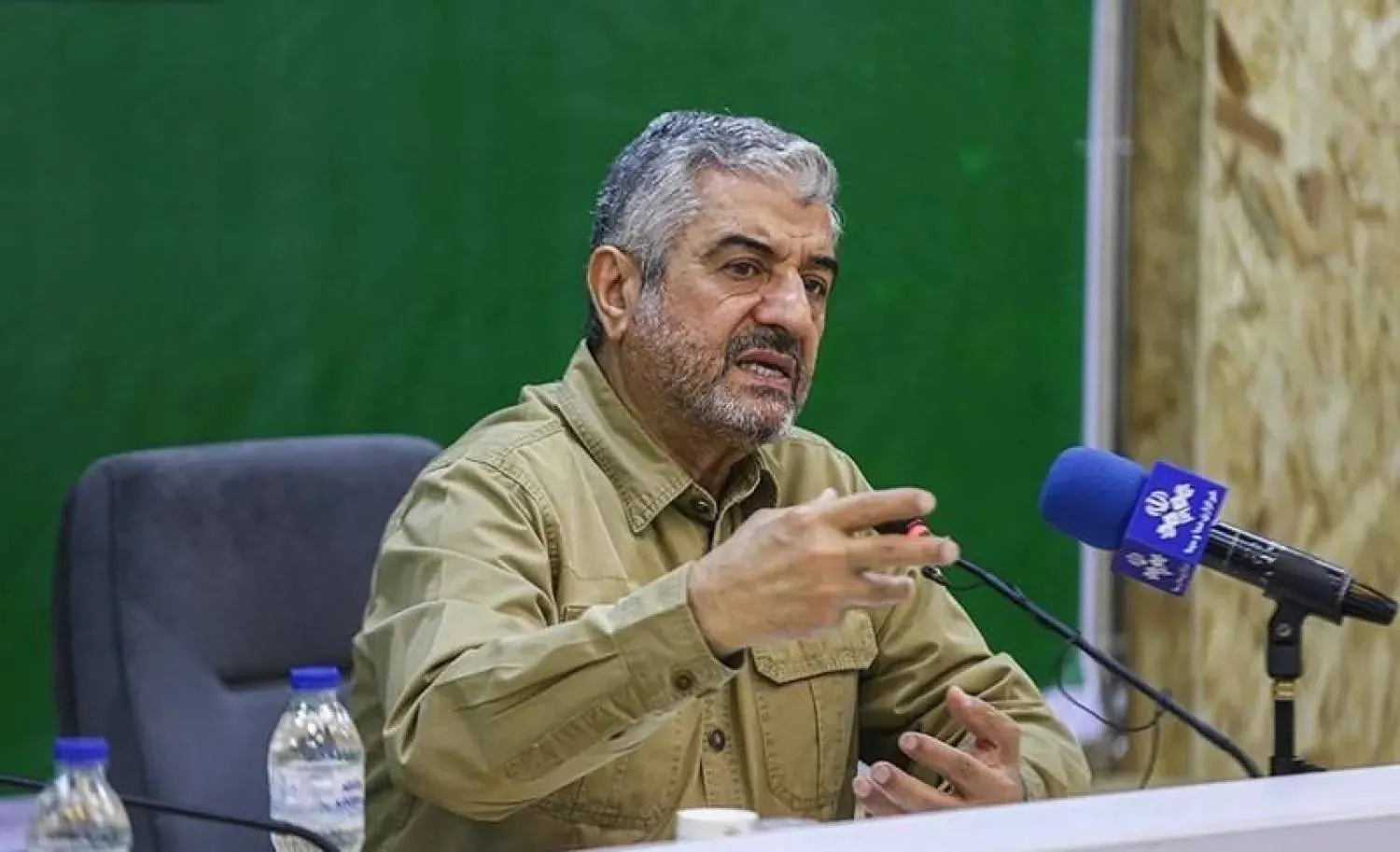
Mohammad Ali Jafari, a senior commander in Iran’s Revolutionary Guards (File photo - state television) 
TT

Former IRGC Chief Says No Direct Talks Before US Confidence-Building Steps

Mohammad Ali Jafari, a senior commander in Iran’s Revolutionary Guards (File photo - state television) 

Mohammad Ali Jafari, former commander-in-chief of Iran’s Revolutionary Guard Corps (IRGC), said Iran would not enter negotiations with the United States before Washington implements “preconditions” and “confidence-building measures.”

In an interview with the IRGC-affiliated Tasnim news agency, Jafari said Tehran would reject any negotiations before the war ends on all fronts, sanctions are lifted, frozen Iranian assets are released, war damages are compensated and Iran’s sovereignty over the Strait of Hormuz is recognized.

Jafari said the United States “must pay the price for violating its commitments” after Iran was subjected to two military attacks during negotiations. He said the experience had produced a “strategic shift” in Tehran’s negotiating approach, now based on written guarantees and commitments against renewed military threats, alongside practical steps such as releasing frozen assets.

He further revealed that Iran is not currently engaged in direct negotiations with Washington, but is exchanging messages through a third country, such as Pakistan, to present its conditions and seek guarantees. If such commitments are secured, negotiations on other issues, including the nuclear file, could follow later.

Jafari said Iranian President Masoud Pezeshkian and Parliament Speaker Mohammad Bagher Ghalibaf, who oversees the negotiations, are acting within the framework of decisions by the ruling establishment and directives from Supreme Leader Mojtaba Khamenei.

He noted that Washington “has no option” but to accept “Iran’s legitimate demands” or continue the war, warning that if fighting resumes, Iran would launch “stronger strikes” than before. He added that the cost of continuing the war for the United States and its regional allies would be “far greater” than for Iran.

Jafari’s remarks on Thursday came days after he said Iran’s response was based on five preconditions: ending the war, lifting sanctions, releasing frozen assets, war reparations and recognition of Iran’s sovereignty over the Strait of Hormuz. He stressed that “there will be no negotiations before they are achieved.”

Jafari currently heads the IRGC’s cultural and social divisions and is considered a close ally of General Mohammad Bagher Zolghadr, who became secretary of Iran’s Supreme National Security Council after former secretary Ali Larijani was killed during the war.

The first round of Iranian-US talks, mediated by Pakistan and held on April 12, ended without agreement, despite a ceasefire that took effect on April 7.

US President Donald Trump said on Monday that the ceasefire with Iran was “close to collapse” after Tehran’s latest response to a US proposal to end the war showed the sides remained divided on several issues. He also sought to ease tensions after naval clashes last week.

In response, Ghalibaf said Iran’s armed forces were ready to respond decisively to any “aggressive act.”

Iran’s response focused on ending the war on all fronts, particularly in Lebanon, where Israel is fighting the Iran-backed Hezbollah group.

Tehran also demanded compensation for war damages, stressed Iranian sovereignty over the Strait of Hormuz and called on the United States to end its naval blockade, guarantee no further attacks, lift sanctions and end the US ban on Iranian oil sales.

Iran also demanded recognition of its “sovereignty” over the Strait of Hormuz, where maritime traffic has been halted through the waterway that previously carried one-fifth of global oil and gas supplies.

Separately, lawmaker Mahmoud Nabavian, a member of parliament’s National Security Committee who accompanied the Iranian negotiating team, disclosed details of the Iranian-US talks in Pakistan.

Nabavian said the Islamabad talks included four sessions and that US Vice President JD Vance said in the first session Washington had two main demands: the full reopening of the Strait of Hormuz and the removal from Iran of all uranium enriched to 60%.

According to Nabavian, the Iranian delegation insisted on sanctions relief and recognition of Iran’s enrichment rights, but Vance asked to address the Strait of Hormuz first. Ghalibaf replied: “We do not have one issue to solve first; there are four issues on the table,” according to the state-run Mehr news agency.

Nabavian added the two sides later agreed to continue negotiations across four tracks. He noted that the Americans again raised the Strait of Hormuz and Iran’s uranium stockpile, proposing the release of $6 billion in frozen assets in exchange for Iranian cooperation.


Canada Deepens Arctic Defense Ties with Nordics after Trump Threats

Canada Prime Minister Mark Carney talks to reporters during the 8th European Political Community Summit in Yerevan, Armenia on Monday, May 4, 2026. (Sean Kilpatrick/The Canadian Press via AP)
TT

Canada Deepens Arctic Defense Ties with Nordics after Trump Threats

Canada Prime Minister Mark Carney talks to reporters during the 8th European Political Community Summit in Yerevan, Armenia on Monday, May 4, 2026. (Sean Kilpatrick/The Canadian Press via AP)

Since US President Donald Trump’s barrage of threats to seize Greenland, authorities on the frozen island have been seeking help from a northern ally: Canada.

A reserve unit of the Canadian armed forces called the Rangers has long maintained a year-round presence in mostly inaccessible Arctic communities. For three years, authorities in Greenland and Denmark have consulted with Canadian officials on how to set up their own version of the Rangers — conversations that grew more urgent with Trump’s threats and growing fears of Russian hostility in the Arctic, said Reuters.

“The rhetoric coming out of the White House has sped up efforts to rebuff the idea that Arctic communities need the US to come in and save them,” said Whitney Lackenbauer, an honorary lieutenant-colonel Canadian Ranger involved in the talks, who spoke with Reuters during a recent 5,000-kilometer Arctic snowmobile trek by the Rangers. “The Nordic countries and Canada, we’re increasingly realizing we can come together in military and diplomatic ways to send a message that carries moral weight.” As Canada attempts to pivot away from relying on the US to protect its vast Arctic, Prime Minister Mark Carney is strengthening ties and exchanging security tips with the Nordic countries, which he describes as trusted partners. Canada's increased defense collaboration with the Nordics is part of Carney's effort to strengthen alliances between what he calls “middle powers” in a world where the United States is considered a less reliable partner.

The White House said ‌Trump’s leadership has prompted ‌allies “to recognize the need to meaningfully contribute to their own defense” and that the Arctic is a critical region ‌for US national ⁠security and the ⁠economy.

“The administration is participating in diplomatic high-level technical talks with the governments of Greenland and Denmark to address the United States’ national security interests in Greenland,” a White House spokesperson said in an email.

Alliances are shifting in the Arctic as climate change makes it more accessible. Russia has far more military bases than any other nation there and in recent years China has started to increase its presence in the mineral-rich area, mostly in partnership with Russia. While Carney says Canada will no longer rely on any other nation to protect its own territory, he says the Arctic’s greatest threat is from Russia – and the Nordics have been boosting their own defenses since Russia invaded Ukraine.

In March, Canada and the five Nordic countries — Denmark, Finland, Iceland, Norway and Sweden — agreed to deepen their cooperation in military procurement and ramp up defense production to deal with security threats, including cyberattacks. A plan for how Greenland might adapt the Canadian Rangers is expected by the ⁠end of this year, according to government policy documents. Canadian Foreign Affairs Minister Anita Anand told Reuters she meets regularly with Nordic ‌officials to work on collective defense and Arctic security. Canada’s partnership with the United States through NORAD, the North American ‌Aerospace Defense Command, remains critical, she said. But Canada is focused on bolstering new alliances. That includes the opening of a Canadian consulate in Nuuk in February and an invitation to her Nordic counterparts ‌to visit Canada’s Arctic this year.

“We have to build something new, and it has to be a world order that is built on the values that we ‌represent,” Danish Prime Minister Mette Frederiksen told Carney during the Nordic-Canadian summit in Oslo in March. In April, Alexander Stubb became the first Finnish president to visit Canada in a dozen years and signed several agreements on Arctic cooperation. Stubb and Carney took to the ice in Ottawa for a hockey practice, and afterward Stubb said he and Carney message each other almost every day.

The two national leaders sometimes chat about hockey or baseball, Stubb told reporters, but “most of the time it's about NATO or Ukraine or Iran."

NO MORE ‘FREE PASS IN THE ARCTIC’ FOR HOSTILE NATIONS

Lackenbauer, the honorary Canadian Ranger lieutenant-colonel, ‌is also an Arctic expert at Trent University in Peterborough, Ontario. He said Canada should overhaul its approach to Arctic security just as Nordic countries did after Russian troops marched into Ukraine in 2022.

“The more we can go and help Canada’s ⁠allies in northern Europe, the more hostile nations ⁠will get the message that they do not get a free pass in the Arctic,” he said. Among the eight countries that share the Arctic, Canada’s investment in defending the territory has consistently been near the bottom, trailing Russia, the US, Norway, Sweden, Denmark and Finland, according to the Arctic Business Index, a network of far north research institutions and analysts. Along with Greenland, Canada has historically spent the least. Last year, Canada hit the NATO target of spending 2% of its GDP on defense, around CA$63 billion, after repeated complaints from Trump. That compared to a low point of just 1% in 2014.

Neil O’Rourke, Director General at Canada’s Coast Guard for Fleet and Maritime Services, said he and a Danish defense colleague realized years ago that if either country had a serious incident in the Arctic, their first phone call should be to each other.

“Up north, we’re just across the water and it makes much more sense to share resources than to get help from down south,” O’Rourke said in an interview. He said Canada is also trying to learn more from Norway about how its maritime services handle emergency towing of vessels.

Rob Huebert, an Arctic expert at the University of Calgary, said working with the US remains critical, noting that the country produces arguably the most advanced military weaponry and that Canada’s military remains highly dependent on the US for protecting its northernmost regions.

“If we are talking about war-fighting capability, that means working with the US military,” he said. Huebert said Carney’s March trip to observe a Norwegian-led NATO exercise in Bardufoss is perhaps an indication the country’s approach is changing.

“Until very recently, Canada’s participation in NATO’s Arctic exercises in the Nordics has been very token,” he said. “But then all of a sudden because of Trump, we decide we’d better do something with the Nordics.”


Kyiv Says Russia Has Returned 528 Bodies to Ukraine

A handout photo made available by the Ukrainian Presidential Press Service shows Ukrainian prisoners of war (POWs) reacting following their release in a prisoner swap at an undisclosed location in Ukraine, 15 May 2026. (EPA/Ukrainian Presidential Press Service Handout)
TT

Kyiv Says Russia Has Returned 528 Bodies to Ukraine

A handout photo made available by the Ukrainian Presidential Press Service shows Ukrainian prisoners of war (POWs) reacting following their release in a prisoner swap at an undisclosed location in Ukraine, 15 May 2026. (EPA/Ukrainian Presidential Press Service Handout)

Kyiv said on Saturday that Russia had returned 528 bodies to Ukraine identified as Ukrainian soldiers killed in action, in one of the few areas of cooperation between the warring neighbors.

"As a result of repatriation efforts, the bodies of 528 deceased individuals have been returned to Ukraine; according to the Russian side, they may be Ukrainian servicemen," Ukraine's prisoners of war center stated on social media, without specifying when the remains were received.

Investigators and experts "will take all necessary steps to identify the repatriated deceased", the center said, a day after Russia and Ukraine exchanged 205 prisoners of war each.

Last Friday, US President Donald Trump announced a three-day ceasefire in the conflict from Saturday to Monday, as well as an exchange of 1,000 prisoners from each side.

Ukrainian President Volodymyr Zelensky confirmed that Friday's exchange of prisoners marked the first phase of the swap announced by Trump.

Since the start of the Russian invasion of Ukraine more than four years ago, exchanges of prisoners and the remains of fallen fighters have been one of the few areas of cooperation between Moscow and Kyiv.


End of the ‘People’s Army’ Myth: Israel Weighs Resorting to Mercenaries

Israeli soldiers seen in the village of Aitaroun in southern Lebanon, January 27, 2025. (AP)
TT

End of the ‘People’s Army’ Myth: Israel Weighs Resorting to Mercenaries

Israeli soldiers seen in the village of Aitaroun in southern Lebanon, January 27, 2025. (AP)

As Israel’s military grapples with a severe manpower shortage estimated at 15,000 troops — a situation Chief of Staff Eyal Zamir has described as “dangerous for the future of the Jewish state” —

Israeli ultra-Orthodox parties continue to reject military service in favor of Torah study even as Israel’s military grapples with a severe manpower shortage estimated at 15,000 troops - a situation Chief of Staff Eyal Zamir has described as “dangerous for the future of the Jewish state”.

Former senior government official Shlomo Maoz has proposed recruiting 12,000 mercenary soldiers with generous pay packages to address the shortage.

Maoz presented the idea as a personal initiative inspired by Ukraine’s recruitment of 10,000 foreign fighters, however, he said the Israeli army has long relied on a similar force known as “lone soldiers,” currently numbering 7,365.

According to Maoz, 52 percent are soldiers from Jewish families living abroad, while the remaining 48 percent are effectively mercenaries “in every sense of the word.” They come from several countries, including 30 percent from the US, 12 percent from France and 7 percent from Ukraine, while the rest come from Spain, Italy, Germany, Canada and Britain.

These soldiers receive salaries equivalent to $4,000 a week and they currently serve through “secret” arrangements, he revealed.

His new proposal is aimed at bringing these arrangements into the open and formalize the system publicly through the creation of an “Israeli Foreign Legion” composed of four brigades operating under Israeli officers.

Speaking to Israel’s Maariv daily, Maoz stressed that the main problem with the proposal was moral rather than military, as it would mark Israel’s abandonment of the “people’s army” myth.

He described the Israeli military as historically built on the integration of Israelis from more than 100 cultural backgrounds — Ashkenazi and Mizrahi Jews, urban and rural communities, native-born Israelis and new immigrants, people from Europe and Western countries, as well as from Arab and Muslim states, alongside Jews, Muslims, Christians, Druze and Circassians — into what he called a cohesive force that overcame social divisions.

But Maoz argued that the benefits of recruiting mercenaries outweigh the symbolic costs.

He said the military faces an acute shortage, with even conservative estimates pointing to a need for 15,000 additional troops, including at least 9,000 combat soldiers, while religious Jews remain adamantly opposed to conscription.

At the same time, he said, the government is waging an ongoing war on seven fronts, pursuing further occupation and expansion, and establishing 134 new settlements and outposts that all require protection.

“To fill this need, solutions outside the box must be explored,” Maoz urged.

He added that hundreds of thousands of retired military officers from around the world, including fighters, snipers, tank operators, drone specialists and even pilots, could be recruited easily, particularly from Eastern European countries.

Maoz, an economist by background, said financing the project was one of its key challenges. He estimated each soldier would cost between $8,000 and $10,000 a month, with additional state expenses amounting to roughly half that figure.

He revealed that the total cost of a mercenary force would reach around $2.5 billion — a manageable amount given Israel’s foreign currency reserves of $236 billion, equivalent to about 38 percent of gross domestic product.

Pointing to the Ukrainian model, Maoz said around 600 mercenaries join Ukraine’s army every month, bringing the total number of foreign fighters there to 10,000 from 75 nationalities. Kyiv pays them an average of $4,000 per month.

Maoz added that Israel was particularly suited to integrating mercenaries because it has millions of citizens who speak foreign languages as their mother tongue, such as Russian, Slavic languages, English and Spanish.