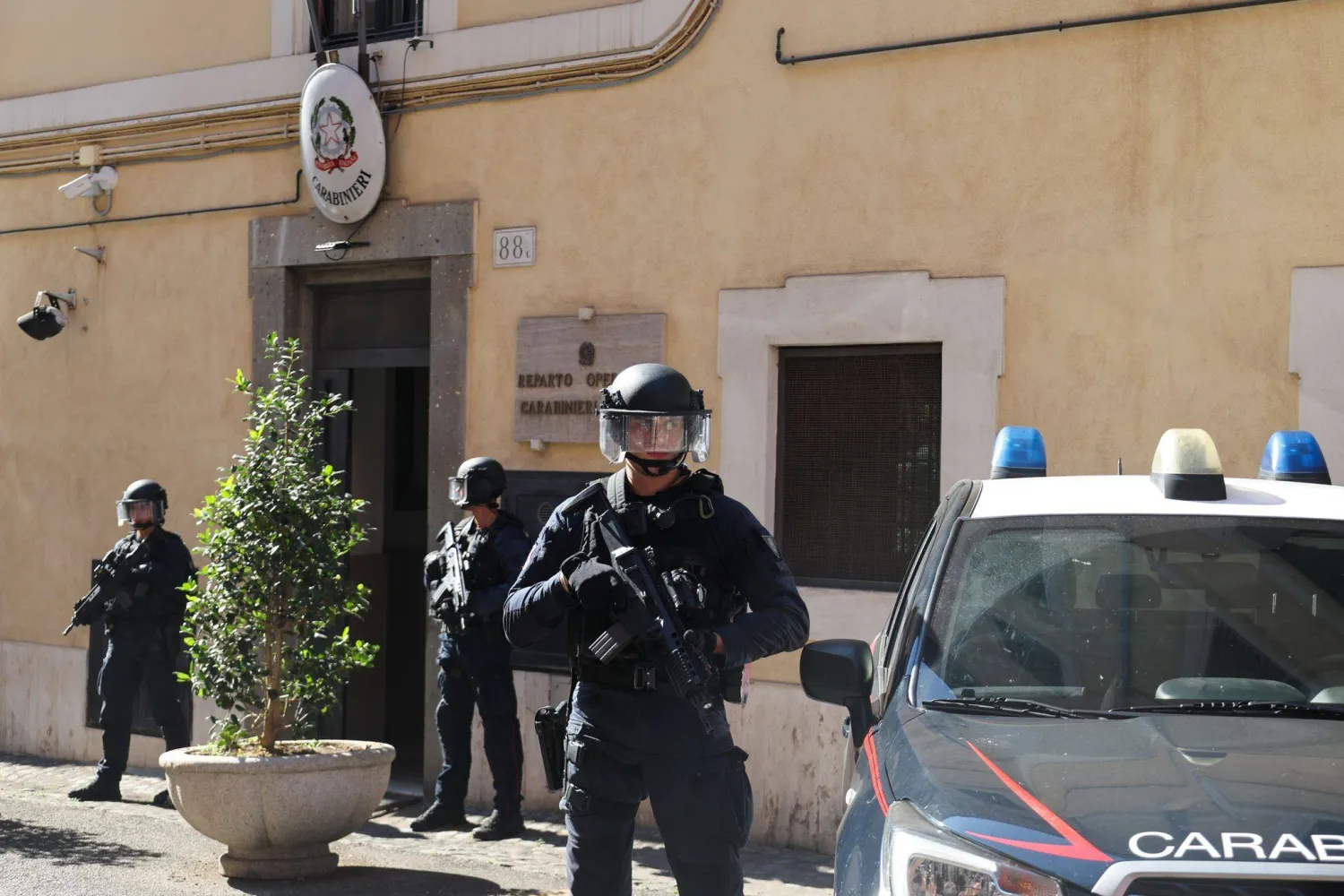
Italy Expels 2 Russian Embassy Staff over Spying Case

30 June 2026, Italy, Rome: Carabinieri vehicles transport suspects from the operations unit on Via Selci to prison in Rome. Photo: Francesco Benvenuti/LaPresse via ZUMA Press/dpa
TT

Italy Expels 2 Russian Embassy Staff over Spying Case

30 June 2026, Italy, Rome: Carabinieri vehicles transport suspects from the operations unit on Via Selci to prison in Rome. Photo: Francesco Benvenuti/LaPresse via ZUMA Press/dpa

The Italian government has decided to expel two military attaches at the Russian Embassy in Italy who were allegedly involved in espionage activities, Foreign Minister Antonio Tajani said on Thursday.

Earlier this week, two ⁠people were arrested ⁠on charges of passing classified information to a Russian agent.

Prosecutors said the main suspect was ⁠a former officer of Italy's Carabinieri police force. Five other individuals are also under investigation.

Tajani said on social media platform X that the two Russian officials must leave Rome within three days.

He ⁠said Moscow continued to employ "hybrid tools" against Italy and the West, describing this as "serious and unacceptable interference" that threatens national security.

Russia's foreign ministry said it would respond to the Italian move.


Kremlin Rejects US Claim Ukrainian Strikes Will Help End War

Smoke rises in the city during a Russian missile strike, amid Russia's attack on Ukraine, in Kyiv, Ukraine July 8, 2026. (Reuters)
TT

Kremlin Rejects US Claim Ukrainian Strikes Will Help End War

Smoke rises in the city during a Russian missile strike, amid Russia's attack on Ukraine, in Kyiv, Ukraine July 8, 2026. (Reuters)

Russia on Thursday hit out at the United States saying Ukrainian strikes on Russian energy sites could help end the war between Moscow and Kyiv.

Ukraine has mounted a retaliatory strike campaign using long-range drones against Russian energy and military facilities, in what Kyiv calls fair retribution for Moscow's drone and missile barrages on Ukrainian cities.

Asked about the strikes during a meeting with Ukrainian President Volodymyr Zelensky on Wednesday, US President Donald Trump appeared to endorse the campaign.

"It's an escalation, but it's also an escalation that can help lead to an end," Trump said.

US Secretary of State Marco Rubio similarly expressed hope the Ukrainian strikes would "create the space now to negotiate the end of this war" that started with Russia's 2022 invasion of Ukraine.

The Kremlin on Thursday said Ukrainian military pressure would not force it into concessions.

"We see certain misconceptions within the White House administration -- that by escalating military pressure it can help move to a peace settlement. That is a mistaken view," Kremlin spokesman Dmitry Peskov told reporters, including AFP.

"Further escalation may prolong the special military operation to some extent," he said, using Russia's preferred term for the offensive.

He also threatened that Moscow's army would respond by "creating a larger security zone" -- a reference to seizing more territory in eastern Ukraine.

Kyiv's attacks on Russian oil depots and refineries have triggered a fuel crisis across Russia, forcing Moscow -- one of the world's top oil producers -- to ban some exports.

More than 90 percent of all Russian regions have introduced some form of rationing or reported shortages in petrol and diesel, according to official statements and local media reports.


600 Dead in DR Congo Ebola Outbreak

A health worker in personal protective equipment stands near displaced people waiting for the burial of suspected Ebola victims at the Kigonze displaced persons camp, one month after an outbreak was declared, in Bunia, eastern Democratic Republic of Congo, June 18, 2026. REUTERS/Gradel Muyisa Mumbere/File Photo
TT

600 Dead in DR Congo Ebola Outbreak

A health worker in personal protective equipment stands near displaced people waiting for the burial of suspected Ebola victims at the Kigonze displaced persons camp, one month after an outbreak was declared, in Bunia, eastern Democratic Republic of Congo, June 18, 2026. REUTERS/Gradel Muyisa Mumbere/File Photo

The Ebola outbreak in the Democratic Republic of Congo has now claimed 600 lives, figures published by the World Health Organization showed Thursday -- only three days after the figure topped 500.

Updated numbers issued by the UN health agency showed there have been 1,759 confirmed cases in DR Congo since the outbreak was declared in mid-May, including 600 confirmed deaths.

Two other people have died in neighboring Uganda, where 17 patients have recovered out of 20 total confirmed cases.

The WHO's figures for the DRC, which come from the health authorities in the vast country, show that the outbreak there has a case fatality rate of 34 percent, AFP reported.

A total of 285 patients in the DRC have recovered, while 304 suspected cases of the viral hemorrhagic fever are under investigation.

The outbreak in northeastern DRC has hit four provinces but is focused on Ituri province.

The outbreak is being driven by the rare Bundibugyo species of Ebola, for which there are no approved vaccines or treatments.

The trial of two potential treatments for Bundibugyo began in the DRC on July 2.

The trial is evaluating the effectiveness of the monoclonal antibody MBP134 and the antiviral drug remdesivir, alone and in combination.

Ebola spreads through close contact and infected bodily fluids.

The DRC's 17th Ebola outbreak was declared on May 15 after several deaths in mineral-rich Ituri province, which is plagued by armed groups.


Iran to Bury Slain Supreme Leader in Culmination of Mass Funeral

Mourners gather in the street ahead of the funeral of Iran's slain Supreme Leader Ali Khamenei and members of his family at the Shrine of Imam Reza, Iran's most revered place of worship, in Mashhad on July 9, 2026. (AFP)
TT

Iran to Bury Slain Supreme Leader in Culmination of Mass Funeral

Mourners gather in the street ahead of the funeral of Iran's slain Supreme Leader Ali Khamenei and members of his family at the Shrine of Imam Reza, Iran's most revered place of worship, in Mashhad on July 9, 2026. (AFP)

Iran buries its slain Supreme Leader Ali Khamenei on Thursday at the country's holiest shrine, with his son and successor Mojtaba Khamenei still hidden from public view after being disfigured in the strike that killed his father.

The burial in Mashhad in northeast Iran follows a week of mass funeral processions, rallies and mourning ceremonies that has coincided with a renewed burst of conflict with the United States following weeks of truce.

Crowds marched through Mashhad on Thursday morning, the golden onion dome and minarets of the Shrine of Imam Reza glinting in the morning sun, as they waved Iranian flags, photographs of the late Khamenei and placards with revolutionary slogans.

As Khamenei's body was transported around Iran and Iraq over the past week, the republic's clerical leaders encouraged huge crowds ‌to attend in ‌an effort to vaunt the might and ideological fire of their theocratic state.

However, ‌despite ⁠it having survived ⁠a months-long blitz by its strongest enemies the United States and Israel, Iran faces huge internal challenges and the legacy of Khamenei's 37-year rule is bitterly disputed.

'KILL TRUMP' PLACARDS APPEAR AT BURIAL CEREMONY

The whereabouts of Mojtaba Khamenei, proclaimed Supreme Leader by a clerical assembly a week after his father's death, has remained a mystery to Iranians.

He has not appeared in public since the war began with the strike that killed Ali Khamenei on February 28, and while he has issued written statements, no image or video or voice recording of him has been issued.

He suffered debilitating injuries in ⁠that same strike, his face disfigured and limbs badly wounded.

Senior sources in Tehran ‌have said he is recovering but that he has not yet been ‌well enough to manage public appearances and state security services are also trying to limit his exposure in case of ‌more US attacks.

As crowds jostled in Mashhad awaiting Khamenei's funeral cortege, the crowd chanted slogans demanding revenge on ‌US President Donald Trump for his killing.

“I swear by the blood of the Supreme Leader, Trump, we will kill you!” they shouted, with women holding up placards reading "Kill Trump".

Khamenei's remains, along with those of four family members killed alongside him, have already been paraded through Tehran, Qom, and the Iraqi cities of Najaf and Karbala.

KHAMENEI'S LONG RULE AND DISPUTED LEGACY

The funeral comes at a critical moment for Iran, turning the page of nearly four decades of Khamenei's rule and months after the latest round of mass nationwide protests against the republic.

Security forces put down that unrest, sparked by anger over the sanctions-throttled economy, by killing thousands of demonstrators in a wave of repression that echoed other bouts of violence over recent years.

While analysts see Iran as having emerged from the war strategically strengthened, with its grip over the vital Strait of Hormuz intact, it has suffered widespread damage that has added to internal economic woes.

The late Khamenei was appointed supreme leader in 1989, a decade after the revolution, and over the decades he consolidated political, economic and military power in his office.

That effort, which increasingly marginalized the elected president and parliament, was conducted in concert with the Iranian Revolutionary Guard Corps that grew in influence throughout Khamenei's rule.

Mojtaba Khamenei was appointed with the backing of the Guards, who are now seen as the dominant force in Iranian political and strategic thinking.