


EU Plans Measures to Help EU Banks Build Scale and Compete with US Rivals

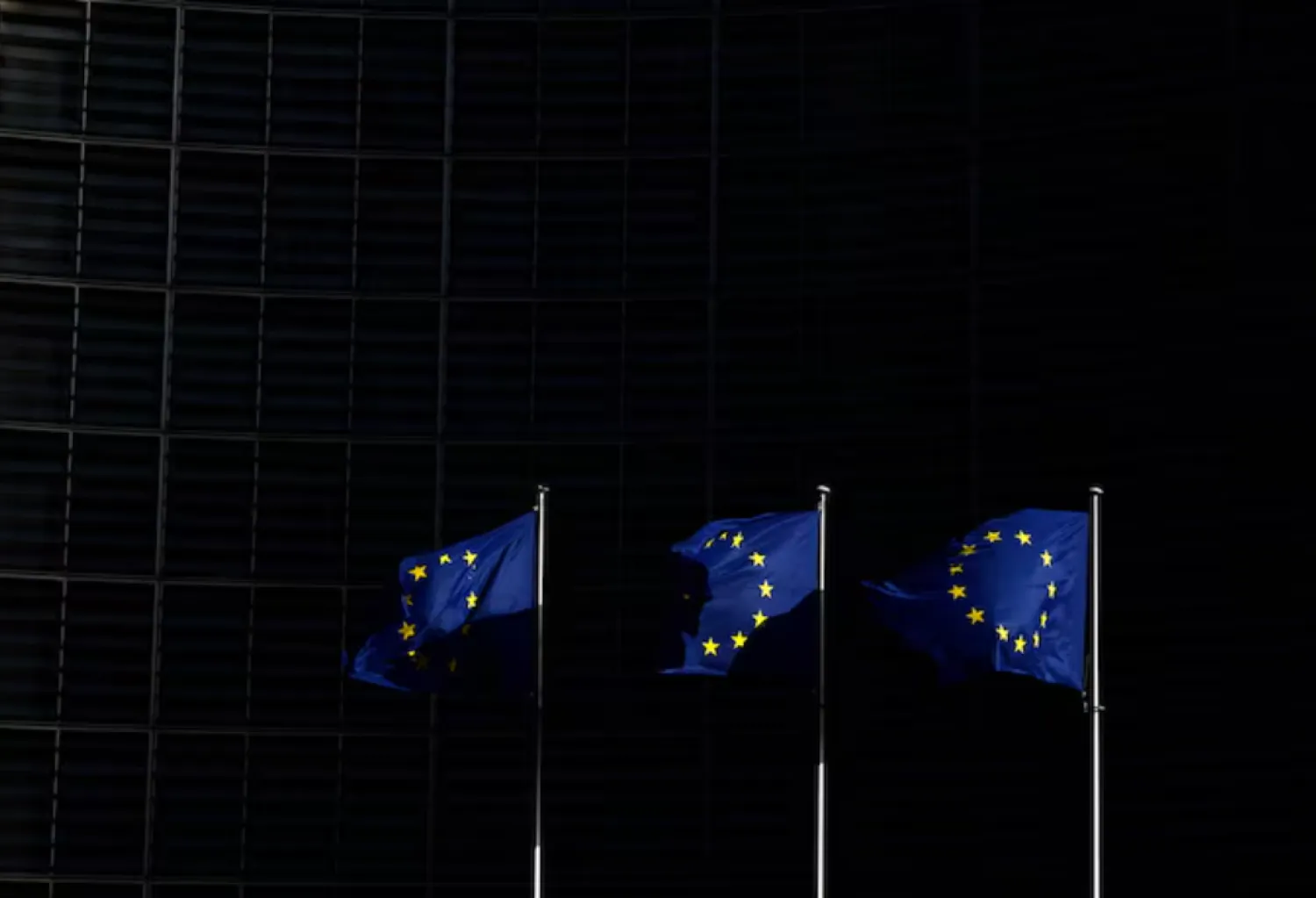
European Union flags flutter outside the European Commission headquarters in Brussels, Belgium Februrary 26, 2026. REUTERS/Yves Herman/File Photo
TT

EU Plans Measures to Help EU Banks Build Scale and Compete with US Rivals

European Union flags flutter outside the European Commission headquarters in Brussels, Belgium Februrary 26, 2026. REUTERS/Yves Herman/File Photo

The European Commission aims to limit political interference in European Union banking mergers and remove obstacles to cross-border banking within the bloc to allow EU banks to compete more effectively against larger US rivals.

An EU executive report released on Friday says internal barriers are preventing EU banks from expanding, leaving them at a disadvantage to US lenders that have benefited from economies of scale in a more integrated US market. EU mergers remain largely within national borders.

"This leads to an outcome where many banking groups in the EU are large relative to the size of their home economy, but not relative to the size of the EU or the banking union economy or international competitors," the report said.

Unjustified national interventions in cross-border bank mergers were preventing banks from acquiring scale at the EU level to reach a critical size, it said. The criticism comes after Germany rejected in June an offer from Italy's UniCredit to take over Commerzbank. UniCredit began its pursuit of Commerzbank back in September 2024, but has faced strong opposition - highlighting how hard it is to pull off cross-border banking deals in Europe.

While Germany officially cited the price offered by the Italian bank as the reason for its rejection, the government has also made clear that Commerzbank is a key lender to German companies and should remain under German ownership.

"It is a mistake from our point of view. If it's okay by the supervisor and the competition authority, cross-border mergers are good things," a senior EU official said, adding that US banks were outcompeting European peers across many business lines in Europe.

"The main driver of competitiveness is not the rulebook ... it's the absence of scale," the official said.

The EU executive, the report said, will propose a range of measures in the first quarter of 2027.

These include plans to crack down on EU members that breach EU rules limiting the circumstances under which they can intervene in proposed mergers.

Other proposals would allow cross-border banking groups to meet capital and liquidity requirements more at the parent level, rather than the current system with additional requirements for subsidiaries. Removing such constraints could release €230 billion ($263.1 billion) of liquid assets, the report said.

It will also replace its proposal from a decade ago to create a European deposit insurance scheme with a new plan to simply deposit insurance measures in the bloc.

The banking industry gave the report a mixed reception. French banking lobby FBF described the report as containing "several positive orientations" but said concrete measures on key issues were required, including better regulatory coordination and limits on country-specific rules. Christian Sewing, Deutsche Bank CEO and president of the Association of German Banks, urged swift action, calling for adjustments to the lower limit on capital requirements known as the output floor, relief for trade finance and improvements on software investments, as well as urging a review of financial stability buffers.



Iran Urges Citizens to Cut Electricity Use after US Strikes

FILE PHOTO: A man walks next to a symbolic mockup of an Iranian missile and an Iranian flag at Imam Hussein Square in Tehran, Iran, July 12, 2026. Reuters
TT

Iran Urges Citizens to Cut Electricity Use after US Strikes

FILE PHOTO: A man walks next to a symbolic mockup of an Iranian missile and an Iranian flag at Imam Hussein Square in Tehran, Iran, July 12, 2026. Reuters

Iran's energy ministry called on citizens to reduce electricity use on Friday after the power grid came under strain following US strikes on energy infrastructure in the south, AFP reported.

The ministry in a statement urged people to switch off air conditioners in peak hours "to help ensure a stable electricity supply in the southern provinces, which are currently facing extreme heat and attacks on electricity supply facilities".


UN Agency: Transport of Dead Bodies Within Congo Risks Further Ebola Spread

FILE PHOTO: A health worker in personal protective equipment stands near displaced people waiting for the burial of suspected Ebola victims at the Kigonze displaced persons camp, one month after an outbreak was declared, in Bunia, eastern Democratic Republic of Congo, June 18, 2026. REUTERS/Gradel Muyisa Mumbere//File Photo/File Photo
TT

UN Agency: Transport of Dead Bodies Within Congo Risks Further Ebola Spread

FILE PHOTO: A health worker in personal protective equipment stands near displaced people waiting for the burial of suspected Ebola victims at the Kigonze displaced persons camp, one month after an outbreak was declared, in Bunia, eastern Democratic Republic of Congo, June 18, 2026. REUTERS/Gradel Muyisa Mumbere//File Photo/File Photo

The transport of Ebola victims' bodies between different areas of the Democratic Republic of Congo, often for funerals in their home communities, risks further spreading the virus, the UN migration agency said on Friday.

More than 2,000 Ebola cases and 700 deaths have been recorded in Congo and neighboring Uganda as of July 14, and around two-thirds of the deaths occurred outside clinics or ⁠hospitals, said the International ⁠Organization for Migration.

The often fatal viral disease spreads through direct contact with bodily fluids from infected people or animals, and causes symptoms that can include high fever, vomiting and internal and external bleeding. This ⁠particular epidemic is caused by the Bundibugyo strain of the virus.

Ebola remains highly infectious after death, making funeral practices a critical component of outbreak control.

"If we don't really manage the dead bodies well, if we don't engage the community ... then it means there will be more spread within the community," Reuters quoted Andrew Mbala from IOM as saying.

IOM officials said the ⁠transport ⁠of bodies across districts within Congo was a particular challenge as families seek to bury relatives in their home communities.

"There hasn't been any crossing of dead bodies to another country, but we have seen a lot of crossings of dead bodies within the country," said Mbala.

Such movement risks carrying the virus into new areas if bodies are not handled safely, the IOM warned.


China Warns of Reciprocal Countermeasures after US Shortens Foreign Journalist Visas

FILE PHOTO: A truck loaded with bicycles drives out of a collection area for shared bicycles near Beijing's Central Business District (CBD), China, July 6, 2026. REUTERS/Maxim Shemetov/File Photo/File Photo
TT

China Warns of Reciprocal Countermeasures after US Shortens Foreign Journalist Visas

FILE PHOTO: A truck loaded with bicycles drives out of a collection area for shared bicycles near Beijing's Central Business District (CBD), China, July 6, 2026. REUTERS/Maxim Shemetov/File Photo/File Photo

The Trump administration announced Thursday it will drastically shorten visas for foreign journalists in the US to 240 days, down from years, and cut those for Chinese journalists to only 90 days, raising concerns over press freedom in the United States and prompting China to warn of possible reciprocal countermeasures.

The rule announced by the Department of Homeland Security will do away with the “duration of status” system, which allows foreign journalists to stay and work in the United States as long as they meet eligibility requirements.

That will be replaced with a fixed period of time, though the visas may be extended.

The agency says it's necessary to better vet the visa holders. But advocates for foreign journalists oppose the change, saying the drastically shorter stay would severely restrict their ability to live and work in the States.

The even shorter visa rule for Chinese journalists, which does not include those from the “special administrative regions” of Hong Kong or Macao, is particularly harsh and could add tensions to the already fraught relations between Washington and Beijing, despite both leaders stating they intend to stabilize ties.

The decision comes at a time when President Donald Trump is targeting news organizations with multiple threats and legal actions at home and his administration is tightening immigration policies, though foreign journalists are not considered immigrants.

The rule will take effect 60 days after it’s published in the Federal Register. Congress can reject a rule, but it's extremely rare.

“We are outraged that the Trump administration has cruelly limited the duration of visas for foreign journalists from a period of up to five years to a fixed eight months,” the advocacy group Reporters with Borders said in a statement. “This change destroys international journalists’ ability to report from the US and makes it extremely difficult for international outlets to operate here at all.”

“The relentless cycle of visa renewals restricts press freedom, as journalists will feel compelled to avoid drawing the administration’s ire, lest their applications be rejected,” The Associated Press quoted it as saying.

The Committee to Protect Journalists released a statement calling the new visa policy “the behavior of a backsliding democracy, not the international vanguard of free speech.”

In proposing the change in August 2025, the federal agency said the rising number of foreign journalists in the US “poses a challenge” to its ability “to monitor and oversee these nonimmigrants while they are in the United States.”

It added that students and foreign visitors also will see their previous rule of “duration of status” replaced with fixed periods by the same decision.

By admitting them into the country for a fixed period, the Department of Homeland Security said it could better vet the visa holders to ensure their activities are permissible. The visas can be extended.

The first Trump administration sought to change the visa rules in 2020, but the proposal was withdrawn in 2021 when President Joe Biden took office.

But the White House then tightened visas for Chinese journalists to only 90 days, in response to the treatment of US journalists in China, including the expulsion of three Wall Street Journal reporters, as tensions flared up during the COVID-19 pandemic between the two countries.

The Biden administration later relaxed the rule, allowing stays to increase to up to a year.

When the Trump administration proposed to revive the 90-day rule last year, the Chinese Foreign Ministry said it opposed “the US’s discriminatory move targeting a specific country.”

China warns of reciprocal measures China's Foreign Ministry called the decision “discriminatory” and said it would affect the work of Chinese media in the US.

“China urges the US to immediately revoke its discriminatory policies targeting Chinese journalists and effectively safeguard their lawful rights and interests in the US,” said Foreign Ministry spokesperson Lin Jian at a daily briefing in Beijing.

He added that “China reserves the right to take reciprocal countermeasures.”